The pound surges against the US dollar

I am not going to claim the pound has risen in recent months against the dollar because of Brexit. It is up by 10% from the lows. I am sure anti Brexit commentators would have been full of how it was a result of Brexit if we had fallen against the dollar. Recent events remind us that the main forces shaping leading currencies have nothing to do with our vote. Sterling often sits somewhere between the Euro and the dollar, reflecting our substantial trade with both sides of the Atlantic, and our monetary policy which is also currently mid way between the two. We are witnessing a big move in the value of the Euro relative to the dollar.

So why is the dollar falling and the Euro rising? The Euro is strengthening because markets think the European Central Bank next year will have to tighten monetary policy and stop buying up so many bonds with created money. Meanwhile markets have revised their view of how quickly the US will move up interest rates, presently concluding no further increase is likely this year. There are spare places to fill on the Fed’s Policy Committee, where Mr Trump is likely to push for more dovish participants. Meanwhile Mr Draghi at the ECB is under German pressure to reduce the stimulus that Bank is pumping into the Euro area economy.

The Japanese authorities are still trying to keep their currency down. They plan to carry on with a large programme of money creation and have pledged to keep their ten year borrowing rate at zero, which makes it cheap for the state to spend more than it raises in taxes. The pound fell against the yen after the vote and has now risen back almost to where it was before. It is up from an October low of 126 yen to £1 to 143 yen.

So out of the big four reserve currencies used as SDRs, the dollar is the weakest and the Euro the strongest for the time being. Sterling and the yen lie in between, with sterling the recent stronger of the two. The recent move will help US and UK exporters to the EU, and hit EU exporters to the US. Mr Trump is having his way so far in the currency market, as he wanted a weaker dollar after a long period of dollar strength. Mr Draghi at the ECB has a new dilemma thanks to these changes. He does not want a stronger Euro as he is still trying to boost both inflation and output. A stronger Euro limits price rises and makes exporting more difficult.

112 countries united to save productive land

With President Xi Jinping stressing international cooperation on Monday to combat desertification, more countries have agreed to act in an unprecedented global campaign to conserve productive land.

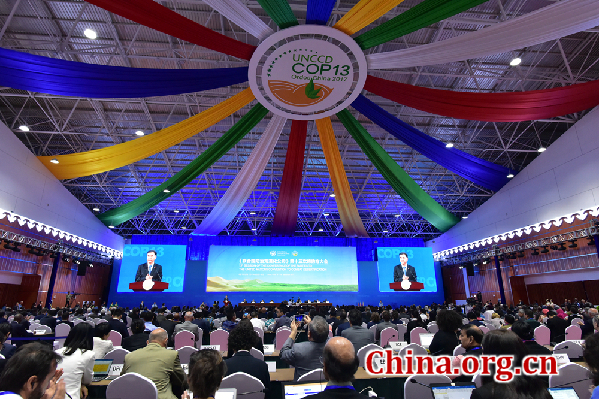
A high-level meeting of the 13th Session of the Conference of the Parties (COP13) to the United Nations Convention to Combat Desertification (UNCCD) opens in Ordos, Inner Mongolia Autonomous Region, Sept. 11, 2017. [Photo by Han Lin/China.org.cn] 

During a high-level meeting of the 13th Session of the Conference of the Parties (COP13) to the United Nations Convention to Combat Desertification (UNCCD) in Ordos, Inner Mongolia, Vice Premier Wang Yang read a letter by Xi to the conference, with the theme of “Combating Desertification for Human Well-being,” which intends to develop a new strategic framework for the UNCCD and will be significant for guaranteeing global ecological security.

António Guterres, secretary-general of the United Nations, also sent a video message to the meeting. “Healthy and productive land is a foundation for dignity and prosperity. The planet’s limited land resources are under growing pressure. Climate change, land degradation and drought threaten food security and stability and the well-being of societies,” he said.

“The solution is to assess resilience and promote inclusive and sustainable development,” he pointed out, “That means better managing land, rehabilitating what has been lost, and being better prepared for droughts and the challenges of a warming planet. I encourage you to be bold. And the world looks to the UNCCD parties to deliver an ambitious and practical strategy for alleviating land degradation and desertification.”

Wang said over the coming decades that China will place an emphasis on combating desertification as an important part of the development of the ecological civilization, work and communicate comprehensively with the international community, and strive to explore a path of desertification control with Chinese characteristics.

Liu Dongsheng, vice minister of the State Forestry Administration said in a press conference held later that China has done a remarkable job in combating desertification and over the past few years has restored more land than has degraded. Deserts have gone from expanding annually by 10,400 square kilometers at the end of the last century in China to reducing by 2,424 square kilometers. This year, the country has restored over 1,000 square kilometers above the net balance. Liu added that China will handle 50 percent of manageable desert by 2020 and restore all of the manageable desertified land by 2050.

But as Xi noted in the letter, land desertification is a major ecological issue affecting the existence and development of mankind, and the situation for controlling desertification remains grave despite the progress the world has achieved since the UNCCD came into effect 21 years ago.

According to the UNCCD, up to 2 billion hectares of land are degraded. On average, 12 million hectares are lost every year and 169 countries are affected by land degradation, desertification and drought. China, Brazil, Russia, India, Nigeria and South Africa have committed to the national targets in a move that could see over 1.3 billion of the mostly poor people regaining food, water, energy and job security. Conservative estimates put the cost of land degradation globally at US$297 billion per year.

Under the Land Degradation Neutrality: The Target Setting Program spearheaded by the UNCCD and supported by 17 international partners, 112 countries have agreed to make the United Nations Sustainable Development Goals target of achieving land degradation neutrality by 2030 a national target for action to conserve productive land. More than 60 of these countries have already established national land degradation baselines and set neutrality targets.

Desertification, land degradation and drought are now recognized as threats to global security due to their impacts on livelihoods tied to the productivity of land. This year, drought led to the worst humanitarian crises since World War II. Migration driven by desertification is expected to reach 60 million by 2045, it was revealed at a ministerial meeting held later on Monday, where more than 80 ministers from all over the world discussed pursuing land degradation neutrality.

“The population is growing at an extra 200,000 people every day, while 20 countries have declared drought emergencies in the last 18 months alone. We are clearly not sufficiently prepared for these challenges. Hundreds of millions of people go to bed desperate, hungry and thirsty as a result. Under business as usual scenarios, there is no future relief,” said Monique Barbut, executive secretary of UNCCD.

She said the Convention, at its current Conference, “can offer the poor a new deal. By using our land resources rationally and acting before it is too late, there is enough for everyone to live well…We can be better prepared for drought and offer stable, green and land-based employment and development for millions of rural people. We can promote harmony between city and country and offer opportunity for all.”

About 1,400 delegates from 196 parties and more than 20 international organizations attended the 13th Session of the Conference of the Parties to the UNCCD from Sept. 6 -16.

CSCLF, Honda launch program to help distressed youth

Honda, the Japan-based multinational automaker, has partnered with the China Soong Ching Ling Foundation (CSCLF) on Monday to support distressed and poor youth in China.

The CSCLF & Honda Dream Fund is launched in Beijing on Sept. 11, 2017. [Photo/China.org.cn] 

Called the CSCLF & Honda Dream Fund, the program was launched in Beijing to help youngsters nationwide pursue their dreams.

“China is an enormous country with a large population, and many of the youth have lost their dreams due to economic constraints,” said Mizuno Yasuhide, president of Guangqi Honda Automobile Co., Ltd.

He hoped that the fund can encourage young people to dream boldly and embrace more hope and opportunities in life.

Unlike traditional charity programs, the fund provides a package of measures to the qualified students including long-term financial support, mentorship and continued tracking system to monitor and evaluate their performance.

The program will not only target talented students in prestigious universities but also those in remote areas and vocational schools, according to Honda’s briefing.

As of the end of 2016, there were over 40 million people in China living below the country’s poverty line, accounting for about 3 percent of the country’s population.

Jing Dunquan, vice chairman of CSCLF, said the fund will help establish a platform for poor young Chinese to pursue and achieve their dreams and motivate them to embrace a better future.

He hoped the initiative will also bring vitality to China-Japan relations.

Remarks at ‘R U OK? Day’ Breakfast

PRIME MINISTER:

Well good morning. It’s great to be here with Andrew Wallace who is standing in for Julian Leeser, who together with Mike Kelly are Co-Chairs of the Friendship Group. I acknowledge Greg Hunt, the Minister for Health and Sport, Bill Shorten, Julie Collins the Shadow Minister for Ageing and Mental Health, Murray Bleach, the Chairman Suicide Prevention Australia, Mike Connaghan – Chairman of RUOK? and Mike and I were reflecting on how many decades it is since we first met and worked together in advertising but there it is. You’re looking very youthful. That’s what happens if you don’t go into politics.

And of course Professor Batterham is our guest speaker this morning – and so many other leaders in health and in suicide prevention, and of course all my Parliamentary colleagues here as well.

Now we’re all united here behind Suicide Prevention Day and R U OK? Day. Suicide Prevention Day was on Sunday and R U OK? Day is later this week.

Each year, around one in every five Australians experience mental illness and in 2015, more than 3,000 took their own life.

Now, suicide is about people, it’s about families, not numbers. But the statistics confront us all and call on us to do much better.

I am firmly of the view that our reluctance to talk about mental health issues – whether you call it a stigma or a taboo – has been a very real barrier to addressing this issue. You can’t deal with a problem that you do not acknowledge.

So we have started to talk about suicide and mental health and in an open and honest way, as we have not done in the past.

Now my own electorate of Wentworth includes one of the most beautiful yet tragic places in Australia, The Gap. It is a place where many, many Australians take their lives. A part of The Gap story until he died in 2012 was an extraordinary man called Don Ritchie who was an old sailor and also very tall, I might add.

For the best part of half a century, he lived near The Gap and when he would go for walks and he saw somebody there – anxious, perhaps standing on the wrong side of the fence – he would talk to them.

He would say: “Are you OK? How are you going? Do you want to have a chat? Do you want to come in and have a cup of tea?” He would gently lure them back from the brink by doing no more than showing that he cared for them.

That is why ‘R U OK? Day?’ is so important. Because what it is all about, is showing that we do care. Four letters ‘R U O K’ import so much. They send a message of love, they send a message of care. Critically important and what could be more Australian than looking out for your mates? Or looking out for people you don’t even know? Looking out for somebody who seems anxious, worried, or someone at work that isn’t quite themselves. It is a caring and a loving question. And it raises very prominently this issue of awareness, to the forefront.

At Gap Park for example, as the local Member, I’ve pushed for more funding and support for suicide prevention. Since 2010 there has been implemented a ‘Gap Master Plan’ and I want to acknowledge the support that Julia Gillard provided as Prime Minister to support the local government, the Woollahra Council, towards that funding.

It was a series of measures of signs, telephones, obviously of cameras so that the police can keep an eye on what’s going on there and also a very innovative design in defences that are hard to get over, but easier to get back over, if you know what I mean.

So all of this makes a difference and since 2010 the local police tell me there has been a significant increase in the number of successful interventions at The Gap. But still, far, far too many people die there and in many other places around Australia.

Now, we’re working better to understand the factors that have contributed to rising suicide rates and to support communities to respond to their own unique circumstances.

We’re committed to reducing suicide rates through regional trials, research and building the evidence base with flexible models that address regional needs and work in our local communities.

This includes the implementation of 12 regional suicide prevention trial sites in Townsville, the Kimberley and Darwin and other places. Digital innovation trials and ten lead sites to trial different care models. All looking to see what actually works.

We’re also investing a great deal more in mental health and making services more effective, accessible and tailored to local needs.

Since 2016, we’ve invested an additional $367.5 million in mental health and suicide prevention support.

That includes a $194.5 million election package towards building a modern 21st century mental health system and our $173 million in new funding in the 2017‑18 Budget and $58.6 million to expand mental health and suicide prevention services for current and ex-serving ADF members and their families.

So we’re putting existing resources to work. But you know, the most important resource is you, is all of us. You know my very good friend and a good friend of all of yours, I know, Ian Hickie has got a great concept. He talks about the ‘mental wealth of nations’, sort of elaborating from Adam Smith.

The truth is that mental health is enormously costly, in every respect.

It’s costly for individuals who suffer, its costly to their families but it’s especially costly when people take their own lives.

So we all have a vested interest in each others’ mental health. The most important thing we can do is to look out for each other.

Yes, governments and parliaments and health professionals spend money and trial new approaches and use digital technologies more effectively and we’re doing all these things and we’ll no doubt do much more in the future.

But you know, just four letters ‘R U OK?’ can make a difference. Because they represent another four letters, ‘L O V E’ – love. That’s what it’s about; showing that love and care for the people with whom you are with, whether they are your families, your friends or your workmates. Reach out to them, ask are you okay, show you care. You could not just change a life, you could save a life.

Thank you very much.

[ENDS]
Press Releases: Deputy Secretary Sullivan’s Meeting with Communist Party of Vietnam External Relations Chairman Hoang Binh Quan


Media Note

Office of the Spokesperson

Washington, DC

September 11, 2017


On September 11, Deputy Secretary of State John Sullivan met with Communist Party of Vietnam External Relations Chairman Hoang Binh Quan to discuss a range of bilateral and regional issues. The Deputy Secretary and the Chairman affirmed the bright future for the United States-Vietnam Comprehensive Partnership and continued cooperation to ensure peace, stability, and prosperity in the Asia-Pacific region.