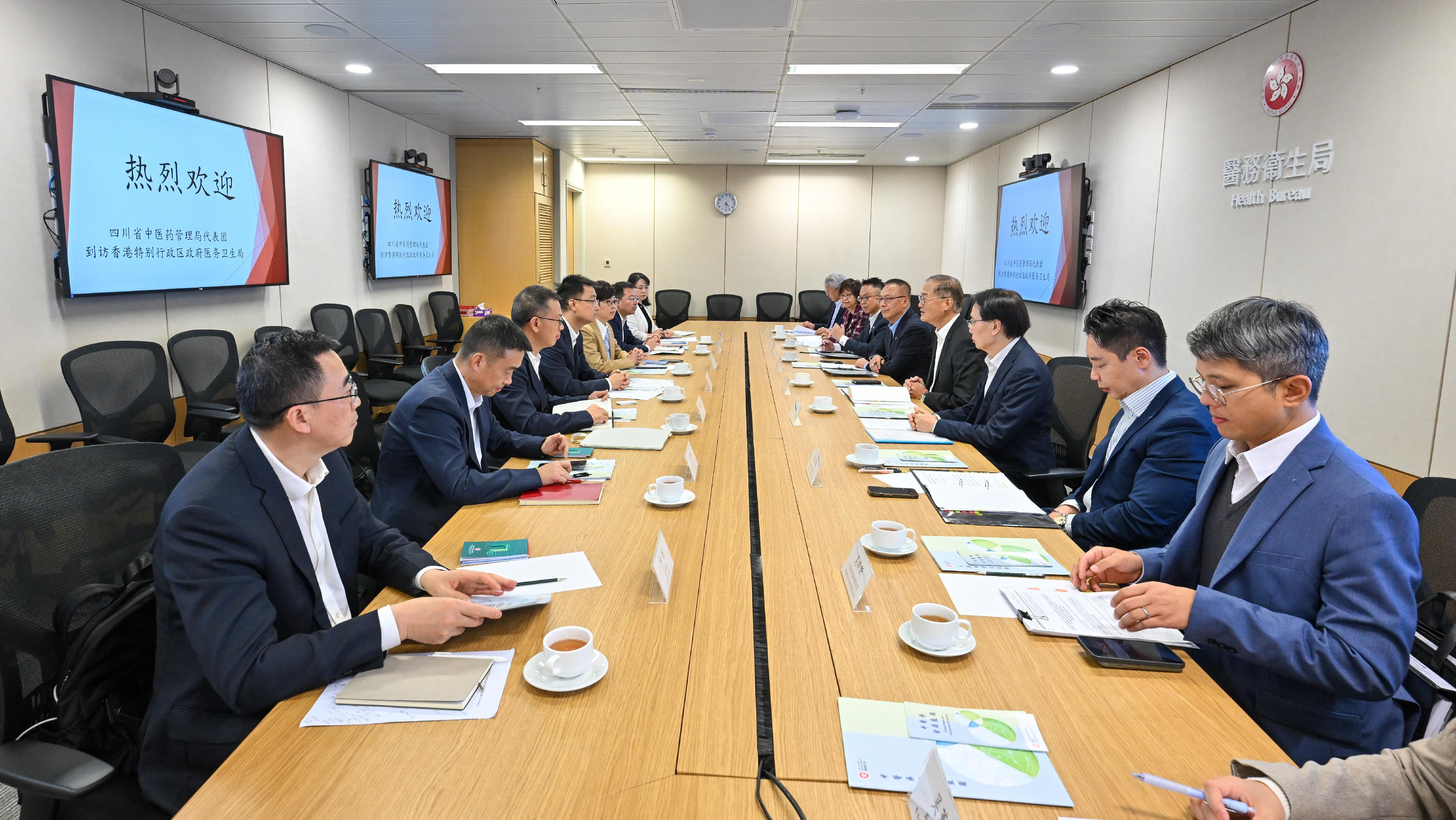
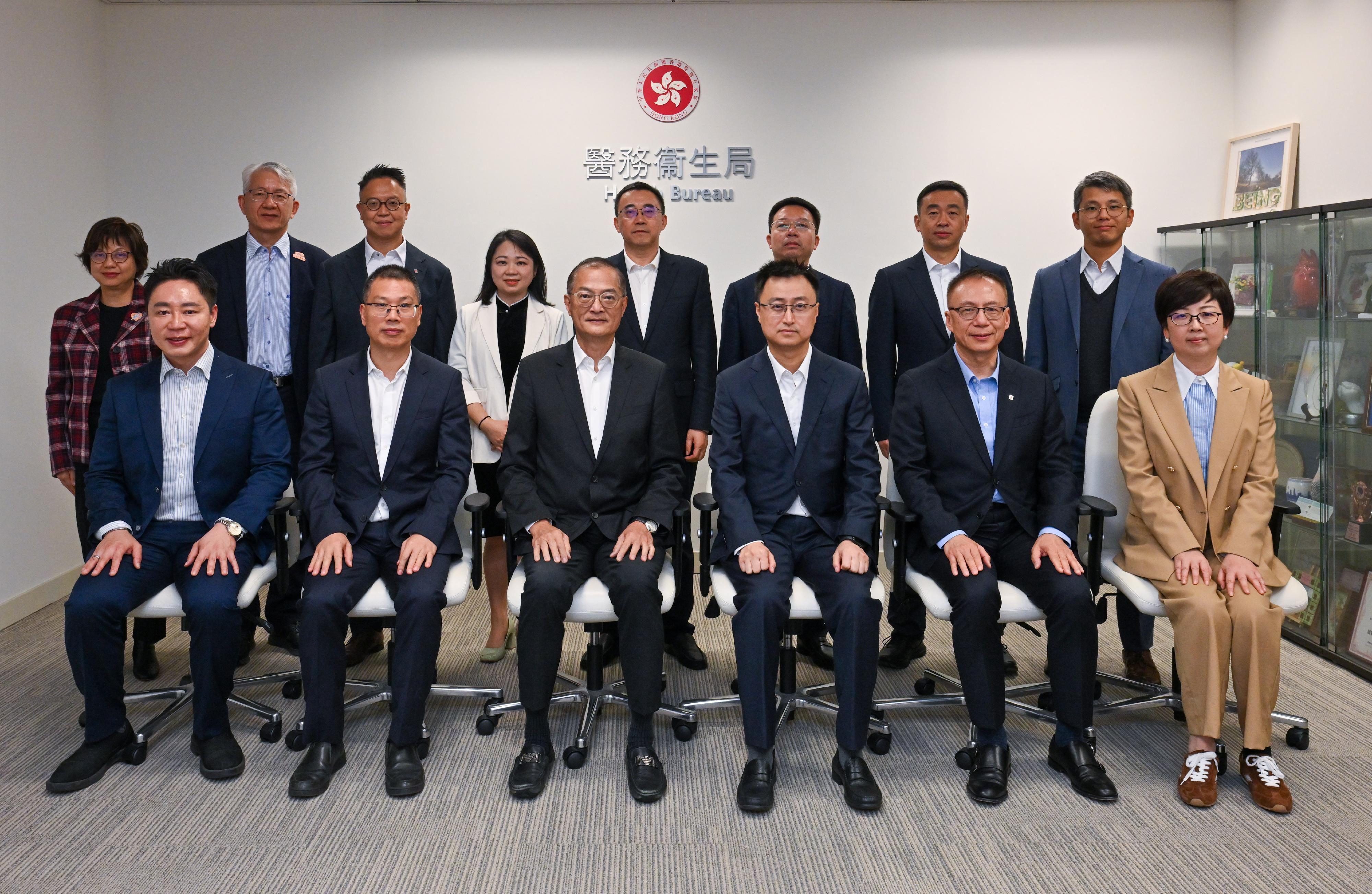
The Secretary for Health, Professor Lo Chung-mau, met with a delegation led by the Secretary of the Party Leadership Group and Director of the Sichuan Provincial Administration of Traditional Chinese Medicine (SPATCM), Mr Zheng Chuan, today (November 24) to exchange views on deepening collaboration for the high-quality development of Chinese medicine (CM) between Sichuan and Hong Kong.
Professor Lo welcomed the delegation. He said, "Sichuan and Hong Kong have been maintaining close liaison in the field of CM and continuously advancing co-operation and exchanges in areas including CM talent cultivation, industry development, and academic research. I am most grateful for the great support of the SPATCM for CM development in Hong Kong over the years, and look forward to both sides continuing to deepen co-operation and jointly promote the high-quality development of CM."
During the meeting, Professor Lo emphasised that the Hong Kong Special Administrative Region (HKSAR) Government has, for the first time, formulated the First Five-Year Plan for Economic and Social Development of the Hong Kong Special Administrative Region (2026-2030) to comprehensively and proactively align with the National 15th Five-Year Plan Outline. He shared with the delegation the strategic directions of the HKSAR Government for promoting the high-quality and high-standard development of CM on all fronts. The HKSAR Government is fully implementing the various tasks laid out in the Chinese Medicine Development Blueprint. Through the two flagship institutions for CM development, The Chinese Medicine Hospital of Hong Kong (CMHHK) and the Government Chinese Medicines Testing Institute (GCMTI), the HKSAR Government further advances the development of CM services, scientific research collaboration, talent cultivation and the establishment of Chinese medicines standards, with a view to extending the benefits of CM services and products to more countries, thereby promoting CM to go global.
Professor Lo continued to introduce to the delegation the various policy measures for promoting CM development in the Chief Executive's 2026 Policy Address, covering the launch of 24-hour in-patient services at CMHHK by the end of this year, the establishment of the International Consortium of Herb-Drug Interaction, the continued development of the Hospital Authority's integrated Chinese-Western medicine services, and the sponsoring of regional and international CM conferences and exhibitions.
Professor Lo emphasised, "The HKSAR Government attaches great importance to CM exchanges with various provinces and cities on the Mainland and will continue to uphold the principles of complementarity and mutual benefit to deepen exchanges, collaboration and mutual learning of experiences between Sichuan and Hong Kong in the CM field, thereby jointly contributing to the revitalisation and development of CM in the country."
During its visit to Hong Kong, the delegation will visit Queen Mary Hospital, CMHHK and the GCMTI.