Consumer Price Indices for October 2026

     The Census and Statistics Department (C&SD) released today (November 20) the Consumer Price Index (CPI) figures for October 2026. According to the Composite CPI, overall consumer prices rose by 2.2% in October 2026 over the same month a year earlier, larger than the corresponding increase (1.9%) in September 2026. The larger increase in October 2026 was mainly due to the end of the rates concession in September 2026. Netting out the effects of all Government's one-off relief measures, the year-on-year rate of increase in the Composite CPI (i.e. the underlying inflation rate) in October 2026 was 2.0%, slightly smaller than that in September 2026 (2.1%).

     On a seasonally adjusted basis, the average monthly rate of increase in the Composite CPI for the 3-month period ending October 2026 was 0.3%, and that for the 3-month period ending September 2026 was 0.2%. Netting out the effects of all Government's one-off relief measures, the corresponding rates of increase were 0.1% and 0.2%.

     Analysed by sub-index, the year-on-year rates of increase in the CPI(A), CPI(B) and CPI(C) were 2.0%, 2.2% and 2.3% respectively in October 2026, as compared to 1.4%, 2.0% and 2.3% respectively in September 2026. Netting out the effects of all Government's one-off relief measures, the year-on-year rates of increase in the CPI(A), CPI(B) and CPI(C) were 1.7%, 2.1% and 2.2% respectively in October 2026, as compared to 1.7%, 2.2% and 2.4% respectively in September 2026.

     On a seasonally adjusted basis, for the 3-month period ending October 2026, the average monthly rates of increase in the CPI(A), CPI(B) and CPI(C) were all 0.3%. The corresponding rates of increase for the 3-month period ending September 2026 were all 0.2%. Netting out the effects of all Government's one-off relief measures, the average monthly rates of increase in the seasonally adjusted CPI(A), CPI(B) and CPI(C) for the 3-month period ending October 2026 were 0.1%, 0.2% and 0.2% respectively, and the corresponding rates of increase for the 3-month period ending September 2026 were all 0.2%.

     Amongst the various components of the Composite CPI, year-on-year increases in prices were recorded in October 2026 for electricity, gas and water (12.7%), miscellaneous services (5.0%), transport (4.5%), durable goods (1.4%), miscellaneous goods (1.4%), housing (1.4%), meals out and takeaway food (0.9%), and clothing and footwear (0.5%).

     On the other hand, year-on-year decreases in the components of the Composite CPI were recorded in October 2026 for basic food (-0.8%), and alcoholic drinks and tobacco (-0.4%).

     Taking the first 10 months of 2026 together, the Composite CPI rose by 1.8% over the same period a year earlier. The respective increases in the CPI(A), CPI(B) and CPI(C) were 1.6%, 1.9% and 1.9% respectively. The corresponding increases after netting out the effects of all Government's one-off relief measures were 1.7%, 1.5%, 1.8% and 1.9% respectively.

     For the 3 months ending October 2026, the Composite CPI rose by 1.9% over the same period a year earlier, while the CPI(A), CPI(B) and CPI(C) rose by 1.6%, 2.0% and 2.2% respectively. The corresponding increases after netting out the effects of all Government's one-off relief measures were 2.0%, 1.7%, 2.1% and 2.2% respectively.

     For the 12 months ending October 2026, the Composite CPI on average rose by 1.7% over the same period a year earlier. The respective increases in the CPI(A), CPI(B) and CPI(C) were 1.5%, 1.8% and 1.8% respectively. The corresponding increases after netting out the effects of all Government's one-off relief measures were 1.6%, 1.4%, 1.7% and 1.8% respectively.

Commentary

     A Government spokesman said that consumer price inflation stayed moderate in October. The underlying Composite CPI rose by 2.0% over a year earlier, slightly lower than the increase of 2.1% in September. Prices of fuel-related items continued to rise noticeably, but spillover effects remained limited, with prices of most other items increasing modestly or declining.

     Looking ahead, earlier increases in international oil prices will continue to feed through to local consumer prices of fuel-related items. However, price pressures on other fronts should remain broadly in check, keeping overall inflation moderate. Nevertheless, geopolitical tensions remain a key source of near-term uncertainty for international fuel prices and warrant close monitoring.

Further information

     The CPIs and year-on-year rates of change at section level for October 2026 are shown in Table 1. The time series on the year-on-year rates of change in the CPIs before and after netting out the effects of all Government's one-off relief measures are shown in Table 2. For discerning the latest trend in consumer prices, it is also useful to look at the changes in the seasonally adjusted CPIs. The time series on the average monthly rates of change during the latest 3 months for the seasonally adjusted CPIs are shown in Table 3. The rates of change in the original and the seasonally adjusted Composite CPI and the underlying inflation rate are presented graphically in Chart 1.

     More detailed statistics are given in the "Monthly Report on the Consumer Price Index". Users can browse and download this publication at the website of the C&SD (www.censtatd.gov.hk/en/EIndexbySubject.html?pcode=B1060001&scode=270).

     For enquiries about the CPIs, please contact the Consumer Price Index Section of the C&SD (Tel: 3903 7374 or email: cpi@censtatd.gov.hk). 

Northern Metropolis Development Ordinance gazetted

     ​The Northern Metropolis Development Ordinance (the Ordinance) was gazetted today (November 20).
      
     The Northern Metropolis will be developed with the objectives of university town, innovation and technology, industry, and an environment suitable for living, work, and travel. It will be the main platform for Hong Kong to deeply engage in the development of the Guangdong-Hong Kong-Macao Greater Bay Area, and to actively integrate into and serve the overall national development, while serving as a strategic engine for Hong Kong to foster economic transformation and develop new quality productive forces. Upon passage by the Legislative Council (LegCo) at its third reading on November 12, the Ordinance carries great significance for Hong Kong in proactively aligning with the National 15th Five-Year Plan and implementing Hong Kong's First Five-Year Plan.
      
     The Ordinance provides the legal basis for various facilitation measures, covering town planning, land compensation, building works approvals, noise control as well as facilitating cross-boundary flows. It serves to expedite the development and construction processes, while helping enterprises to establish their presence in the Northern Metropolis. The Development Bureau and relevant bureaux are formulating the first batch of subsidiary legislation needed to implement such facilitation measures, with a view to tabling them for the LegCo's vetting in January and bringing them into effect in the first quarter of 2027.
      
     Pursuant to the provisions of the Ordinance that have come into operation, the Secretary for Development has published the plan (numbered NM/001) concerning the area of the Northern Metropolis delineated for the Ordinance in the following website (www.nm.gov.hk/en/about-nm/nmdevelopmentordinance). A copy has also been made available in the office of the Land Registry for inspection by the public free of charge during opening hours (see www.landreg.gov.hk/en/services/services_d.htm for details).

Welcome remarks by SDEV at luncheon session of 2nd International Infrastructure and Projects Leaders Summit (English only)

     ​Following are the welcome remarks by the Secretary for Development, Ms Bernadette Linn, at the luncheon session of the 2nd International Infrastructure and Projects Leaders Summit today (November 20):
     
Distinguished guests, ladies and gentlemen, 

Welcome

     I am delighted to extend a warm welcome to all of you joining us today for the 2nd International Infrastructure and Projects Leaders Summit (IIPLS). This summit also serves as the opening of the inaugural InfraEX Week 2026. I would like to express my sincere gratitude to all our speakers in the morning session and our government representatives for your insightful sharing, which perfectly fits into the theme of the summit "Envisioning a Sustainable Future: From Insights to Impacts".

Outcome of 1st IIPLS and opportunities of 2nd IIPLS
     
     Two years ago, we successfully hosted the inaugural summit. The inaugural event laid a solid foundation for broader and deeper international collaboration and strategic partnerships.

     I am happy to give you an update of what we have achieved over the past two years since the first summit. Hong Kong has risen to the second place globally in overall competitiveness and we have secured the fourth place in the aspect of "Basic Infrastructure" in the latest IMD World Competitiveness Yearbook. In addition, Hong Kong's position in an international construction cost ranking is continuously improving from the third place globally in 2020 to the ninth place in 2024 and further down to the 16th place this year. To avoid any misunderstanding, for this cost ranking index, having a lower rank is an improvement, and we have significantly improved. Through comprehensive strategies, we expect to achieve an overall reduction of over 10 per cent in our public works construction costs annually, amounting to $12-15 billion in the coming few years.

     This year's summit once again brings together distinguished experts, senior government officials, and industry leaders from around the world to Hong Kong, the international infrastructure centre. While you are joining the summit, we do not want to lose any opportunities, so we are also joining hands with the University of Hong Kong and the Construction Industry Council to enable better synergy for open dialogue and close collaboration.

National 15th Five-Year Plan and Hong Kong's First Five-Year Plan
     
     This year marks the opening year of the National 15th Five-Year Plan and Hong Kong's First Five-Year Plan. As we proactively integrate into and serve overall national development under "one country, two systems", we remain committed to fulfilling our role as a "super-connector" and "super value-adder". Specifically, we strive to facilitate the internationalisation of national standards and showcase our nation's innovation and technology to the world. In doing so, we are driving the systematic transformation and upgrading of the construction industry toward advanced, intelligent, and high-quality development. 

Expediting Northern Metropolis development
     
     At the heart of our local development strategy is the Northern Metropolis, which is a new impetus for Hong Kong in developing new quality productive forces. Adopting a planning-oriented and infrastructure-led approach, we are committed to producing about 900 hectares of spade-ready sites in the coming five years. And in the coming five years, we are also committed to delivering over 70 000 residential units, and providing one million square metres of new economic floor space. This mega development in the Northern Metropolis serves as a vital strategic vehicle for housing, innovation and technology, and industry integration.

AI, advanced technology and standards
     
     To deliver these projects efficiently and in a sustainable manner, we are actively transforming our practices across the board. Beyond streamlining the approval processes, we are harnessing artificial intelligence and driving the widespread adoption of advanced construction materials and technologies. We now have what we call the Building Technology Research Institute, a setup wholly owned by the Government, yet outside the government bureaucracy. This institute will help us translate R&D outcomes into practical industry applications, advance standards, and conduct accreditation, certification, and testing. The new institute strongly complements our Construction Industry Council, a statutory body comprising stakeholders in the sector to promote good practices and advanced skills, basically striving for continuous improvement. Through these breakthroughs, our engineering pioneers are redefining productivity, safety, and environmental stewardship across the industry.
     
Future-ready workforce
     
     Technology and physical infrastructure alone are not enough. Building a sustainable tomorrow requires a talented, adaptable, and professional community. It is the people that matter. Cultivating a future-ready workforce which is equipped with digital literacy, engineering excellence, and cross-sector expertise remains central to our efforts in capacity-building.

     In this regard, leveraging Hong Kong's strength as a world city, the Centre of Excellence for Major Project Leaders under the Development Bureau has become a Belt and Road Capacity Building Platform and will further connect to the world. This Centre of Excellence will establish international branding, and share knowledge for shared prosperity with Belt and Road countries and beyond. We will continuously strengthen the role of the Centre in the coming years, with the vision of upgrading the Centre and reshaping it into a "Centre of Excellence for International Infrastructure Governance and Major Project Leaders".
     
Closing
     
     As we conclude our morning session today, we look forward to four dedicated plenary sessions in the afternoon that will delve deeper into different topics. Without further ado, I hope that you will enjoy the rest of the lunch, and fill up your stomachs for a thriving afternoon session.

     I wish you all an enriching and fruitful time at the summit and during the InfraEX Week. Thank you.

Hong Kong Customs operation combats illegal importation of animals (with photos)

     Hong Kong Customs launched a special enforcement operation in November to combat illegal importation of animals and detected two suspected cases of illegally importing animals. Seven live cats and two live dogs were seized, with a total estimated market value of about $92,000. Seven people were arrested.

     Through cyber patrol and intelligence analysis, Hong Kong Customs discovered social media accounts promoting cross-boundary animal transport services. Suspecting that individuals were using illicit channels to import animals, Hong Kong Customs launched a special enforcement operation this month and stepped up inspections of high-risk passengers and cargo at various boundary control points. 

     During the operation, seven local residents were arrested, comprising three males and four females, aged between 33 and 56. Among them, two were suspected of illegally importing the animals, two were responsible for local delivery, while the remaining three were recipients. The arrestees have been released on bail pending further investigation.

     Investigations of the above-mentioned cases are ongoing and the likelihood of further arrests is not ruled out. All the seized animals have been handed over to the Agriculture, Fisheries and Conservation Department for follow-up action.

     Being a government department specifically responsible for tackling smuggling, Customs will continue to enhance co-operation and intelligence exchanges with other law enforcement agencies, and carry out targeted anti-smuggling operations at suitable times to disrupt relevant crimes.

     Customs reminds the public that importing animals into Hong Kong without a valid permit is an offence.

     Under the Rabies Regulation (Cap. 421A), any person found guilty of illegally importing animals, carcasses or animal products is liable to a maximum fine of $50,000 and imprisonment for one year upon conviction.

     Members of the public may report any suspected smuggling activities to Customs' 24-hour hotline 182 8080 or its dedicated crime-reporting email account (crimereport@customs.gov.hk) or online form (eform.cefs.gov.hk/form/ced002).

Photo  Photo  

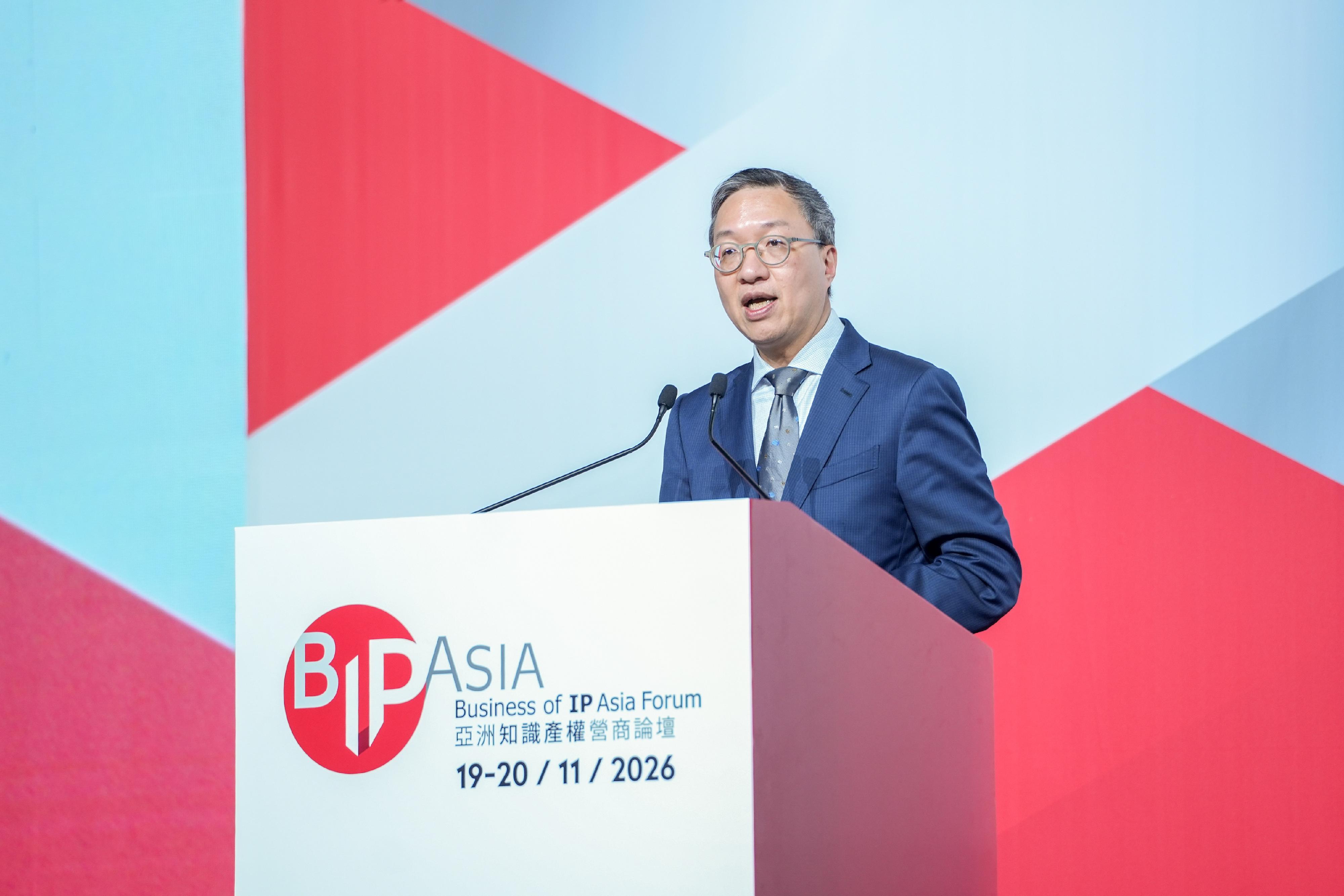
Welcome remarks by SJ at 16th Business of IP Asia Forum Concurrent Breakout Session (English only) (with photo)

     Following are the welcome remarks by the Secretary for Justice, Mr Paul Lam, SC, at the 16th Business of IP Asia Forum Concurrent Breakout Session "Turning Creativity into Economic Value: Clearing Legal Roadblocks in IP Commercialization" today (November 20):

Distinguished guests, ladies and gentlemen,

     A very good afternoon. A warm welcome to the 2026 Business of IP (BIP) Asia Forum. I am delighted to open this thematic breakout session co-organised by the Department of Justice and the Hong Kong Trade Development Council.

     To set the stage, we must first look at the broader vision guiding our development. The National 15th Five-Year Plan prioritises accelerating innovation, strengthening intellectual property (IP) protection and utilisation, and supporting Hong Kong in deepening its status as an international legal and dispute resolution services centre, as well as a regional IP trading centre. Echoing this national strategy, the Chief Executive's 2026 Policy Address highlights the Government's all-front commitment to developing Hong Kong as a premier regional IP trading hub. Today's session timely explores how innovators and enterprises could capitalise on these macro policy objectives via IP commercialisation.  

The engine: IP commercialisation in action

     To see this vision in action, let's start from home – our local cultural and creative industries. As a cultural melting pot of East and West, Hong Kong has been accelerating the commercial development of these sectors through cross-sectoral and cross-genre collaborations of local IPs, enabling innovators and enterprises to confidently capitalise on our macro policy objectives.

     For instance, movie IPs are deployed to promote tourism. Building on the resounding success of a Hong Kong movie, "Twilight of the Warriors: Walled In", 《九龍城寨之圍城》, the Hong Kong Tourism Board collaborated with the movie producer to launch an exhibition titled "Live out the Cinematic Charm of Hong Kong" in the name of that movie, where merchandise vendors offered classic dishes, nostalgic toys and movie merchandise on-site. This demonstrates how cultural buzz can be converted into tangible economic value.

     Another example is the Hong Kong Palace Museum's recently concluded special exhibition, "Ancient Egypt Unveiled: Treasures from Egyptian Museums", which attracted over 670 000 visitors. The Museum launched around 170 original merchandise items inspired by ancient Egyptian civilisation, such as the black cat plush and blind box. These products have generated more than $33 million in revenue for the Museum. The Museum's original IP, Pharaoh Cat, became a sold-out hit. You may recall having seen this cat at MTR stations and on KMB buses.

     To further lower the costs of IP transactions and facilitate IP trading, the Government introduced the Inland Revenue (Amendment) (Tax Deductions for Intellectual Property Expenditure) Bill 2026 into the Legislative Council last month. This Bill would implement tax-deduction arrangements for capital expenditure incurred by enterprises for purchasing eligible IP rights, or for the licence to use eligible IP rights. By reducing the tax associated with IP acquisition, we aim to encourage more enterprises to actively invest in IP development and commercialisation, thereby injecting stronger momentum into Hong Kong's development as a premier regional IP trading hub.

The shield: a robust IP protection regime

     We must recognise that the fruits of IP can truly flourish only when backed by solid legal safeguards. Safeguarding IP rights acts as a vital shield for innovation; it is the cornerstone for fostering technological development and allowing creators to safely monetise their work.

     Hong Kong possesses a robust legislative framework protecting all forms of IP, including patents, trademarks, registered designs and copyright. As a World Trade Organization (WTO) member, our IP protection regime fully aligns with the international standards set forth in the WTO Agreement on Trade-Related Aspects of IP Rights.    

     Guided by the strategic blueprints I mentioned earlier, we will advance the extension of suitable international IP treaties to Hong Kong in an orderly manner. Currently, we are proactively forging ahead with the preparatory work for implementing the Protocol Relating to the Madrid Agreement Concerning the International Registration of Marks in Hong Kong.  

     To ensure that the local registered designs regime follows the mainstream international practices and meets future local industrial development needs, particularly those driven by the new industrialisation and growth of the digital economy, we are proactively planning to update the relevant regime. The Government is formulating a code of practice addressing copyright issues and the application of legal principles relating to the development of generative artificial intelligence technology, serving as a vital reference for the industry.

The safety net: excellence in dispute resolution

     As global innovation rapidly develops and IP commercialisation expands across borders, commercial disputes inevitably arise. Hong Kong is well-positioned to provide pre-eminent IP dispute resolution services. Both our IP protection regime and dispute resolution services are well recognised and widely acclaimed by the international community.  

     According to the World Competitiveness Yearbook 2026, Hong Kong ranks seventh globally in IP rights. Building on this, and with the Central People's Government's support, Hong Kong signed a Memorandum of Understanding (MOU) with the World Intellectual Property Organization (WIPO) in September 2025 regarding co-operation on the WIPO Lex-Judgments database. Under the MOU, Hong Kong contributes leading IP judgments from the Judiciary to the database, facilitating the international IP community's access to such judgments, while showcasing the quality of Hong Kong's IP-related jurisprudence. By enhancing the global transparency of our IP legal regime, we instill greater confidence to international businesses and IP rights holders to invest, innovate and commercialise their assets in Hong Kong.

     Of equal significance is the pioneering Arrangement on Reciprocal Recognition and Enforcement of Judgments in Civil and Commercial Matters by the Courts of the Mainland and of the Hong Kong Special Administrative Region, which has been given effect by our local legislation. Hong Kong judgments on IP disputes are now generally recognised and enforceable in the Chinese Mainland. This marks an unprecedented breakthrough as it goes beyond the conventional international norms in the Hague Convention (Hague Convention on the Recognition and Enforcement of Foreign Judgments in Civil or Commercial Matters) which explicitly excludes IP matters.

     Moving onto arbitration, our arbitration regime and services are also globally recognised by the international legal community. According to the 2025 Queen Mary University of London International Arbitration Survey, Hong Kong ranks as the second most preferred seat for arbitration globally and the most preferred seat in the Asia-Pacific region.

     Our Arbitration Ordinance (Cap. 609) was amended in 2017 to expressly provide that disputes over IP rights, whether arising within or outside Hong Kong, are arbitrable, and that enforcing an arbitral award is not contrary to public policy solely because it involves an IP dispute. This enhancement gives Hong Kong a competitive edge over other jurisdictions in the region.  

     To maintain our edge, the Government is resolutely pressing ahead with initiatives to strengthen Hong Kong's status as a leading international arbitral seat, including enhancing our arbitration legislative framework. To ensure that such a framework remains competitive and stays at the forefront of international development, the Working Group on Arbitration Law Reform was established in October last year to review and make recommendations on amendments to the Arbitration Ordinance. Drawing on its recommendations, we have put forward proposed amendments to the Arbitration Ordinance and launched a one-month stakeholder consultation, and target to complete the relevant legislative amendments within next year.

     Earlier today, you may have attended sessions at the BIP Asia Forum on diverse topics covering IP financing, valuation and management. I trust that our session today will complete the picture, with our panel speakers discussing the benefits of resolving IP disputes through arbitration and sharing case studies. They will also discuss how IP commercialisation drives innovation and fuels the local cultural and creative industries in Hong Kong.

     Looking ahead, the Government will continue its multipronged strategy to support and strengthen the capability of different industries, including cultural and creative sectors, in utilising IP. Supported by our solid legal infrastructure, Hong Kong has every opportunity to cement its role as a leading international legal and dispute resolution services centre and a regional IP trading centre in the years ahead.

     On this note, I wish this Forum and today's session every success. Thank you very much.

Photo