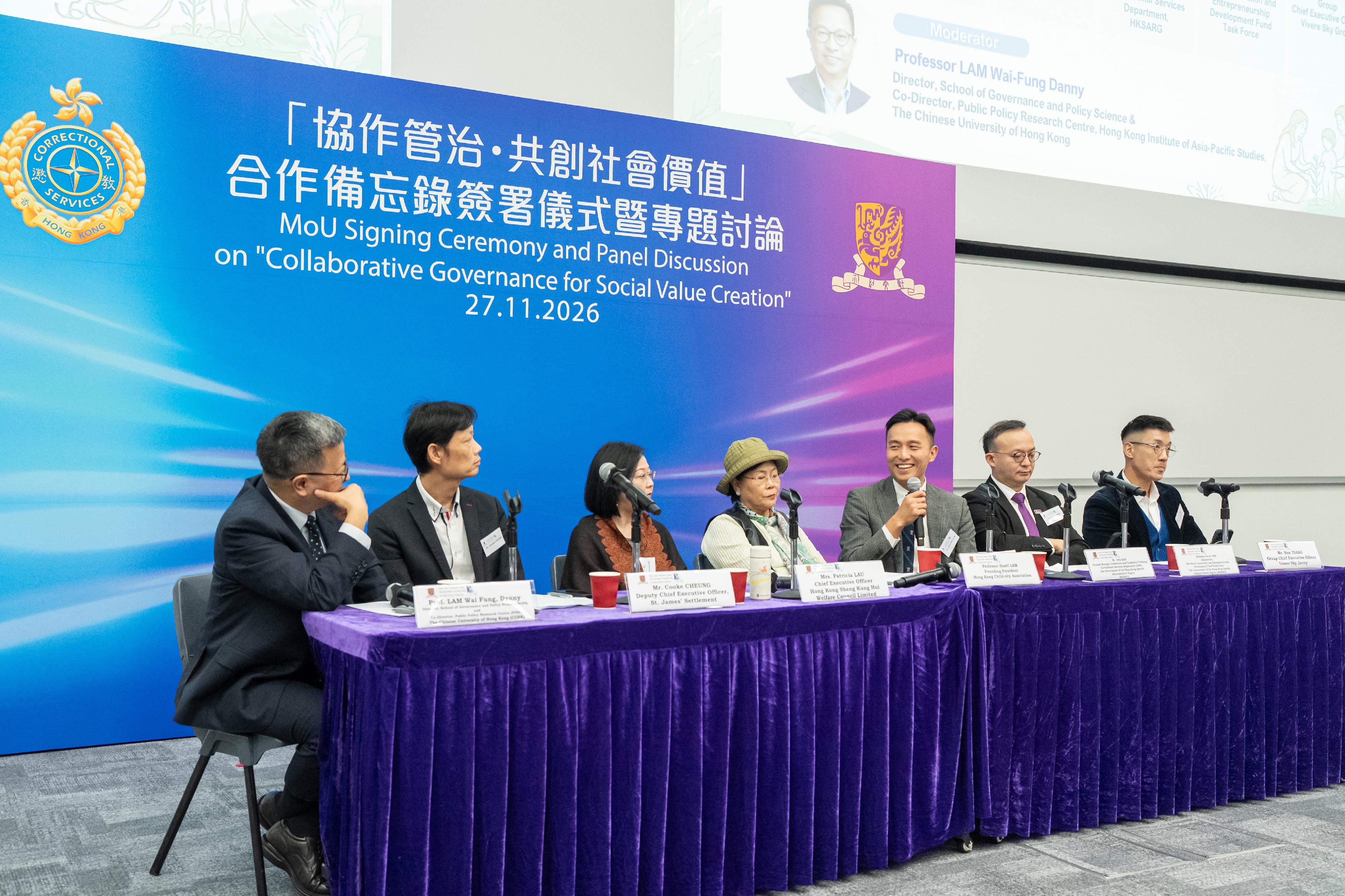
The Correctional Services Department (CSD) and the Chinese University of Hong Kong (CUHK) signed a Memorandum of Understanding (MOU) today (November 27). Under the theme of co-creating social value, the MOU sets out collaboration on conducting research in areas such as community resilience, positive education and youth leadership development; promoting knowledge exchanges and community engagement as well as cultural heritage preservation, and the development and creation of cultural and creative products based on the concept of sustainable development.
The five‑year MOU establishes a framework for collaboration between the CSD and the CUHK, including the provision of designs and raw materials that embed the concept of sustainable development by the CUHK for the CSD to develop and manufacture cultural and creative products at correctional institutions to enhance the creativity and value of the CSD's Made in Prison products; the arrangement for the CUHK to provide training programmes on cultural heritage preservation and sustainable production models for persons in custody (PICs) to enhance their employability; co‑organisation of events to promote the CSD's Made in Prison products, enhancing public understanding of rehabilitation and crime prevention work; and organisation of experiential learning activities to encourage young people to participate in civic affairs and cultural heritage preservation work.
Witnessed by the Deputy Commissioner of Correctional Services (Rehabilitation and Management), Mr Ng Chiu-kok, and the Dean of the Faculty of Social Science and Director of the Hong Kong Institute of Asia-Pacific Studies of the CUHK, Professor Anthony Fung, the MOU was signed by the Assistant Commissioner of Correctional Services (Rehabilitation), Mr Tong Soen, and the Director of the School of Governance and Policy Science and Co-Director of the Public Policy Research Centre of the CUHK, Professor Danny Lam.
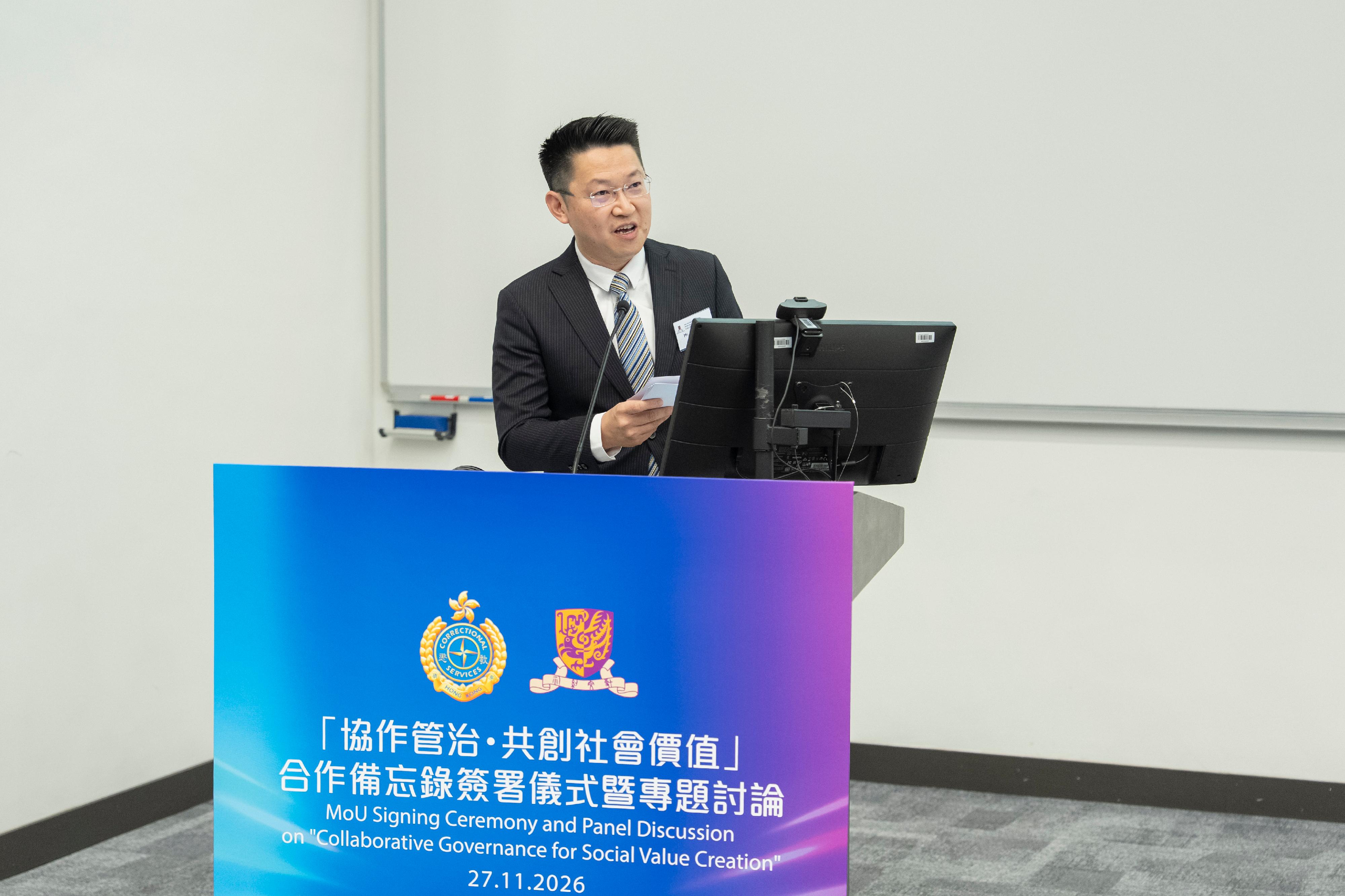
Speaking at the ceremony, Mr Ng said that promoting rehabilitation work and community education is not only the CSD's mission, but also a key factor in maintaining long-term social stability and inclusiveness. Through collaborating with the Public Policy Research Centre of the Hong Kong Institute of Asia-Pacific Studies of the CUHK, the CSD will combine its practical experience in rehabilitation work with rigorous academic research to devise forward‑looking plans that support rehabilitation work within correctional institutions.
At the same time, the CSD will advance positive education to foster law-abiding awareness and positive values among young people, and deepen public understanding of and support for rehabilitation work through community engagement, thereby creating a more favourable environment for rehabilitated persons to reintegrate into society and generating measurable and lasting social value for Hong Kong.
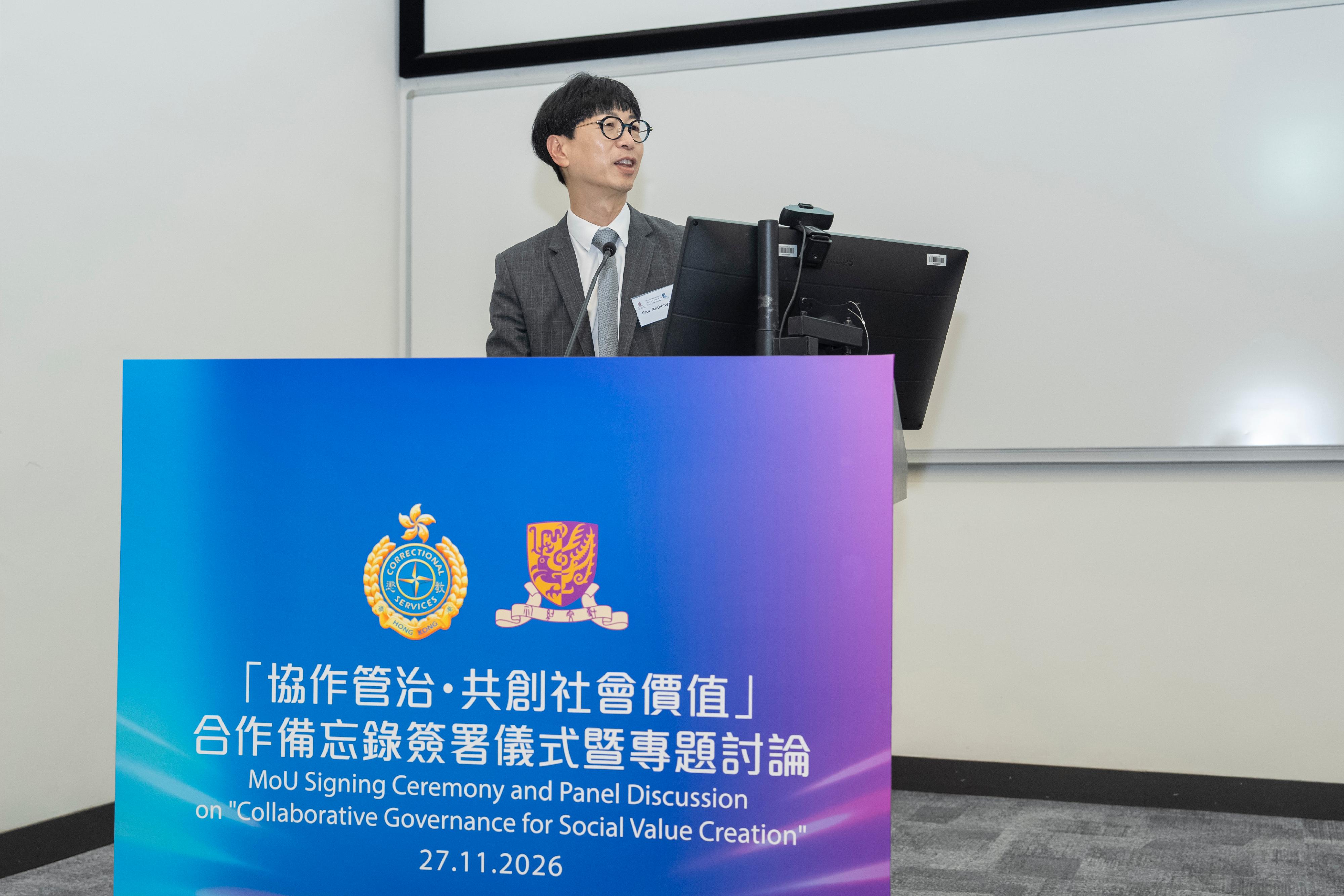
Professor Fung highlighted that practising sustainable development requires integrating diverse social resources and pooling the efforts of all sectors to collectively respond to multifaceted societal challenges, maximise the effectiveness of resources and enhance overall social welfare. This co-operation with the CSD exemplifies the application of policy science. Through knowledge exchange, it fosters two-way interaction between academic research and frontline practical experience, and deepens stakeholders' collaboration to jointly build a mutually supportive and inclusive ecosystem that creates new social and cultural values, marking an important step toward greater social inclusiveness and sustainable development, thereby building a more resilient society.
The first collaborative product launched by both parties is a natural handmade soap developed by PICs using "pu giong", a distinctive herb harvested from Lai Chi Wo Hakka Village. The soap embodies the significance of cultural inheritance as well as rehabilitation and transformation. The handmade soap will later be available for sale on the CSD's online charity gift sales platform, Made in Prison, to promote rehabilitation and cultural heritage preservation to the public. After deducting necessary costs, the proceeds from the sales will be donated to local registered charities, providing PICs with an opportunity to give back to society.