Author Archives: GovWorldMag

Government stability

Remain, Labour and many in the media are running endless stories about the possible fall of the PM or the government. These stories are false mischief.

Let me remind you of the process to remove a Conservative PM. 15% of the Conservative MPs have to ask for a Confidence vote in the leader.Then more than half the MPs have to vote No Confidence. As most Conservative MPs support the Leader neither of these two events are about to happen.

For there to be an early General election the government would have to lose a Confidence  motion in the Commons. I know of no Conservative. MP who would vote to do that. The DUP are not after an early election either.

read more

World’s first 2,000-ton electric boat launched

The world’s first 2,000-metric-ton electric boat was launched Sunday in the southern city of Guangzhou.

The world's first 2,000-metric-ton electric boat was launched Sunday in the southern city of Guangzhou.

The world’s first 2,000-metric-ton electric boat was launched Sunday in the southern city of Guangzhou. 

With a battery capacity of 2,400 kilowatt-hours, the self-unloading ship built by Guangzhou Shipyard International has zero exhaust emissions.

The ship is powered by lithium battery and super capacitor, and can last up to 80 kilometers after a two-hour recharge.

The steel cargo ship will be used to carry coal and it will navigate on the Pearl River and other bodies of water.

read more

Getting in to Oxbridge

I have read with interest the allegations that Oxford and Cambridge do not admit enough pupils from poorer and non professional backgrounds. From my regular contacts with Oxford I think it is a much more welcoming institution than when I went there, which does much more to reach out to people who do  not come from communities with strong Oxbridge links. The University spends time talking to schools that have no history of sending pupils to the university, time encouraging more students to apply, and provides a range of bursaries and scholarships to help some students with costs. It has made good progress in changing attitudes within the University and in welcoming people from all backgrounds.

I was the first person in my family to go to university. I was surprised when a teacher suggested to me that I put my name in for the Oxford entrance exam at the beginning of my fourth term in the 6th Form. I was just 16, as I had jumped a year at  prinary school. What little I knew about Oxford made me think it was unattainable. They told me at school I would  be in  with a chance, and I am grateful to them for putting opportunity in my way. Everyone with a chance needs an adult in their school or family circle who suggests they try. Governors, Councillors and teachers must ensure all state schools look out for talent to apply to the best universities.

I was  very self critical in the 6th form, struggling to develop a  well informed voice I was happy with. I pitched myself against the great minds I read in books and thought I always fell short. I tried out  various styles of analysis and writing. One essay attracted particular criticism from a teacher which it doubtless deserved. When challenged why I was writing like that, I replied  defensively without thought or good reason that I assumed that was what Oxford would want.

Then came one of those defining moments that teachers sometimes achieve without realising it. He replied, “In that case why do you want to go there?” The sheer irreverence of the quip made me realise Oxford could be for people like me, and was only worth going to if it could further my development. He in a way liberated me from possible  failure, and confirmed a realisation I had often flirted with that  study  was about me, the quality of my enquiry  and the development of my ideas. There are strict limits to how much anyone else can teach you once you have grasped the conventional wisdom of your subject. I was already grappling with what I thought were the imperfections of the contemporary work in my discipline.

I was invited to interview. The system was you went to stay at your first choice College,  but had to stay for longer in case other Colleges in their group – there were 3 groups – also wanted to interview you for a place.

I was staying in a noisy room in an annex building on  a main road. It was cold and the room friendless as the student that usually lived there had had to strip the room for my arrival. I waited and waited until I was finally summonsed to an interview. It was perfunctory. There was no apparent intellectual challenge. I assumed they were going through the motions and had decided against me by the time I got there. I had not researched who was likely to be interviewing me and felt cheated there was no good argument.  I did not understand the significance of the hypothetical question about which year I could turn up if offered a place.  I waited and waited for an interview elsewhere but none came. I was finally told I could go. By this time I was thinking I was glad I would go off to London who had already offered me a place if I got 2 E grade A levels . In London they had engaged with my views at the interview.

I was amazed when a letter came some time later offering me a place and an Open Scholarship. My bad feelings about my sojourn  at Oxford were banished by the offer and by the positive reaction to it of my school. It certainly changed my life. Oxford did not need  me to take any  A levels but I stayed at school to complete them. 2 Es were needed for a local authority  grant. Although that took all the pressure off, for me it did the opposite. I now felt I had to live up to the faith placed in me. I got permission to go to the local university library to work, as I had run out of books to read at school.

In those days we were not to my knowledge invited to any preparatory or introductory discussions. There was no attempt to reach out when you arrived for interview. The Oxford I went to was full of ex public school boys who were better prepared.  They were more used to the College life as it reflected patterns from the richer boarding schools. They had been  tutored for the exams and made conversant with the dons who would interview them.

The modern Oxford I meet has a much  better range of people from a wide range of backgrounds. There are many more women with the strict segregation of old Oxford with just 5 women’s colleges broken down completely.  The student groups I have spoken to do not see their past school or social origins as significant as it was in the Oxford I attended. Oxbridge provides a good home for those with the discipline of self instruction and study. I just hope every school does encourage their brightest and best to apply. One of the best features of  Oxford when I was an undergraduate was the open lecture lists. You could go to any lecture in any subject. I tended to go to the most interesting lectures in some other subjects to provide a more rounded education, rather than to the ones in my subject which did not normally present new material if you had read enough.

read more

Paddler plans to kayak to Arctic Ocean

The Irtysh River flows from Hou Zhili’s hometown and leads to the Arctic Ocean – a journey Huo plans to make alone in a kayak.
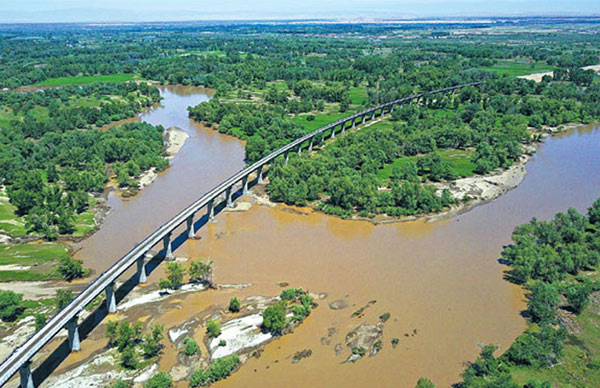
The Irtysh River in the northen Xinjiang Uygur autonomous region is the only river in China that leads to the Arctic Ocean.[Photo by Hu Huhu/Xinhua]

The Irtysh River in the northen Xinjiang Uygur autonomous region is the only river in China that leads to the Arctic Ocean.[Photo by Hu Huhu/Xinhua] 

From where he lives in Fuyun county, Xinjiang Uygur autonomous region, the 41-year-old has completed what many see as epic feats – kayaking unpowered for 2,020 kilometers on the China and Kazakhstan sections of the Irtysh in 2014 and 2016.

The paddler is preparing for the final and most challenging stage of the 2,200-km Russia section, plus the last 1,160-km of the Ob River, which the Irtysh flows into before its waters reach the northern sea.

From its source in the Altay Mountains in Fuyun, the 4,248-km Irtysh River flows northwest through Kazakhstan before merging with the Ob River in Russia. It is the only river in China that leads to the Arctic Ocean.

Huo’s love for kayaking began when he was a teenager. In the 1980s, several white-water adventurers on China’s two largest rivers, the Yangtze and the Yellow River, had become famous and started a craze among bold Chinese who took to rafting on streams across the country.

Some youngsters from Hou’s hometown even drifted for hundreds of kilometers along the Irtysh on rafts made of old tires.

In 2012, he decided to close his graphic design company and turned his hobby into a full-time occupation.

After arduous training, on Aug 28, 2014, Hou set out alone in his yellow and orange boat from Koktokay, a town near the source of the Irtysh.

He paddled for 50 km a day, and took 23 days to arrive at Kaba county, where the 520-km China section of the river ends.

The river begins to freeze in November and does not thaw until April, so Huo planned to complete the Kazakhstan section the following year. When the time came, however, he was refused a visa.

His chance finally arrived as tourism cooperation between China and Kazakhstan improved with the Belt and Road Initiative.

Kazakhstan relaxed its visa procedures for Chinese tourists last year.

In August 2016, with the help of travel agencies from both sides of the border, Hou set out from Jeminay, a Chinese county bordering Kazakhstan. It took him 33 days to paddle the 1,500-km section.

The journey was longer and tougher than he expected.

The river width and current varied constantly. He fought hard to meet his target of 50 km a day. Camping on the riverbank when dusk fell was risky.

“I was lucky to return from the dangerous journey unharmed,” he said.

Along the way, Hou was deeply moved by the friendly Kazakh people who gave him fresh produce and invited him to stay at their homes.

It has not been cheap. The challenge has cost a good portion of his savings.

To finish the task, he has to kayak further than the total of his two previous trips.

He also has to cross the vast and frigid Siberian landscape. The adventure in Russia will be much more demanding – physically and financially.

Hou went to Russia in September to assess his travel route and to coordinate with local tourism authorities.

He said the preparation is going well. The prospect of navigating a watercourse that is frozen solid for much of the year has not dampened his ambition.

Hou plans to start from the Russian city of Omsk next summer and to paddle all the way to Labytnangi, the last town on the Irtysh. From there he will approach the great northern ocean.

“I want to be a true hero in the eyes of my daughter,” said Huo, who has a 12-year-old girl. Hou’s wife, who at first did not understand his drive to complete such a dangerous journey now accepts his ambition and backs him.

“That support inspires me to hold on to my dream, no matter how many challenges I encounter,” he said.

read more