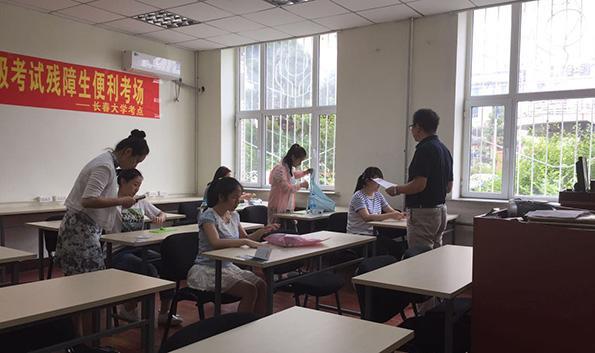
Five blind students joined their peers Saturday to sit the national college English test in Changchun, capital of northeast China’s Jilin Province, where test papers in Braille were used for the first time.
|
|
|
The five students, from Changchun University’s School of Special Education, were given test papers in Braille in a separate classroom away from other students.
|
The five students, from Changchun University’s School of Special Education, were given test papers in Braille in a separate classroom away from other students. Their test lasted 195 minutes instead of the standard 130 minutes, as it takes longer to read and write in Braille.
In a classroom next door, three other visually impaired — but not totally blind — students were given large-font test papers and 169 minutes to answer with the help of magnifying lenses and reading lamps.
“All the visually impaired students were put in well-lit classrooms on the first floor and provided with power cords, bottled water and snacks,” said Li Meng, an exam official with Changchun University.
Two teachers, one of whom knew Braille, stood by in case the students needed help, he said.
For Luo Qian, a senior student majoring in acupuncture and massage, Saturday’s test was a dream come true.
“If I pass the test, I will be one step closer to graduate school,” said Luo, from central China’s Hunan Province. She stayed up until after midnight revising for the test over the past few weeks.
Luo said she dreamed of becoming a teacher to help disabled children in her hometown earn their own living.
Luo wrote to education authorities in Jilin Province last September, asking for test papers in Braille to be made available for blind students, but her plea was unanswered and she failed to take the test last December as she hoped.
She repeated her request to Ministry of Education earlier this year and in May was told test papers in Braille would be available in the June test.
“This is the second major landmark for visually impaired students after test papers in Braille were used in the national college entrance exam in 2014,” Luo said after the test.
That year, Li Jinsheng, a student from central China’s Henan Province, became the first blind candidate to take the college entrance test. The move encouraged thousands of visually impaired students to study harder, enter higher education and live with dignity.
Changchun University’s College for Special Education is one of China’s largest higher education institutions for disabled young people. More than 370 of its students are visually impaired, according to Liu Haihan, a top college official.
The biannual College English Test, better known as the CET, is a national English as a foreign language test, which includes listening, reading and writing.
CET-4 or CET-6 is a requirement for university students.
Many universities will not allow a student to graduate without obtaining such a certificate, and it is often a prerequisite for those entering the job market.
read more