Government steps up mosquito prevention and control work (with photo)
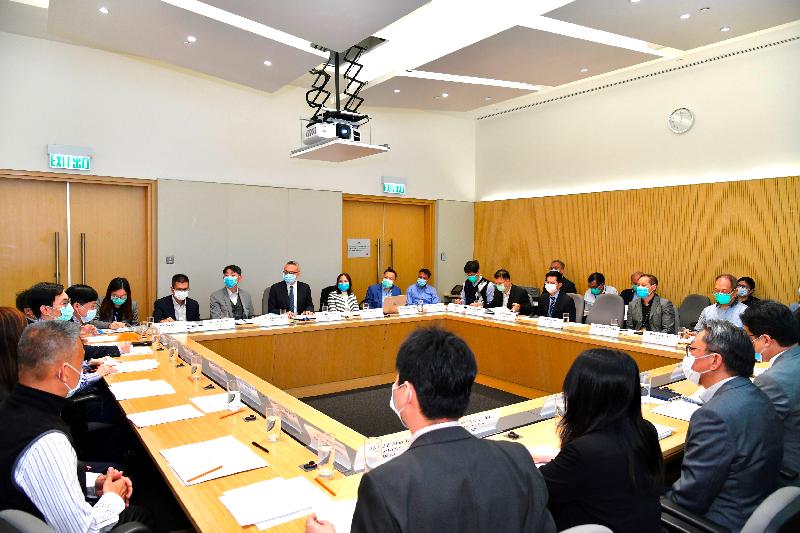
In view of the first local dengue fever (DF) case recorded this year, the inter-departmental Pest Control Steering Committee held a special meeting today (April 17) to review immediate actions taken to tackle the case and inter-departmental collaboration. Various bureaux and departments will stay vigilant to carry out mosquito prevention and control measures in order to reduce the risk of spreading DF in Hong Kong.
In addition to advising people to take personal protective measures, the Government urges members of the public to always maintain strict environmental hygiene and remove stagnant water in a timely manner in outdoor and household settings with a view to minimising mosquitoes breeding and preventing the spread of DF and other mosquito-borne diseases.
The Centre for Health Protection (CHP) of the Department of Health (DH) briefed the meeting on the latest situation and risk assessment of DF. The Food and Environmental Hygiene Department (FEHD) gave an account of the vector investigation and the mosquito prevention and control work conducted immediately at the areas within a 500-metre radius of the patient’s residence in Sung Shan New Village in Yuen Long. These included collecting mosquito samples for DF virus tests, conducting fogging operations, spraying larvicide, putting in place additional new mosquito traps, and distributing DF prevention promotional leaflets to villagers. Also, the FEHD has already enhanced environmental management of the area, including removal of waste, disposal of articles that may contain water, clearing of stagnant water and keeping drains free of blockage.
Various departments resolved to enhance comprehensive mosquito prevention and control work in areas under their purview in the coming few days, which include identifying black spots of mosquito infestation for immediately carrying out fogging operations, clearing of stagnant water and putting in place new mosquito traps at suitable locations. All parties will persevere in taking forward the related works.
To target mosquito problems in rural areas, the Home Affairs Department will contact local groups to raise the anti-mosquito awareness of the public and take action, which will include disposing of articles that may contain water, clearing of stagnant water, and putting in place mosquito traps in private premises to reduce the number of adult mosquitoes.
The Steering Committee has mapped out the work plan and targets for this year in January. Various departments have simultaneously started carrying out anti-mosquito works this month as planned to eliminate breeding grounds early, and at the same time commenced fogging operations that will continue until the end of the rainy season.
Apart from releasing the Gravidtrap index to reflect the distribution of Aedes albopictus, the FEHD will also release the density index from this month to better quantify the effectiveness of mosquito control work as well as to enable various departments to grasp mosquito infestation conditions and conduct more targeted control measures. Starting this month, the FEHD has put in place about 5 000 newly designed Gravidtraps across the territory as a replacement for the ovitraps currently in use so as to directly count the population of adult mosquitoes.
With regard to the experience of rodent prevention and control work in the past, the FEHD found that the condition of some of the back alleys are still not up to satisfaction. In particular, improper disposal of food waste by food premises and accumulation of miscellaneous items in back alleys have occurred repeatedly. Targeting irregularities of food premises such as food preparation, scullery and illegal dumping of refuse in back alleys, the FEHD will take more stringent enforcement actions as well as enhance environmental hygiene. In addition, various departments will target repair works that are usually more prone to rodent infestation and step up rodent control work at facilities including flower beds and gullies.
The FEHD is conducting field trials of thermal imaging cameras with an artificial intelligence analytical function in Kowloon City District for recording rodent activity and the extent in order to collect data to upgrade the quantifying functions of rodent surveillance. At the meeting, the FEHD reported the progress of the field trials and explained how to apply the technology in measuring rodent activity. Before and after carrying out an anti-rodent operation in designated target areas in nine districts in May, the FEHD will also install thermal imaging cameras for analysis with a view to quantifying and reviewing the effectiveness of the operation. The FEHD is conducting tests on a poisonous bait with food flavours and is also testing a new break back trap during the special operations in six public markets. Being more sensitive than traditional traps, the newly designed break back traps are more effective in catching rodents. The tests are expected to be completed in July. If proved to be effective, they will be put into more extensive use.
Representatives from three bureaux, 21 departments and an organisation attended today’s meeting.
Members of the public may visit the websites of the FEHD (www.fehd.gov.hk/english/pestcontrol/Pcas.html) and the CHP under the DH (www.chp.gov.hk/en/features/38847.html) for more information on pest control and dengue fever.