image_pdfimage_print

Author Archives: hksar gov

LCQ15: Adjournment of court hearings

     Following is a question by the Hon Dennis Kwok and a written reply by the Chief Secretary for Administration, Mr Matthew Cheung Kin-chung, in the Legislative Council today (April 22):

Question:

     In response to the Coronavirus Disease 2019 (commonly known as “the Wuhan pneumonia”) epidemic, the Judiciary has adjourned all hearings originally scheduled to be held in courts (including tribunals) from January 29 to March 22, 2020, and the various court registries and offices handled only urgent and essential hearings/matters during the said period. The Judiciary subsequently announced that it would, starting from March 2, pave the way for the orderly resumption of proceedings for all levels of courts and re-opening of court registries/offices within March. In other words, courts at all levels and their offices have not been in normal and full operation for as long as two months. In this connection, will the Government inform this Council if it knows:

(1) (i) the criteria adopted by the Judiciary for determining that the aforesaid court closure arrangements should be made, and (ii) whether the Judiciary took into consideration that the prolonged closure of courts would prejudice members of the public’s right of access to justice by means of judicial proceedings; if the Judiciary did, whether the Judiciary has reviewed if such decisions struck a balance between fighting against the epidemic and upholding justice; if the Judiciary has not, of the reasons for that;

(2) the number of cases affected by the court closures, with a breakdown by the courts involved and type of cases (i.e. (i) civil cases, (ii) criminal cases, and (iii) others);
 

Court (i) (ii) (iii) Total
Court of Final Appeal        
Court of Appeal of the High Court        
Court of First Instance of the High Court        
District Court        
Magistrates’ Courts        
Labour Tribunal (not applicable)  
Lands Tribunal (not applicable)  
Competition Tribunal (not applicable)  
Coroner’s Court (not applicable)  
Obscene Articles Tribunal (not applicable)  
Small Claims Tribunal (not applicable)  
 
(3) whether the Judiciary will take measures to expeditiously reschedule the hearings which have been adjourned as a result of the court closures; if the Judiciary will, of the details; if not, the reasons for that;

(4) whether the Judiciary has, in response to the outbreak of the Severe Acute Respiratory Syndrome in 2003, formulated a contingency plan in respect of court operation and hearings during an infectious disease outbreak; if the Judiciary has, of the details, and whether the Judiciary has implemented such a plan in tackling the current epidemic; if the Judiciary has no such contingency plan, of the reasons for that; and 

(5) whether the Judiciary has plans to expedite the implementation of information technology application projects, with a view to enabling the electronic transmission of documents among the parties to the proceedings and the conduct of hearings by telephone or video link, so as to reduce the impacts of court closures necessitated by infectious disease outbreaks in future; if the Judiciary does, of the timetable and details; if not, the reasons for that?

Reply:

President,

     Based on the information provided by the Judiciary, the Government’s consolidated reply to the five parts of the Question is appended as follows.  

     In view of public health considerations under the COVID-19 pandemic, the Judiciary has generally adjourned court proceedings from January 29, 2020 (General Adjourned Period or GAP). During GAP, urgent and essential hearings continue to be heard and the Judiciary has been doing its best to handle urgent and essential court business under such constraints. GAP has now been extended until May 3, 2020, and will be subject to review having regard to the prevailing public health situation. The Judiciary stresses that the health and safety of the public, including those of court users, Judges and Judicial Officers (JJOs) and the Judiciary’s staff, remain the paramount considerations in the handling of court operations.

     The Judiciary has stated that the general adjournment and its duration are unprecedented amid an unprecedented public health challenge for the whole community. The decision to impose and extend GAP, as well as the determination of the scope of urgent and essential business that is to be dealt with during GAP, was made by the Chief Justice, as the head of the Judiciary, after striking a careful balance between public health considerations and the public interest involved in the due administration of justice, while taking into account any logistical and legal considerations. The Judiciary is constantly reviewing the latest situation and devising appropriate plans to mitigate the impact on court business owing to GAP. While access to justice is important, the Judiciary must also take into account the paramount considerations of protecting the health and safety of the public in tackling this unprecedented phenomenon of COVID-19 pandemic.

The Judiciary’s Efforts in Mitigating the Impact of GAP

     The Judiciary is keenly aware that GAP has affected court users and stakeholders to varying extent and has been taking proactive steps to mitigate its impact. More specifically, it has been taking a multi-pronged approach in addressing and alleviating the impact on court business owing to GAP. The Judiciary’s efforts in this regard are summarised below: 

(a) the Judiciary has made special arrangements for all urgent and essential court hearings and business to be handled promptly during the period. In addition, the Judiciary recognises that the longer the general adjournment has become, the more matters may become urgent and essential. As such, the Judiciary has been constantly reviewing the scope of urgent and essential business which should be handled during GAP and refining its scope on a regular basis. As a result, physical hearings on urgent and essential business, including fresh remand cases, urgent bail hearings and judicial review hearings and urgent appeals, are heard at all levels of courts during GAP. In addition, despite the general closure of court registries and offices, enhanced measures have constantly been introduced to handle the filing of additional types of documents and other matters in support of the expanded scope of urgent and essential business. In fact, the scope of urgent and essential court business and the list of enhanced measures have been adjusted 11 times since January 29, 2020;

(b) proactive case management is done by all JJOs of cases assigned to them, so that clear and prompt directions will be given to the parties as necessary. This will also enable those cases which will be ready for hearing upon the expiry of GAP to be re-fixed as early as practicable;

(c) where appropriate, JJOs will consider or invite the parties to consider disposing the cases on paper as far as possible, in particular for civil cases, e.g. interlocutory matters. Paper disposal is an existing and well-accepted means of processing cases without the need for oral hearing;

(d) the Judiciary has been proactively taking incremental steps to explore the use of alternative modes of hearing submissions by video-conferencing facilities (VCF) and telephone. Further details on the use of information technology (IT ) to handle court business are set out in paragraphs under “Use of Information Technology” below;

(e) the Judiciary has re-assured all stakeholders and parties that there will be sufficient lead time for notification and preparation, regardless of whether the cases will proceed as scheduled after GAP or be re-fixed; and

(f) additional temporary JJOs will continue to be engaged as appropriate and more effective listing arrangements will be introduced where practicable to enhance the judicial capacity in dealing with the increased volume of judicial work culminated during GAP.

     The Judiciary will continue to closely monitor the public health situation and take proactive steps to prepare for the eventual resumption of court proceedings in an orderly, staggered and progressive manner as appropriate taking into account all relevant considerations. At the same time, the Judiciary will continue to take appropriate public health and crowd control measures to help ensure the safety of court users, JJOs and staff of the Judiciary.

Use of Information Technology

     During GAP where physical attendance at the court premises and contacts in person should be minimised and gathering of crowds should be avoided, the Judiciary is actively pursuing the greater use of IT to support and facilitate the conduct of court business during GAP in the context of its long-term strategy. At the same time, the Judiciary has been in communication with relevant stakeholders as to how the greater use of IT could facilitate and support the conduct of court business. The major developments are summarised below.

     First, the Judiciary takes a positive and proactive approach in the use of IT in support of the court operations but it is important to stress that any measure must be in accordance with the law. The Judiciary recognises the need and urgency of providing the legislative backing for initiatives such as the intended introduction of e filing and transaction, including e payment, for court proceedings. In this regard, under the Information Technology Strategy Plan, the Judiciary has been proactively developing by phases an integrated court case management system (iCMS) across all levels of courts to enable an electronic mode for handling court-related documents and payments. The Court Proceedings (Electronic Technology) Bill, which seeks to provide the necessary legal basis, was introduced into the Legislative Council on January 8, 2020. Subject to the enactment of the Bill and some further subsidiary legislation, the iCMS will first be implemented at the District Court (DC) and part of the Magistrates’ Courts (MCs). The Judiciary looks forward to the passage of the Bill and bringing all these work to fruition as soon as practicable.

     Pending the provision of the necessary legislative backing, the Judiciary has been taking steps to explore and introduce certain administrative measures within the confines of its IT security policy and practices to enable the handling of certain documents by electronic means. These include:

(a) special email accounts have been created to enable parties to lodge certain documents to the court electronically to facilitate paper disposal; and

(b) the scope of an existing electronic submission platform in the DC has been expanded for implementation in other courts. This platform was extended to the High Court (HC) and the Family Court from April 1, 2020 to enable the electronic submission of documents including but not limited to those relating to hearings, e.g. list of authorities and hearing bundles. The platform was further extended to the Lands Tribunal from April 15, 2020.

     As stated above, the Judiciary has also been proactively taking incremental steps to use alternative modes of hearing submissions in civil cases by VCF by phases. The Judiciary issued on  April 2, 2020 a Guidance Note for Remote Hearings for Civil Business in the High Court (Phase 1: Video-Conferencing Facilities) which sets out the practice for remote hearings by VCF in civil cases in the Court of Appeal and the Court of First Instance of the HC during GAP. Two cases using VCF were tried out in the week of April 6 and the experience was satisfactory. The Judiciary notes that feedback from practitioners on the use of VCF for remote hearings is generally positive. A few more cases using VCF have also been listed at the HC in the coming few weeks. In the next phase, the Judiciary is actively considering the expansion of the use of VCF for remote hearings in some other civil courts. The Judiciary is also examining the possibility of using phone hearings for simple interlocutory hearings. The Judiciary will announce the details when ready.  

     Apart from the consideration of compliance with the law, it is important that any application of IT must be secure and the integrity of the specific aspects of the court operation involving the use of IT cannot be jeopardised or compromised. The Judiciary will continue to adopt a pragmatic approach. The Judiciary will also continue to maintain a close dialogue with the legal profession and other stakeholders on matters relating to the use of IT for court business during GAP and in the longer run.

Social Distancing

     The Judiciary has been adopting a “space-out” approach to ensure smooth people flow and avoid over-crowdedness in court premises including courtrooms and registry areas. This is reflected in the refined scope of business to be handled, including registry business (as revised from time to time), the manner in which cases are listed for hearing, the number of courts that are opened for hearing, the manner in which court proceedings are spaced out, the number of and manner in which MCs are opened for business, and the preventive and crowd control measures implemented. Some examples of preventive and crowd control measures include the setting of capacity limits for each courtroom, court lobby and registry areas, as well as the implementation of a queuing and admission ticketing system as appropriate. These measures will continue to apply during and beyond GAP as necessary.

Impact on Caseload 

     The Judiciary has not kept precise statistics on cases and proceedings affected (including those adjourned), those took place and those disposed of through other means such as paper disposal or settlement, etc. since the general adjournment on January 29, 2020. However, within the reduced capacity of the courts because of the need for social distancing, the courts have been handling as much court business as efficiently and safely as possible during GAP by various means as described above. The Judiciary has also been redeploying or engaging temporary registry staff to help clear the backlog of cases filed with the registries as expeditiously as possible. read more
CHP investigates four additional cases of COVID-19

     The Centre for Health Protection (CHP) of the Department of Health has announced that as of 4pm today (April 22), the CHP was investigating four additional confirmed cases of COVID-19, taking the number of cases to 1 034 in Hong Kong so far (comprising 1 033 confirmed cases and one probable case).

     The newly reported cases announced today involve two males and two females aged between 2 and 68. Among them, all had a travel history during the incubation period and one is an overseas student. The CHP’s epidemiological investigations and relevant contact tracing on the confirmed cases are ongoing. For case details and contact tracing information, please see the Annex.
 
     The CHP urged members of the public to maintain an appropriate social distance with other people as far as possible in their daily lives. In particular, they should go out less and avoid social activities such as meal gatherings or other gatherings to reduce the chance of contacting infected persons, who may not present any symptoms, and minimise the risk of outbreak clusters emerging in the community.
     
     A spokesman for the CHP said, “Given that the situation of COVID-19 infection remains severe and continuous increase in the number of cases reported around the world, members of the public are strongly urged to avoid all non-essential travel outside Hong Kong.
 
     “The CHP also strongly urges the public to maintain at all times strict personal and environmental hygiene, which is key to personal protection against infection and prevention of the spread of the disease in the community. On a personal level, members of the public should wear a surgical mask when having respiratory symptoms, taking public transport or staying in crowded places. They should also perform hand hygiene frequently, especially before touching the mouth, nose or eyes.
 
     “As for household environmental hygiene, members of the public are advised to maintain drainage pipes properly, regularly pour water into drain outlets (U-traps) and cover all floor drain outlets when they are not in use. After using the toilet, they should put the toilet lid down before flushing to avoid spreading germs.”
 
     The CHP will report the cases to the World Health Organization, the National Health Commission, the Health Commission of Guangdong Province, relevant health authorities and the Hospital Authority.
 
     The CHP has set up hotlines (2125 1111 and 2125 1122), which operate from 8am to midnight daily, for public enquiries. As at 4pm today, a total of 96 850 calls had been received.
 
     Moreover, the Government has launched the website “COVID-19 Thematic Website” (www.coronavirus.gov.hk) for announcing the latest updates on various news on COVID-19 infection and health advice to help the public understand the latest updates.
 
     To prevent pneumonia and respiratory tract infection, members of the public should always maintain good personal and environmental hygiene. They are advised to:
 
• Wear a surgical mask when taking public transport or staying in crowded places. It is important to wear a mask properly, including performing hand hygiene before wearing and after removing a mask;
• Perform hand hygiene frequently, especially before touching the mouth, nose or eyes, after touching public installations such as handrails or door knobs, or when hands are contaminated by respiratory secretions after coughing or sneezing;
• Maintain drainage pipes properly and regularly (about once a week) pour about half a litre of water into each drain outlet (U-trap) to ensure environmental hygiene;
• Cover all floor drain outlets when they are not in use;
• After using the toilet, put the toilet lid down before flushing to avoid spreading germs;
• Wash hands with liquid soap and water, and rub for at least 20 seconds. Then rinse with water and dry with a disposable paper towel. If hand washing facilities are not available, or when hands are not visibly soiled, performing hand hygiene with 70 to 80 per cent alcohol-based handrub is an effective alternative;
• Cover your mouth and nose with tissue paper when sneezing or coughing. Dispose of soiled tissues into a lidded rubbish bin, then wash hands thoroughly; and
• When having respiratory symptoms, wear a surgical mask, refrain from work or attending class at school, avoid going to crowded places and seek medical advice promptly.
  read more

Hong Kong Customs detects third case this year involving over 10 million suspected illicit cigarettes (with photo)

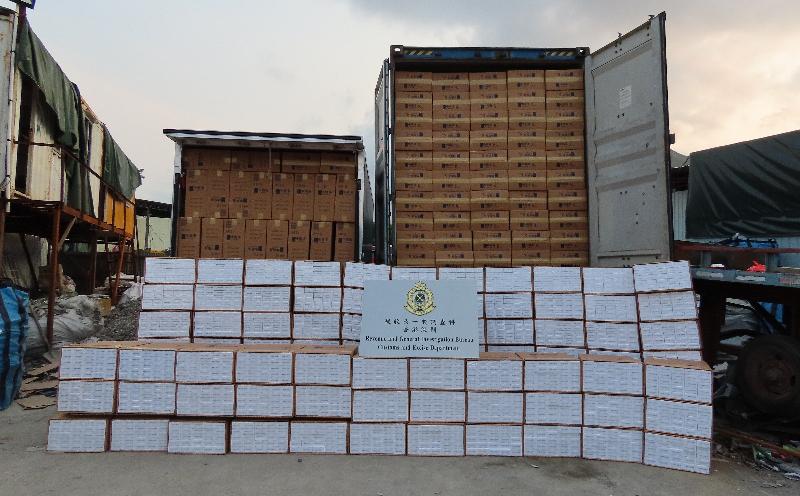
     Hong Kong Customs yesterday (April 21) seized about 10 million suspected illicit cigarettes in Yuen Long with an estimated market value of about $28 million and a duty potential of about $19 million. This is the third case detected by Customs this year involving more than 10 million suspected illicit cigarettes.

     During an anti-illicit cigarette operation conducted in Yuen Long yesterday, Customs officers seized the batch of suspected illicit cigarettes from a truck and a 40-foot-long container inside a scrap metal yard. Two men, aged 40 and 34, were arrested.

     Upon initial investigation, Customs believed that the illicit cigarette syndicate had adopted a circuitous route to transship the illicit cigarettes to Hong Kong in an attempt to evade law enforcement agencies.

     Investigation is ongoing.

     Customs detected this large-scale illicit cigarette smuggling case with more than 10 million in quantity again following detection of the smuggling case in February this year with the largest amount of illicit cigarettes in the past two decades, in which about 31 million suspected illicit cigarettes were seized, and a seizure of about 10.2 million suspected illicit cigarettes made in March. This has demonstrated that the strategy of tackling at source has proved to be an effective way to cut the illicit cigarette supply chain. Customs will continue to adopt this strategy and spare no effort in combating illicit cigarette activities for protection of revenue.

     Smuggling is a serious offence. Under the Import and Export Ordinance, any person found guilty of importing or exporting unmanifested cargo is liable to a maximum fine of $2 million and imprisonment for seven years.

     Under the Dutiable Commodities Ordinance, anyone involved in dealing with, possession of, selling or buying illicit cigarettes commits an offence. The maximum penalty upon conviction is a fine of $1 million and imprisonment for two years.

     Members of the public may report any suspected illicit cigarette activities to Customs’ 24-hour hotline 2545 6182 or its dedicated crime-reporting email account (crimereport@customs.gov.hk).

Photo  
read more

LCQ2: Opening up facilities of the Fanling Golf Course

     Following is a question by the Hon Tanya Chan and a written reply by the Secretary for Home Affairs, Mr Lau Kong-wah, in the Legislative Council today (April 22):

Question:
 
     The Fanling Golf Course (FGC) is a sports and recreational facility developed by the Hong Kong Golf Club for use by its members on a piece of land leased from the Government under a private recreational lease (PRL). Under the relevant clause of PRL, FGC is currently required to open up its facilities for use by eligible outside bodies only for a maximum of three sessions of three hours each per week. In addition, the lessee of the land where FGC is located voluntarily opens up FGC’s facilities for use by eligible outside bodies from Monday to Friday, as well as its night range for public use from 6pm to 10pm every day. However, some members of the public have pointed out that in recent months, the driving range has often been fully booked in no time, rendering them unable to book the relevant facilities on many occasions. In this connection, will the Government inform this Council:
 
(1) whether it knows the utilisation rate of FGC, as well as the number of days and number of hours for which the relevant facilities were available for booking and actually hired by non-members, in each month of the past two years, with a tabulated breakdown by the targets to which the facilities were opened up (i.e. eligible outside bodies and the public); if not, whether it will request the lessee concerned to provide such data;
 
(2) even though the Government has indicated that it will, when granting FGC a new PRL, add a clause requiring “the further opening up of facilities to outside bodies” (i.e. requiring the lessee to open up 30 per cent of its total sports and recreational facility capacity to eligible outside bodies, and co-organise at least 240 hours of sports activities every month with sports bodies for participation by members of the public), FGC still occupies as vast as 140 hectares of land upon excluding 32 hectares to be used for housing purpose, whether the Government will, in the new PRL, require the lessee to open up more than 30 per cent of the facilities to outside bodies and increase the number of opening hours; if so, of the details; if not, the reasons for that; and
 
(3) whether it has gained an understanding from the lessee concerned as to why members of the public have been unable to book FGC’s driving range on many occasions in recent months, and requested the lessee to examine (i) whether there have been cases of persons being improperly given the right to make priority bookings or failing to take up their booked sessions on multiple occasions, and (ii) whether appropriate follow-up actions have been taken in respect of such cases?
 
Reply:
 
President,
 
     In 2011, the Executive Council (ExCo) approved the modification on the policy of Private Recreational Leases (PRL) pertaining to the requirement of opening up sports facilities to eligible outside bodies, i.e. adjusting from a maximum of three sessions of three hours per week to a minimum of 50 hours per month. The modified requirement for opening up facilities is applicable to the renewal of leases which expired in 2011 and 2012.
 
     The current lease of FGC, which was granted in 1999 and will expire in August 2020, is not subject to the modification approved by the ExCo in 2011. Nevertheless, the Hong Kong Golf Club (HKGC) has voluntarily followed ExCo’s modification and opened up its sports facilities to eligible outside bodies (Note 1) for at least 50 hours per month. Details have been uploaded onto the website of the Home Affairs Bureau (HAB): www.hab.gov.hk/file_manager/en/documents/other_information/voluntary_open.pdf. Moreover, HKGC has opened up its 18-hole course at FGC for use on weekdays by members of the public holding valid handicap certificates issued by recognised golf clubs or golfers’ associations. Its driving range is also open for public use from 6pm to 10pm every day (weekdays and public holidays).
 
     The reply to the three parts of the question is as follows:
 
(1) The HAB requires PRL holders to submit quarterly reports for monitoring utilisation of facilities on PRL sites. The reports contain quarterly data without monthly breakdown. Information on utilisation of FGC’s facilities is tabulated below:
 

Quarter Actual number of hours utilised
    Eligible outside bodies Non-members
2018 Q1 3 647 55 193
  Q2 4 855 44 685
  Q3 2 298 33 462
  Q4 4 497 56 867
2019 Q1 4 738 61 750
  Q2 6 525 47 259
  Q3 4 438 48 842
  Q4 4 292 62 088
           
     According to the information provided by the HKGC, around 120 000 golf rounds (Note 2) were played annually in the past two years at FGC, with eligible outside bodies and non-members accounting for about 40 per cent of the total utilisation.
 
(2) Sports and recreational facilities of private sports clubs vary in type, quantity and area occupied. The extent to which such facilities are opened up is therefore calculated based on their total sports and recreational facility capacity, instead of the size of the land. Specifically, according to the new PRL policy, private sports clubs are required to further open up their sports and recreational facilities, including opening up at least 30 per cent of the total sports capacity of such facilities to eligible outside bodies, and partner with sports organisations to organise sports programmes that are open for enrolment by members of the public with a minimum of 240 sports programme hours per month.
 
     When applying for renewal upon expiry of the current lease of FGC, a new plan on the opening up of facilities has to be submitted. The new plan will be approved only if it complies with the relevant requirement under the new policy.
 
(3) The driving range open for use at FGC has 27 bays, which are available for booking on a first-come-first-served basis by members of the public from 6pm to 10pm every day. In general, facilities at the driving range are able to meet the daily public demand. However, the demand for the driving range has increased at the initial stage of the COVID-19 epidemic due to closure of other golf courses and reduction in the number of golfers who played in the Mainland. Given the subsequent severe situation of the epidemic, all PRL sites (including FGC) have, as required by the Government, closed their sports and recreational facilities since March 24 this year until further notice.
 
Note 1: Eligible outside bodies include schools registered under the Education Ordinance, non-governmental organisations receiving recurrent subventions from the Social Welfare Department, uniformed groups, youth organisations, national sports associations and government departments.  In accordance with the new PRL policy, the existing categories of eligible outside bodies have been expanded to include member organisations of the Sports Federation & Olympic Committee of Hong Kong, China; sports organisations affiliated to national sports associations; district sports associations; the Hong Kong Schools Sports Federation; the New Territories Regional Sports Association; and sports organisations funded by government departments since 2019.
 
Note 2: There are a maximum of four players in the same flight. Each individual playing on a course will be counted as one golf round. read more