image_pdfimage_print

Author Archives: hksar gov

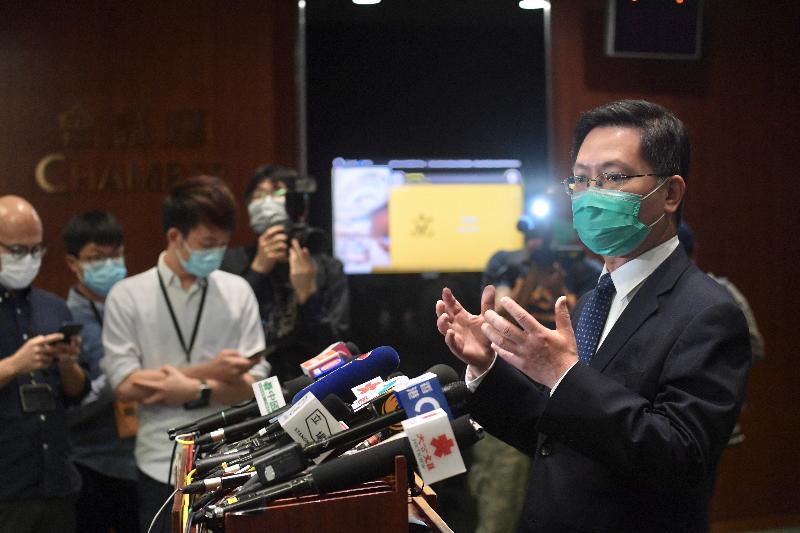
S for IT meets the media at Legislative Council Complex (with photo)

     Following is the transcript of remarks by the Secretary for Innovation and Technology, Mr Alfred Sit, at a media session at the Legislative Council Complex today (April 23):
      
Reporter: Mr Sit, can you tell us how specifically are you going to promote innovation and technology in Hong Kong during your term of office, given that, you know, the industry has been criticising being lagging behind many other places around the world? Secondly, how would you respond to the criticism that you are not familiar with the industry given that you have spent a long time at the EMSD? And also, thirdly, there are some critics who are concerned about the Government would be installing facial recognition technology across the territory. Does the Government have plans to do that in the future?

Secretary for Innovation and Technology: Well, in Hong Kong, we have many committed and talented people who are well committed to promoting innovation technology in Hong Kong. But the problem that we have now is that we have very good innovative people and innovative products. But we need to co-operate with different trades so that we can accredit the products and then have the products commercialised, so the whole process we need to have more input, to have more promotion, so that we have more co-operation among all the sectors in the trade. As regards the second question about my experience in innovation and technology. Well, I have to admit that in my 30-plus years of service in the Government, we have met a lot of people who are working on innovation and technology. So we worked with them in promoting the innovative products in the Government and we are going to continue to do so. My strength, I suppose, is to understand the system in the Government, so that we can give the opportunities to the people to make use of the good system in the Government to have the products put for trial. That’s my strength. And I am going to listen to the views of our practitioners in the innovation sector, so that they can tell us more what we can do from the Government’s perspective. So that we can help them to promote their product, to facilitate them to enter into the other markets.
 
Reporter: For the facial recognition technology, does the Government have plans to install some of these technologies across the territory?
 
Secretary for Innovation and Technology: For innovative products, we need to have a good balance about the privacy and the advantage of application of new products. We need to have a good balance. It may be too premature to say which product we should use, which product we should not use. We need to have good balance to listen to the views of people. So that we can have a good balance.
 
(Please also refer to the Chinese portion of the transcript.)

Photo  
read more

CS visits new quarantine units at JPC Centre at Pat Heung

     The Chief Secretary for Administration, Mr Matthew Cheung Kin-chung, today (April 23) visited the Junior Police Call Permanent Activity Centre (JPC Centre) at Pat Heung, Yuen Long, to inspect the newly developed temporary quarantine units that will soon commence operation and express his appreciation to the staff and volunteers managing the site.

     Accompanied by the Secretary for Development, Mr Michael Wong, and the Director of Architectural Services, Mrs Sylvia Lam, Mr Cheung toured the new quarantine units and received a briefing from technical staff on-site on how they managed to build 120 new quarantine units in around two months and sped up its construction through the application of the modular integrated construction (MiC) method.

     He was pleased to note that the works which started in February this year were completed earlier this week. Together with about 80 quarantine units refurbished from existing quarters that have commenced operation in late March, the JPC Centre provides more than 200 quarantine units in total.

     Mr Cheung said, “Although the number of new confirmed cases in Hong Kong has subsided these days, the community must stay vigilant, given that virus infection does not know any boundary and that the pandemic remains severe and developments are hard to predict. The Government will keep up its anti-epidemic effort under the three key principles of responding promptly, staying alert to the situation and working in an open and transparent manner, including the provision of additional quarantine units, so as to cope with the possibility of a sudden turn in the epidemic situation.”

     “The quarantine centres set up by the Government are designed to cater for close contacts of confirmed cases under compulsory quarantine. Since January, a total of about 4 500 persons have been accommodated at quarantine centres, among whom 84 showed symptoms during their stay and were confirmed cases. This demonstrates the effectiveness of the quarantine centres in preventing community outbreaks,” he said.

     “The Government has been racing against time in developing additional quarantine units through refurbishment and construction. I would like to express my gratitude to all colleagues of the Architectural Services Department and other relevant government departments as well as staff of the contractor for their relentless efforts day and night in building new quarantine units within such a short period of time in a safe manner. Their spirit of standing united to fight the disease is exemplary,” he added.

     He also expressed his appreciation to colleagues of the Department of Health, the Police Force, the Fire Services Department, the Civil Aid Service and relevant government departments as well as the volunteers for working together in managing the operation of the site.

     Mr Cheung said that, with a view to safeguarding against any sudden turn in the epidemic situation in Hong Kong, the Government had announced that the measures to regulate catering business premises, scheduled premises and prohibit group gatherings would be extended by two weeks starting from today. He urged members of the public to be accommodating and self-disciplined and continue to comply with the measures for maintaining social distance to fight the epidemic together.

     Currently, the Government has four quarantine centres in operation, which are situated in Chun Yeung Estate in Fo Tan, the Lei Yue Mun Park and Holiday Village in Chai Wan, the Heritage Lodge of the Jao Tsung-I Academy in Lai Chi Kok, and the JPC Centre at Pat Heung. Together, they provide a total of about 1 700 quarantine units. The Government will continue to develop about 1 000 additional units as quarantine facilities through the application of the MiC at the Lei Yue Mun Park and Holiday Village, the Sai Kung Outdoor Recreation Centre and on a piece of Government land at Penny’s Bay. The units are expected to be completed and put into use from April to July in phases. read more

Consumer Price Indices for March 2020

     The Census and Statistics Department (C&SD) released today (April 23) the Consumer Price Index (CPI) figures for March 2020. According to the Composite CPI, overall consumer prices rose by 2.3% in March 2020 over the same month a year earlier, larger than the average rate of increase in January and February 2020 (1.8%). The comparison to the average rate of increase in January and February is to neutralise the effect caused by different timing of the Lunar New Year between two years, which occurred in late January this year but in early February last year. The larger increase in the Composite CPI in March compared to January and February combined was mainly due to the Government’s payment of public housing rentals and waiver of two-thirds of rent for tenants of Group B estates by Hong Kong Housing Society in January 2020. Netting out the effects of all Government’s one-off relief measures, the year-on-year rate of increase in the Composite CPI (i.e. the underlying inflation rate) in March 2020 was 2.6%, smaller than the average rate of increase in January and February 2020 (3.1%). The smaller increase was mainly due to the smaller increases in the prices of pork. 

     The year-on-year rate of increase in the Composite CPI in March 2020 was 2.3%, larger than that in February 2020 (2.2%). Netting out the effects of all Government’s one-off relief measures, the year-on-year rate of increase in the Composite CPI in March 2020 was 2.6%, also larger than that in February 2020 (2.5%).

     On a seasonally adjusted basis, the average monthly rate of change in the Composite CPI for the three-month period ending March 2020 was 0.0%, the same as that for the three-month period ending February 2020. Netting out the effects of all Government’s one-off relief measures, the corresponding rates of increase were both 0.1%.

     Analysed by sub-index, the year-on-year rates of increase in the CPI(A), CPI(B) and CPI(C) were 2.5%, 2.3% and 2.1% respectively in March 2020, as compared to the average rates of increase of 0.4%, 2.4% and 2.5% respectively in January and February 2020, and 2.7%, 2.1% and 1.8% respectively in February 2020. Netting out the effects of all Government’s one-off relief measures, the year-on-year rates of increase in the CPI(A), CPI(B) and CPI(C) were 3.1%, 2.5% and 2.1% respectively in March 2020, as compared to the average rates of increase of 3.7%, 2.9% and 2.6% respectively in January and February 2020, and 3.3%, 2.3% and 1.8% respectively in February 2020. 

     On a seasonally adjusted basis, for the three-month period ending March 2020, the average monthly rates of change in the seasonally adjusted CPI(A), CPI(B) and CPI(C) were -0.1%, 0.0% and 0.0% respectively, same as those for the three-month period ending February 2020. Netting out the effects of all Government’s one-off relief measures, the average monthly rates of increase in the seasonally adjusted CPI(A), CPI(B) and CPI(C) for the three-month period ending March 2020 were 0.2%, 0.1% and 0.1% respectively, same as those rates of increase for the three-month period ending February 2020. 

     Amongst the various components of the Composite CPI, year-on-year increases in prices were recorded in March 2020 for food (excluding meals bought away from home) (13.0%), miscellaneous goods (3.5%), housing (2.6%), meals bought away from home (1.6%), transport (1.1%) and miscellaneous services (1.1%). 

     On the other hand, year-on-year decreases in the components of the Composite CPI were recorded in March 2020 for electricity, gas and water (-16.1%); clothing and footwear (-4.0%); durable goods (-2.4%) as well as alcoholic drinks and tobacco (-0.6%). 

     In the first quarter of 2020, the Composite CPI rose by 2.0% over a year earlier, while the CPI(A), CPI(B) and CPI(C) rose by 1.1%, 2.4% and 2.4% respectively. The corresponding increases after netting out the effects of all Government’s one-off relief measures were 2.9%, 3.5%, 2.7% and 2.4% respectively. 

     For the 12 months ending March 2020, the Composite CPI was on average 2.8% higher than that in the preceding 12-month period. The respective increases in the CPI(A), CPI(B) and CPI(C) were 2.9%, 2.8% and 2.7% respectively. The corresponding increases after netting out the effects of all Government’s one-off relief measures were 3.0%, 3.6%, 2.9% and 2.6% respectively. 

Commentary

     A Government spokesman said that the underlying consumer price inflation rate went down from 3.1% for January and February combined to 2.6% in March, as food inflation moderated slightly while price pressures on most other major CPI components showed varying degrees of easing.

     Looking ahead, inflation should remain moderate in the near term. Domestic cost pressures have abated amid the austere local economic situation. External price pressures are expected to subside further in view of the global recession and the recent strengthening of the Hong Kong dollar along with the US dollar. The Government will continue to monitor the inflation situation closely, particularly the impact on the lower-income people.

Further information

     The CPIs and year-on-year rates of change at section level for March 2020 are shown in Table 1. The time series on the year-on-year rates of change in the CPIs before and after netting out the effects of all Government’s one-off relief measures are shown in Table 2. For discerning the latest trend in consumer prices, it is also useful to look at the changes in the seasonally adjusted CPIs. The corresponding time series on the average monthly rates of change during the latest three months for the seasonally adjusted CPIs are shown in Table 3. The rates of change in the original and the seasonally adjusted Composite CPI and the underlying inflation rate are presented graphically in Chart 1.

     More detailed CPI data (including year-on-year comparison, month-to-month comparison, seasonally adjusted data series and the CPIs by the Classification of Individual Consumption According to Purpose (COICOP)) are available in the monthly reports. Users can download the March 2020 issue of the “Monthly Report on the Consumer Price Index” (www.censtatd.gov.hk/hkstat/sub/sp270.jsp?productCode=B1060001), the time series of CPIs at detailed level (www.censtatd.gov.hk/hkstat/sub/sp270.jsp?productCode=D5600001), the time series of CPIs at COICOP division level (www.censtatd.gov.hk/hkstat/sub/sp270.jsp?productCode=D5600002) and the time series of CPIs after netting out the effects of all Government’s one-off relief measures (www.censtatd.gov.hk/hkstat/sub/sp270.jsp?productCode=D5600003) free of charge at the website of the C&SD.

     For enquiries about the CPIs, please contact the Consumer Price Index Section of the C&SD (Tel: 3903 7374 or email: cpi@censtatd.gov.hk). read more