image_pdfimage_print

Author Archives: hksar gov

“Reduce and Recycle 2.0” Campaign launched to promote “Save More, Recycle More” concept (with photo)

     The Environmental Campaign Committee (ECC) and the Environmental Protection Department (EPD) launched the “Reduce and Recycle 2.0” Campaign today (June 16) to encourage the public to go green and support green recovery and a circular economy while fighting against the COVID-19 epidemic. Apart from promoting waste reduction at source, the Campaign will step up calls on the public to make good use of the community recycling network and practise the green living concept of “Save More, Recycle More”.
 
     The slogan “Blue for paper, yellow for aluminium cans and brown for plastic bottles” has been used to highlight the three common recyclables. However, recycling involves more than those three types of recyclables. The EPD is expanding its recycling network through the addition of outlets in the community and the collection of more recyclable types, including glass bottles, fluorescent lamps and tubes, rechargeable batteries, small electrical appliances, and regulated waste electrical and electronic equipment. The community recycling network of the EPD will ensure that all clean recyclables collected can be properly handled and turned into resources. As for fluorescent lamps and tubes, rechargeable batteries and electrical appliances, which contain chemical materials, they will be treated so that they are fit for recycling.
 
     The Campaign will promote various themes in phases. The first phase, which will last for about three months, was launched today.
 
     The first phase of the Campaign will highlight different types of recyclables and the community recycling network. The EPD is sparing no effort in developing the community recycling network. The Community Green Stations (CGSs) project started in 2015 to encourage the “Use Less, Waste Less” lifestyle concept and clean recycling through environmental education and community partnership. Meanwhile, the EPD is actively upscaling the existing Community Recycling Centres (CRCs) and extending their service to cover all 18 districts in the city by setting up new recycling points. The CGSs and the CRCs complement each other in developing a new recycling network to serve members of the public territory-wide. Both the CGSs and the CRCs will collect eight types of recyclables, namely paper, metals, different types of plastics (including styrofoam), glass containers, fluorescent lamps and tubes, rechargeable batteries, small electrical appliances and regulated waste electrical and electronic equipment.
 
     The second phase of the Campaign will focus on raising public awareness of plastic-free living and encourage the avoidance of single-use plastic tableware, packaging materials and more at source. There will also be new initiatives to promote clean recycling, including the Pilot Scheme on Collection and Recycling Services of Plastic Recyclable Materials in three districts (i.e. Eastern, Kwun Tong and Sha Tin) and the Pilot Scheme on Reverse Vending Machines (to prepare for the introduction of the Producer Responsibility Scheme on Plastic Beverage Containers later).
    
     The EPD has also set up outreaching teams, named Green Outreach, to provide property management companies and members of the public with on-site briefings on and assistance in carrying out waste separation and clean recycling. The Campaign will organise regional activities later and the Green Outreach teams will co-operate with community partners to disseminate the latest information on waste reduction and recycling and further promote the green lifestyle concept of “Save More, Recycle More”.
 
     Besides the eight types of recyclables mentioned above, the Campaign will also focus on the promotion of food waste recycling at a later stage to tie in with Hong Kong’s new milestone of converting food waste into energy.
 
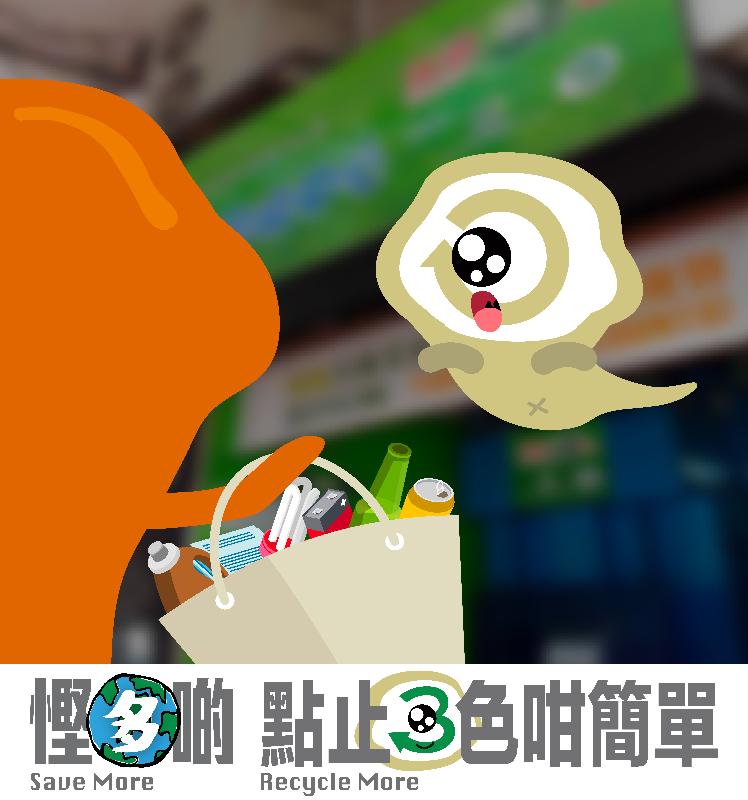
     For the purpose of the Campaign, a new character, Greeny, will be introduced to partner with the Environment Bureau’s ambassador Big Waster to promote the message “Save More, Recycle More”. Complemented by online games and exhibitions, the duo will disseminate knowledge about waste reduction and recycling. Members of the public are welcome to visit the Facebook pages of Big Waster and the ECC for the green stories of Big Waster and his new buddy Greeny, as well as the latest information about waste reduction and recycling.
Photo  
read more

Employers and employees should take precautions against heat stroke

     As the Hong Kong Observatory has issued the Very Hot Weather Warning, the Labour Department (LD) reminds employers and employees to take appropriate precautions to prevent heat stroke when working in a hot or humid environment.
 
     Heat stroke could occur if an employee works in a hot or humid environment for prolonged periods of time, as the body may fail to regulate its temperature by effective heat dissipation through sweating.
 
     The symptoms of heat-related illnesses include feeling thirsty, fatigue, nausea, vomiting, headache, dizziness, muscle spasm or even mental confusion, and loss of consciousness or convulsion in severe cases.
 
     Construction workers, cleaning workers, kitchen workers and porters, for example, are more prone to heat stroke as they may be working for long hours in such an environment, especially if appropriate preventive measures have not been taken.
 
     The LD reminds employers to arrange for a suitable assessment of the risk of heat stress in the work environment and take appropriate preventive measures. The LD has produced two leaflets entitled “Checklist for Heat Stress Assessment at Construction Sites” and “Checklist for Heat Stress Assessment at Outdoor Cleansing Workplaces” respectively. Employers engaged in construction or outdoor cleaning work are advised to refer to these checklists in assessing the risk of heat stress at their workplaces. As for heat stress assessment at a workplace in general, employers can refer to a booklet entitled “Risk Assessment for the Prevention of Heat Stroke at Work” produced by the LD.
 
     The LD also reminds employers and employees to take the following precautions to prevent heat stroke:
 
Employers
———
(1) Take heed of the weather report and adopt shift work arrangements for employees to reduce their exposure to the hot environment, or arrange appropriate rest breaks for them during very hot periods;
(2) Avoid working under direct sunlight and set up temporary sunshade wherever possible;
(3) Provide cool potable water for employees at all times during work. If necessary, provide drinks containing electrolyte for employees to replenish loss of salt during profuse sweating;
(4) Minimise physical demands by using tools or mechanical aids at work;
(5) Increase air flow by enhancing ventilation or air-conditioning as appropriate;
(6) Isolate heat-generating facilities at the workplace and use insulating materials to minimise heat dissipation to the other work areas; and
(7) Provide relevant information and training for employees on heat stroke such as preventive measures and first aid treatment.
 
Employees
———
(1) Wear clothing made of suitable materials (for example, cotton) that is loose-fitting and light-coloured to help heat dissipation, minimise heat absorption and allow sweat evaporation;
(2) Wear a wide-brimmed hat when working outdoors;
(3) Drink plenty of water or other appropriate beverages with electrolytes to replenish the fluids and salt lost through sweating; and
(4) Whenever there are any symptoms of heat-related illnesses, rest in a cool or shady place and drink water, inform supervisors to take appropriate actions immediately.
 
     Some employees may have difficulty in adapting to a hot working environment owing to their own health conditions. Employers should take this into account and consider the recommendations of their doctors when assigning work to these employees.
 
     In addition to the publications on risk assessment, the LD has produced a leaflet entitled “Prevention of Heat Stroke at Work in a Hot Environment” for the public. The publications can be obtained free of charge from the offices of the Occupational Health Service of the LD, or downloaded from the department’s webpage at www.labour.gov.hk/eng/public/content2_9.htm.
 
     The LD organises occupational health talks in public places and at its own training venues regularly to raise employers’ and employees’ awareness of occupational health. Details of health talks on the prevention of heat stroke at work in a hot environment from June to August are as follows:
 
(A)
Dates: June 29, July 7 and 27, August 7, 13 and 28, September 7 and 18
(am);
June 23, July 3, 20 and 29, August 4, 10 and 20, September 3, 14 and 24
(pm)
Time: Half-day
Venue: Occupational Safety and Health Training Centre of the Labour Department, 13/F, KOLOUR·Tsuen Wan I, 68 Chung On Street, Tsuen Wan, New Territories
 
(B)
Dates: July 6 and 24, August 4 and 20
Time: Half-day, morning
Venue: Occupational Safety and Health Centre of the Labour Department, G/F,
Kwun Tong Community Health Centre Building, 60 Hip Wo Street, Kwun Tong
(MTR Kwun Tong Station Exit A1)
 
(C)
Date: June 18, July 20 and August 3
Time: 3pm to 4.30pm
Venue: Lecture Hall, Hong Kong Space Museum, 10 Salisbury Road,
Tsim Sha Tsui, Kowloon (MTR Tsim Sha Tsui Station Exit E)

(Taking into account the latest epidemic development, relevant infection control measures are adopted in different venues of health talks.)

     For enrolment or enquiries about these occupational health talks, please call 2852 4040 or 2361 8240 (for talks organised at the Occupational Safety and Health Centre). Moreover, the LD also provides an outreach health education service and occupational health nurses will, on invitation, disseminate occupational health information at workplaces at a convenient time. Please contact the nursing officer at 2852 4062 for details. All these health talks are free of charge. read more