Effective Exchange Rate Index
The effective exchange rate index for the Hong Kong dollar on Tuesday, June 16, 2020 is 107.7 (down 0.4 against yesterday’s index). read more


The effective exchange rate index for the Hong Kong dollar on Tuesday, June 16, 2020 is 107.7 (down 0.4 against yesterday’s index). read more
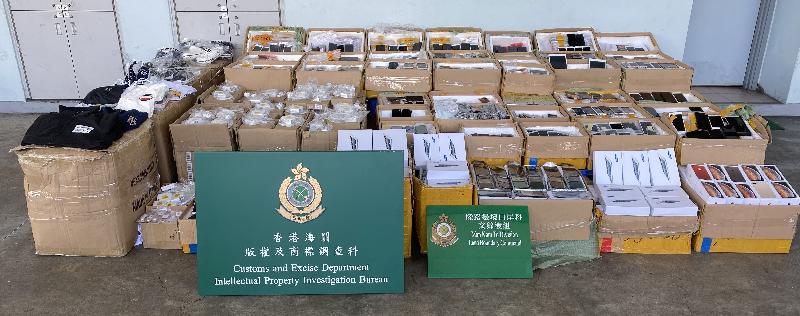
Hong Kong Customs seized about 3 300 items of suspected counterfeit goods with an estimated market value of about $3.2 million at Man Kam To Control Point on June 13.
Through risk assessment, Customs officers intercepted an incoming truck at Man Kam To Control Point on that day. The batch of suspected counterfeit goods, including mobile phones and accessories, clothing and footwear, was found inside the cargo compartment. The 44-year-old male driver was arrested.
Investigation is ongoing and the arrested man has been released on bail pending further investigation.
Under the Trade Descriptions Ordinance, any person who imports or exports any goods to which a forged trademark is applied commits an offence. The maximum penalty upon conviction is a fine of $500,000 and imprisonment for five years.
Members of the public may report any suspected counterfeiting activities to Customs’ 24-hour hotline 2545 6182 or its dedicated crime-reporting email account (crimereport@customs.gov.hk).
The Buildings Department approved 14 building plans in April, with five on Hong Kong Island, five in Kowloon and four in the New Territories.
Of the approved plans, nine were for apartment and apartment/commercial developments, two were for commercial developments, one was for factory and industrial developments, and two were for community services developments.
In the same month, consent was given for works to start on nine building projects which, when completed, will provide 126 856 square metres of gross floor area for domestic use involving 2 165 units, and 55 065 sq m of gross floor area for non-domestic use. The department has received notification of commencement of superstructure works for five building projects.
The department also issued 15 occupation permits, with three on Hong Kong Island, five in Kowloon and seven in the New Territories.
Of the buildings certified for occupation, the gross floor area for domestic use was 164 187 sq m involving 2 526 units, and 41 038 sq m was for non-domestic use.
The declared cost of new buildings completed in April totalled about $3.6 billion.
In addition, six demolition consents involving six building structures were issued.
The department received 2 182 reports about unauthorised building works (UBWs) in April and issued 267 removal orders on UBWs.
The full version of the Monthly Digest for April can be viewed on the Buildings Department’s homepage (www.bd.gov.hk). read more
Police are aware that an organiser has filed a notification to hold a public meeting and a public procession on Hong Kong Island this afternoon (June 16). Upon risk assessment, Police regarded that the public meeting and p… read more
Following is the transcript of remarks by the Chief Executive, Mrs Carrie Lam at a media session before the Executive Council meeting today (June 16):
Reporter: Hello, about the ban on public gatherings, you said that chances are that the ban may be relaxed but not lifted. Could you explain in English why, taking into account that the COVID-19 situation has stabilised? And second question about the central official saying the government in Mainland will have the jurisdiction in most serious national security cases, you said that you can’t comment on the specifics now but how can you reassure Hong Kong people that our independent judiciary power will not be undermined, and that including the final adjudication? And lastly about the proposed “referendum”, your administration has criticised this “referendum” to see if there will be a strike over the national security laws, but some organisers said the right to strike is actually ensured by the Basic Law and they questioned if your government has violated provisions related to protection against anti-union discrimination. How do you make of their criticism? Thank you.
Chief Executive: First of all, the question about Cap.599G on prohibiting group gatherings. It applies to all sorts of group gatherings of a certain number of persons. It is not targeting a particular type of group gatherings. At the moment, we are prohibiting gatherings of more than eight persons, with some exceptions, for example provided under other regulations for religious gatherings and things like that. We really need to take into account the several factors that I have been explaining on this occasion in the last four months. This sort of social distancing measure is very significant and very relevant in any anti-epidemic work but we have to strike a balance between at least three main factors. One is the public health concerns. Secondly is the economy, the impact on the economy. Thirdly is the acceptance – or I would now call the tolerance – of the people because if you continue to keep these measures in place people become intolerant, so they will not comply with these regulations. At every stage of looking into this subject of group gathering we are trying to find a balance amongst the three factors.
As far as the current situation is concerned, I would say that the public health, or the epidemic situation is rather stable but that doesn’t mean that we need not be vigilant. You have seen other cities that have gone for some re-opening, relaxation and then they see a re-emergence of COVID-19 cases. The direction at this point in time, taking into account the impact on the economy and the people’s acceptance, I would say is relaxation, but relaxing how far is not an exact science. It is something that we need to deliberate. I can say that we have fully deliberated and we are now seeking endorsement from the Executive Council because that particular regulation has to be authorised by the Chief Executive in Council.
About comments made by the Deputy Director of the Hong Kong and Macao Affairs Office yesterday on an occasion to celebrate the 30th anniversary of the promulgation of the Basic Law, without the details about the provisions in the legislation and how they are going to be applied, it is not possible for me, and not appropriate, because I am not party to the law-making institution, to comment on the individual comments made by my Mainland counterparts, except to reiterate the very important principles guiding this law-making process. They are laid down in the explanatory statement to the draft Decision discussed by the National People’s Congress leading to the approval on May 28. Included in the five main principles are the principles to ensure that there is full compliance with this very important principle of “One Country, Two Systems”, that everything has to be done in accordance with the law and the legitimate rights and freedoms of the Hong Kong people are being safeguarded and protected. And I noticed that subsequent to that explanatory statement, the Hong Kong and Macao Affairs Office issued on May 29 another statement elaborating on this important principles and on top of that reiterated that this new piece of legislation will not change Hong Kong’s high degree autonomy and will not affect judicial independence, including that of final adjudication.
As far as this proposed “referendum”, there is no such thing as a “referendum” in Hong Kong or in our political process. Your question is about whether strikes are legitimate and protected under the constitutional provisions of Basic Law. I think one has to look at the purpose of the strike. If the purpose of a strike has nothing to do whatsoever with the workplace, with being members of a union in voicing their concerns against the employers and so on, then it will not be covered by that sort of constitutional protection. Thank you.
(Please also refer to the Chinese portion of the transcript.) read more