image_pdfimage_print

Author Archives: hksar gov

HAD to open temporary night heat shelters

     The Home Affairs Department will open 19 temporary night heat shelters tonight (June 24) for people in need of the service.
      
     The shelters will be open from 10.30pm until 8am tomorrow.
      
     For further information, please call the department’s hotline before midnight on 2572 8427.
      
     The 19 night heat shelters are located at:
 
Hong Kong Districts:
———————
 
Central and Western –
Sai Ying Pun Community Complex Community Hall
3/F, Sai Ying Pun Community Complex
2 High Street, Sai Ying Pun
 
Eastern –
Causeway Bay Community Centre
3/F, 7 Fook Yum Road, Causeway Bay
 
Southern –
Lei Tung Community Hall
Lei Tung Estate, Ap Lei Chau
 
Wan Chai –
Wan Chai Activities Centre
LG/F, Wan Chai Market, 258 Queen’s Road East, Wan Chai
 
Kowloon Districts:
——————
 
Kowloon City –
Hung Hom Community Hall
1/F, Kowloon City Government Offices
42 Bailey Street, Hung Hom
 
Kwun Tong –
Lam Tin (West) Estate Community Centre
71 Kai Tin Road, Lam Tin
 
Sham Shui Po –
Shek Kip Mei Community Hall
G/F, Block 42, Shek Kip Mei Estate, Sham Shui Po
 
Wong Tai Sin –
Tsz Wan Shan (South) Estate Community Centre
45 Wan Wah Street, Tsz Wan Shan
 
Yau Tsim Mong –
Henry G Leong Yaumatei Community Centre
60 Public Square Street, Yau Ma Tei
 
New Territories Districts:
————————–
 
Islands –
Tung Chung Community Hall
G/F, Tung Chung Municipal Services Building
39 Man Tung Road, Tung Chung
 
Kwai Tsing –
Kwai Shing Community Hall
Podium, Block 6, Kwai Shing West Estate, Kwai Chung
 
North –
North District Community Centre
4/F, 2 Lung Wan Street, Sheung Shui
 
Sai Kung –
Hang Hau Community Hall
G/F, Sai Kung Tseung Kwan O Government Complex
38 Pui Shing Road, Hang Hau, Tseung Kwan O
 
Sha Tin –
Lung Hang Estate Community Centre
Lung Hang Estate, Sha Tin
 
Tai Po –
Tai Po Community Centre
2 Heung Sze Wui Street, Tai Po
 
Tsuen Wan –
Lei Muk Shue Community Hall
G/F, Hong Shue House, Lei Muk Shue Estate, Tsuen Wan
 
Tuen Mun –
Butterfly Bay Community Centre
Butterfly Estate (near Tip Sum House), Tuen Mun
 
Yuen Long –
Long Ping Community Hall
Long Ping Estate, Yuen Long
 
Yuen Long –
Tin Yiu Community Centre
Tin Yiu Estate, Tin Shui Wai read more

Sixteen persons arrested during anti-illegal worker operations (with photo)

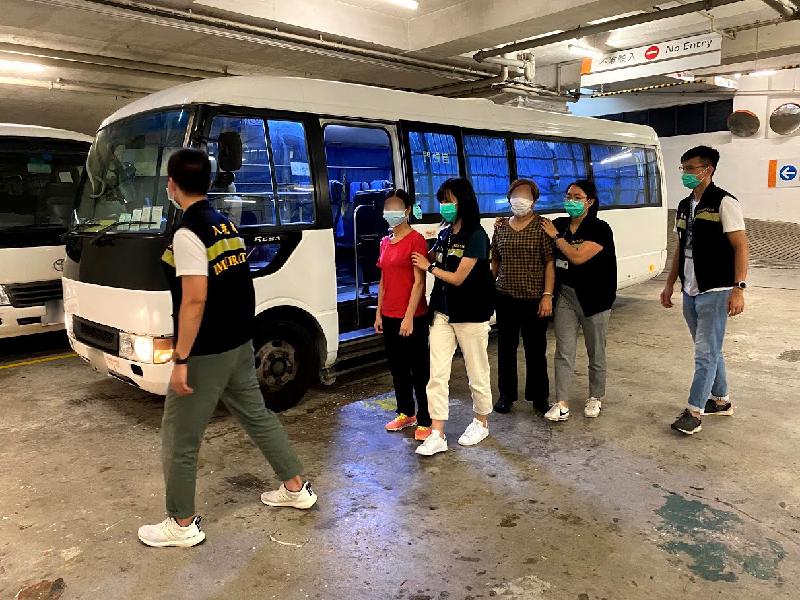
     The Immigration Department (ImmD) mounted territory-wide anti-illegal worker operations codenamed “Twilight” on June 22 and 23. A total of 10 suspected illegal workers and six suspected employers were arrested.
 
     During the operations, ImmD Task Force officers raided 32 target locations including container sites, factories, recycling sites and restaurants. The suspected illegal workers comprised five men and five women, aged 33 to 54. Among them, one man was a holder of a recognisance form, which prohibits him from taking any employment. In addition, one man and three women were suspected of using and being in possession of forged Hong Kong identity cards. Meanwhile, four men and two women, aged 26 to 58, were suspected of employing the suspected illegal workers.
 
     “Any person who contravenes a condition of stay in force in respect of him shall be guilty of an offence. Also, visitors are not allowed to take employment in Hong Kong, whether paid or unpaid, without the permission of the Director of Immigration. Offenders are liable to prosecution and upon conviction face a maximum fine of $50,000 and up to two years’ imprisonment. Aiders and abettors are also liable to prosecution and penalties,” an ImmD spokesman said.
 
     The spokesman warned that, as stipulated in section 38AA of the Immigration Ordinance, illegal immigrants or people who are the subject of a removal order or a deportation order are prohibited from taking any employment, whether paid or unpaid, or establishing or joining in any business. Offenders are liable upon conviction to a maximum fine of $50,000 and up to three years’ imprisonment. The Court of Appeal has issued a guideline ruling that a sentence of 15 months’ imprisonment should be applied in such cases. It is an offence to use or possess a forged Hong Kong identity card or a Hong Kong identity card related to another person. Offenders are liable to prosecution and a maximum penalty of a $100,000 fine and up to 10 years’ imprisonment.
 
     The spokesman reiterated that it is a serious offence to employ people who are not lawfully employable. The maximum penalty is imprisonment for three years and a fine of $350,000. The High Court has laid down sentencing guidelines that the employer of an illegal worker should be given an immediate custodial sentence. According to the court sentencing, employers must take all practicable steps to determine whether a person is lawfully employable prior to employment. Apart from inspecting a prospective employee’s identity card, the employer has the explicit duty to make enquiries regarding the person and ensure that the answers would not cast any reasonable doubt concerning the lawful employability of the person. The court will not accept failure to do so as a defence in proceedings. It is also an offence if an employer fails to inspect the job seeker’s valid travel document if the job seeker does not have a Hong Kong permanent identity card. The maximum penalty for failing to inspect such a document is imprisonment for one year and a fine of $150,000.
 
     Under the existing mechanism, the ImmD will, as a standard procedure, conduct initial screening of vulnerable persons, including illegal workers, illegal immigrants, sex workers and foreign domestic helpers, who are arrested during any operation with a view to ascertaining whether they are trafficking in persons (TIP) victims. When any TIP indicator is revealed in the initial screening, the officers will conduct a full debriefing and identification by using a standardised checklist to ascertain the presence of TIP elements, such as threats and coercion in the recruitment phase and the nature of exploitation. Identified TIP victims will be provided with various forms of support and assistance, including urgent intervention, medical services, counselling, shelter, temporary accommodation and other supporting services. The ImmD calls on TIP victims to report crimes to the relevant departments.

Photo  
read more

LCQ6: Civil servants of the HKSAR Government

     Following is a question by the Hon Wu Chi-wai and a reply by the Secretary for the Civil Service, Mr Patrick Nip, in the Legislative Council today (June 24):

Question:

     It has been reported that the Secretary for the Civil Service has recently stated that under the “one country, two systems”, civil servants employed by the Hong Kong Special Administrative Region (HKSAR) Government are civil servants of the State at the same time. Nevertheless, both the Basic Law and the Civil Service Code of HKSAR do not contain similar statements. In this connection, will the Government inform this Council:

(1) of the legal basis for the aforesaid statement; whether there are official documents which corroborate such a statement;

(2) as the relevant articles in the Law of the People’s Republic of China on Civil Servants (the PRC Law on Civil Servants) provide that the civil servant system shall be under the leadership of the Communist Party of China and the guidance of the Thoughts and Theories of certain incumbent and former topmost leaders, and that civil servants shall support the socialist system, whether civil servants of HKSAR are required to comply with these articles; if so, whether civil servants of HKSAR will be subject to disciplinary actions for not complying with these articles; and

(3) whether it has plans to incorporate into the Civil Service Code of HKSAR the various requirements for civil servants of the State as provided in the PRC Law on Civil Servants; if so, of the details?

Reply:

President,

     Article 1 of the Basic Law stipulates that “[t]he Hong Kong Special Administrative Region is an inalienable part of the People’s Republic of China”. Article 12 of the Basic Law provides that “[t]he Hong Kong Special Administrative Region shall be a local administrative region of the People’s Republic of China, which shall enjoy a high degree of autonomy and come directly under the Central People’s Government”.
      
     President Xi Jinping, in his address delivered at the Inaugural Ceremony of the Fifth Term Government of the Hong Kong Special Administrative Region on July 1, 2017, mentioned that “[a]s a special administrative region directly under the Central Government, Hong Kong has been re-integrated into China’s national governance system since the very day of its return. The Central Government exercises jurisdiction over Hong Kong in accordance with China’s Constitution and the Basic Law of the Hong Kong Special Administrative Region, and the corresponding systems and institutions have been set up for the special administrative region”. Article 2 of the Basic Law stipulates that “[t]he National People’s Congress authorizes the Hong Kong Special Administrative Region to exercise a high degree of autonomy and enjoy executive, legislative and independent judicial power, including that of final adjudication, in accordance with the provisions of this Law”. Article 5 of the Basic Law also stipulates that the socialist system and policies shall not be practised in the Hong Kong Special Administrative Region. Therefore, under the principle of “One Country, Two Systems”, the Hong Kong Special Administrative Region (HKSAR) is part of China, while practising systems (including the civil service system) different from those of the Mainland.
      
     Under Article 45 of the Basic Law, the Chief Executive shall be appointed by the Central People’s Government, and Article 43 of the Basic Law provides that the Chief Executive shall be accountable to the Central People’s Government and the HKSAR in accordance with the provisions of the Basic Law. Under Article 60 of the Basic Law, the head of the Government of the HKSAR shall be the Chief Executive; and under Article 99 of the Basic Law, civil servants of the HKSAR Government must be responsible to the Government of the HKSAR. The above Articles clearly demonstrate the link of civil servants of the HKSAR Government, through the HKSAR Government and its head (i.e. the Chief Executive), to the Central People’s Government, under the constitutional order. Therefore, civil servants of the Government of the HKSAR are not only civil servants of the Government of the HKSAR, but also civil servants of the Government of the Hong Kong Special Administrative Region of the People’s Republic of China.
      
     The full name of the “Hong Kong Special Administrative Region” is the “Hong Kong Special Administrative Region of the People’s Republic of China”, and “civil servants of the Government of the Hong Kong Special Administrative Region” means the same as “civil servants of the Government of the Hong Kong Special Administrative Region of the People’s Republic of China”.
      
     According to the Civil Service Code, civil servants shall serve the Chief Executive and the Government of the day with total loyalty and to the best of their ability. Also, civil servants, being a key component of the public service, have a constitutional role to give their best in serving the Chief Executive and the Government of the day. Under “One Country, Two Systems”, when considering and handling policy matters and issues, civil servants of the HKSAR Government should not confine themselves only to the perspective from the HKSAR. They should deliver their work in accordance with the Basic Law, and the laws and systems of Hong Kong, while at the same time they should also take into consideration the perspective that Hong Kong is part of the country, so as to enable the discharge of their duties in a comprehensive and thorough manner.
      
     As mentioned above, under the principle of “One Country, Two Systems”, the HKSAR practises systems different from those of the Mainland, including the civil service system. Article 103 of the Basic Law stipulates that “[t]he appointment and promotion of public servants shall be on the basis of their qualifications, experience and ability. Hong Kong’s previous system of recruitment, employment, assessment, discipline, training and management for the public service, including special bodies for their appointment, pay and conditions of service, shall be maintained, except for any provisions for privileged treatment of foreign nationals”. The Law of the People’s Republic of China on Civil Servants (PRC Law on Civil Servants) does not apply to the civil servants of the HKSAR Government. In fact, Annex III of the Basic Law, which lists out the national laws to be applied in the HKSAR, does not include the PRC Law on Civil Servants. As such, there is no need to incorporate into the Civil Service Code of the HKSAR Government the requirements for Mainland civil servants as provided in the PRC Law.
 
     Thank you, President. read more

Operator and manager fined for illegal club operation

     A man and a company were each fined $2,500 at the Kowloon City Magistrates’ Courts today (June 24) for contravening the Clubs (Safety of Premises) Ordinance.

     The courts heard that in June last year, officers from the Office of the Licensing Authority (OLA) of the Home Affairs Department conducted an inspection at a club on Hillwood Road in Tsim Sha Tsui, which had been operating with a certificate of compliance (CoC).

     During the investigation, the OLA officers found that the number of people at the club exceeded the maximum allowable capacity as stipulated in the CoC. Condition 6 of the CoC was breached.

     The man and the company, being the manager and the CoC holder of the club, were charged with contravening section 21(1)(a) and section 21(2) of the Ordinance respectively.

     A spokesman for the department reminded all CoC holders to comply with the conditions as stipulated therein. Enforcement action will continue to be taken against illegal club operation.
       read more