image_pdfimage_print

Author Archives: hksar gov

Establishment of Committee for Safeguarding National Security of HKSAR (with photos)

     A Government spokesman announced today (July 3) that the Hong Kong Special Administrative Region (HKSAR) has established the Committee for Safeguarding National Security of the HKSAR in accordance with Article 12 of The Law of the People’s Republic of China on Safeguarding National Security in the Hong Kong Special Administrative Region (the National Security Law). The Chief Executive, Mrs Carrie Lam, in accordance with Article 16(2) of the National Security Law, has also appointed Ms Edwina Lau as Deputy Commissioner of Police (National Security), to head the department for safeguarding national security of the Hong Kong Police Force. Ms Lau took the oath of office today.
 
     The Committee for Safeguarding National Security of the HKSAR is chaired by the Chief Executive. The members comprise the Chief Secretary for Administration, Mr Matthew Cheung Kin-chung; the Financial Secretary, Mr Paul Chan; the Secretary for Justice, Ms Teresa Cheng, SC; the Secretary for Security, Mr John Lee; the Commissioner of Police, Mr Tang Ping-keung; the Deputy Commissioner of Police (National Security), Ms Edwina Lau; the Director of Immigration, Mr Au Ka-wang; the Commissioner of Customs and Excise, Mr Hermes Tang; and the Director of the Chief Executive’s Office, Mr Chan Kwok-ki. Mr Chan is also the Secretary General of the Committee. 
 
     As stipulated in Article 15 of the National Security Law, the Committee shall have a National Security Adviser. The Central People’s Government has appointed Mr Luo Huining to take up the post, and he will sit in on meetings of the Committee. The duties of the Committee shall be (1) analysing and assessing developments in relation to safeguarding national security in the HKSAR, making work plans and formulating policies for safeguarding national security in the HKSAR; (2) advancing the development of the legal system and enforcement mechanisms of the HKSAR for safeguarding national security; and (3) co-ordinating major work and significant operations for safeguarding national security in the HKSAR.
 
     On the appointment of Ms Lau, Mrs Lam said, “Ms Lau has served in the Hong Kong Police Force for 35 years and has demonstrated distinguished leadership, professionalism and perseverance. I have no doubt that she can discharge the historic responsibility of leading the National Security Department of the Hong Kong Police Force to fulfil the crucial duty to safeguard national security at this critical moment.”
 
     The spokesman also announced that a specialised prosecution division responsible for the prosecution of national security offences under the Department of Justice has been established as required by Article 18 of the National Security Law. The first batch of prosecutors of that division has been appointed by the Secretary for Justice after obtaining the consent of the Committee. The head of the division will be appointed later.
 
     As required by Article 44(1) of the National Security Law, the Chief Executive, after consulting the Committee and the Chief Justice of the Court of Final Appeal, has also designated six serving magistrates from the Judiciary as designated judges to handle cases concerning offences endangering national security.
 
     “The Committee will shortly convene the first meeting to fully advance the work on safeguarding national security,” the spokesman added.
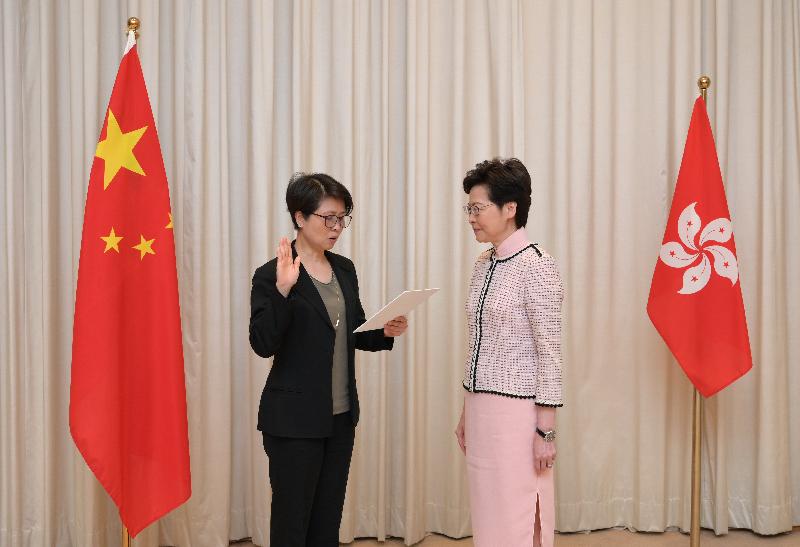
Photo  Photo  
read more

Government releases Persons with Disabilities and Rehabilitation Programme Plan

     The Labour and Welfare Bureau (LWB) released today (July 3) the Persons with Disabilities and Rehabilitation Programme Plan (RPP) formulated by the Rehabilitation Advisory Committee (RAC). The Government accepted in principle the strategic directions and recommendations in the RPP, and will follow up on their implementation.
 
     The RPP sets out the vision to recognise the diversified developmental needs of persons with disabilities; respect the autonomy and independence of persons with disabilities; and establish a disability inclusive society that enables persons with disabilities to develop their capabilities, unleash their potential and contribute to society. Guided by this vision, the RPP outlines four strategic directions, underpinned by 20 themes and 62 strategic recommendations, which are summarised as follows:
 

Strategic Direction I Provide timely and appropriate support to equip persons with disabilities with the ability to cope with changes at different stages during their lifespan.
(24 strategic recommendations under seven themes)
Strategic Direction II Enhance community care services to enable persons with disabilities and their families living in the community to obtain necessary support, and be admitted to residential care homes as soon as possible when in need.
(13 strategic recommendations under five themes)
Strategic Direction III Promote disability inclusive culture, facilitate accessible environment, transportation and access to information so that persons with disabilities can fully participate in social life.
(19 strategic recommendations under six themes)
Strategic Direction IV Ensure sustainable development of diversified services for persons with disabilities in response to the changing needs.
(six strategic recommendations under two themes)
 
     “The RPP is a ‘living document’ covering the various service needs of persons with disabilities at different stages of their lives. The Government will, taking account of the readiness of individual strategic recommendations, continue to adopt the approach of ‘implementation as and when ready’ in implementing the recommendations in the short and medium-to-long terms. The RAC will continue to assist the Government in reviewing the implementation progress of the RPP strategic recommendations in accordance with the four strategic directions and making adjustments as appropriate,” a spokesman for the LWB said.
 
     The RPP was last updated in 2007. The Chief Executive announced in the 2017 Policy Address that the Government has tasked the RAC to formulate a new RPP. The RAC has adopted three guiding principles in formulating the new RPP: abiding by the purpose of the United Nations Convention on the Rights of Persons with Disabilities; adopting a life span approach in examining the needs of persons with disabilities in different aspects and stages of their lives; and facilitating cross-sectoral and inter-departmental collaboration to establish a disability inclusive society for persons with disabilities.
 
     The formulation of the new RPP comprised three stages, namely Scoping, Formulation of Recommendations and Consensus Building, with public engagement conducted under each stage to listen to and incorporate views of the public and stakeholders as appropriate. The three stages of public engagement were carried out from March 2018 to January 2020. The RAC formally submitted the new RPP to the Government in June 2020.

     The Chinese version of the RPP final report and the reports under each stage have been uploaded to the website of the LWB (www.lwb.gov.hk). An easy-to-read version on the RPP strategic directions and themes will also be uploaded later. read more

Operator and managers of unlicensed guesthouses fined

     A man and two women were fined from $3,000 to $5,000 at the Kowloon City Magistrates’ Courts and the Tuen Mun Magistrates’ Courts today (July 3) for contravening the Hotel and Guesthouse Accommodation Ordinance.

     The courts heard that in November and December last year, officers of the Office of the Licensing Authority (OLA) from the Home Affairs Department, when searching the Internet for intelligence about unlicensed guesthouse activities, identified two suspected unlicensed guesthouses on Castle Peak Road in Tuen Mun and Hankow Road in Tsim Sha Tsui. The OLA officers posed as lodgers and successfully rented rooms in the guesthouses on a daily basis through an Internet platform.

     According to the OLA’s records, the guesthouses did not possess licences under the Ordinance on the days of lodging. The man and women responsible for operating and managing the premises were charged with contravening section 5(1) of the Ordinance.

     A department spokesman stressed that operating or managing an unlicensed guesthouse is a criminal offence and can lead to a criminal record. Upon conviction, the offender is liable to a maximum fine of $200,000 and two years’ imprisonment. Guesthouse licensees may advertise or offer to provide sleeping accommodation on the Internet. To assist the public and the tourists to identify licensed guesthouses, the licensees should indicate clearly “Licensed guesthouse” in all promotional advertisement materials or advertisements related to the guesthouse.

     The spokesman appealed to anyone with information about suspected unlicensed guesthouses to report it to the OLA by the hotline (Tel: 2881 7498), by email (hadlaenq@had.gov.hk), by fax (2504 5805) using the report form downloaded from the OLA website (www.hadla.gov.hk), or through the mobile application “Hong Kong Licensed Hotels and Guesthouses”. read more

Twenty-three persons arrested during anti-illegal worker operations

     The Immigration Department (ImmD) mounted territory-wide anti-illegal worker operations codenamed “Twilight” on June 29 and yesterday (July 2). A total of 15 suspected illegal workers and eight suspected employers were arrested.

     During the operations, ImmD Task Force officers raided 33 target locations including manicure shops, a massage parlour, a residential building, restaurants and a warehouse. The suspected illegal workers comprised four men and 11 women, aged 29 to 56. Among them, two men and one woman were holders of recognisance forms, which prohibit them from taking any employment. In addition, one man and three women were suspected of using and being in possession of forged Hong Kong identity cards. Meanwhile, five men and three women, aged 28 to 52, were suspected of employing the suspected illegal workers.

     “Any person who contravenes a condition of stay in force in respect of him shall be guilty of an offence. Also, visitors are not allowed to take employment in Hong Kong, whether paid or unpaid, without the permission of the Director of Immigration. Offenders are liable to prosecution and upon conviction face a maximum fine of $50,000 and up to two years’ imprisonment. Aiders and abettors are also liable to prosecution and penalties,” an ImmD spokesman said.

     The spokesman warned that, as stipulated in section 38AA of the Immigration Ordinance, illegal immigrants or people who are the subject of a removal order or a deportation order are prohibited from taking any employment, whether paid or unpaid, or establishing or joining in any business. Offenders are liable upon conviction to a maximum fine of $50,000 and up to three years’ imprisonment. The Court of Appeal has issued a guideline ruling that a sentence of 15 months’ imprisonment should be applied in such cases. It is an offence to use or possess a forged Hong Kong identity card or a Hong Kong identity card related to another person. Offenders are liable to prosecution and a maximum penalty of a $100,000 fine and up to 10 years’ imprisonment.

     The spokesman reiterated that it is a serious offence to employ people who are not lawfully employable. The maximum penalty is imprisonment for three years and a fine of $350,000. The High Court has laid down sentencing guidelines that the employer of an illegal worker should be given an immediate custodial sentence. According to the court sentencing, employers must take all practicable steps to determine whether a person is lawfully employable prior to employment. Apart from inspecting a prospective employee’s identity card, the employer has the explicit duty to make enquiries regarding the person and ensure that the answers would not cast any reasonable doubt concerning the lawful employability of the person. The court will not accept failure to do so as a defence in proceedings. It is also an offence if an employer fails to inspect the job seeker’s valid travel document if the job seeker does not have a Hong Kong permanent identity card. The maximum penalty for failing to inspect such a document is imprisonment for one year and a fine of $150,000.

     Under the existing mechanism, the ImmD will, as a standard procedure, conduct initial screenings of vulnerable persons, including illegal workers, illegal immigrants, sex workers and foreign domestic helpers, who are arrested during any operation with a view to ascertaining whether they are trafficking in persons (TIP) victims. When any TIP indicator is revealed in the initial screening, the officers will conduct a full debriefing and identification by using a standardised checklist to ascertain the presence of TIP elements, such as threats and coercion in the recruitment phase and the nature of exploitation. Identified TIP victims will be provided with various forms of support and assistance, including urgent intervention, medical services, counselling, shelter, temporary accommodation and other supporting services. The ImmD calls on TIP victims to report crimes to the relevant departments. read more

CE welcomes State Council’s appointments

     The Chief Executive, Mrs Carrie Lam, welcomed the State Council’s decision today (July 3) to appoint Mr Luo Huining as the National Security Adviser to the Committee for Safeguarding National Security of the Hong Kong Special Administrative Region (HKSAR) in accordance with the relevant provisions of The Law of the People’s Republic of China on Safeguarding National Security in the Hong Kong Special Administrative Region (National Security Law).
 
     Mrs Lam also welcomed the appointments made by the State Council on the personnel of the office established by the Central People’s Government (CPG) in the HKSAR for safeguarding national security, including the appointment of Zheng Yanxiong as head of the Office for Safeguarding National Security of the Central People’s Government in the Hong Kong Special Administrative Region, and the appointment of Li Jiangzhou and Sun Qingye as deputy heads of the Office.
 
     “I welcome the appointments made by the State Council. The HKSAR Government, the National Security Advisor to the Committee for Safeguarding National Security of the HKSAR and the Office for Safeguarding National Security of the CPG in the HKSAR will work closely, perform their respective functions and do their utmost in implementing the National Security Law, fulfilling the duty of the HKSAR in safeguarding national security.
 
     In accordance with the National Security Law, the Committee for Safeguarding National Security of the HKSAR is chaired by the Chief Executive. The Committee shall be responsible for affairs relating to and assume primary responsibility for safeguarding national security in the HKSAR. It shall be under the supervision of and accountable to the CPG. The Committee shall have a National Security Adviser, who shall be designated by the CPG and provide advice on matters relating to the duties and functions of the Committee. The National Security Adviser shall sit in on meetings of the Committee.
 
     As regards the Office for Safeguarding National Security of the CPG in the HKSAR, it shall peform the following: analysing and assessing developments in relation to safeguarding national security in the HKSAR, and providing opinions and making proposals on major strategies and important policies for safeguarding national security; overseeing, guiding, co-ordinating with, and providing support to the HKSAR in the performance of its duties for safeguarding national security; collecting and analysing intelligence and information concerning national security; and handling cases concerning offences endangering national security in specified circumstances in accordance with the National Security Law. read more