image_pdfimage_print

Author Archives: hksar gov

HKSAR Government firmly rejects remarks by US Consul General

     In response to media enquiries, a spokesman of the Hong Kong Special Administrative Region (HKSAR) Government today (July 6) firmly rejected recent public remarks made by the Consul General of the United States of America (US) to Hong Kong and Macau on the Law of the People’s Republic of China on Safeguarding National Security in the Hong Kong Special Administrative Region (the National Security Law) enacted by the Standing Committee of the National People’s Congress (NPCSC).

     The Chief Secretary for Administration, Mr Matthew Cheung Kin-chung, joined by the Secretary for Security, Mr John Lee, met with the US Consul General to Hong Kong and Macau, Mr Hanscom Smith, today to register the HKSAR Government’s grave concern over the matter.

     The spokesman said, “National security is a matter within the purview of the Central Authorities. In a unitary or federal state, legislation on national security is invariably carried out by the central authorities rather than local governments.

     “As the highest organ of state power in China, the National People’s Congress has the constitutional power and the duty to enact national security legislation for the HKSAR. The national law enacted has taken into account Hong Kong’s actual situation.”

     The spokesman pointed out that according to Article 1 of the Basic Law, the HKSAR is an inalienable part of the People’s Republic of China (PRC). Article 12 of the Basic Law stipulates that the HKSAR shall be a local administrative region of the PRC, which shall enjoy a high degree of autonomy and come directly under the Central People’s Government.

     The spokesman stressed, “The implementation of the ‘One Country, Two Systems’ principle in the HKSAR is entirely an internal matter of the PRC. No other state or legislature has the right to intervene, directly or indirectly, in such internal affairs.

     “The National Security Law seeks to prevent, suppress and impose punishment for four types of acts and activities that seriously endanger national security. It targets an extremely small minority of people without adversely affecting the basic rights and freedoms legitimately enjoyed by Hong Kong people. It is an important step towards improving the ‘One Country, Two Systems’ institutional system and represents an essential and timely decision for restoring stability in Hong Kong. The law will not affect the high degree of autonomy, judicial independence and the rule of law in Hong Kong.

     “Social unrest, the failure of the rule of law and a lack of protection for corporate assets and personal safety are genuine factors that would undermine investors’ confidence.

     “As a matter of fact, these were the factors that led to the fall of Hong Kong’s international rankings in the past year. The US has its own national security legislation, but we have never heard that such legislation affected the economic development and business environment of the US.

     “The National Security Law can promptly reverse the chaotic situation of the past year and restore stability in Hong Kong, thereby improving Hong Kong’s business and investment environment. We strongly believe that only with national security safeguarded can Hong Kong enjoy long-term stability and security.

     “The legislation will be conducive to Hong Kong continuously improving its strengths, attracting overseas talents and strengthening its status as an international financial centre as well as a shipping and trading hub, in addition to giving impetus to promoting the development of innovation and technology. Our much-valued institutional strengths and core competitiveness will also remain intact. They include the rule of law and judicial independence, open and flexible markets, a simple and low tax regime, an efficient public sector and a favourable business environment with a level playing field.      read more
CHP investigates 17 additional confirmed cases of COVID-19

     The Centre for Health Protection (CHP) of the Department of Health has announced that as of 4pm today (July 6), the CHP was investigating 17 additional confirmed cases of coronavirus disease 2019 (COVID-19), taking the number of cases to 1,286 in Hong Kong so far (comprising 1,285 confirmed cases and one probable case).
      
     The newly reported cases announced today involve 12 males and five females aged between 3 and 78. Except for the 1283rd case, all had travel history during the incubation period.
      
    The 1283rd case involves a 30-year-old male who works at the same restaurant at Ping Shek Estate as the 1269th case. The patient, with good past health, lives in Fook Cheung Building, 32-48 Ka Shin Street, Tai Kok Tsui. He developed sore throat on July 4 and sought medical attention at Kwong Wah Hospital yesterday (July 5). His respiratory specimen tested positive for severe acute respiratory syndrome coronavirus 2 (SARS-CoV-2). He is now admitted to Queen Elizabeth Hospital for treatment.
 
     The patient had no travel history. He met the 59-year-old male patient of the 1269th case on July 3. According to the CHP’s initial epidemiological investigation, it is believed that the two cases are epidemiologically linked. 
 
     As a precautionary measure for early detection of possible transmission in the community, the CHP starting today will distribute deep throat saliva specimen bottles to residents of the residence of the 1283rd case and to people who had visited the work premises of the patients. The CHP appeals to the related persons to return their samples to the CHP as soon as possible for early testing and to seek medical attention early if symptoms develop.
      
     The CHP’s epidemiological investigations and relevant contact tracing on the confirmed cases are ongoing. For case details and contact tracing information, please see the Annex.
              
     The CHP again urged members of the public to maintain an appropriate social distance with other people as far as possible in their daily lives to minimise the risk of infection. In particular, they should go out less and avoid social activities such as meal gatherings or other gatherings to reduce the chance of contacting infected persons who may not present any symptoms, and minimise the risk of outbreak clusters emerging in the community.
               
     A spokesman for the CHP said, “Given that the situation of COVID-19 infection remains severe and that there is a continuous increase in the number of cases reported around the world, members of the public are strongly urged to avoid all non-essential travel outside Hong Kong.
      
     “The CHP also strongly urges the public to maintain at all times strict personal and environmental hygiene, which is key to personal protection against infection and prevention of the spread of the disease in the community. On a personal level, members of the public should wear a surgical mask when having respiratory symptoms, taking public transport or staying in crowded places. They should also perform hand hygiene frequently, especially before touching the mouth, nose or eyes.
          
     “As for household environmental hygiene, members of the public are advised to maintain drainage pipes properly, regularly pour water into drain outlets (U-traps) and cover all floor drain outlets when they are not in use. After using the toilet, they should put the toilet lid down before flushing to avoid spreading germs.”
      
     Moreover, the Government has launched the website “COVID-19 Thematic Website” (www.coronavirus.gov.hk) for announcing the latest updates on various news on COVID-19 infection and health advice to help the public understand the latest updates. Members of the public may also gain access to information via the COVID-19 WhatsApp Helpline launched by the Office of the Government Chief Information Officer. Simply by saving 9617 1823 in their phone contacts or clicking the link wa.me/85296171823?text=hi, they will be able to obtain information on COVID-19 as well as the “StayHomeSafe” mobile app and wristband via WhatsApp.
      
     To prevent pneumonia and respiratory tract infection, members of the public should always maintain good personal and environmental hygiene. They are advised to:
      
• Wear a surgical mask when taking public transport or staying in crowded places. It is important to wear a mask properly, including performing hand hygiene before wearing and after removing a mask;
• Perform hand hygiene frequently, especially before touching the mouth, nose or eyes, after touching public installations such as handrails or doorknobs, or when hands are contaminated by respiratory secretions after coughing or sneezing;
• Maintain drainage pipes properly and regularly (about once a week) pour about half a litre of water into each drain outlet (U-trap) to ensure environmental hygiene;
• Cover all floor drain outlets when they are not in use;
• After using the toilet, put the toilet lid down before flushing to avoid spreading germs;
• Wash hands with liquid soap and water, and rub for at least 20 seconds. Then rinse with water and dry with a disposable paper towel. If hand washing facilities are not available, or when hands are not visibly soiled, performing hand hygiene with 70 to 80 per cent alcohol-based handrub is an effective alternative;
• Cover your mouth and nose with tissue paper when sneezing or coughing. Dispose of soiled tissues into a lidded rubbish bin, then wash hands thoroughly; and
• When having respiratory symptoms, wear a surgical mask, refrain from work or attending class at school, avoid going to crowded places and seek medical advice promptly. read more

Two persons sentenced for breaching compulsory quarantine order

     Two men were sentenced to immediate imprisonment for four weeks respectively by the Kwun Tong Magistrates’ Courts today (July 6) for violating the Compulsory Quarantine of Certain Persons Arriving at Hong Kong Regulation (Cap. 599C).

     The first case involves a man aged 34, who was earlier issued a compulsory quarantine order stating that he must conduct quarantine at home for 14 days. He was intercepted by a police officer at MTR North Point Station on April 7 and was found to have left the place of quarantine without reasonable excuse nor permission given by an authorised officer before the expiry of the quarantine order. The second case involves a 24-year-old man, who was earlier issued a compulsory quarantine order stating that he must conduct quarantine at home for 14 days. When the Police were deployed to handle a traffic accident on April 26, the man, who was involved in the traffic accident, was found to have left the place of quarantine without reasonable excuse nor permission given by an authorised officer before the expiry of the quarantine order. They were charged with contravening sections 8(1) and 8(5) of the Regulation and were sentenced by the Kwun Tong Magistrates’ Courts today to immediate imprisonment for four weeks respectively. 
 
     Pursuant to the Regulation, save for exempted persons, all persons who have stayed in the Mainland, Macao or Taiwan in the 14 days preceding arrival in Hong Kong, regardless of their nationality or travel documents, will be subject to compulsory quarantine for 14 days. Moreover, pursuant to the Compulsory Quarantine of Persons Arriving at Hong Kong from Foreign Places Regulation (Cap. 599E), starting from March 19, all persons arriving from countries or territories outside China would also be subject to compulsory quarantine for 14 days. Breaching a quarantine order is a criminal offence and offenders are subject to a maximum fine of $25,000 and imprisonment for six months. The Department of Health (DH) solemnly reminds persons under quarantine to comply with the statutory requirements and conduct quarantine for 14 days.

     A spokesman for the DH said the sentence sends a clear message to the community that breaching the Regulation is a criminal offence and that the Government will not tolerate such actions. As of today, a total of 28 persons have been convicted by the courts with imprisonment sentences of up to three months or a fine of $10,000. The spokesman reiterated that resolute actions will be taken against anyone who has breached the Regulation.  read more

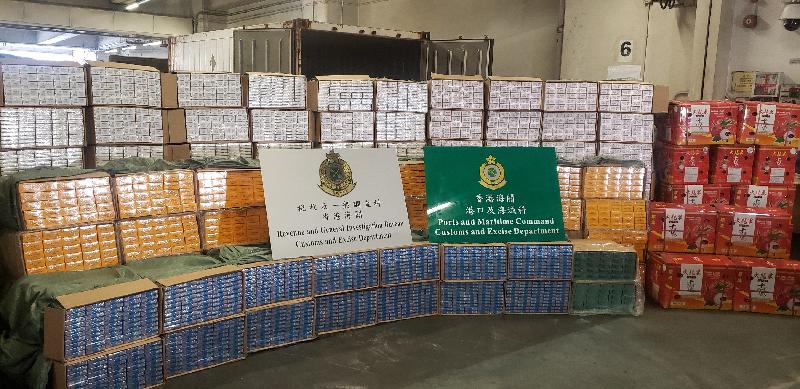
Hong Kong Customs seizes suspected illicit cigarettes (with photo)

     Hong Kong Customs today (July 6) seized about 2.4 million suspected illicit cigarettes with an estimated market value of about $6.5 million and a duty potential of about $4.6 million at the Kwai Chung Customhouse Cargo Examination Compound.

     Through intelligence analysis, Customs officers selected a seaborne refrigerated container, declared as carrying dragon fruit, arriving in Hong Kong from Ho Chi Minh City, Vietnam, for inspection.

     Upon inspection, Customs officers found the batch of suspected illicit cigarettes inside 242 cartons mix-loaded with 100 boxes of dragon fruit in the container.

     Investigation is ongoing.

     Customs will continue its risk assessment and intelligence analysis for interception at source as well as through its multi-pronged enforcement strategy targeting storage, distribution and peddling to combat illicit cigarette activities.

     Smuggling is a serious offence. Under the Import and Export Ordinance, any person found guilty of importing or exporting unmanifested cargo is liable to a maximum fine of $2 million and imprisonment for seven years.

     â€‹Under the Dutiable Commodities Ordinance, anyone involved in dealing with, possession of, selling or buying illicit cigarettes commits an offence. The maximum penalty upon conviction is a fine of $1 million and imprisonment for two years.

     Members of the public may report any suspected illicit cigarette activities to Customs’ 24-hour hotline 2545 6182 or its dedicated crime-reporting email account (crimereport@customs.gov.hk).

Photo  
read more