image_pdfimage_print

Author Archives: hksar gov

LCQ17: Statistics on the work of the Urban Renewal Authority

     Following is a question by the Hon Fernando Cheung and a written reply by the Secretary for Development, Mr Michael Wong, in the Legislative Council today (July 8):
 
Question:

     Regarding the statistics on the work of the Urban Renewal Authority (URA), will the Government inform this Council if it knows:

(1) the following information on each of the redevelopment projects for which the work on acquisition and rehousing was completed in the financial years from 2010-11 to 2019-20 (set out in Table 1 by project name):

(a) the number of households at the time of the Freezing Survey, with a breakdown by category of occupiers (i.e. (i) owner-occupiers, (ii) domestic tenants, (iii) occupiers of rooftop structures, and (iv) others), and

(b) the number of households who were offered rehousing or compensation, with a breakdown by the following arrangements made for them: (v) being rehoused in the public rental housing units provided by the Hong Kong Housing Authority, (vi) being rehoused in the public rental housing units provided by the Hong Kong Housing Society, (vii) being rehoused in the units of the rehousing blocks under the URA, (viii) being offered the basic ex-gratia payment, (ix) being offered a compensation in the form of an ex-gratia payment equivalent to three times the ex-gratia allowance offered by the Lands Department on resumption (because they were ineligible for the basic ex-gratia payment), and (x) being offered a compensation in the form of an ex-gratia payment equivalent to two times the ex-gratia allowance offered by the Lands Department on resumption (because they moved in after the date of the Freezing Survey or due to other reasons);

Table 1

Financial year Project number Project name (a) (b)
(i) (ii) (iii) (iv) Total (v) (vi) (vii) (viii) (ix) (x)
                           
 
(2) the following information on the various types of units in the rehousing blocks under the URA (i.e. (a) one-person unit (with shared kitchen), (b) one-person unit (with independent kitchen), (c) two-person unit (with shared kitchen), (d) two-person unit (with independent kitchen), and (e) family unit) in each of the financial years from 2010-11 to 2019-20 (set out in Table 2):
(i) the number of units,
(ii) the smallest and the largest usable areas of such units,
(iii) the lowest and the highest rents for such units (excluding those units used as transitional housing),
(iv) the number of units occupied,
(v) the number of vacant units available for allocation to tenants affected by redevelopment, and
(vi) the number of units leased to or reserved for social welfare organisations;

Table 2
Type of unit   Shun Sing Mansion Rich Building Bedford Tower 12 Soy Street, Mong Kok
(a) (i)        
(ii)        
(iii)        
(iv)        
(v)        
(vi)        
         
 
(3) in each of the redevelopment projects for which the work on acquisition and rehousing was completed in the financial years from 2010-11 to 2019-20, the number of units used for non-residential purposes at the time of the Freezing Survey, with a breakdown by:
(a) the type of units (i.e. (i) ground level unit, (ii) exit staircase shop, (iii) cockloft unit, (iv) upstairs unit, and (v) others),
(b) the category of occupiers (i.e. (vi) owner, (vii) tenant, (viii) occupier, and (ix) others), and
(c) the nature of business operations (i.e. (x) retail, (xi) eatery, (xii) workshop, (xiii) service, (xiv) office, and (xv) others);
(set out in Table 3 by project name); and

Table 3
Financial year Project number Project name (a) (b) (c)
(i) (ii) (iii) (iv) (v) Total (vi) (vii) (viii) (ix) (x) (xi) (xii) (xiii) (xiv) (xv)
                                     
 
(4) in respect of each of the redevelopment projects completed in the financial years from 2010-11 to 2019-20, the following details of the applications made by the affected shop operators for renting the shop premises provided in the completed redevelopment projects under the “Local Shop Arrangement” implemented by the URA (set out in Table 4 by project name):
(i) the number and percentage of shop operators who made such applications,
(ii) the number of shop operators who signed a tenancy agreement,
(iii) the shortest and the longest terms of the tenancy agreements signed for the first time,
(iv) whether rental concessions were offered to the shop operators, and
(v) the details of the rental concessions (if any)?

Table 4
Financial year Project number Project name (i) (ii) (iii) (iv) (v)
               
 
Reply:

President,

     Based on the information provided by the Urban Renewal Authority (URA), my reply to the four parts of the question is as follows:

(1) The requested information on the redevelopment projects for which acquisition and rehousing work was completed by the URA in the financial years from 2010-11 to 2019-20 is set out in Annex I.

(2) There are four rehousing blocks under the URA, namely Shun Sing Mansion, Rich Building, Bedford Tower and 12 Soy Street, Mong Kok.

     The units of these rehousing blocks are categorised into one-person units (with shared kitchen), two-person units (with shared kitchen) and family units. The information on various types of units in each rehousing block as requested by the Member is set out in Annex II.

(3) The information on units used for non-residential purposes at the time of the Freezing Survey in each of the redevelopment projects for which acquisition and rehousing work was completed by the URA in the financial years from 2010-11 to 2019-20 is set out in Annex III.

     As the collation of information on the nature of business operations of the units for non-residential purposes at the time of the Freezing Survey involves very substantial data compilation work, the URA is not able to provide the relevant information within a limited time frame.

(4) Depending on the circumstances, the URA would assist eligible non-domestic owner-operators and tenant-operators within the area of a redevelopment project to rent shop premises in the future redevelopment. Details of applications from affected shop operators in the URA’s redevelopment projects for renting the shop premises in the completed redevelopments in the financial years from 2010-11 to 2019-20 are set out in Annex IV. read more

HAD to open temporary night heat shelters

     The Home Affairs Department will open 19 temporary night heat shelters tonight (July 8) for people in need of the service.
 
     The shelters will be open from 10.30pm until 8am tomorrow.
 
     For further information, please call the department’s hotline before midnight on 2572 8427.
 
     The 19 night heat shelters are located at:
 
Hong Kong Districts:
———————
 
Central and Western –
Sai Ying Pun Community Complex Community Hall
3/F, Sai Ying Pun Community Complex,
2 High Street, Sai Ying Pun
 
Eastern –
Causeway Bay Community Centre
3/F, 7 Fook Yum Road, Causeway Bay
 
Southern –
Lei Tung Community Hall
Lei Tung Estate, Ap Lei Chau
 
Wan Chai –
Wan Chai Activities Centre
LG/F, Wan Chai Market, 258 Queen’s Road East, Wan Chai
 
Kowloon Districts:
——————
 
Kowloon City –
Hung Hom Community Hall
1/F, Kowloon City Government Offices,
42 Bailey Street, Hung Hom
 
Kwun Tong –
Lam Tin (West) Estate Community Centre
71 Kai Tin Road, Lam Tin

Sham Shui Po –
Shek Kip Mei Community Hall
G/F, Block 42, Shek Kip Mei Estate, Sham Shui Po
 
Wong Tai Sin –
Tsz Wan Shan (South) Estate Community Centre
45 Wan Wah Street, Tsz Wan Shan
 
Yau Tsim Mong –
Henry G Leong Yaumatei Community Centre
60 Public Square Street, Yau Ma Tei
 
New Territories Districts:
————————–
 
Islands –
Tung Chung Community Hall
G/F, Tung Chung Municipal Services Building,
39 Man Tung Road, Tung Chung
 
Kwai Tsing –
Kwai Shing Community Hall
Podium, Block 6, Kwai Shing West Estate, Kwai Chung
 
North –
Cheung Wah Community Hall
Cheung Wah Estate, Fanling
 
Sai Kung –
Hang Hau Community Hall
G/F, Sai Kung Tseung Kwan O Government Complex,
38 Pui Shing Road, Hang Hau, Tseung Kwan O
 
Sha Tin –
Lung Hang Estate Community Centre
Lung Hang Estate, Sha Tin
 
Tai Po –
Tai Po Community Centre
2 Heung Sze Wui Street, Tai Po
 
Tsuen Wan –
Lei Muk Shue Community Hall
G/F, Hong Shue House, Lei Muk Shue Estate, Tsuen Wan
 
Tuen Mun –
Butterfly Bay Community Centre
Butterfly Estate (near Tip Sum House), Tuen Mun
 
Yuen Long –
Long Ping Community Hall
Long Ping Estate, Yuen Long
 
Yuen Long –
Tin Yiu Community Centre
Tin Yiu Estate, Tin Shui Wai

     The temporary night heat shelters will resume their functions as either community centres or community halls in the daytime for hire by the local community and cannot continue to be open as heat shelters. People may choose to take refuge from the heat during the daytime in the common areas in any of the 21 designated community centres or community halls. Their opening hours are from 9am to 10pm. For addresses of the community centres or community halls, please browse the following webpage: www.had.gov.hk/file_manager/en/documents/public_services/emergency_services/List_CH_CC_Day_E.pdf. read more

LCQ6: Government Public Transport Fare Concession Scheme for Elderly and Eligible Persons with Disabilities

     Following is a question by the Hon Michael Tien and a reply by the Secretary for Labour and Welfare, Dr Law Chi-kwong, in the Legislative Council today (July 8):

Question:

     The Government commissioned a consultant at the end of 2018 to conduct a comprehensive review on the Government Public Transport Fare Concession Scheme for the Elderly and Eligible Persons with Disabilities (the $2 transport fare concession scheme), which is expected to be completed in the middle of this year. The Government announced in January this year that the eligible age threshold for the Scheme would be lowered from 65 to 60, and that it had requested the consultant to draw up implementation options in the review report. In this connection, will the Government inform this Council:

(1) whether the Government has received the review report; if so, of the specific recommendations and other details in the report; whether it will make public the report; if so, of the date; if it will not, the reasons for that;

(2) given that the Government has had eight years of experience in implementing the $2 transport fare concession scheme, why the initiative of merely lowering the age threshold cannot be implemented immediately but has to wait for the consultant to put forward implementation options; whether there is a definite implementation date for the initiative; and

(3) whether, prior to the implementation of the initiative, it will consider taking other measures to reduce the transport expenses of persons aged between 60 and 64, e.g. allowing them to use the Elder Octopus for enjoying the elderly fare concessions?

Reply:

Acting President,
     
     Since the Government Public Transport Fare Concession Scheme for the Elderly and Eligible Persons with Disabilities (the Scheme) was introduced in 2012, the number of eligible elderly persons has increased from 980,000 to 1.32 million in 2019, representing an increase of about 35 per cent. Having considered the trend of an ageing population in Hong Kong, the Government expects the number of eligible elderly to rise further to more than 1.75 million by 2025. At the same time, the recurrent expenditure for reimbursing public transport operators under the Scheme reached $1,300 million in 2019/20, or 5.7 times over 2012. The recurrent expenditure is expected to increase substantially to about $3,000 million in 2025/26. Taking into account the proposal to lower the eligible age of the Scheme to 60, the number of eligible persons in 2025 will increase by about 620,000 and on this basis, the estimated recurrent expenditure required is expected to be as high as $7,000 million in 2025/26.

     The estimated government expenditure mentioned above has not covered the proposal from relevant industries of extending the Scheme to red minibuses and other modes of public transport. At the same time, as the number of beneficiaries continues to rise, public expenditure will increase substantially. Hence, the Government needs to consider seriously effective measures to prevent abuses of the Scheme in order to ensure that public funds are used properly. All these factors will affect each other and are included in the review of the Scheme by the consultant commissioned by the Government. The consultant has completed a public consultation and is in the process of compiling the final report. The Government will carefully consider the analysis and recommendations of the consultant’s report, in particular the implementation arrangements and financial commitment of the optimisation proposals.

     In respect of Member’s detailed questions, our reply is as follows:

(1) The Government engaged a consultancy firm in 2018 to conduct a comprehensive review of the effectiveness and sustainability of the Scheme and carry out in-depth studies on relevant areas including whether other public transport modes should be covered, whether eligibility criteria of beneficiaries under the Scheme should be adjusted, how abuses can be prevented effectively, application of new technologies, etc. The consultancy firm is also required to assess the feasibility and long-term financial impact of proposed recommendations. The consultant has completed the public consultation and collected views of the industry, and is now compiling the final report. The Government will carefully consider the analysis and recommendations set out the consultant’s report and assess the implementation arrangements and financial commitment of the Government. The final report will be made public. 

(2) and (3) Following the announcement by the Chief Executive in January 2020 of the Government’s proposal to lower the age eligibility of the Scheme from 65 to 60, the Labour and Welfare Bureau and the Transport Department have immediately requested the consultant to accord priority to studying practical options to implement the proposal in the comprehensive review of the Scheme being conducted. In fact, during the consultation exercise for the review of the Scheme, the consultant has listened to and collected a number of improvement proposals from the industry and the public. As I have briefly mentioned earlier in this reply, the lowering of age eligibility and the addition of more public transport modes will have a significant impact on the financial commitment of the Government in the face of the general trend of an ageing population in Hong Kong. Upon receipt of the consultant’s report, it is necessary for the Government to consider carefully the feasibility, detailed arrangements, timing of implementation, financial assessment and so on of the improvement measures proposed in the report. If the eligible age is lowered to 60 before a decision on how other public transport modes could be admitted to the Scheme, public transport modes that have not been included in the Scheme may lose a large number of passengers and face financial difficulty. According to available information, in 2018, a total of 3.6 million anonymous Elder Octopus cards or personalised Octopus cards for elderly aged 65 or above were issued and had been used within past three years and the number of cards increases by about 0.3 million per year, whilst there were only 1.27 million elderly aged 65 or above in 2018 and the annual increase of elderly reaching 65 is only around 50,000. Failure to prevent abuse effectively will cause substantial waste of public money. 

     Noting the public’s interest in the Scheme and the expectation to lower the age eligibility to 60 as soon as possible, the Government has undertaken to make public the consultant’s report and give detailed accounts of its decision and implementation timetable after the review is completed. read more

Singapore-headquartered corporate service provider establishes foothold in Hong Kong (with photos)

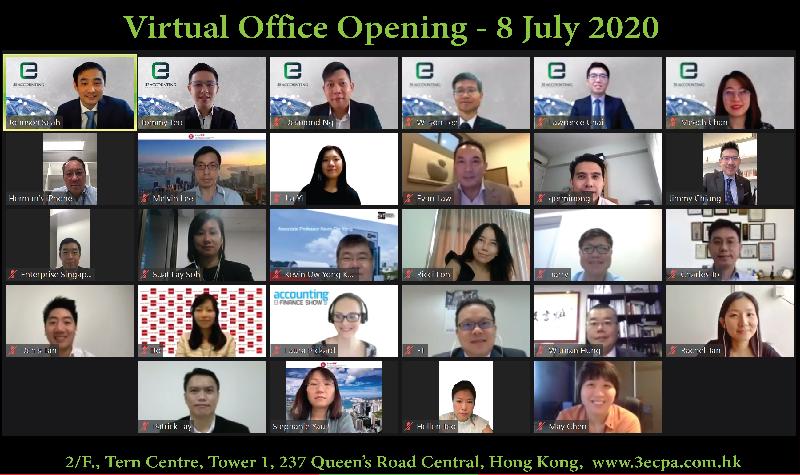
     â€‹Singapore-headquartered corporate service provider 3E Accounting opened its Hong Kong office today (July 8), tapping the continuous growth in demand for corporate services among newly set up companies in the city.
      
     The office is located in downtown Central and offers a series of professional services including company incorporation, accounting, tax, immigration and compliance services for start-ups and small and medium-sized enterprises (SMEs). Founder and Chartered Accountant Mr Lawrence Chai said that he is confident that the number of foreign investors setting up a base or presence here will continue to grow in the long term given Hong Kong’s unique economic and geographic advantage in relation to Mainland China’s development.
      
     Mr Chai said, “Hong Kong is an international finance and business hub offering access to the global markets. It is also an important gateway to the Mainland with pivotal roles in the Guangdong-Hong Kong-Macao Greater Bay Area and the Belt and Road Initiative. The city has strong appeal to foreign companies as a strategic springboard to tap business opportunities in the world and China, which provides 3E Accounting ample business opportunities not found elsewhere.”
      
     He added, “The opening of the Hong Kong office will expand our service offerings to our clients, many of whom are keen to invest and incorporate their business in Hong Kong. It is our long-term business strategy to channel our expertise to support our clients’ overseas growth and expansion.”
      
     Associate Director-General of Investment Promotion Dr Jimmy Chiang said, “We welcome the opening of 3E Accounting in Hong Kong, which will add a premium choice for SMEs and entrepreneurs who value quality corporate services to support their operations in Hong Kong. Let me wish 3E Accounting and all their clients every success in their business in Hong Kong and beyond.”
      
About 3E Accounting
      
     Established in 2011, 3E Accounting provides affordable corporate services to start-ups and SMEs. Its mission is to offer the three Es – efficiency, effectiveness and economy – in complete suite of services that address all aspects of professional services including company incorporation, accounting, tax, immigration and compliance services and ongoing administration for every business entity. For more information, please visit www.3ecpa.com.hk.
      
About Invest Hong Kong
      
     Invest Hong Kong is the department of the Hong Kong Special Administrative Region Government responsible for attracting foreign direct investment and supporting overseas and Mainland businesses to set up or expand in Hong Kong. It provides free advice and customised services for overseas and Mainland companies. For more information, please visit www.investhk.gov.hk.
      
     For event photos, please visit www.flickr.com/photos/investhk/albums/72157714986279861.

Photo  Photo  
read more

LCQ3: Demand-side management measures for the property market

     Following is a question by the Hon Jimmy Ng and a reply by the Secretary for Financial Services and the Treasury, Mr Christopher Hui, in the Legislative Council today (July 8):
 
Question:
 
     Owing to the economic downturn in Hong Kong, various trades are now facing tremendous operating pressure, and the banks also tend to be more prudent in commercial lending. Some owners of enterprises intend to sell their properties to meet cash flow needs. However, the various demand-side management measures for the property market (commonly referred to as “harsh measures”) have greatly increased the difficulty in cashing out. In this connection, will the Government inform this Council:
 
(1) as it is learnt that the Singapore Government intends to relax its demand-side management measures for the property market to attract international capital to invest in Singapore, thereby boosting its economy, whether the authorities have assessed this situation and considered, before this major competitor in the Asian region launches the relevant measures, lowering the rates of ad valorem stamp duty to the previous levels to enhance Hong Kong’s competitiveness; and
 
(2) as some business operators have suggested that even if the Government does not immediately “withdraw the harsh measures” in one go for fear of affecting the opportunities for members of the public to buy their own homes, it should at least implement the following three measures: (i) gradually lowering the ad valorem stamp duty rate from the current 15 per cent to the previous levels; (ii) revising the arrangement under which a person, who replaces his/her property by acquiring a new residential property before disposing of his/her only original residential property, is required to pay the stamp duty first before they may apply for refund for the stamp duty paid; and (iii) “withdrawing the harsh measures” for non-residential property transactions, whether the authorities will implement these measures; if so, of the details; if not, the reasons for that?
 
Reply:
 
Acting President,
 
     One of the important objectives of the Hong Kong Special Administrative Region Government’s housing policies is to maintain the healthy development of the property market. Over the past few years, in light of the actual situation of the local property market, the Government has adopted a two-pronged approach by striving to increase both land and housing supply to meet demand, and introducing several rounds of demand-side management measures to combat short-term speculative activities and reduce investment and external demands. These measures aim to prevent further exuberance in the property market which may pose significant risks to our macroeconomic and financial stability, to ensure the healthy development of the property market, and to accord priority to home ownership needs of Hong Kong permanent residents amidst the prevailing tight housing supply. When formulating policies related to the property market, different countries and regions put in place appropriate measures based on their local economic and property market conditions as well as their own policy considerations.
 
     The Hon Ng suggested that lowering the rates of stamp duty on property might help attract foreign investments and enhance Hong Kong’s competitiveness. The Government reckons that investors will consider a wide range of factors when identifying a location to set up business, including business environment and opportunities, tax regime and tax rates, and cost of operation. Given the actual situation of Hong Kong’s property market at present, demand-side management measures can ensure the healthy development of the property market, which is conducive to a stable business environment, thus maintaining Hong Kong’s competitiveness as an international financial and business centre.
 
     The Government understands that enterprises may face greater cash flow pressure under the current economic conditions. In this year’s Budget and under the two rounds of Anti-epidemic Fund, the Government has launched a series of relief measures totalling over $280 billion to alleviate the financial burden of enterprises. These include the launch of the Special 100% Loan Guarantee for small and medium enterprises and the Employment Support Scheme for eligible enterprises to ease their cash flow difficulties.
 
     In consultation with the Transport and Housing Bureau, my consolidated reply to the two parts of the question raised by the Hon Ng is as follows:
 
     In considering whether stamp duty rates concerning residential properties should be adjusted, the Government must carefully take into account the impact of relevant arrangements on the property market as a whole. Owing to global and local factors, the residential property market has turned quieter since the second half of 2019. Property prices, though retreated slightly, have shown signs of rebound recently. Overall property prices remain at a level beyond the affordability of the general public. The home purchase affordability ratio (Note) in the first quarter of 2020 still stayed at a high level of 73 per cent, well above the 20-year long-term average of 45 per cent from 2000 to 2019.
 
     Any move to relax demand-side management measures or to lower stamp duty rates may be speculated by the market as a signal for adjustments to the Government’s policies on the property market. It may also stimulate demand for local residential properties from some citizens, and lead to a counter-productive result of pushing up property prices when the current housing supply still lags behind demand. Therefore, the Government must act prudently.
 
     For non-residential properties, the Government’s objective of introducing the doubled ad valorem stamp duty is to forestall the spread of the overheating in the residential property market to the non-residential property market. Although the prices of non-residential properties have been trending downwards since 2019, they still stood at relatively high levels. The Government will continue to monitor the market situation closely.
 
     Under the existing mechanism, if a Hong Kong permanent resident acquires a new residential property to replace his/her only original residential property, he/she has to pay the relevant stamp duty first and claim partial refund of the stamp duty paid after disposing of the original property. The Government acknowledges that the arrangement may increase the acquisition costs for persons replacing their residential properties. However, if the relevant requirements are relaxed, it may invite some owners without genuine intention to dispose of their original properties to, under the guise of property replacement, defer payment of stamp duty or hold more than one residential property for a longer period with a view to making profits. This is at variance with the policy intent of introducing demand-side management measures and goes against taking care of the practical needs of Hong Kong permanent residents in replacing their properties.
 
     The Government will, as always, keep watch on the market conditions and take timely and appropriate measures in response to market changes by making reference to a series of indicators, including property prices, the home purchase affordability ratio, transaction volume and supply of properties, and local and global economic changes, with a view to ensuring the healthy development of the property market.
 
Note: Home purchase affordability ratio refers to the ratio of mortgage payment for a 45-square metre flat to median income of households (excluding those living in public housing), at the prevailing mortgage rate for a tenure of 20 years. read more