image_pdfimage_print

Author Archives: hksar gov

Labour Department highly concerned about fatal work accident that happened today

     The Labour Department (LD) is highly concerned about a fatal work accident that happened at a construction site in Kai Tak this morning (July 14), in which a male worker while assisting in loading machine components onto the compartment of a lorry was hit by a machine component slid down on the lorry compartment.  He was injured and certified dead in the hospital. The LD is saddened by the death of the worker and expresses its deepest sympathies to the victim’s family.
         
     The LD’s spokesman said, “We commenced an immediate on-site investigation as soon as we were notified of the accident and will issue suspension notices to the contractors concerned, suspending any work related to loading and unloading of machines or machine components on vehicles on the site. The contractors cannot resume the work process until the LD is satisfied that measures to abate the relevant risks have been taken.”

     The spokesman added, “We will complete investigation as soon as possible to identify the cause of the accident, ascertain the liability of the duty holders and recommend improvement measures. We will take actions pursuant to the law if there is any violation of the work safety legislation.”
         
     The general duty provisions of the Factories and Industrial Undertakings Ordinance require employers to provide safe working environments, plant and safe systems of work for their employees. Those who contravene the above provisions are liable to a maximum fine of $500,000 and imprisonment for six months.
         
     In regard to today’s accident, the LD will issue a Work Safety Alert through its website and email, giving a brief account of the accident concerned to duty holders, workers’ unions, professional bodies of safety practitioners and others, reminding the industry of the importance of following safety precautionary measures to prevent a recurrence of similar accidents.
         
     The LD will also remind the employer concerned of the liability for employees’ compensation under the Employees’ Compensation Ordinance, assist family members of the deceased to claim employees’ compensation and closely follow up on the case. For those with financial difficulties, the LD will assist them to apply for appropriate emergency funds. Subject to the needs and wishes of family members of the deceased, the LD will also liaise with the Social Welfare Department for financial or other assistance.
         
     For the sake of securing the safety and health of employees at work, the LD appeals to employers to provide plant and systems of work that are safe and without risks to health. Employees should co-operate with their employers, adopt all safety measures and use personal protective equipment provided properly to avoid endangering their own work safety and that of other workers.  read more
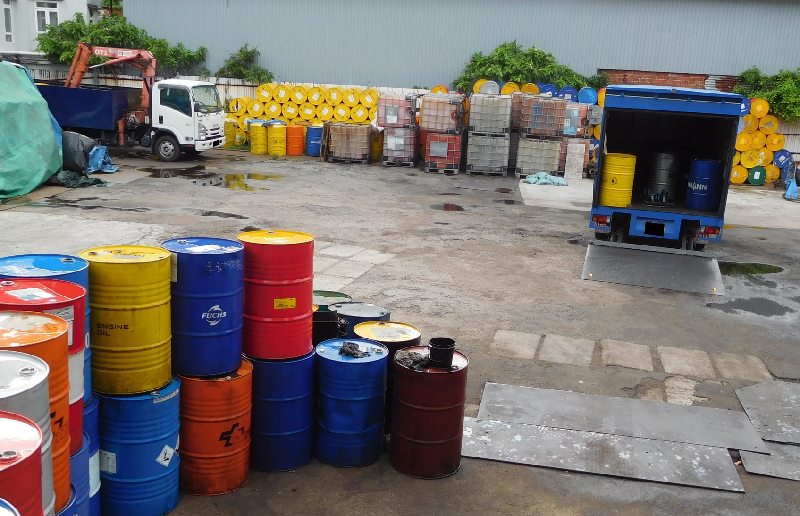
Two unlicensed collectors convicted of illegally handling chemical waste (with photo)

     Two unlicensed collectors were convicted and fined a total of $26,500 at Fanling Magistrates’ Courts today (July 14) and July 7 for contravening the Waste Disposal Ordinance (WDO) and the Waste Disposal (Chemical Waste) (General) Regulation as a result of illegally collecting and handling spent lubricating oil and waste lead-acid batteries.

     The Environmental Protection Department (EPD) has been endeavouring to combat illegal collection and handling of chemical waste generated from vehicle repairs in workshops. Last year, enforcement officers of the EPD carried out a series of operations according to intelligence received and successfully intercepted unlicensed collectors allegedly collecting spent lubricating oil and waste lead-acid batteries from vehicle repair workshops illegally. One of the unlicensed chemical waste collectors, namely KWK Trading Limited, delivered spent lubricating oil to their open-air storage site in the New Territories. There were no warning sign and chemical waste spill facilities at the site. The spent lubricating oil seized there was over 20 000 litres.

     In addition, enforcement officers of the EPD intercepted a suspected vehicle and seized a number of waste lead-acid batteries without proper packaging and labelling. It was confirmed that the driver involved was collecting chemical waste without a licence.

     After collecting evidence, the EPD prosecuted the company and driver involved under the WDO and the Waste Disposal (Chemical Waste) (General) Regulation.

     An EPD spokesman stressed that spent lubricating oil and waste lead-acid batteries generated from vehicle repairs in workshops, which are classified as chemical waste, contain various corrosive and toxic chemicals. If not handled properly, they would pollute the environment and cause harm to public health.

     The spokesman reminded members of the vehicle repair business that they must register as chemical waste producers with the EPD in accordance with the Waste Disposal (Chemical Waste) (General) Regulation. Chemical waste must be properly packaged, labelled and stored, and has to be collected by licensed chemical waste collectors for delivery to licensed chemical waste disposal facilities for treatment.

     Moreover, the spokesman urged that, for replacement of lubricating oil or lead-acid batteries, vehicle owners should engage the services of vehicle repair workshops or companies that have been registered with the EPD.

     Anyone engaged in the illegal collection, storage and disposal of chemical waste will be prosecuted. First-time offenders are liable to a maximum fine of $200,000 and six months’ imprisonment.

     Members of the public may visit the EPD’s website for more information about the control of chemical waste: www.epd.gov.hk/epd/english/environmentinhk/waste/guide_ref/guide_cwc.html.

Photo  
read more

CHP investigates 48 additional confirmed cases of COVID-19

     The Centre for Health Protection (CHP) of the Department of Health has announced that as of 4pm today (July 14), the CHP was investigating 48 additional confirmed cases of coronavirus disease 2019 (COVID-19), taking the number of cases to 1 570 in Hong Kong so far (comprising 1 569 confirmed cases and one probable case).
  
     The newly reported cases announced today involve 27 males and 21 females aged between 19 and 90 years. Among them, eight had travel history during the incubation period.
 
     In light of the local cases announced today, the CHP will distribute deep throat saliva specimen bottles to residents of buildings where the patients live, as well as to those with whom they might have had contact during the infectious period. People are also urged to seek medical attention early if symptoms develop.
 
     The CHP’s epidemiological investigations and relevant contact tracing on the confirmed cases are ongoing. For case details and contact tracing information, please see the Annex.
 
     The CHP again urged members of the public to maintain an appropriate social distance with other people as far as possible in their daily lives to minimise the risk of infection. In particular, they should go out less and avoid social activities such as meal gatherings or other gatherings to reduce the chance of contacting infected persons who may not present any symptoms, and minimise the risk of outbreak clusters emerging in the community.
           
     A spokesman for the CHP said, “Given that the situation of COVID-19 infection remains severe and that there is a continuous increase in the number of cases reported around the world, members of the public are strongly urged to avoid all non-essential travel outside Hong Kong.
  
     “The CHP also strongly urges the public to maintain at all times strict personal and environmental hygiene, which is key to personal protection against infection and prevention of the spread of the disease in the community. On a personal level, members of the public should wear a surgical mask when having respiratory symptoms, taking public transport or staying in crowded places. They should also perform hand hygiene frequently, especially before touching the mouth, nose or eyes.
      
     “As for household environmental hygiene, members of the public are advised to maintain drainage pipes properly, regularly pour water into drain outlets (U-traps) and cover all floor drain outlets when they are not in use. After using the toilet, they should put the toilet lid down before flushing to avoid spreading germs.”
  
     Moreover, the Government has launched the website “COVID-19 Thematic Website” (www.coronavirus.gov.hk) for announcing the latest updates on various news on COVID-19 infection and health advice to help the public understand the latest updates. Members of the public may also gain access to information via the COVID-19 WhatsApp Helpline launched by the Office of the Government Chief Information Officer. Simply by saving 9617 1823 in their phone contacts or clicking the link wa.me/85296171823?text=hi, they will be able to obtain information on COVID-19 as well as the “StayHomeSafe” mobile app and wristband via WhatsApp.
  
     To prevent pneumonia and respiratory tract infection, members of the public should always maintain good personal and environmental hygiene. They are advised to:
  
• Wear a surgical mask when taking public transport or staying in crowded places. It is important to wear a mask properly, including performing hand hygiene before wearing and after removing a mask;
• Perform hand hygiene frequently, especially before touching the mouth, nose or eyes, after touching public installations such as handrails or doorknobs, or when hands are contaminated by respiratory secretions after coughing or sneezing;
• Maintain drainage pipes properly and regularly (about once a week) pour about half a litre of water into each drain outlet (U-trap) to ensure environmental hygiene;
• Cover all floor drain outlets when they are not in use;
• After using the toilet, put the toilet lid down before flushing to avoid spreading germs;
• Wash hands with liquid soap and water, and rub for at least 20 seconds. Then rinse with water and dry with a disposable paper towel. If hand washing facilities are not available, or when hands are not visibly soiled, performing hand hygiene with 70 to 80 per cent alcohol-based handrub is an effective alternative;
• Cover your mouth and nose with tissue paper when sneezing or coughing. Dispose of soiled tissues into a lidded rubbish bin, then wash hands thoroughly; and
• When having respiratory symptoms, wear a surgical mask, refrain from work or attending class at school, avoid going to crowded places and seek medical advice promptly. read more

CHP investigates 48 additional confirmed cases of COVID-19

     The Centre for Health Protection (CHP) of the Department of Health has announced that as of 4pm today (July 14), the CHP was investigating 48 additional confirmed cases of coronavirus disease 2019 (COVID-19), taking the number of cases to 1 570 in Hong Kong so far (comprising 1 569 confirmed cases and one probable case).
  
     The newly reported cases announced today involve 27 males and 21 females aged between 6 and 90 years. Among them, eight had travel history during the incubation period.
 
     In light of the local cases announced today, the CHP will distribute deep throat saliva specimen bottles to residents of buildings where the patients live, as well as to those with whom they might have had contact during the infectious period. People are also urged to seek medical attention early if symptoms develop.
 
     The CHP’s epidemiological investigations and relevant contact tracing on the confirmed cases are ongoing. For case details and contact tracing information, please see the Annex.
 
     The CHP again urged members of the public to maintain an appropriate social distance with other people as far as possible in their daily lives to minimise the risk of infection. In particular, they should go out less and avoid social activities such as meal gatherings or other gatherings to reduce the chance of contacting infected persons who may not present any symptoms, and minimise the risk of outbreak clusters emerging in the community.
           
     A spokesman for the CHP said, “Given that the situation of COVID-19 infection remains severe and that there is a continuous increase in the number of cases reported around the world, members of the public are strongly urged to avoid all non-essential travel outside Hong Kong.
  
     “The CHP also strongly urges the public to maintain at all times strict personal and environmental hygiene, which is key to personal protection against infection and prevention of the spread of the disease in the community. On a personal level, members of the public should wear a surgical mask when having respiratory symptoms, taking public transport or staying in crowded places. They should also perform hand hygiene frequently, especially before touching the mouth, nose or eyes.
      
     “As for household environmental hygiene, members of the public are advised to maintain drainage pipes properly, regularly pour water into drain outlets (U-traps) and cover all floor drain outlets when they are not in use. After using the toilet, they should put the toilet lid down before flushing to avoid spreading germs.”
  
     Moreover, the Government has launched the website “COVID-19 Thematic Website” (www.coronavirus.gov.hk) for announcing the latest updates on various news on COVID-19 infection and health advice to help the public understand the latest updates. Members of the public may also gain access to information via the COVID-19 WhatsApp Helpline launched by the Office of the Government Chief Information Officer. Simply by saving 9617 1823 in their phone contacts or clicking the link wa.me/85296171823?text=hi, they will be able to obtain information on COVID-19 as well as the “StayHomeSafe” mobile app and wristband via WhatsApp.
  
     To prevent pneumonia and respiratory tract infection, members of the public should always maintain good personal and environmental hygiene. They are advised to:
  
• Wear a surgical mask when taking public transport or staying in crowded places. It is important to wear a mask properly, including performing hand hygiene before wearing and after removing a mask;
• Perform hand hygiene frequently, especially before touching the mouth, nose or eyes, after touching public installations such as handrails or doorknobs, or when hands are contaminated by respiratory secretions after coughing or sneezing;
• Maintain drainage pipes properly and regularly (about once a week) pour about half a litre of water into each drain outlet (U-trap) to ensure environmental hygiene;
• Cover all floor drain outlets when they are not in use;
• After using the toilet, put the toilet lid down before flushing to avoid spreading germs;
• Wash hands with liquid soap and water, and rub for at least 20 seconds. Then rinse with water and dry with a disposable paper towel. If hand washing facilities are not available, or when hands are not visibly soiled, performing hand hygiene with 70 to 80 per cent alcohol-based handrub is an effective alternative;
• Cover your mouth and nose with tissue paper when sneezing or coughing. Dispose of soiled tissues into a lidded rubbish bin, then wash hands thoroughly; and
• When having respiratory symptoms, wear a surgical mask, refrain from work or attending class at school, avoid going to crowded places and seek medical advice promptly. read more