image_pdfimage_print

Author Archives: hksar gov

Cargo clearance facilities at Liantang Port/Heung Yuen Wai Boundary Control Point open today (with photos/videos)

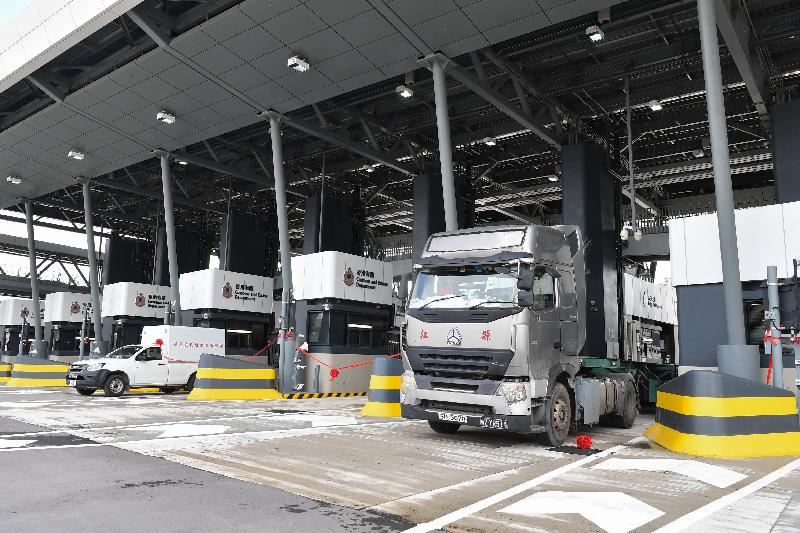
     The cargo clearance facilities of the Liantang Port (LP)/Heung Yuen Wai (HYW) Boundary Control Point (BCP) opened today (August 26). The Chief Executive, Mrs Carrie Lam; the Secretary of the CPC Guangdong Provincial Committee, Mr Li Xi; the Governor of Guangdong Province, Mr Ma Xingrui; Deputy Director of the Hong Kong and Macao Affairs Office of the State Council Mr Zhang Xiaoming; the Director of the Liaison Office of the Central People’s Government in the Hong Kong Special Administrative Region (HKSAR), Mr Luo Huining; the Director General of the Guangdong Sub-Administration of the General Administration of Customs, Mr Zhang Guangzhi; the Head of the National Office of Port Administration of the General Administration of Customs, Mr Huang Guansheng; the Secretary of the CPC Shenzhen Municipal Committee, Mr Wang Weizhong; and the Mayor of the Shenzhen Municipal Government, Mr Chen Rugui, jointly officiated at the opening ceremony of the BCP at the Customs Cargo Inspection Area of the LP in Shenzhen.
 
     Mrs Lam led a delegation of officials of the HKSAR Government to attend the opening ceremony of the BCP. Addressing the ceremony, she said that the opening of the LP/HYW BCP on the 40th anniversary of the establishment of the Shenzhen Special Economic Zone was particularly meaningful. The new BCP greatly shortens the travelling time between Hong Kong, Shenzhen and eastern Guangdong, thereby facilitating the smooth and efficient operation of cross-boundary logistics; furthering the co-operation and development of Hong Kong, Shenzhen, eastern Guangdong and neighbouring provinces; enhancing the “one-hour living circle” of Guangdong, Hong Kong and Macao; and providing extremely favourable infrastructure connectivity for the development of the Guangdong-Hong Kong-Macao Greater Bay Area.
 
     She said that construction of the LP/HYW BCP has fully reflected the people-oriented principle. The design of the Passenger Terminal Building (PTB) of the new BCP made reference to the winning design of an international competition co-organised by Hong Kong and Shenzhen, and the HYW BCP in Hong Kong is the first BCP to adopt the design principle of “direct access to people and vehicles”, bringing greater convenience to people.
 
     Highlighting in her speech that the HKSAR Government had to reprovision the entire Chuk Yuen Village to make way for the building of the PTB, she said the issue was peacefully resolved thanks to the understanding and co-operation of the villagers. She expressed her heartfelt gratitude to Mr Lau Wong-fat, the late Chairman of the Heung Yee Kuk, for his efforts in making possible the smooth reprovisioning of the village. She also thanked all the people participating in the construction of the BCP for their contributions.
 
     The LP/HYW BCP is the seventh land-based control point between Hong Kong and Shenzhen. The cargo clearance facilities of the new BCP opened first at 4pm today, and will operate from 7am to 10pm daily. As for the passenger facilities, relevant departments will review the situation and commission the facilities at a suitable time taking into account the epidemic situation and the cross-boundary anti-epidemic measures.
 
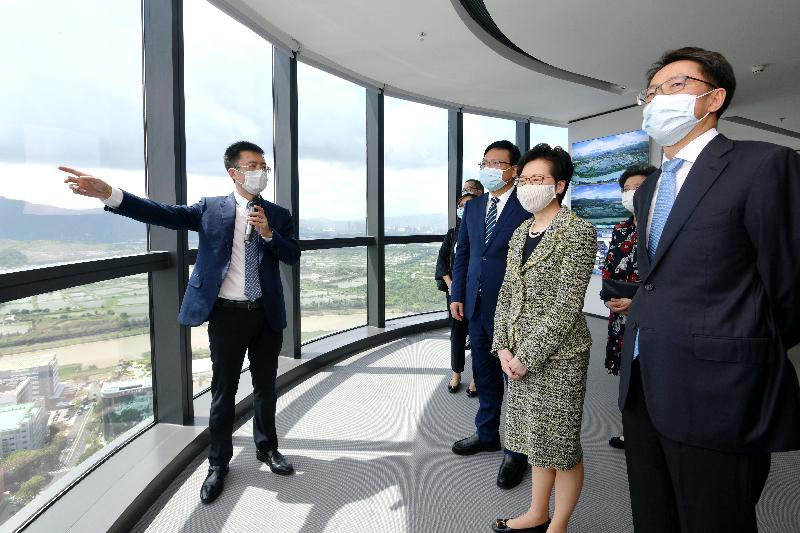
     After the ceremony, Mrs Lam, accompanied by the Secretary for Innovation and Technology, Mr Alfred Sit; the Secretary for Constitutional and Mainland Affairs, Mr Erick Tsang Kwok-wai; and the Director of the Chief Executive’s Office, Mr Chan Kwok-ki, visited the Shenzhen-Hong Kong Innovation and Technology Co-operation Zone in Shenzhen, where Mr Chen gave a briefing on the latest developments of the zone. Mrs Lam said she was pleased to note that there are currently 370 000 square metres of space for scientific research in the zone and more than 100 projects have established a presence there or have shown an interest in doing so. Development of the zone is making good progress and it will have strong links and co-operation with the Hong Kong-Shenzhen Innovation and Technology Park located in the Lok Ma Chau Loop. She said that the HKSAR Government is moving forward with the work of the Hong Kong-Shenzhen Innovation and Technology Park at full steam, with a view to making the first batch of land parcels available by 2021, completing the first-stage construction of three buildings by the end of 2024 and allowing tenants to move in by early 2025.
 
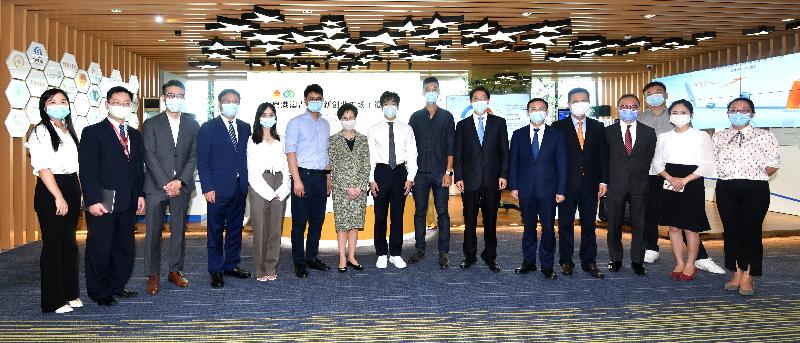
     Mrs Lam and the other officials then visited the youth innovation and entrepreneurship projects of the Hong Kong University of Science and Technology. They also visited the Guangdong-Hong Kong-Macao youth innovation and entrepreneur workshop and exchanged views with young Hong Kong entrepreneurs who started businesses there. She pointed out that the HKSAR Government is committed to promoting youth innovation and entrepreneurship in the Greater Bay Area, and said the Government has rolled out a new subsidy scheme under the Youth Development Fund to provide support to Hong Kong young people who are interested in starting their businesses in Hong Kong and in the Mainland cities of the Greater Bay Area. She expressed the hope that they can seize the opportunities of the Greater Bay Area’s development and integrate into the overall development of the nation.
 
     After the visit, Mrs Lam and the other officials attended a lunch hosted by Mr Chen and returned to Hong Kong.
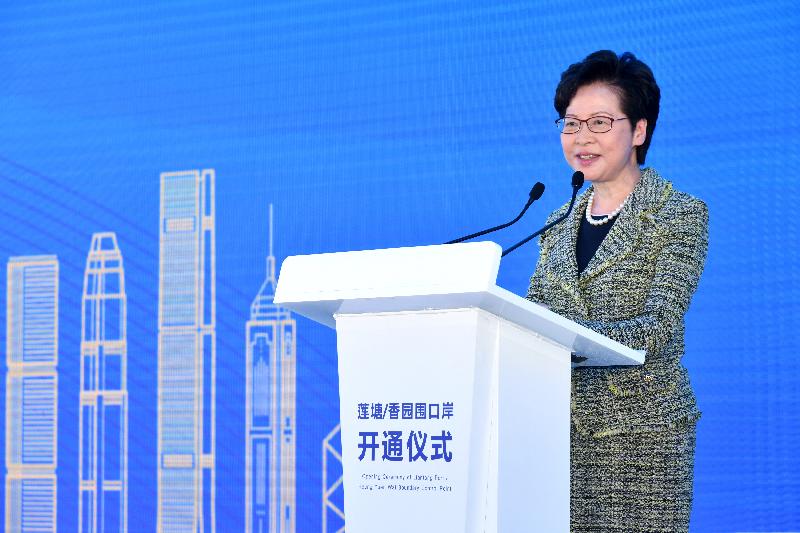
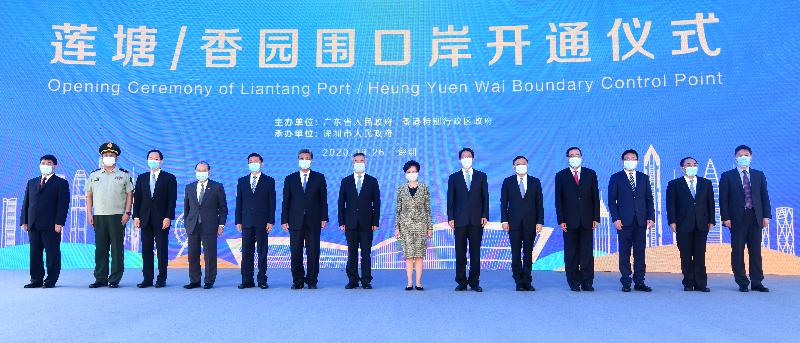
Photo  Photo  Photo  Photo  Photo  Photo  Photo  Photo  Photo  Photo  
read more

External merchandise trade statistics for July 2020

     The Census and Statistics Department (C&SD) released today (August 26) the external merchandise trade statistics for July 2020. In July 2020, the values of Hong Kong’s total exports and imports of goods both recorded year-on-year decreases, at 3.0% and 3.4% respectively.
 
     In July 2020, the value of total exports of goods decreased by 3.0% over a year earlier to $328.5 billion, after a year-on-year decrease of 1.3% in June 2020. Concurrently, the value of imports of goods decreased by 3.4% over a year earlier to $358.3 billion in July 2020, after a year-on-year decrease of 7.1% in June 2020. A visible trade deficit of $29.8 billion, equivalent to 8.3% of the value of imports of goods, was recorded in July 2020.
 
     For the first seven months of 2020 as a whole, the value of total exports of goods decreased by 6.3% over the same period in 2019. Concurrently, the value of imports of goods decreased by 8.5%. A visible trade deficit of $205.3 billion, equivalent to 8.9% of the value of imports of goods, was recorded in the first seven months of 2020.
 
     Comparing the three-month period ending July 2020 with the preceding three months on a seasonally adjusted basis, the value of total exports of goods increased by 1.7%. Meanwhile, the value of imports of goods increased by 0.9%.
 
Analysis by country/territory
 
     Comparing July 2020 with July 2019, total exports to Asia as a whole grew by 0.6%. In this region, increases were registered in the values of total exports to some major destinations, in particular the mainland of China (the Mainland) (+5.2%), Vietnam (+4.4%) and Taiwan (+0.4%). On the other hand, decreases were recorded in the values of total exports to the Philippines (-21.3%), India (-20.5%), Korea (-20.0%), Thailand (-15.3%) and Japan (-15.2%).
 
     Apart from destinations in Asia, decreases were registered in the values of total exports to some major destinations in other regions, in particular the USA (-20.2%), the United Kingdom (-19.9%) and Germany (-16.5%).
 
     Over the same period of comparison, decreases were registered in the values of imports from some major suppliers, in particular the USA (-22.4%), Japan (-18.3%) and the Mainland (-8.1%). Concurrently, increases were recorded in the values of imports from Taiwan (+45.0%), Vietnam (+35.2%), Malaysia (+21.1%), Singapore (+13.8%) and Korea (+13.8%).
 
     For the first seven months of 2020 as a whole, year-on-year decreases were registered in the values of total exports to most major destinations, in particular India (-25.1%), the USA (-23.3%), Germany (‑20.7%), Singapore (-18.3%), Korea (-13.6%) and Japan (-11.8%). However, year-on-year increases were registered in the values of total exports to Taiwan (+9.0%) and the Mainland (+2.8%).
 
     Over the same period of comparison, year-on-year decreases were registered in the values of imports from some major suppliers, in particular the USA (-20.9%), the Mainland (‑12.7%) and Japan (-7.4%). However, year-on-year increases were registered in the values of imports from Vietnam (+46.0%), Taiwan (+20.3%), Korea (+8.3%) and Singapore (+5.5%).
 
Analysis by major commodity
 
     Comparing July 2020 with July 2019, decreases were registered in the values of total exports of some principal commodity divisions, in particular “miscellaneous manufactured articles (mainly jewellery, goldsmiths’ and silversmiths’ wares)” (by $4.6 billion or -23.0%), “telecommunications and sound recording and reproducing apparatus and equipment” (by $4.2 billion or -6.9%), “articles of apparel and clothing accessories” (by $3.9 billion or -40.0%) and “power generating machinery and equipment” (by $3.1 billion or -34.1%). However, increases were registered in the values of total exports of “electrical machinery, apparatus and appliances, and electrical parts thereof” (by $14.5 billion or 11.1%) and “office machines and automatic data processing machines” (by $1.6 billion or 4.5%).
 
     Over the same period of comparison, decreases were registered in the values of imports of some principal commodity divisions, in particular “miscellaneous manufactured articles (mainly jewellery, goldsmiths’ and silversmiths’ wares)” (by $4.1 billion or -17.7%), “non-metallic mineral manufactures” (by $3.9 billion or ‑29.0%) and “articles of apparel and clothing accessories” (by $3.3 billion or -37.3%). However, increases were registered in the values of imports of “electrical machinery, apparatus and appliances, and electrical parts thereof” (by $11.4 billion or 8.1%) and “essential oils and resinoids and perfume materials; toilet, polishing and cleansing preparations” (by $1.5 billion or 36.8%).
 
     For the first seven months of 2020 as a whole, year-on-year decreases were registered in the values of total exports of some principal commodity divisions, in particular “telecommunications and sound recording and reproducing apparatus and equipment” (by $65.4 billion or -16.0%), “miscellaneous manufactured articles (mainly jewellery, goldsmiths’ and silversmiths’ wares)” (by $36.5 billion or -27.7%) and “non-metallic mineral manufactures” (by $34.8 billion or -36.9%). However, year-on-year increases were registered in the values of total exports of “electrical machinery, apparatus and appliances, and electrical parts thereof” (by $51.1 billion or 6.0%) and “office machines and automatic data processing machines” (by $15.4 billion or 6.9%).
 
     Over the same period of comparison, year-on-year decreases were registered in the values of imports of some principal commodity divisions, in particular “non-metallic mineral manufactures” (by $46.4 billion or -42.2%), “telecommunications and sound recording and reproducing apparatus and equipment” (by $43.3 billion or -11.6%) and “miscellaneous manufactured articles (mainly jewellery, goldsmiths’ and silversmiths’ wares)” (by $34.3 billion or -22.4%). However, year-on-year increases were registered in the values of imports of “electrical machinery, apparatus and appliances, and electrical parts thereof” (by $34.3 billion or 3.7%) and “power generating machinery and equipment” (by $10.9 billion or 21.5%).
  
Commentary
 
     A Government spokesman said that merchandise exports remained weak in July, declining by 3.0% from a year earlier in value terms. Exports to the US, the EU and many other major Asian markets fell further on a year-on-year basis amid subdued external demand. Meanwhile, exports to the Mainland sustained moderate growth alongside the solid economic recovery there.
 
     Looking ahead, the threat of COVID-19 will remain until an effective vaccine or treatment is widely available. The weak global economy, together with the tense China-US relations, will continue to cloud the outlook for Hong Kong’s merchandise exports in the near term. The Government will monitor relevant developments closely.
 
Further information
 
     Table 1 at the annex presents the analysis of external merchandise trade statistics for July 2020. Table 2 presents the original monthly trade statistics from January 2017 to July 2020, and Table 3 gives the seasonally adjusted series for the same period.
 
     The values of total exports of goods to 10 main destinations for July 2020 are shown in Table 4, whereas the values of imports of goods from 10 main suppliers are given in Table 5.
 
     Tables 6 and 7 show the values of total exports and imports of 10 principal commodity divisions for July 2020.
 
     All the merchandise trade statistics described here are measured at current prices and no account has been taken of changes in prices between the periods of comparison. A separate analysis of the volume and price movements of external merchandise trade for July 2020 will be released in mid-September 2020.
 
     The July 2020 issue of “Hong Kong External Merchandise Trade” contains detailed analysis on the performance of Hong Kong’s external merchandise trade in July 2020 and will be available in mid-September 2020. Users can download the publication free of charge at the website of the C&SD (www.censtatd.gov.hk/hkstat/sub/sp230.jsp).
 
     Enquiries on merchandise trade statistics may be directed to the Trade Analysis Section (2) of the C&SD (Tel: 2582 5042). read more