image_pdfimage_print

Author Archives: hksar gov

Government responds to media enquiries on BGI’s testing services

     In response to media enquiries on the test results of the Sunrise Diagnostic Centre Limited, a joint venture company of BGI in Hong Kong that provides COVID-19 testing services for the Government, the Government today (August 26) responded as follow:

     The Public Health Laboratory Services Branch (PHLSB) under The Centre for Health Protection (CHP) of the Department of Health (DH) has been designated by the World Health Organization (WHO) this year as a WHO COVID-19 Reference Laboratory and WHO COVID-19 external quality assessment programme provider. The PHLSB also provides a quality assessment programme for local laboratories.

     In accordance with the existing mechanism of the DH, specimens tested with a positive COVID-19 result in all private laboratories in Hong Kong are considered preliminary positive. The specimens must be referred to the PHLSB in accordance with established procedures for confirmatory tests. After a positive result is confirmed by the PHLSB, the CHP will classify it as a confirmed case. It is the DH’s established practice for all preliminary positive cases to be confirmed by the PHLSB.

     Generally speaking, it is not uncommon for the PHLSB and the private laboratories to have discordant results using different platforms during the confirmatory process, and it has happened occasionally in the past. The DH may collect samples for the relevant cases again for further testing if necessary.

     The Government reiterated that all private laboratories providing testing services for the Government must participate in and pass the CHP’s External Quality Assessment Programme (EQAP) for COVID-19 testing so as to ensure the technical level of testing services provided.

     According to the DH’s record, the temporary air-inflated laboratory at Sun Yat Sen Memorial Park Sports Centre operated with the support of the Sunrise Diagnostic Centre Limited passed the PHLSB’s EQAP on August 18 and the accuracy of its sample pooling method was confirmed. In addition, BGI and the Sunrise Diagnostic Centre Limited participated in and passed the EQAP for their testing facilities in June and July respectively. According to the information provided by the Sunrise Diagnostic Centre Limited, BGI’s testing technology has also passed the external quality evaluation in Mainland China, Japan, the Netherlands and Malaysia etc. At this stage, there is no evidence that the quality of the testing services it provides to the Government falls short of the standard. read more

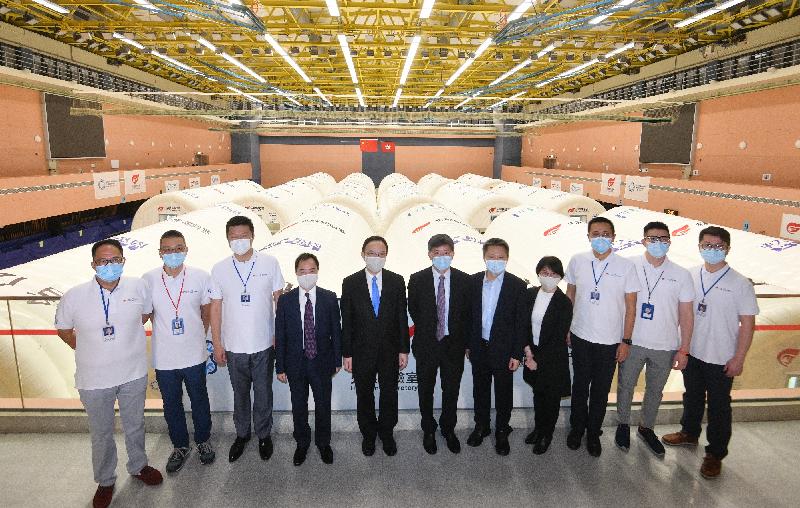
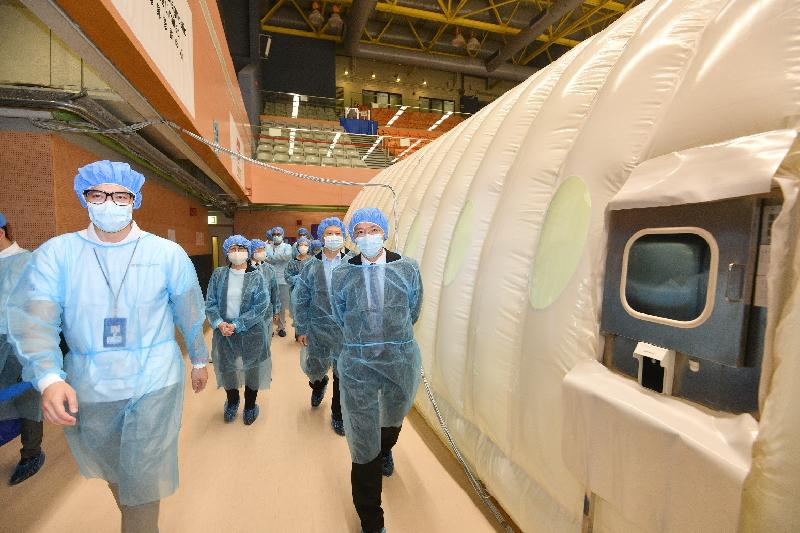
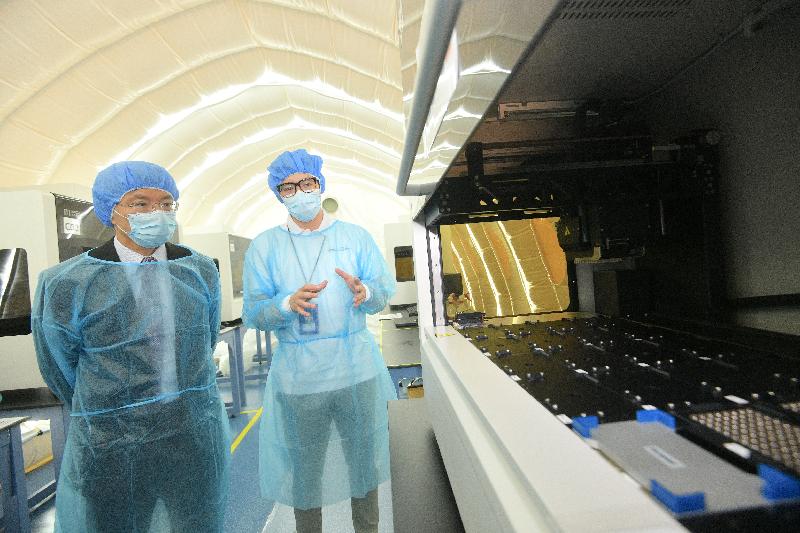
Temporary air-inflated laboratory geared up (with photos/video)

     The temporary air-inflated laboratory at Sun Yat Sen Memorial Park Sports Centre is now ready, following some two weeks of preparation, to support large-scale testing under the Government’s Universal Community Testing Programme (UCT Programme) to be launched on September 1. For the Mainland nucleic acid test support team (Support Team) which was formed and specifically deployed to Hong Kong by the Central Government to assist the Hong Kong Special Administrative Region (HKSAR) in ramping up testing capacity, its members including laboratory testing personnel recognised in the Mainland have familiarised themselves with the local environment and stand ready for supporting the initiative.
 
     To assist Hong Kong to launch a large-scale universal community testing within a short period of time, the Support Team had earlier assisted in the preparatory work for the temporary laboratory with a view to substantially ramping up the virus testing capacity of Hong Kong. The Permanent Secretary for Food and Health (Health), Mr Thomas Chan, who led the work group on testing of the HKSAR (work group), along with leader of the Support Team, Mr Yu Dewen, as well as members of the work group and the Support Team today (August 26) visited the Sun Yat Sen Memorial Park Sports Centre to inspect the preparation of the temporary air-inflated laboratory and testing procedures. Sunrise Diagnostic Centre Limited, a joint venture with BGI set up in Hong Kong, is responsible for supporting the Support Team in the set up and operation of the temporary air-inflated laboratory. During the visit, representatives of Sunrise Diagnostic Centre had explained in detail various aspects of the preparatory work and operational flow of the temporary air-inflated laboratory.
 
     Mr Chan said that the HKSAR Government expressed heartfelt gratitude to the Central Government for its support to enhance the testing capacity in Hong Kong, which had laid a solid foundation for the UCT Programme. After the inspection, the work group and the Support Team considered that the preparation of the temporary air-inflated laboratory is progressing well and expressed confidence in the smooth operation of the laboratory when the UCT Programme is launched. The Government will endeavour to protect public health and ensure the UCT Programme be implemented in a safe and orderly manner to provide voluntary virus tests for all citizens. He appeals to members of the public to actively participate in the UCT Programme to fight the epidemic together, and to contribute to the eradication and control of epidemic in Hong Kong, paving way for gradual relaxation of social distancing measures and return to normal life.
 
     The Public Health Laboratory Services Branch (PHLSB) of the Department of Health (DH) has been designated by the World Health Organization (WHO) this year as the WHO COVID-19 Reference Lab and WHO COVID-19 external quality assessment programme provider. The PHLSB also provides a quality assessment programme for local laboratories. The temporary air-inflated laboratory had passed the DH’s assessment under the external quality assessment programme and complied with the requirements to provide COVID-19 tests for the Government. The laboratory also meets the requirements of a Biosafety Level 2 laboratory, and has implemented relevant infection control measures to ensure hygiene and appropriate waste management without emission of harmful gas.

Photo  Photo  Photo  Photo  
read more

CHP investigates 24 additional confirmed cases of COVID-19

     The Centre for Health Protection (CHP) of the Department of Health has announced that as of 0.00am, August 26, the CHP was investigating 24 additional confirmed cases of coronavirus disease 2019 (COVID-19), taking the number of cases to 4 735 in Hong Kong so far (comprising 4 734 confirmed cases and one probable case).

     Among the newly reported cases announced, no patient had a travel history during the incubation period.

     The CHP’s epidemiological investigations and relevant contact tracing on the confirmed cases are ongoing. For case details and contact tracing information, please see the Annex or the list of buildings with confirmed cases of COVID-19 in the past 14 days and the latest local situation of COVID-19 available on the website “COVID-19 Thematic Website” (www.coronavirus.gov.hk).

     In view of the severe epidemic situation, the CHP called on members of the public to avoid going out, having social contact and dining out. They should put on a surgical mask and maintain stringent hand hygiene when they need to go out. As a number of recent cases involve elderly people, the CHP strongly urged the elderly to stay home as far as possible and avoid going out. They should consider asking their family and friends to help with everyday tasks such as shopping for basic necessities.

     A spokesman for the CHP said, “Given that the situation of COVID-19 infection remains severe and that there is a continuous increase in the number of cases reported around the world, members of the public are strongly urged to avoid all non-essential travel outside Hong Kong.

     “The CHP also strongly urges the public to maintain at all times strict personal and environmental hygiene, which is key to personal protection against infection and prevention of the spread of the disease in the community. On a personal level, members of the public should wear a surgical mask when having respiratory symptoms, taking public transport or staying in crowded places. They should also perform hand hygiene frequently, especially before touching the mouth, nose or eyes.

     “As for household environmental hygiene, members of the public are advised to maintain drainage pipes properly, regularly pour water into drain outlets (U-traps) and cover all floor drain outlets when they are not in use. After using the toilet, they should put the toilet lid down before flushing to avoid spreading germs.”

     Moreover, the Government has launched the website “COVID-19 Thematic Website” (www.coronavirus.gov.hk) for announcing the latest updates on various news on COVID-19 infection and health advice to help the public understand the latest updates. Members of the public may also gain access to information via the COVID-19 WhatsApp Helpline launched by the Office of the Government Chief Information Officer. Simply by saving 9617 1823 in their phone contacts or clicking the link wa.me/85296171823?text=hi, they will be able to obtain information on COVID-19 as well as the “StayHomeSafe” mobile app and wristband via WhatsApp.

     To prevent pneumonia and respiratory tract infections, members of the public should always maintain good personal and environmental hygiene. They are advised to:

• Wear a surgical mask when taking public transport or staying in crowded places. It is important to wear a mask properly, including performing hand hygiene before wearing and after removing a mask;
• Perform hand hygiene frequently, especially before touching the mouth, nose or eyes, after touching public installations such as handrails or doorknobs, or when hands are contaminated by respiratory secretions after coughing or sneezing;
• Maintain drainage pipes properly and regularly (about once a week) pour about half a litre of water into each drain outlet (U-trap) to ensure environmental hygiene;
• Cover all floor drain outlets when they are not in use;
• After using the toilet, put the toilet lid down before flushing to avoid spreading germs;
• Wash hands with liquid soap and water, and rub for at least 20 seconds. Then rinse with water and dry with a disposable paper towel. If hand washing facilities are not available, or when hands are not visibly soiled, performing hand hygiene with 70 to 80 per cent alcohol-based handrub is an effective alternative;
• Cover your mouth and nose with tissue paper when sneezing or coughing. Dispose of soiled tissues into a lidded rubbish bin, then wash hands thoroughly; and
• When having respiratory symptoms, wear a surgical mask, refrain from work or attending class at school, avoid going to crowded places and seek medical advice promptly. read more