Author Archives: hksar gov

CHP investigates imported measles case

     The Centre for Health Protection (CHP) of the Department of Health (DH) today (May 22) is investigating an imported measles case and reminded members of the public who are non-immune to measles to ensure that they have completed two doses of measles vaccination before travelling to reduce the risk of infection.

     The case involves a 29-year-old female who developed fever since May 14. She sought medical attention from a private doctor and attended the Accident and Emergency Department of Tuen Mun Hospital on May 14 and 15 respectively. She developed cough, runny nose and rash on May 16. She attended the Hong Kong Adventist Hospital – Tsuen Wan on May 18 and was admitted for treatment. Her clinical specimen was tested positive for the measles virus upon nucleic acid testing. She was discharged on May 19. 

     The case travelled to the Philippines during the incubation period (April 30 to May 6). As she did not have contact with measles patients in Hong Kong, the case was classified as an imported case.

    She had worked in three schools and a residential care home for the elderly (RCHE) during the communicable period. The CHP has maintained a close liaison with the schools and RCHE for follow-up on the contacts of the case. The CHP has reached 135 contacts in the abovementioned four institutions, no high risk persons have been identified and all were asymptomatic. The CHP assessed that they all have immunity against measles (completed two doses of measles vaccination or born before 1967). The CHP will continue to put the four institutions under medical surveillance and relevant management of the institutions was requested to report to the CHP if any persons develop measles symptoms for follow up.
   
     The CHP’s investigation is ongoing.

     Recently, the number of measles cases in some overseas countries has been increasing. The outbreaks in North America (including the United States and Canada), Europe and neighbouring areas (including Vietnam, Cambodia and the Philippines) are ongoing due to the relatively low vaccination rate. Furthermore, an increasing number of measles cases have also been recorded in Japan and Australia this year. Overseas cases mainly affected people who were unvaccinated or had unknown vaccination status. This shows the importance of maintaining a high vaccination rate and herd immunity within the community.

     “The incubation period of measles (i.e. the time from infection to onset of illness) is seven to 21 days. Symptoms include fever, skin rash, cough, runny nose and red eyes. When such symptoms appear, people should wear surgical masks, stay home from work or school, avoid crowded places and contact with unvaccinated people, especially those with weak immune system, pregnant women and children under one year old. Those who suspected they are infected should consult their doctors as soon as possible and inform healthcare workers of their history of exposure to measles,” the Controller of the CHP, Dr Edwin Tsui, said.

      “Under the Hong Kong Childhood Immunisation Programme, the overall immunisation coverage in Hong Kong has been maintained at a very high level through the immunisation services provided by the DH’s Maternal and Child Health Centres and the School Immunisation Teams. As evidenced by the findings on vaccination coverage of primary school students and the territory-wide immunisation surveys conducted regularly by the DH, the two-dose measles vaccination coverage has remained consistently high, well above 95 per cent, and the local seroprevalence rates of measles virus antibodies reflect that most of the people in Hong Kong are immune to measles. However, Hong Kong, as a city with a high volume of international travel, still faces the potential risk of importation of measles virus and its further spread in the local community. Hence, a small number of people who have not completed measles vaccination (such as non-local born people including new immigrants, foreign domestic helpers, overseas employees and people coming to Hong Kong for further studies) are still at risk of being infected and spreading measles to other people who do not have immunity against measles, such as children under one year old who have not yet received the first dose of measles vaccine,” he added.

     Dr Tsui also noted that people born before 1967 could be considered to have acquired immunity to measles through natural infection, as measles was endemic in many parts of the world and in Hong Kong at that time. People born in or after 1967 who have not yet completed the two doses of measles vaccination or whose measles vaccination history is unknown, to consult their family doctors as soon as possible to complete the vaccination and ensure adequate protection against measles. For those who plan to travel to measles-endemic areas, they should check their vaccination records and medical history as early as possible. If they have not been diagnosed with measles through laboratory tests and have never received two doses of measles vaccine or are not sure if they have received measles vaccine, they should consult a doctor at least two weeks prior to their trip for vaccination.

     Besides being vaccinated against measles, members of the public should take the following measures to prevent infection:
 

  • Maintain good personal and environmental hygiene;
  • Maintain good indoor ventilation;
  • Keep hands clean and wash hands properly;
  • Wash hands when they are dirtied by respiratory secretions, such as after sneezing;
  • Cover the nose and mouth while sneezing or coughing and dispose of nasal and mouth discharge properly;
  • Clean used toys and furniture properly; and
  • Persons with measles should be kept out of school till four days from the appearance of a rash to prevent the spread of the infection to non-immune persons in school.
  
     For more information on measles, the public may visit the CHP’s measles thematic page. Members of the public who are going to travel can visit the website of the DH’s Travel Health Service for news of measles outbreaks outside Hong Kong. read more
Speech by Acting SCED at launch event of Business Climate Survey for Swedish Companies in Hong Kong SAR 2025 (English only)

     Following is the speech by the Acting Secretary for Commerce and Economic Development, Dr Bernard Chan, at the launch event of the Business Climate Survey for Swedish Companies in Hong Kong SAR 2025 (Business Climate Survey 2025) today (May 22):
 
Secretary Jevrell (State Secretary to the Minister for International Development Cooperation and Foreign Trade of Sweden, Mr Håkan Jevrell), Consul General Bergholm (Consul General of Sweden in Hong Kong, Ms Louise Bergholm), distinguished guests, ladies and gentlemen,

     Good evening. My pleasure to join you all today. This annual Business Climate Survey is indeed a valuable resource for understanding the perceptions and experiences of Swedish businesses in our city. I would like to sincerely congratulate Team Sweden for this initiative.

     Hong Kong and Sweden have been enjoying a mutually beneficial relationship. Among the European Union member states, Sweden is our fourth-largest partner in services trade and 13th-largest partner in merchandise trade. In 2024, the merchandise trade between the two places amounted to HK$6.6 billion, a testament to the robust economic ties between the two economies. Hong Kong is also home to several world-renowned Swedish companies, such as IKEA and H&M, whose high-quality products have become household names in our city. We deeply value their contributions to Hong Kong’s economy and society.

     The annual report reveals that Swedish businesses in Hong Kong perceive an improvement in the business climate compared to last year. This is indeed encouraging news, and it reaffirms Hong Kong’s position as an important regional hub and an attractive destination for Swedish companies to establish and expand their operations. Hong Kong’s competitive advantages, which include the rule of law, free flow of capital, a free trade and investment regime, and an efficient and clean government, all remain intact. Together with our low, simple and competitive tax system, open business environment, world-class infrastructure and multicultural talent pool, Hong Kong continues to offer unparalleled advantages for businesses from around the globe.

     Like Sweden, Hong Kong is a staunch supporter of free trade. As a founding member of the World Trade Organization, we have never implemented any customs tariffs. We will continue to uphold the principle of free trade and firmly oppose any unilateral and bullying actions that undermine the global trading system.

     Despite the challenges posed by the economic slowdown in overseas markets and the impact of geopolitics, the Hong Kong Special Administrative Region (HKSAR) Government has been actively working to consolidate our status as an international trade centre through diversified measures. Under “one country, two systems”, Hong Kong has the unique advantage of connecting both the Mainland and the rest of the world. We are committed to seizing opportunities to strengthen our international ties, particularly through closer partnerships with the Guangdong-Hong Kong-Macao Greater Bay Area and the expansion of overseas markets. In the face of a complex and ever-changing global trade landscape, we will do our best to turn risks into opportunities, ensuring the sustainable development of Hong Kong as a global trade hub.
 
     According to the latest annual survey in 2024, Hong Kong has a record high of 9 960 companies with overseas or Mainland parent companies, including around 100 from Sweden, representing a year-on-year increase of over 7 per cent. These figures underscore Hong Kong’s growing attractiveness as a destination for global businesses, including those from Sweden.

     As shown in the findings of this year’s Business Climate Survey, our city’s institutional fundamentals and core strengths, such as our common law system, regulatory regime aligned with international rules, as well as key national strategies like the Greater Bay Area development and the Belt and Road Initiative, are key reasons why so many Swedish companies have chosen to establish their presence here. The HKSAR Government will continue to work hard to maintain and enhance our favourable business environment.

     To promote the development of strategic industries, Hong Kong is actively seeking technology partnerships in areas such as green tech, climate solutions and sustainable urban development, where Sweden excels. We believe that Swedish innovation in clean energy, circular economy and smart cities aligns perfectly with Hong Kong’s development goals. Our investment promotion agency, Invest Hong Kong (InvestHK), along with its consultant office in Gothenburg, will continue to provide one-stop customised support services to Swedish businesses exploring opportunities in our city.

     In short, Hong Kong is the only place in the world where the global advantage and the China advantage converge in a single economy. Our city is an ideal destination for Swedish businesses and investment, especially for those looking to enter the vast market of Mainland China.

     Before I conclude, I would like to take this opportunity to invite you all to the upcoming European Community Networking Reception 2025, to be held on June 4. This event will provide a wonderful platform for you to connect, collaborate and explore new business opportunities with fellow European companies. Your presence would undoubtedly enrich our discussions and networking. For more information, please visit InvestHK’s website. I look forward to seeing you there.

     In closing, I would like to congratulate again Team Sweden on the successful launch of the 2025 Business Climate Survey. Hong Kong remains committed to fostering a business-friendly environment and strengthening our ties with Sweden. Together, we can unlock new opportunities and achieve greater success in the years to come.

     Thank you so much. Enjoy the evening. read more

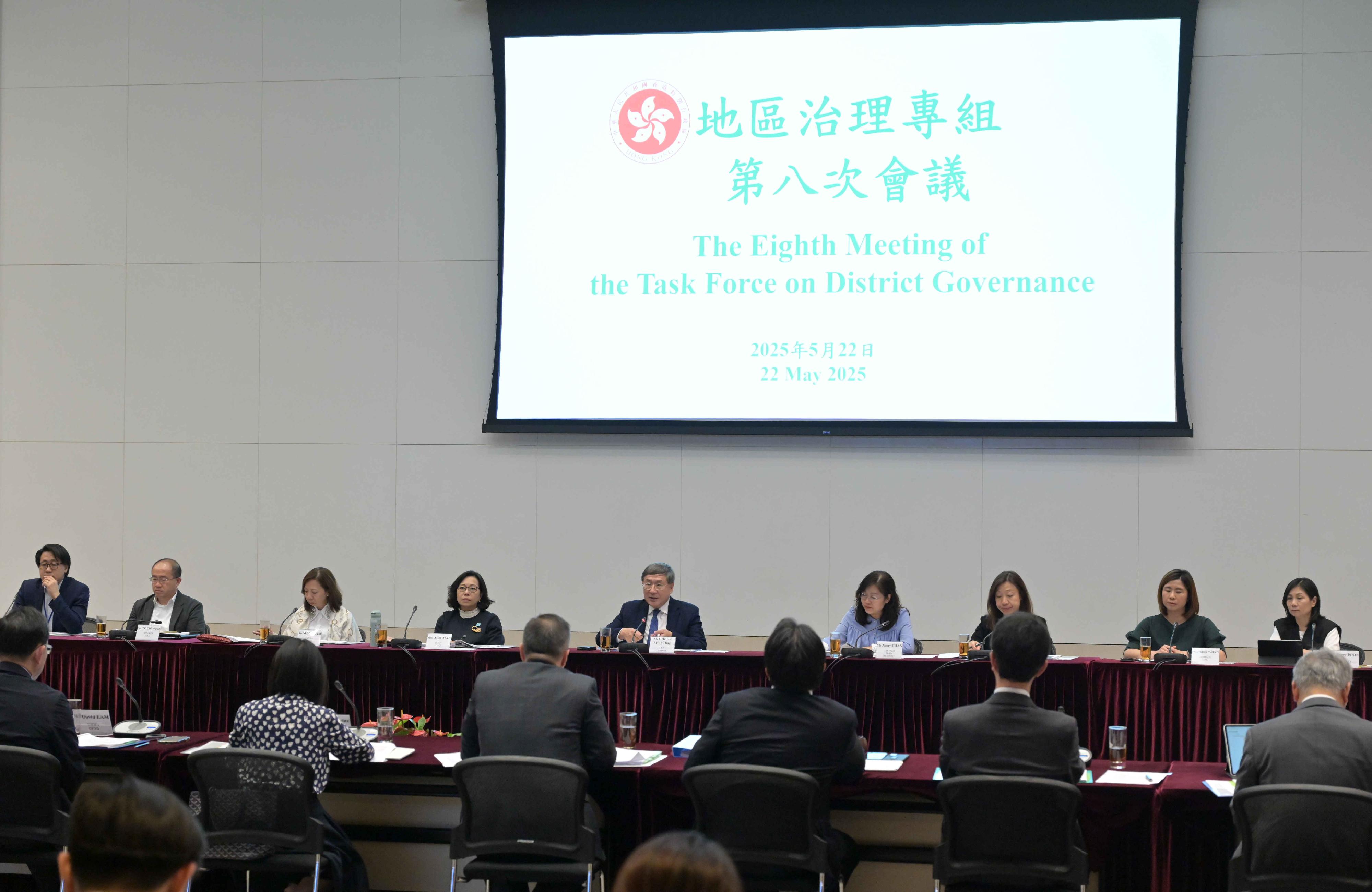
DCS chairs eighth meeting of Task Force on District Governance (with photos)

     The Deputy Chief Secretary for Administration, Mr Cheuk Wing-hing, chaired the eighth meeting of the Task Force on District Governance today (May 22) to follow up on the initiatives in accordance with the work assigned by the Steering Committee on District Governance. The meeting co-ordinated various departments in formulating specific implementation measures on issues of local concern and continuously reviewed the work progress and performance.
      
     Mr Cheuk said, “With the full implementation of the improved district governance structure, various policies and measures have been carried out in accordance with the overall strategies set by the Steering Committee, leading to concrete improvements in district facilities and environmental hygiene. The Task Force will continue to co-ordinate departments in optimising resources and deepening collaboration to advance people-centric measures and unite community efforts in building a better home.”

     The Steering Committee chaired by the Chief Secretary for Administration has formulated strategies for 12 district issues, including multiple measures to enhance the local environment and improve streetscapes to create a more comfortable and livable environment while boosting the city’s appeal to tourists. The Task Force followed up at the meeting on the implementation progress and outcome of relevant initiatives, including:

1. Combating air-conditioner water dripping to improve community environment

     The Food and Environmental Hygiene Department (FEHD) is adopting a multipronged approach from May to September 2025 to address air conditioner water-dripping nuisances at 30 blackspots which particularly affect commuters at bus stops, including public education and stringent enforcement. In respect of publicity and education, as of April 30, the FEHD distributed around 16 000 leaflets and posters across 495 buildings and housing estates, reminding residents to take proactive measures to reduce dripping-related disturbances. By May 15, the FEHD had inspected 306 private buildings and estates, and issued 180 statutory “Nuisance Notices” to owners/residents responsible for hygiene disturbances caused by dripping air conditioners, requiring them to abate the nuisance within a specified period.

2. Cleaning pedestrian walkways to improve city streets

     Starting in February 2025, the FEHD launched cleaning operations at 81 selected locations across the territory, utilising mini street-washing vehicles equipped with pressure washer surface cleaners and high-pressure hot water cleaners to remove stubborn stains and moss. After three months, significant improvements were observed at these sites. The FEHD has since May expanded the operations to 80 additional locations with street cleanliness issues.

3. Strengthening thematic planting

     To enrich urban landscapes and boost tourist appeal, relevant departments plan to plant more flowering trees across 11 new projects in 2025, creating visually appealing neighborhoods. Two beautification projects were completed in Q1 2025, including planting about 40 Cassia bakeriana along major pedestrian pathways at the Kai Tak Sports Park, and introducing over 300 ornamental trees, such as Liquidambar formosana, pink trumpet trees, jacaranda and Indian almond at Shing Fung Road Park in Kowloon City. The relevant departments will continue to implement the various beautification projects during the remainder of this year. These include planting flowering plants near various competition venues to enhance the surroundings in preparation for the 15th National Games in November; and adding decorative lights to trees in the piazza of the Hong Kong Cultural Centre to create a more vibrant night-time atmosphere.

4. Enhancing the community environment and strengthening local characteristics

     The Highways Department (HyD) has undertaken renovation and beautification works for 36 footbridges and tunnels, with 26 structures already completed. The HyD has also identified four locations for streetscape enhancements, featuring installation of thematic manhole covers, replacement of pavement tiles, and large-scale aesthetic upgrades to lampposts, thereby reinforcing local characteristics and scenery.

     The Task Force also reviewed at the meeting the arrangements for displaying publicity materials to celebrate the 28th anniversary of the establishment of the Hong Kong Special Administrative Region and received reports on the work of relevant departments on other eight key district issues (Note).

     Mr Cheuk said, “This year marks the 28th anniversary of the return of Hong Kong to our motherland and the fifth anniversary of the promulgation and implementation of the Law of the People’s Republic of China on Safeguarding National Security in the Hong Kong Special Administrative Region. I urge all departments to unite, leverage the strengths of our enhanced district governance system, and jointly foster a vibrant festive atmosphere for celebrations and major events, deepening people’s sense of patriotism.”
 
Note: The eight key issues include: (1) expanding after-school care and enhancing support for parents; (2) caring for the elderly and enhancing community support; (3) fostering clean markets and mobilising the community to participate in anti-rodent work; (4) enhancing public order and combating crimes on all fronts; (5) improving pedestrian facilities and ensuring road safety; (6) improving the environment of public housing estates and creating comfortable homes; (7) caring for the elderly and promoting digital inclusion; and (8) Improving the waiting environment at public transport interchanges to enhance the travel experience.

Photo  
read more

CHP investigates case of invasive meningococcal infection

     The Centre for Health Protection (CHP) of the Department of Health today (May 22) is investigating a case of invasive meningococcal infection, and reminds the public to avoid direct contact with droplets from carriers or infected persons and to maintain good personal and environmental hygiene at all times to minimise the risk of contracting this serious disease.
      
     The case involved a 68-year-old male with underlying illnesses, who presented with fever, left knee pain and swelling on May 17. He attended the Accident and Emergency Department of Pamela Youde Nethersole Eastern Hospital on May 18 and was admitted for treatment on the same day. His left knee joint fluid specimen tested positive for Neisseria meningitidis upon laboratory testing. The clinical diagnosis was septic arthritis of the left knee. The patient is now in a stable condition.
      
     An initial investigation revealed that the patient had no travel history during the incubation period. His home contacts have remained asymptomatic so far. The CHP’s investigation is ongoing.
    
     Meningococcal infection is one of the statutory notifiable diseases. As of today, the CHP has recorded six cases this year.

     Meningococcal infection is caused by a bacterium known as meningococcus. It is mainly transmitted by direct contact with respiratory secretions, including droplets from the nose and throat, of infected persons. Severe illness may result when the bacteria invade the bloodstream (meningococcaemia) or the membranes that envelop the brain and spinal cord (meningococcal meningitis). Meningococcaemia is characterised by a sudden onset of fever, an intense headache, purpura, shock and even death in severe cases. Meningococcal meningitis is characterised by high fever, severe headache, stiff neck followed by drowsiness, vomiting, fear of bright light, or rash; it can cause brain damage or even death.
      
     To prevent meningococcal infection, members of the public are advised to take the following measures: 
 

  • Wash hands with liquid soap and water properly, especially when they are soiled by respiratory secretions, e.g. after sneezing, and clean hands with alcohol-based handrub when they are not visibly soiled;
  • Cover the nose and mouth when sneezing or coughing, hold the spit with a tissue, dispose of nasal and mouth discharge in a lidded rubbish bin, and wash hands immediately;
  • Avoid crowded places;
  • Avoid close contact with patients who have a fever or severe headache;
  • Consult doctors about meningococcal vaccination before travelling to high-risk areas; and
  • Seek medical advice if you become ill after returning from high-risk areas, and discuss your recent travel history with your doctor.
 
     The public may visit the CHP’s website for more information on meningococcal infection. read more