Author Archives: hksar gov

Hainan and Hong Kong sign Memorandum of Cooperation in Boao, Hainan (with photos/video)

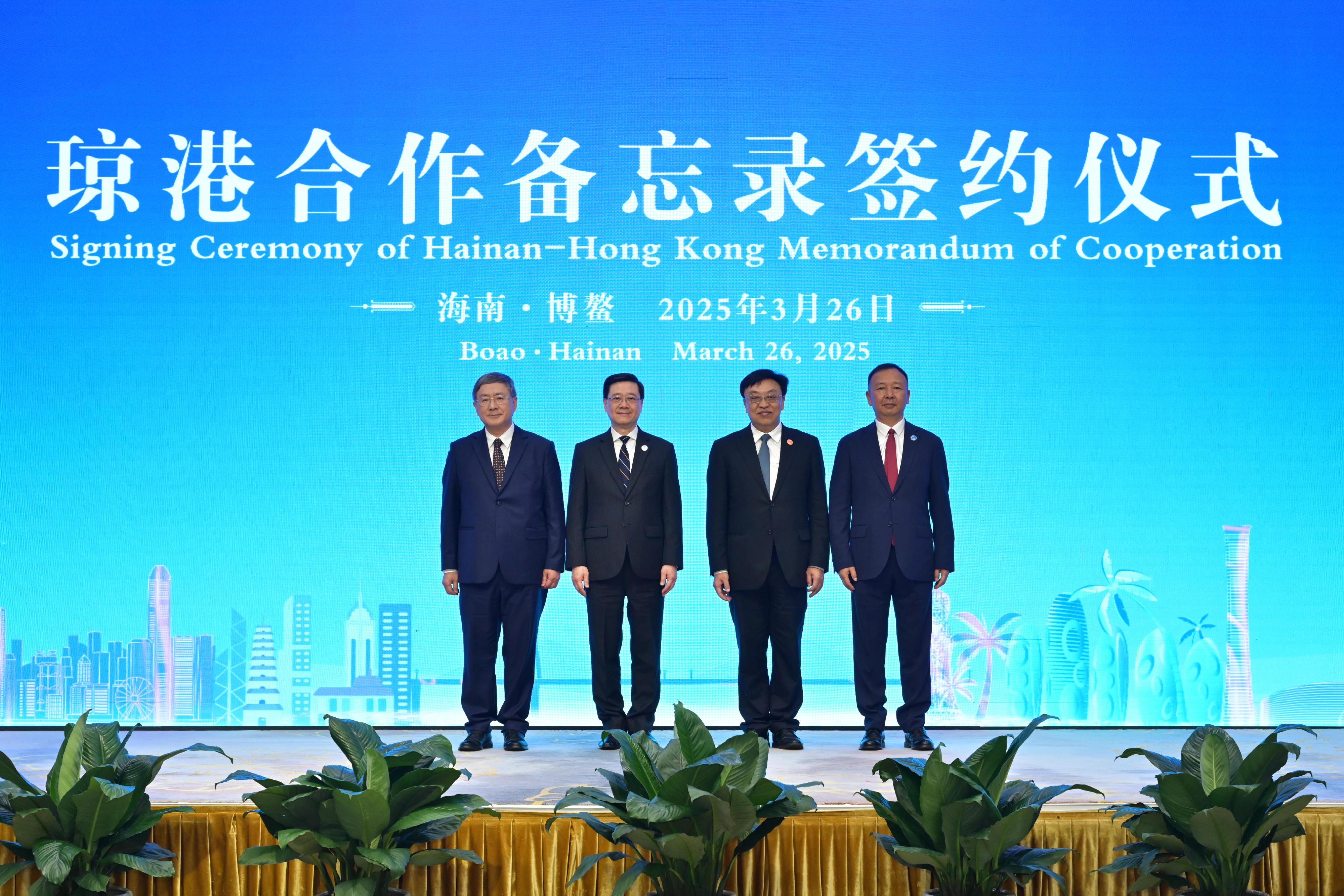
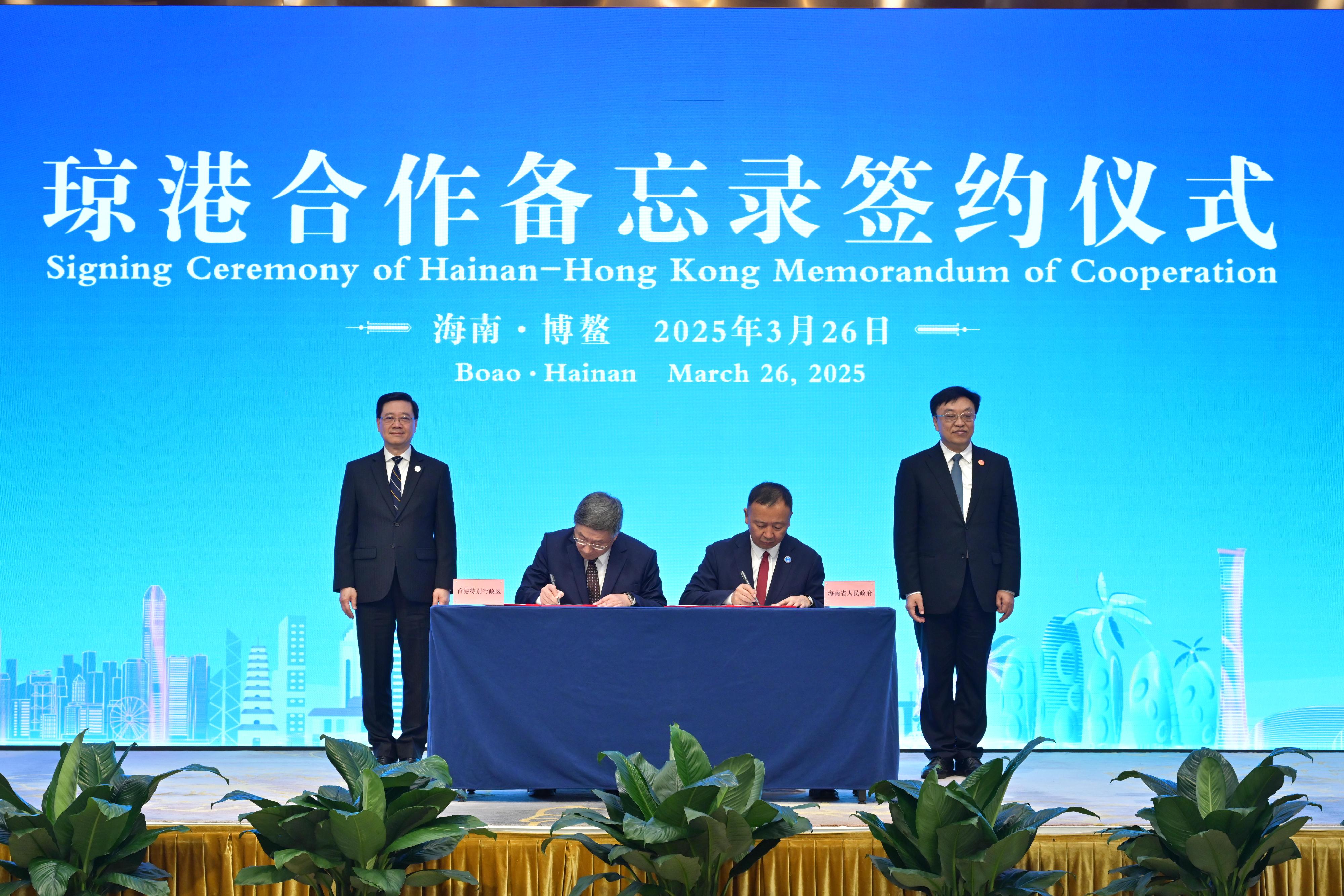
     The Chief Executive, Mr John Lee, attended the Signing Ceremony of Hainan Hong Kong Memorandum of Cooperation in Boao, Hainan, today (March 26) and, together with the Secretary of the CPC Hainan Provincial Committee, Mr Feng Fei, witnessed the signing of the Hainan Provincial People’s Government and Hong Kong Special Administrative Region Government (HKSAR) Memorandum of Cooperation by the Deputy Chief Secretary for Administration, Mr Cheuk Wing-hing, and Vice Governor of Hainan Provincial People’s Government Mr Bateer.

     Deputy Director of the Liaison Office of the Central People’s Government in the HKSAR Mr Qi Bin also attended the signing ceremony. Officials of the HKSAR Government who also attended the conference included the Deputy Chief Secretary for Administration, Mr Cheuk Wing-hing; the Secretary for Innovation, Technology and Industry, Professor Sun Dong; the Director of the Chief Executive’s Office, Ms Carol Yip; and the Under Secretary for Constitutional and Mainland Affairs, Mr Clement Woo.

     Hong Kong and Hainan reached consensus on the following five co-operation areas:

Trade and Investment

     Actively explore the expansion of in-depth co-operation in the areas of medicine, finance, commerce and trade, tourism and culture, and data services industries.

     Leverage the role of the Hainan Free Trade Port in expanding the room for Hong Kong’s development. Promote Hong Kong’s better integration into the overall development of the country and leverage Hong Kong’s distinctive advantages as a “super-connector”.

     Support Hong Kong enterprises in participating in the China International Consumer Products Expo and encourage Hainan enterprises and associations to organise and participate in trade fairs in Hong Kong.

Finance

     Encourage enterprises from the Hainan Free Trade Port to issue bonds in Hong Kong and support high-quality enterprises from the Hainan Free Trade Port in listing in Hong Kong.

Safe and Orderly Flow of Data

     Promote the safe and orderly flow of data between Hainan and Hong Kong, and jointly promote co-operation in data services between the two sides.

Tourism

     Support the tourism industry of Hainan in commencing joint international marketing and develop products for multi-destination tourism with the travel trade and aviation sector of Hong Kong.

Talent Exchange

     Pursue further opening up of more sectors of Hainan’s services market to Hong Kong, including finance, legal services, accounting, consulting, convention and exhibition, architectural and planning, under the framework of the Agreement on Trade in Services of Mainland and Hong Kong Closer Economic Partnership Arrangement (CEPA), with a view to expanding the scope for practice by Hong Kong’s professional services sector while lifting the standard of internationalisation of Hainan’s professional services sector.

     Based on their Hong Kong professional qualifications, allow Hong Kong professionals with qualifications listed in the recognised Hong Kong professional qualifications directory to provide relevant professional services to enterprises and residents in the Hainan Free Trade Port, upon approval by the relevant authorities of the professional industries.

     The document (Chinese only) is in the Annex.

Photo  Photo  Photo  
read more

LCQ6: Land grant policy

     Following is a question by Dr the Hon Wendy Hong and a reply by the Secretary for Development, Ms Bernadette Linn, in the Legislative Council today (March 26):
 
Question:
 
     Regarding the land grant policy, will the Government inform this Council:
 
(1) of the current number of sites granted by the Government under short-term tenancies (STTs), the area of the sites involved and their utilisation (including their uses and actual tenancy periods);
 
(2) as it is learnt that the Government will resume and re-tender sites with expired STTs, or renew such tenancies with the same tenants on a quarterly basis, and that about 40 per cent of the STT tenants have rented the relevant sites for over 20 years after repeated renewals of tenancies, with the longest period being 55 years, and there are views pointing out that the continuous renewal of tenancies with the same tenants has turned STTs into long-term tenancies, whether the Government will rationalise the current STT policy to reduce instances of constantly re-tendering existing sites or continuously renewing their tenancies on a quarterly basis, and provide medium to long-term land tenancies of, for example, 10 to 20 years for industries with demand, large investments and long payback periods, so as to facilitate enterprises’ long-term planning and investments, and increase the Government rent revenue and potential tax revenue for the Government; and
 
(3) given that the Government will grant land by way of private treaty for specified use for a longer term in justified circumstances to meet Hong Kong’s economic, social and community needs, and in the light of the current objective of promoting the diversification of industries and re-industrialisation, whether the Government will grant more land by such way, so as to provide operating sites with more certainty for the development of the industries concerned?
 
Reply:
 
President,
 
     The Government grants land in different ways to support economic development.
      
     In particular, the Government will normally grant leases with a 50-year tenure for commercial or industrial sites which are suitable for long-term development by way of open tender. Another way is private treaty grant (PTG) whereby, under the premise of facilitating implementation of individual policy and social development, land is directly granted to designated enterprises or institutions without tender for specified use with policy support. PTGs are mostly for special purpose leases and, subject to policy consideration, the lease tenure may be shorter than 50 years. Whether the land is granted by way of tender or PTG, both methods involve granting land in the form of land lease, which bring greater certainty for leaseholders and is conducive to long-term planning and investment. With the benefit of lease certainty, leaseholders are required to make a one-off upfront payment for land premium before execution of the leases.
      
     On the other hand, the Government also grants short term tendencies (STTs) by way of tender or direct grant. STTs support various social and economic activities and bring regular rental revenue for the Government. According to the land policy implemented for years, the fixed term of STT normally does not exceed seven years, and the tenancy may continue subject to the circumstances upon expiry of the fixed term. While the fixed term of STT is normally shorter than the tenure of a land lease, it provides greater flexibility for the Government in terms of land use and is particularly suitable for Government land not yet needed for long-term development or in respect of which the long-term planned use has yet to be determined. Tenants are also not required to pay an upfront lump sum of land premium, but only need to make regular rent payment and accept periodic market rental adjustment by the Government within the tenancy period, which is also a merit to tenants.
 
     My reply to the various parts of the question raised by Dr the Hon Hong is as follows:
 
(1) As of end-February 2025, the Lands Department (LandsD) managed over 5 800 STTs (involving a total of around 3 000 hectares of land), covering many different uses. STTs for uses related to people’s daily lives take up around 60 per cent, which include public fee-paying carparks, education, social welfare, religion, leisure and recreation, etc.; while STTs for commercial and economic activities take up around 40 per cent, which include shops, workshops, cargo container handling, open or indoor storage, shipyards, etc.
 
(2) Upon expiry of the STT fixed term, if the site is still not needed for long-term development in the coming few years, the LandsD will normally re-tender the site so as to give other interested operators in the market fair opportunities of bidding the site and maintain healthy competition. That said, many direct grant STTs related to commercial or economic activities may, with policy support or owing to special historical reasons, continue quarterly for a relatively long period upon expiry of the fixed term. According to the statistics of LandsD, among the direct grant STTs, there are some 1 600 cases with cumulative tenancy period exceeding 10 years after multiple renewals. Each of these cases has its specific reasons, with the majority of which (over 1 400 cases) belong to a few major categories, including STTs granted for relocation of businesses affected by public works (such as shipyards in earlier years); STTs gradually converted from Government land licences in the early years (usually for shops or workshops); and some sites for public utilities or franchise operation (such as franchised bus depots). 
 
     Currently, the main options under our land grant policy are land leases with tenure as long as 50 years or STTs with a fixed term of at most seven years. We agree that there is room to review whether STTs with a fixed term longer than seven years could be granted to encourage long-term planning and investment by industries and to meet the diversified demand for economic land. In this regard, the Development Bureau (DEVB) will approach different policy bureaux to understand the nature and needs of various industries and economic activities, and study whether there may be a more flexible arrangement in terms of granting STTs. As mentioned above, while tenants of STTs do not need to pay an upfront land premium under tenancies, they will need to face the uncertainty during the longer tenancy period arising from periodic rental adjustment due to the longer tenure. Therefore, different operators may have different views on this issue. On the other hand, if the Government grants land via tenancies with longer period without adopting the mode of land lease that charges an upfront land premium, we will also need to consider the financial implications to the Government. Nevertheless, we are willing to tap the views of Members and the trade during the review.
 
(3) To tie in with the policy goal of developing innovation and technology and other emerging industries, as well as the “industry-driven” land planning approach emphasised in the Northern Metropolis, the DEVB will, from the perspective of land administration policy, support the relevant bureaux in exploring and adopting different modes of land grant, including considering the granting of sites for industries by way of open tender, restricted tender, or PTG so as to attract leading Mainland and overseas enterprises to come to Hong Kong for bringing in new capital and technology and generating job opportunities as well as creating new growth areas for our economy. We believe that the relevant bureaux will make announcement at suitable juncture on the appropriate arrangement for the industries under their policy purview. read more
CE continues visit to Hainan (with photos/videos)

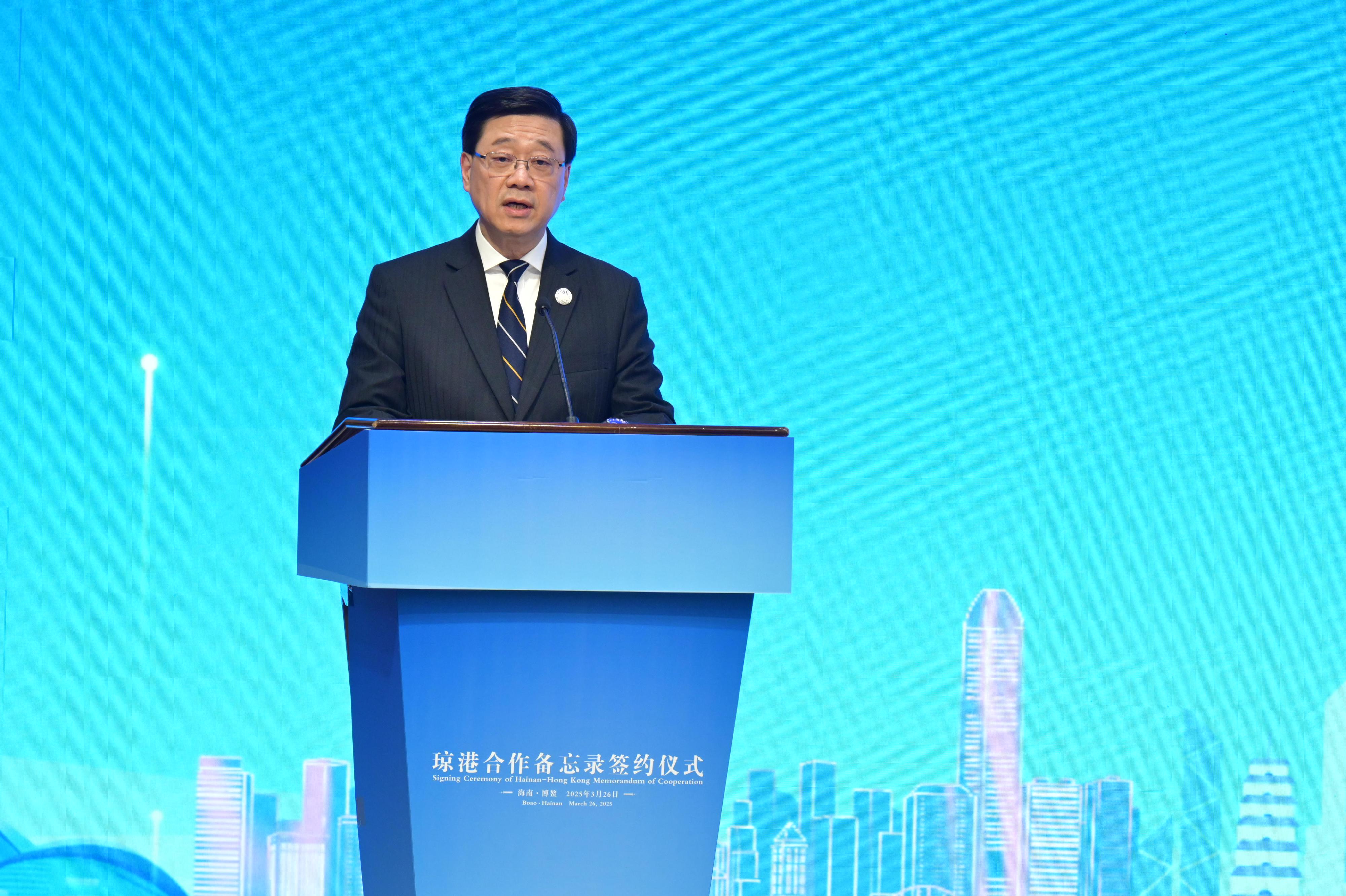
     â€‹The Chief Executive, Mr John Lee, continued his visit to Hainan today (March 26) to meet with leaders of Hainan Province and witness the signing of a Memorandum of Cooperation between the Hong Kong Special Administrative Region (HKSAR) Government and the People’s Government of Hainan Province. He also exchanged views with young people from Hong Kong who are starting businesses and working in Hainan.

     In the morning, Mr Lee met with the Secretary of the CPC Hainan Provincial Committee, Mr Feng Fei, to exchange views on enhancing Hong Kong’s co-operation with Hainan. Noting the close economic and trade ties between Hong Kong and Hainan, Mr Lee said that Hong Kong has long been the major source of external investment in Hainan, with many Hong Kong enterprises conducting business in the province. In 2024, more than 700 Hong Kong enterprises were established in Hainan, and the realised direct investment from Hong Kong was RMB15 billion. With the customs closure operation of the Hainan Free Trade Port and the implementation of preferential policies, Hong Kong enterprises and professionals will have more development opportunities in Hainan.

     After the meeting, Mr Lee and Mr Feng attended the Signing Ceremony of the Hainan-Hong Kong Memorandum of Cooperation. They witnessed the signing of the Memorandum of Cooperation between the HKSAR Government and the People’s Government of Hainan Province on deepening co-operation in five areas, namely trade and investment, finance, safe flow of data, tourism, and talent exchanges.

     Mr Lee noted that the HKSAR Government is fully leveraging Hong Kong’s unique advantages under the “one country, two systems” principle of having strong support of the country while maintaining unparalleled connectivity with the world. Hong Kong is committed to contributing to the introduction of international projects to Hainan and facilitating Hainan’s capital investments in overseas markets, with a view to jointly venturing into the global market with Hainan. The HKSAR Government will promote collaborative development and mutual benefits between the Guangdong-Hong Kong-Macao Greater Bay Area (GBA) and the Hainan Free Trade Port, making greater contributions to the country’s high-quality development and high-level opening up.

     In the afternoon, Mr Lee met with young people from Hong Kong who are working and starting businesses in Hainan to learn about their daily lives and latest developments. He encouraged them to better understand the scope and policies covered in the Memorandum of Cooperation signed by the governments of the two places to seize the opportunities within and realise their aspirations. He also called on the young people to contribute to fostering mutual engagement and integrated development between citizens of the two places.

     In the evening, Mr Lee attended a dinner hosted by the organiser of the Boao Forum for Asia.

     Mr Lee will continue his visit tomorrow (March 27) to attend the opening plenary of the Boao Forum for Asia Annual Conference 2025.

Photo  Photo  Photo  Photo  Photo  Photo  Photo  Photo  Photo  Photo  
read more

CHP investigates suspected food poisoning case related to wild mushrooms

     â€‹The Centre for Health Protection (CHP) of the Department of Health is today (March 26) investigating a suspected case of food poisoning related to the consumption of wild mushrooms, and urged the public not to pick and eat wild mushrooms.
      
     The case involves a 60-year-old female who developed sweating, increased salivation, vomiting and diarrhoea about 15 minutes after consuming self-picked wild mushrooms yesterday (March 25). She sought medical attention at the Accident and Emergency Department of North Lantau Hospital and was admitted for further observation the same day. She is in stable condition.
      
     The CHP’s investigation is ongoing.
      
     Members of the public should not pick wild mushrooms for consumption as it is difficult to distinguish edible mushroom species from inedible ones. Mushroom poisoning is generally acute. Common presentations include gastrointestinal symptoms such as nausea, vomiting and abdominal pain appearing shortly after ingestion. Depending on the mushroom species, patients may also have other symptoms such as profuse sweating, hallucinations, a coma or other neurological symptoms, as well as liver failure. Death may result in severe cases.
      
     If mushroom poisoning is suspected, the patient should seek immediate medical attention and bring along any available remnant for identification. read more

Hong Kong Customs combats illegal streaming of TV channels and infringing anime videos (with photo)

     Hong Kong Customs conducted an enforcement operation yesterday (March 25) to combat infringement activities involving illegal communication of TV channels and infringing anime videos to the public by streaming technology. During the operation, Customs seized two TV decoders of pay TV channels, a TV signal receiver set, three sets of computer servers suspected to be used for illegal streaming, a computer used for remote server operation, a mobile phone and an assortment of electronic equipment and audio-visual devices with a total estimated market value of about $40,000. 

     Customs earlier received information from a copyright owner alleging that someone had set up a web page to distribute copyright-protected pay-TV channels through streaming technology without the authorisation of the copyright owner. Customs officers then initiated an investigation and identified an individual, registered as a user of local pay TV channels, who utilised advanced digital technologies to bypass the digital rights protection measures enforced by copyright owners and communicate the pay-TV channels to the public. Furthermore, the user employed a specialised TV signal receiver and illegal streaming software hosted on the computer servers for the illegal communication of local free TV channels via webpages. The subject promoted this service as a “digital TV retransmission station” to attract Internet users. Additionally, it was discovered that the subject separately set up another website to offer a substantial collection of suspected infringing animated videos for on-demand streaming.

     After a comprehensive investigation and with the assistance of the copyright owner, Customs yesterday raided a residential unit in Tsuen Wan. During a live broadcast of overseas basketball matches, Customs utilised computer forensic programmes to conduct real-time monitoring over related suspected illegal streaming activities and seized the batch of suspected illegal streaming servers and electronic equipment. Officers from the department’s Computer Forensic Laboratory were also summoned to the scene to render support. Through on-site computer evidence collection, over 50 000 digital video files were seized from one of the computer servers, including suspected infringing animated series, movies and variety shows, which were believed to be used for illegal communication.

     During the operation, a 26-year-old man was arrested for operating the websites for suspected infringement activities. He was released on bail pending further investigation. The investigation is ongoing.

     Customs reminds the public not to engage in unauthorised activities involving the dissemination of copyrighted works. Members of public should also respect intellectual property rights and refrain from watching infringing movie/TV works or pay-TV channels through any form of illegal streaming. Webpages, applications or streaming links related to illegal streaming may contain computer viruses or malicious programmes which can pose potential risks to users.

     According to the Copyright Ordinance, it is illegal for anyone, without the authorisation of the copyright owner, to engage in any trade or business that involves communicating works to the public for profit or reward, or in the course of such trade or business, to communicate copyrighted works to the public; or to communicate copyrighted works to the public to an extent that damages the rights of the copyright owner. Upon conviction, the maximum penalty is imprisonment for four years and a fine of $50,000 for each copyrighted work.

     Members of the public may report any suspected infringement activities to Customs’ 24-hour hotline 182 8080 or its dedicated crime reporting email account (crimereport@customs.gov.hk) or online form (eform.cefs.gov.hk/form/ced002).

Photo  
read more