Author Archives: hksar gov

15th National Games Fencing test event to be held this weekend

     â€‹The Challenge Cups Fencing Championships, which is also the 15th National Games (NG) Fencing test event, will be held at Kai Tak Arena, Kai Tak Sports Park this weekend (May 31 and June 1).
   
  The competition event will start at 9am on both days with the participation of over 500 athletes. The event, featuring the open and veteran divisions, consists of men’s and women’s épée, foil and sabre competitions. The épée competition will be staged on the first day, and the foil and sabre competitions will be staged on the next day.
 
     Tickets are distributed to the public through the Fencing Association of Hong Kong, China. Members of the public may register for tickets online from 9am tomorrow (May 29) while stocks last. Those who possess a ticket will undergo a security check at the entrance of Kai Tak Arena and watch the event in the public viewing area. Moreover, a small number of tickets have been reserved for on-site distribution in two sessions. Members of the public who are interested may obtain a ticket at the entrance on level UG of Kai Tak Arena at 9am or 2.30pm on the event days for admission. Each person is entitled to one ticket with free seating on a first-come, first-served basis while stocks last.
 
  Radio Television Hong Kong (RTHK) will provide live broadcasts of parts of the events via RTHK TV 32 and webcast. For details, please visit the RTHK weblink (www.rthk.hk/nationalgames) and their YouTube channel (www.youtube.com/RTHK).
 
  The General Administration of Sport of China in an announcement on May 19 revealed the competition schedule for the 15th NG. The dates of competition events to take place in Hong Kong can be found on the thematic page for the 15th NG (Hong Kong) (www.2025nationalgames.gov.hk/en/ng/schedule.html).
 
  For more information on the 15th NG, the 12th National Games for Persons with Disabilities and the 9th National Special Olympic Games in Hong Kong, please visit the thematic website (www.2025nationalgames.gov.hk/en/index.html), as well as the Facebook page (www.facebook.com/2025nationalgames.hk) and Instagram page (www.instagram.com/2025nationalgames.hk). read more

LCQ10: Arts and mega events

     Following is a question by the Hon Dominic Lee and a written reply by the Secretary for Culture, Sports and Tourism, Miss Rosanna Law, in the Legislative Council today (May 28):

Question: There are views that while Hong Kong has successfully hosted international mega events such as Art Basel Hong Kong in recent years, Singapore has introduced many large-scale events (e.g. concerts by world-renowned singers) through cross-departmental collaboration and dedicated mechanisms, also with notably significant results. In this connection, will the Government inform this Council:

(1) whether it will, with reference to the experience of the Office for Attracting Strategic Enterprises, consider setting up a Committee for Attracting Major Events to coordinate work for attracting major international mega arts events and provide one-stop administrative support to organisers (e.g. assistance with approvals, coordination of venue hiring and cross-border logistics, and provision of ancillary support); if so, of the specific plans (e.g. the terms of reference of the committee and implementation timetable); if not, the reasons for that;

(2) of the respective numbers of large-scale arts events and mega events held in Hong Kong in each of the past five years, and the total amount of resources allocated by the authorities to such events and mega events, together with a breakdown of the amount of subsidies provided by the authorities by name of event; and, among such events and mega events, the percentage of world-class international arts events and mega events (e.g. mega events on the scale of the Venice Biennale);

(3) as it has been learnt that Singapore attracts organizers to hold large-scale arts events and mega events by upgrading venues (e.g. Esplanade – Theatres on the Bay) and providing flexible subsidies, whether the authorities have assessed the competitiveness gap between Hong Kong’s existing venues (e.g. the West Kowloon Cultural District) and those in Singapore; whether it will formulate long-term plans for hardware upgrades and rental concessions to enhance Hong Kong’s competitiveness in hosting mega events; if so, of the details; if not, the reasons for that; and

(4) in order to leverage the benefits of regional collaboration, whether the authorities have plans to collaborate with Mainland cities of the Guangdong-Hong Kong-Macao Greater Bay Area (GBA) in taking forward a collaborative initiative on mega arts events, attracting global event organisers to hold mega events in GBA through joint event planning and preparation, introduction of transportation packages and joint promotional efforts; if so, of the specific cooperation framework and timetable; if not, the reasons for that?

Reply:

President,

My reply to the question raised by the Hon Dominic Lee is as follows:

(1) The Culture, Sports and Tourism Bureau (CSTB) has been striving to consolidate Hong Kong’s position as the capital of international mega arts and cultural events by hosting and supporting more large-scale, diverse and innovative arts and cultural events, thereby providing a platform for East-meets-West international cultural exchange while promoting mega event economy. Furthermore, the Hong Kong Tourism Board has established the Mega Events Development and Advancement Division, which serves as the first point of contact for mega events, and collaborates with stakeholders, such as organisers of mega arts events, to render them various kinds of support, including helping organisers to search venues, arranging site recces, advising on event planning such as date and content and assisting with publicity.

(2) The CSTB set up the Mega Arts and Cultural Events (ACE) Fund in April 2023 to attract and support the staging of international or large-scale arts and cultural events in Hong Kong, with a view to fostering Hong Kong’s development as an East-meets-West centre for international cultural exchange. The Mega ACE Fund has supported 21 mega arts and cultural events so far, in which 11 events have been successfully held in other countries or regions. Among others, the internationally renowned pop culture mega event ComplexCon and the art fair ART021 Hong Kong Contemporary Art Fair were brought to Hong Kong for the first time with the support of the Mega ACE Fund. Details are in the Annex.

(3) The CSTB, the Leisure and Cultural Services Department (LCSD) and the West Kowloon Cultural District (WKCD), endeavour to provide venues for various arts and cultural activities. First of all, with its official commissioning on March 1 this year, the Kai Tak Sports Park (KTSP) provides Hong Kong with the largest and most state-of-the-art venues, including a 50 000-seat Kai Tak Stadium (equipped with a retractable roof and an innovative pitch system), a 10 000-seat Kai Tak Arena (with column-free design and various operational models and seating configurations) and a 5 000-seat Kai Tak Youth Sports Ground. In the past two months, multiple mega sports and entertainment events were successfully held at the KTSP, including large-scale concerts by renowned international and regional bands as well as local singers, which were well received by both citizens and tourists. There will be more entertainment events to be staged at different venues of the KTSP later this year, demonstrating the attractiveness and competitive advantages of its facilities.

     Moreover, we have been allocating resources for building new performance venues and upgrading existing facilities. First, for venues under the LCSD, the newly constructed East Kowloon Cultural Centre as well as the upgraded Tai Po Civic Centre and Sai Wan Ho Civic Centre are expected to be in full operation in 2025. The New Territories East Cultural Centre is also currently under construction. In addition, the Xiqu Centre, the first major performing arts venue of the WKCD, was officially opened in 2019. The WestK Performing Arts Centre of WKCD, which will comprise a 1 450-seat Grand Theatre and a few theatres in smaller scale, is scheduled to be completed in 2026.

     Apart from increasing the number of venues, we also provide facilitation to presenters through enhancing the venue booking arrangements. For example, performance venues under the LCSD currently provide special booking arrangements for large-scale events or programmes that require early planning with special reasons (such as performances involving renowned overseas artists). Presenters can submit booking applications to the LCSD one year in advance and will be given priority consideration to facilitate the organising of mega events. In order to make more precise use of venue resources and release more booking slots for use by different arts groups, we are currently reviewing the usage and hiring arrangements of the LCSD’s performance venues to address to the needs of the arts and culture sector and provide venues for large-scale arts and cultural events. The result will be announced in due course.

(4) The Government has been maintaining close contact with arts and cultural institutions in the Greater Bay Area (GBA) to co-organise large-scale arts and cultural events. The Ministry of Culture and Tourism (MoCT), the People’s Government of Guangdong Province, the Government of the Hong Kong Special Administrative Region (SAR) and the Government of the Macao SAR have been jointly presenting the Guangdong-Hong Kong-Macao Greater Bay Area Culture and Arts Festival (Festival) since 2019. The Festival aims to build a cultural brand of the GBA through presentation and promotion of diversified activities in different cities of the region. At the same time, it aims to encourage audiences from the Mainland and overseas to visit Hong Kong and other cities of the GBA to enjoy performances, exhibitions and other selected activities during the Festival. As the host city of the fourth edition in 2024, Hong Kong planned and coordinated more than 770 live performances, exhibitions and exchange activities as well as over 70 online programmes, attracting more than 2.16 million attendees and over 46 million online viewership. The Festival in 2025 is scheduled for the third quarter.

     On the heritage and museum front, the LCSD will collaborate with various institutions and cultural venues in the GBA from 2024 to 2026 to organise the Ink Art Ensembles exhibition series. The series features five exhibitions in four key cities of the GBA—Shenzhen, Guangzhou, Foshan, and Dongguan. Moreover, the 2024 Hong Kong-Macao Visual Art Biennale, jointly presented by the MoCT, the CSTB, and the Secretariat for Social Affairs and Culture of the Macao SAR, includes a Hong Kong section curated by the Hong Kong Heritage Museum. With the theme of Cultural Integration, the exhibition features a series of artworks across various media. The biennale completed its first two stops in Hangzhou and Nanjing in October 2024 and March 2025 respectively and will continue its tour to Beijing and GBA cities, including Guangzhou and Shenzhen, from June to September 2025.

     Hong Kong will continue to participate in different mega events of the GBA, fostering cultural integration and talent exchanges of the three places, jointly pursuing the inheritance and development of the fine traditions of Chinese culture and opening up international markets, with a view to taking forward the idea of Jointly Developing a Cultured Bay Area as promulgated in the Outline Development Plan for the Guangdong-Hong Kong-Macao Greater Bay Area. read more

LCQ7: Identifying calls from government departments and public organisations

     Following is a question by the Hon Duncan Chiu and a written reply by the Secretary for Commerce and Economic Development, Mr Algernon Yau, in the Legislative Council today (May 28):
 
Question:
 
     It has been reported that telephone frauds have occurred frequently in Hong Kong in recent years and to avoid being defrauded, quite a number of members of the public prefer not answering calls from non-traditional telephone numbers with prefixes of “3” or “5”, etc, telephone numbers not found in their phone contacts and without caller numbers. However, there are views pointing out that such calls may also include those from government departments and public organisations, such as public hospitals, the Police and Immigration Department, etc, and refusal to answer these calls may result in wastage and ineffective use of some public resources as well as affect the use of public services by members of the public. In this connection, will the Government inform this Council:
 
(1) of the major prefixes of existing fixed-line telephone numbers of government departments, public organisations and public hospitals, and the respective percentages of telephone numbers with the relevant prefixes;
 
(2) whether it has examined the actual situation of the effect of frequent occurrence of telephone fraud on the contact made by various government departments and public organisations with members of the public by phone, including the telephone number prefixes which were most affected, the five government departments and public organisations which were most affected, and the estimated number of members of the public who have not been successfully contacted;
 
(3) regarding the failure of staff of government departments and public organisations to effectively contact members of the public by their office fixed-line telephones, whether follow-up mechanism and guidelines have currently been put in place, including the circumstances under which the responsible personnel are allowed to follow up using their private mobile phones; if so, of the details; if not, the reasons for that, and whether it will formulate the relevant mechanism and guidelines in the future; and
 
(4) whether consideration will be given to reorganise and centralise the allocation of telephone numbers of government departments and public organisations with specified prefixes, so as to facilitate identification by members of the public and reduce the chance of refusal to answer calls?
 
Reply:
 
President,
 
     The Office of the Communications Authority (OFCA) has been devising and implementing a series of preventive measures from the perspective of telecommunications services to assist the Hong Kong Police Force (Police) in combating phone deception at the source. In response to the question raised by the Hon Duncan Chiu, having consulted OFCA and the Innovation, Technology and Industry Bureau, our consolidated reply is as follows:
 
     Government departments and public organisations will enter into commercial service contracts with telecommunications service providers respectively based on their own operational needs for suitable telephone services and obtain office phone numbers. In addition, OFCA has established a mechanism to provide designated telephone numbers for government departments or public organisations in need of hotline numbers or communication with the public. Examples include the Government’s one-stop service hotline 1823, the Police’s Anti-Deception Coordination Centre hotline 18222, the Customs and Excise Department’s reporting hotline 1828080, the Immigration Department’s service hotline 1868, and the Home Affairs Department’s “Care Team” inquiry number 182111. The operational arrangements for these phone numbers and actual interface with the public will be determined by the respective government departments and public organisations in accordance with their mode of operation, service nature and needs for communicating with the public. OFCA does not centrally collect or maintain related data or information.
 
     Currently, government departments and public organisations involve hundreds of thousands of telephone numbers and users, with varying nature and requirements for phone services when communicating with the public. If all government departments and public organisations needed to restructure and be uniformly allocated with telephone numbers of designated prefixes, and massively revamp the existing telephone systems as well as hotline/office phone numbers, the whole process would be complex and time-consuming. In particular, there would be a need to put in place transitional arrangements, and all users should be informed of the updated phone numbers. It could instead cause confusion and inconvenience to the public during such a period. Therefore, the suggestion to uniformly allocate telephone numbers with designated prefixes for all government departments and public organisations may not be the most effective way to prevent phone deception. In fact, the tactics of phone deception are ever-changing. Criminals may use other means to impersonate government calls. In this connection, OFCA will continue to work with the telecommunications industry and the Police to mitigate the risk of phone deception on various fronts, including requiring telecommunications service operators to block/suspend suspected fraudulent phone numbers and websites, intercept suspicious calls starting with “+852”, send voice alerts or text messages to all mobile users for overseas calls prefixed with “+852”, and play voice alerts for newly activated prepaid SIM cards, so as to assist the public in guarding against suspicious calls and messages.

     To enhance the regulation and security of mobile device usage by government staff members and to effectively mitigate the risk of leaking sensitive government information, the Digital Policy Office has issued the “Practice Guide for Mobile Security” (Guide). Among others, the Guide requires government bureaux and departments, when considering the adoption of mobile devices in their operations, should first assess their needs for mobile devices and evaluate how mobile solutions can support their business operations. In addition, government bureaux and departments should establish a mobile security policy (including specifying the scope of mobile device use, business needs and security requirements) and formulate appropriate procedures to manage the use of such devices.
 
     For privately owned mobile devices, the Guide specifies that, considering the associated security risks and the risk of data leakage caused by device loss, government bureaux and departments should not use privately owned mobile devices for official business in the absence of appropriate protective measures. read more

SFST urges Toronto companies to re-domicile (with photos)

     The Secretary for Financial Services and the Treasury, Mr Christopher Hui, continued his visit to Toronto, Canada, on May 27 (Toronto Time).
      
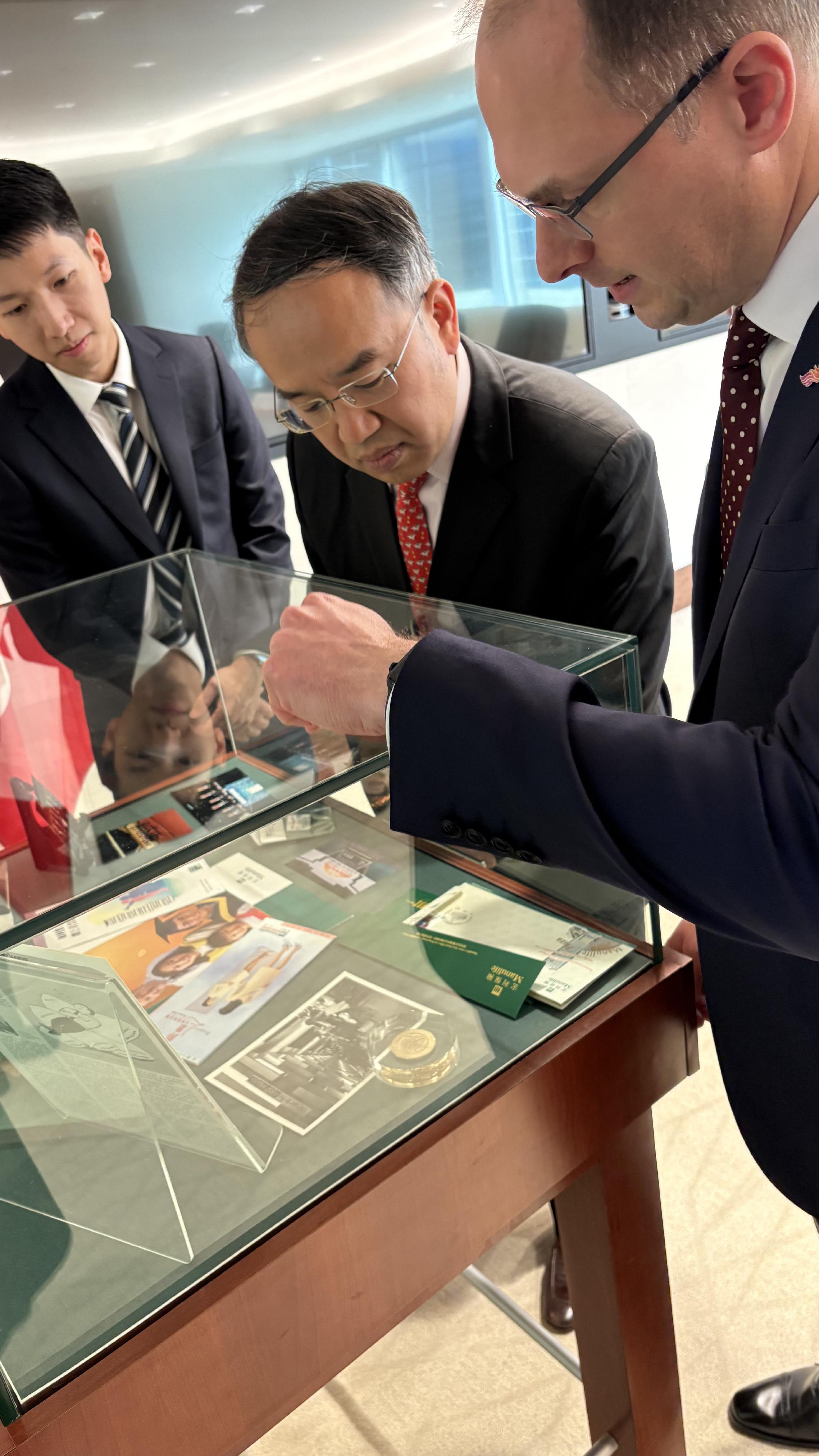
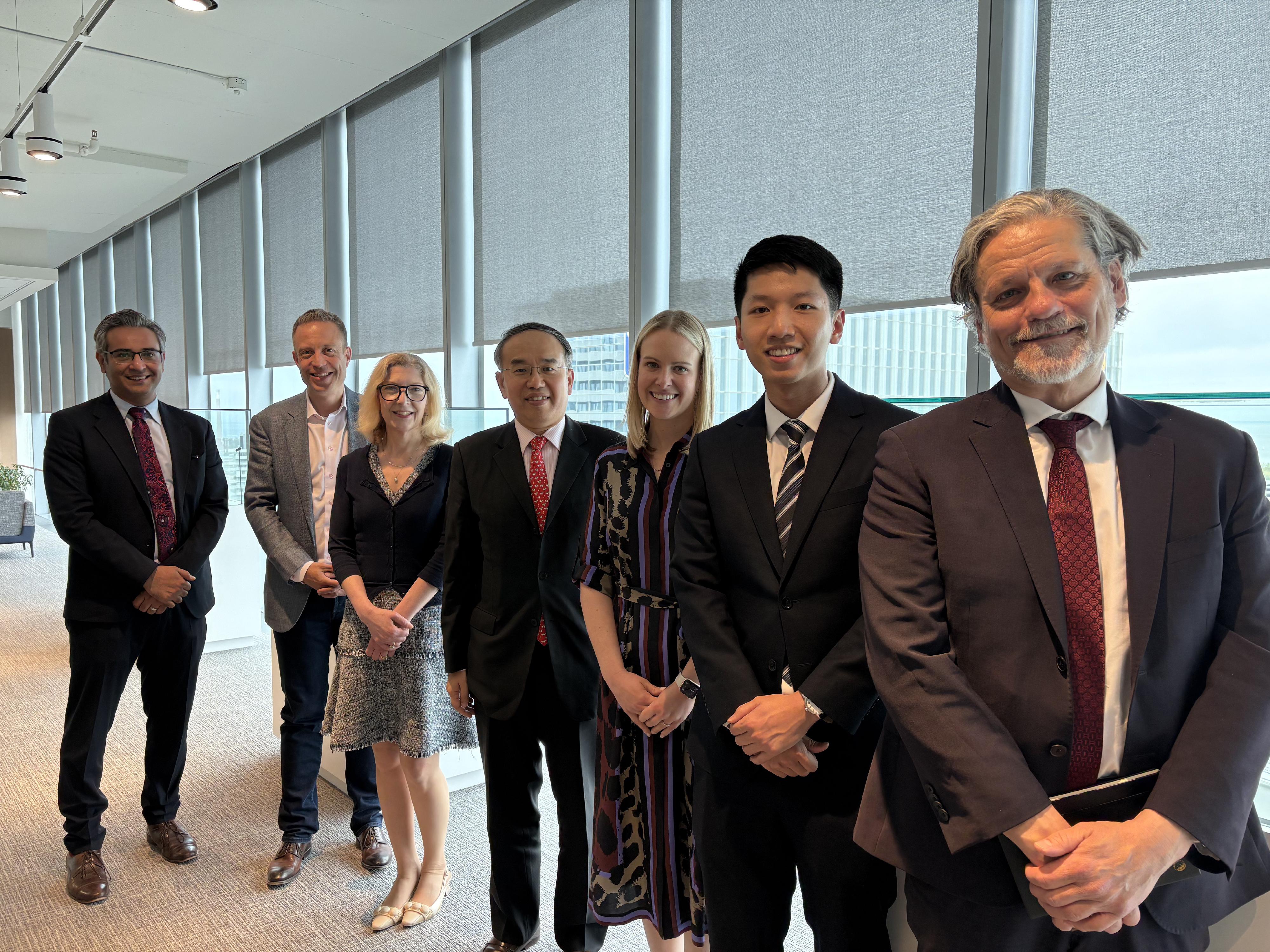
     He visited two Canada-based insurance companies that have extended their business to Hong Kong. Mr Hui met separately with the President and Chief Executive Officer, Mr Phil Witherington, and the Chief Financial Officer, Mr Colin Simpson, of Manulife; as well as the Executive Vice-President and Chief Financial Officer, Mr Tim Deacon, and the Executive Vice-President and Chief Strategy and Enablement Officer, Ms Linda Doughety, of SunLife. He introduced them to the newly enacted legislation on re-domiciliation of companies, encouraging them to consider re-domiciling their companies to Hong Kong to enjoy the relevant legal and taxation convenience, as well as to lower their compliance costs for satisfying two sets of regulatory requirements. He also mentioned that on the very first day the company re-domiciliation regime came into effect last Friday, an international insurance group immediately announced its plan to re-domicile its company to Hong Kong. This news was the best testament to the regime’s effectiveness in enhancing companies’ operational efficiency, thereby consolidating Hong Kong’s position as a leading international financial centre.
      
     Under the new regime, non-Hong Kong-incorporated companies may apply to re-domicile to Hong Kong if they fulfil requirements concerning company background, integrity, member and creditor protection, solvency, etc, while maintaining their legal identity as a body corporate to ensure business continuity. If the company’s actual similar profits are also taxed in Hong Kong after re-domiciliation, the Government will provide the company with unilateral tax credits to eliminate double taxation.
      
     Mr Hui pointed out that Hong Kong has a strong foundation in investment and trade, making it an ideal location for global enterprises to access insurance, reinsurance and risk management services, as well as to establish captive insurers. There are vast opportunities for insurance companies in Hong Kong. 
      
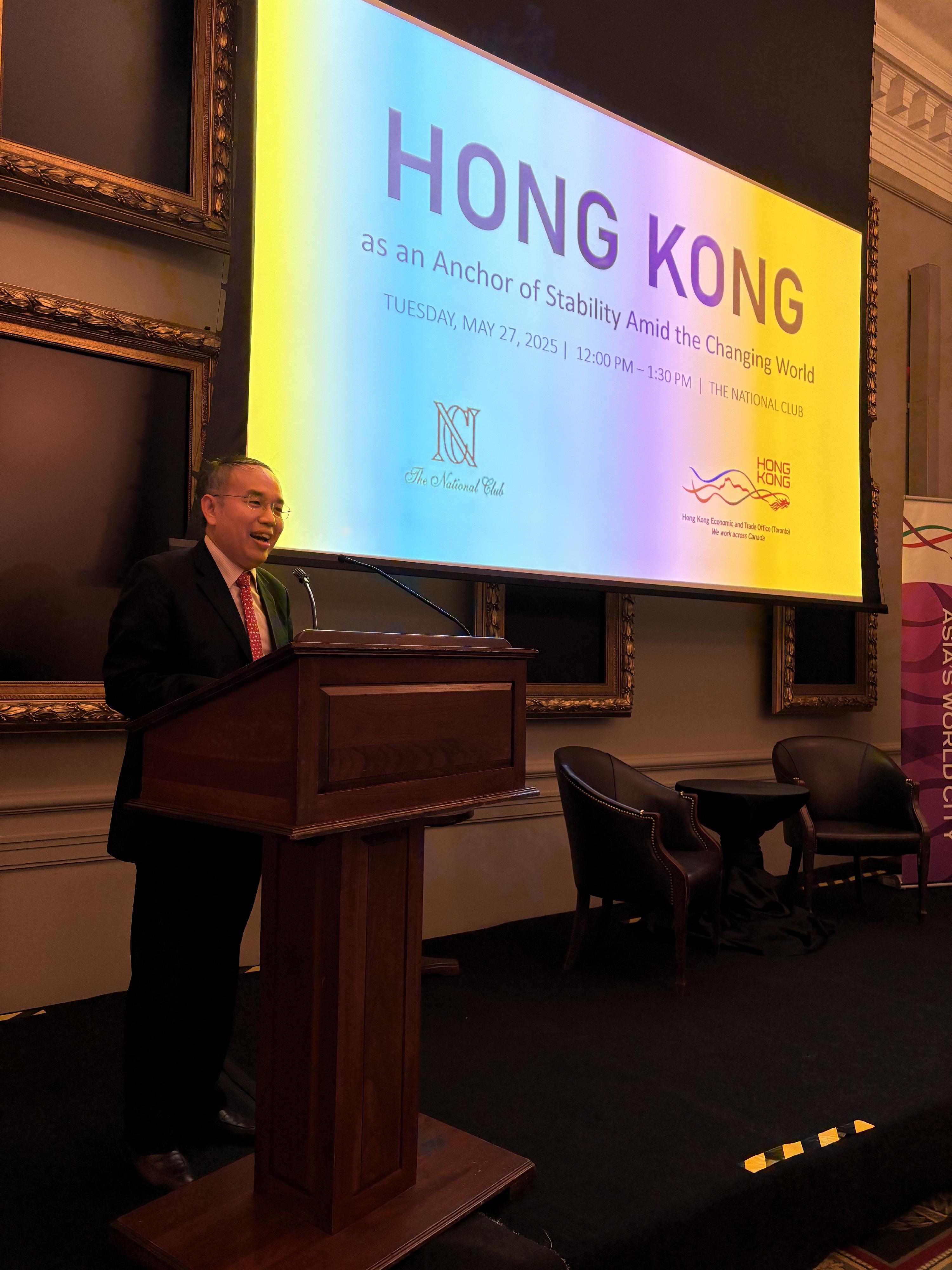
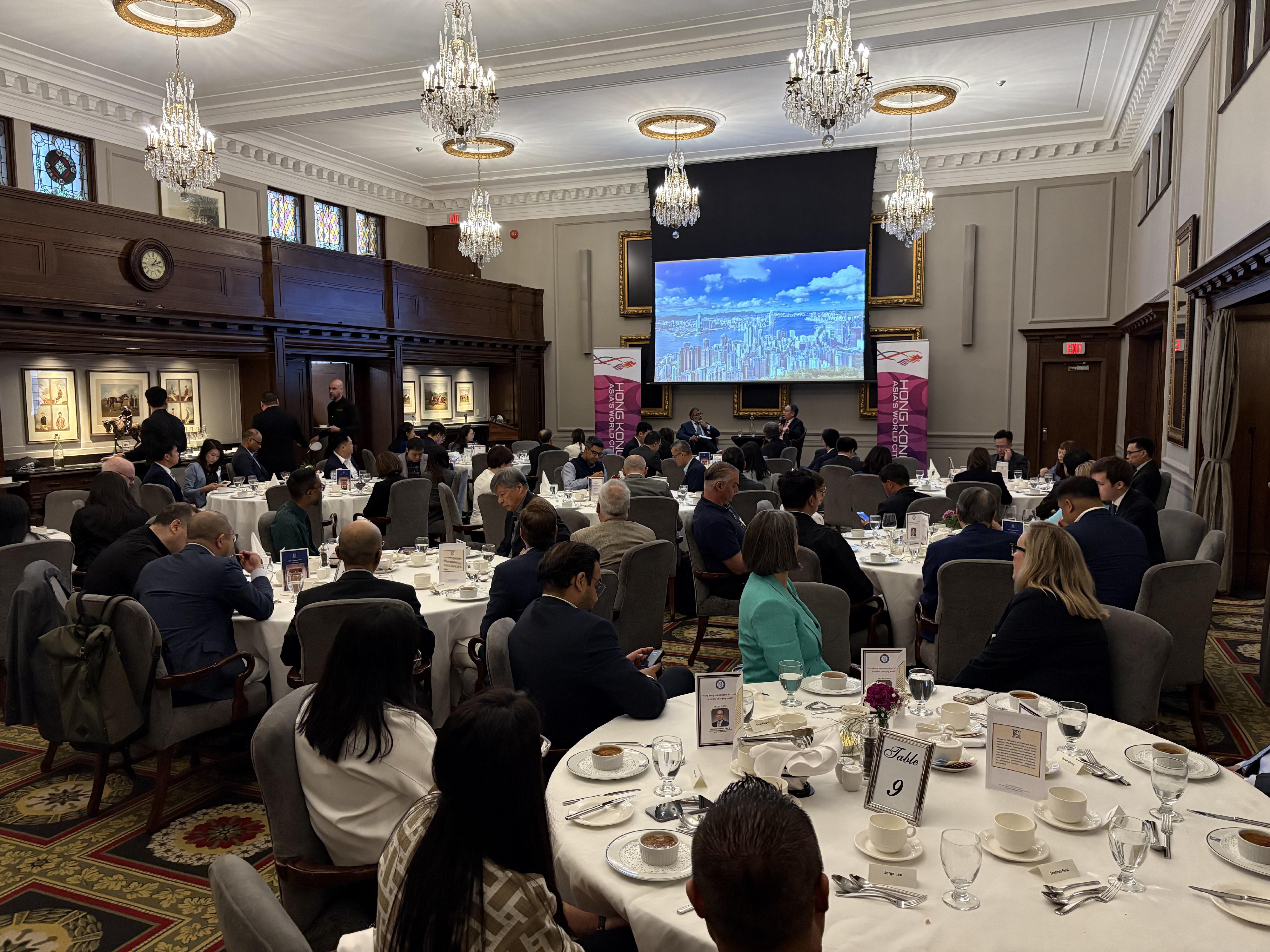
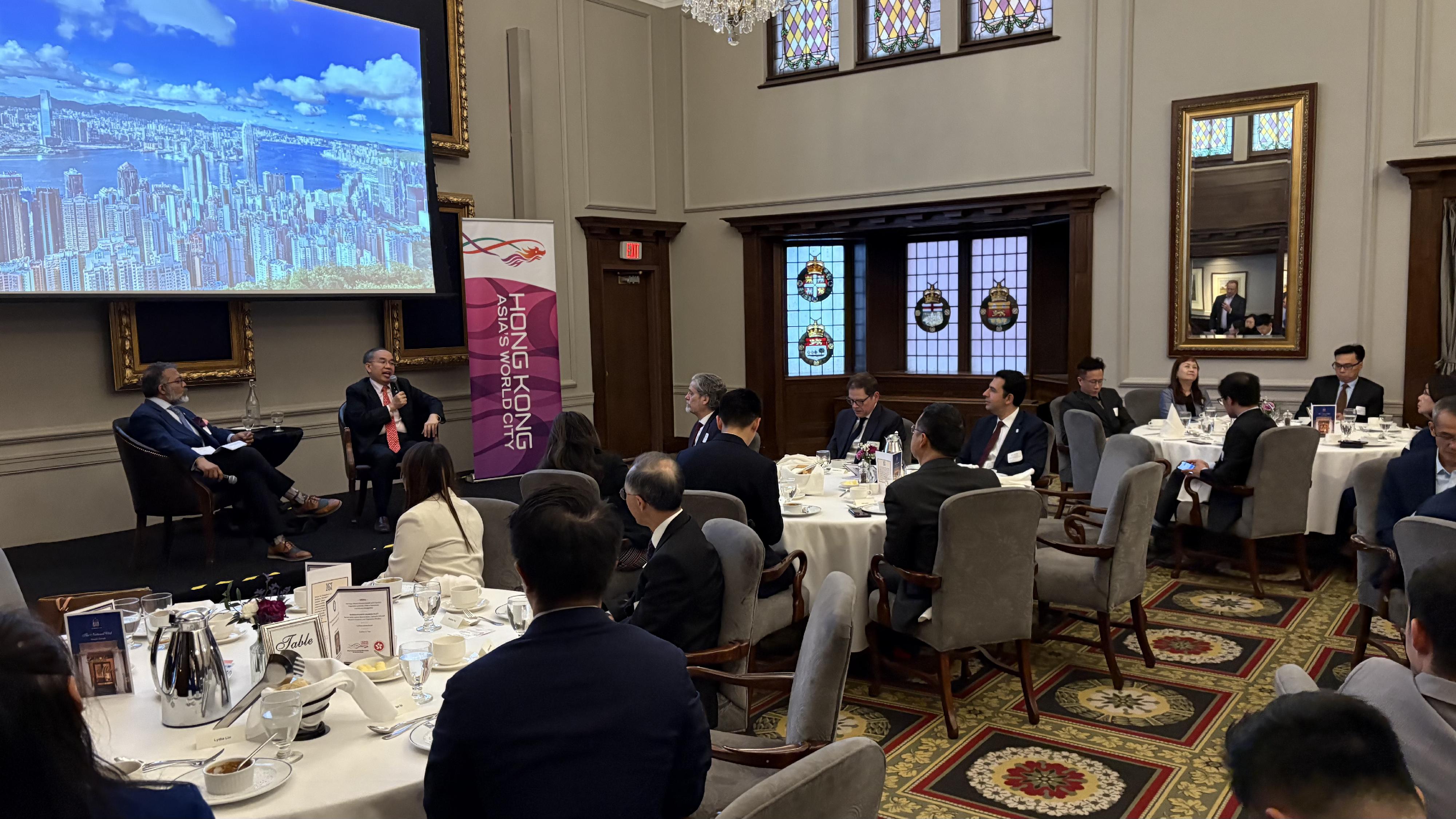
     At noon, Mr Hui attended a business luncheon organised by the Hong Kong Economic and Trade Office (Toronto), Invest Hong Kong (Canada) and the National Club. He gave a presentation themed “Hong Kong as an anchor of stability amid the changing world” to showcase to the attending financial leaders the stellar figures recorded in the financial market, and banking and monetary markets. He also talked about the Government’s efforts in aligning with international standards and boosting the development of green and sustainable finance and the virtual asset market. He said that, with its competitive advantages and proactive measures, as well as the stability and predictability of its financial market, Hong Kong has been earning the confidence of global investors. Mr Hui also had a fireside chat with the President of the National Club, Mr Arnie Guha, and answered questions from the floor. The luncheon was well received. Participants were attracted by the various new developments in Hong Kong’s financial markets introduced by Mr Hui.
      
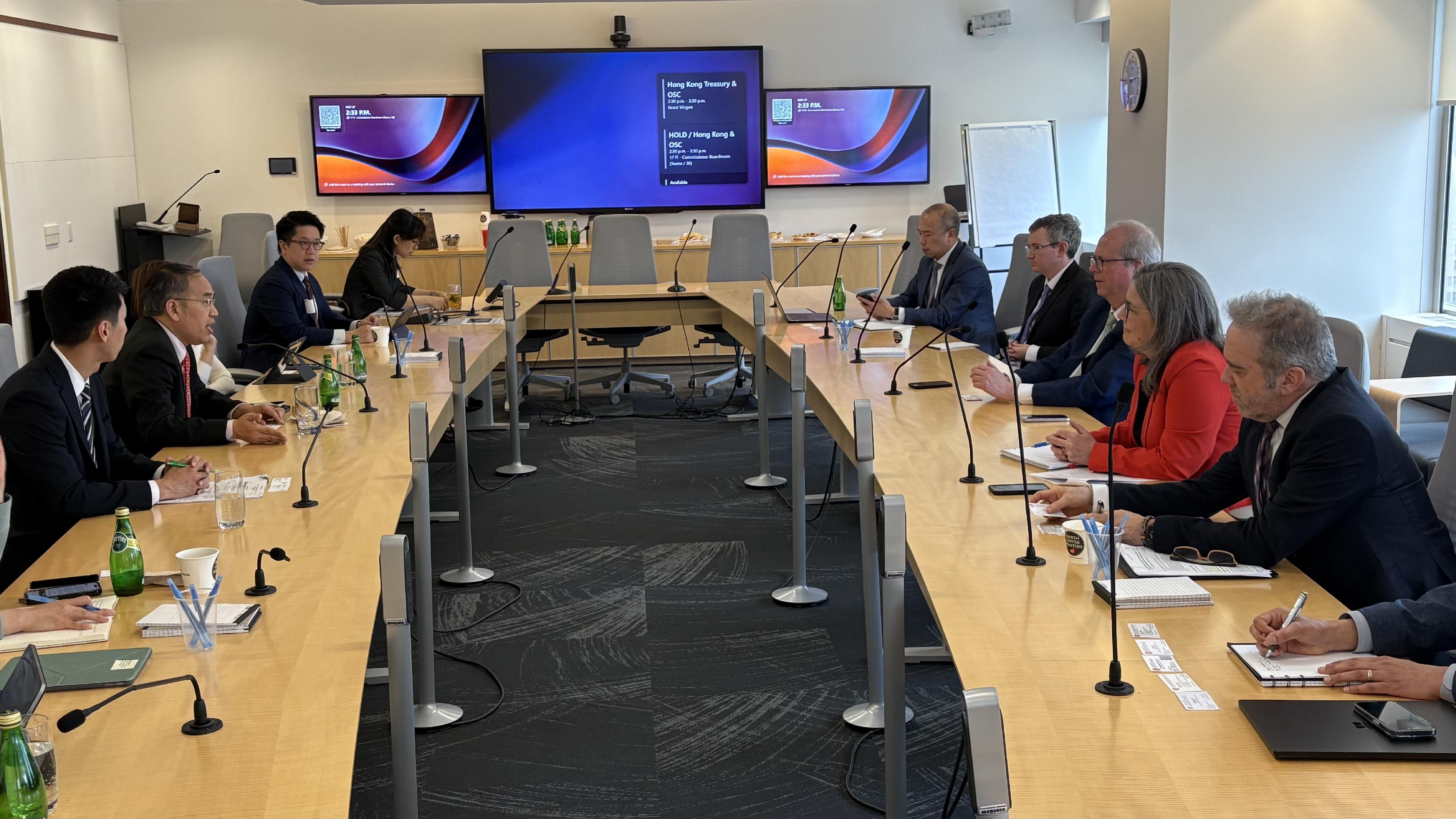
     In the afternoon, Mr Hui met with the Chief Executive Officer of the Ontario Securities Commission (OSC), Mr Grant Vingoe, and OSC representatives. The Securities and Futures Commission of Hong Kong entered into a Memorandum of Understanding with the OSC in mid-May to include Ontario of Canada in its list of acceptable inspection regimes for strengthening the regulatory collaboration and exchange of information between the two regulators. Both Mr Hui and Mr Vingoe agreed that in today’s shifting global landscape, collaboration with trusted allies would ensure capital markets remain robust and resilient.
      
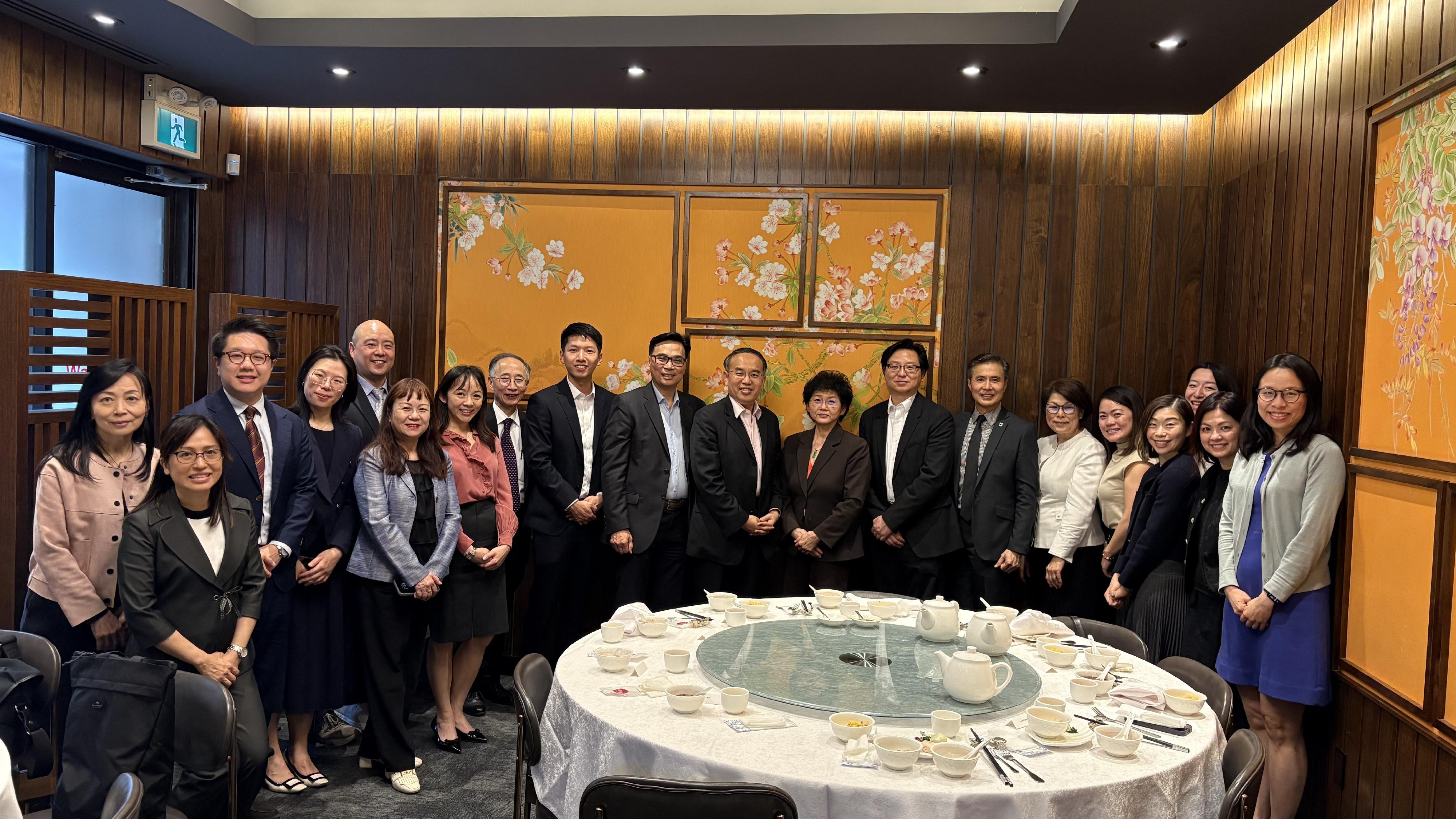
     In the evening, Mr Hui had a dinner meeting with the President of the Hong Kong-Canada Business Association (HKCBA) (Toronto Chapter), Mr Joseph Chaung, and board members to brief them on the latest developments and future direction of Hong Kong’s financial market. The HKCBA has members in eight Canadian cities to foster bilateral trade.
      
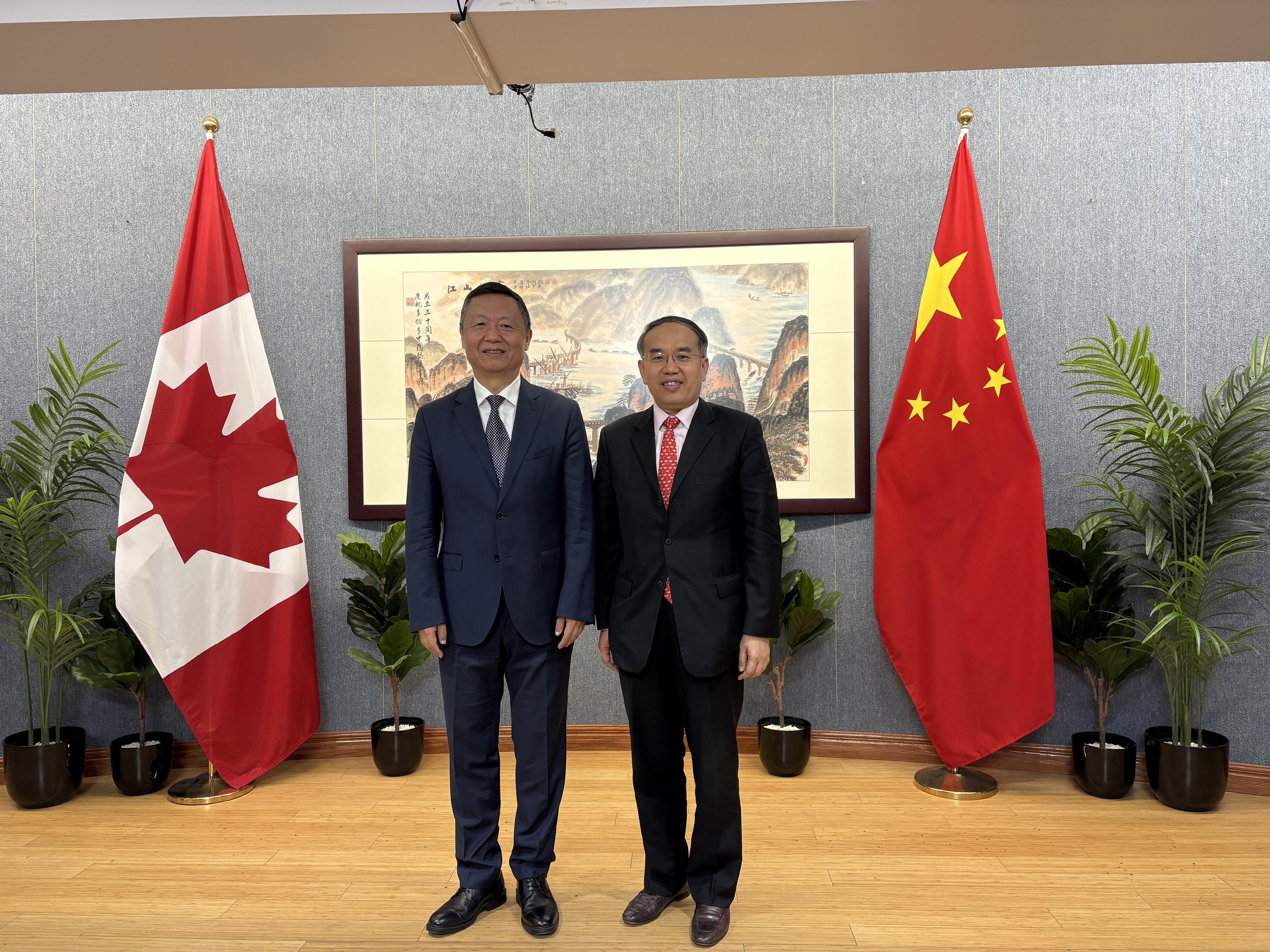
     Mr Hui also paid a courtesy call to the Consul-General of the People’s Republic of China in Toronto, Mr Luo Weidong. Both expressed their anticipation that Hong Kong, with the support of the nation and its solid foundation and forward-looking measures in financial areas, will engage in more co-operation with Canada.
      
     On May 28 (Toronto Time), Mr Hui will travel to Ottawa to meet with government financial officials.

Photo  Photo  Photo  Photo  Photo  Photo  Photo  Photo  
read more

LCQ13: Public housing estates with supply of centralised liquefied petroleum gas

     Following is a question by the Hon Chan Hok-fung and a written reply by the Secretary for Housing, Ms Winnie Ho, in the Legislative Council today (May 28):
 
Question:

     It is learnt that there are 15 public housing estates (PHEs) under the Hong Kong Housing Authority (HA) that are installed with centralised liquefied petroleum gas (LPG) supply. The previous arrangements for renewal of LPG suppliers were such that existing suppliers with satisfactory performance would be eligible for renewal. Subsequently, with reference to the experience in private housing developments, and taking into account public views and the Competition Commission’s recommendations, the HA decided in August 2017 that tenders should be invited for awarding new contracts for the supply of centralised LPG to PHEs upon expiry of the existing contracts. In this connection, will the Government inform this Council:

(1) of the information on current contracts for the centralised LPG supply systems of the 15 PHEs and the Home Ownership Scheme (HOS) estates sharing the same LPG compound (shared HOS estate) (set ‍out in the table below); whether such contracts were awarded by tender; if not, of the reasons for that;
 

PHE Shared HOS estate Current contract information
LPG supplier Start date Expiry date Whether the contract was awarded by tender
Tai Yuen Estate, Tai Po Ting Nga Court        
Yau Oi Estate, Tuen Mun /        
On Ting Estate, Tuen Mun Siu On Court        
Choi Yuen Estate, North District Yuk Po Court        
Butterfly Estate, Tuen Mun Siu Shan Court        
Wu King Estate, Tuen Mun Siu Shan Court        
Lung Tin Estate, Lantau Island Lung Hin Court        
Oi Man Estate, Kowloon /        
Kwong Fuk Estate, Tai Po Wang Fuk Court        
Kam Peng Estate, Peng Chau Peng Lai Court        
Ngan Wan Estate, Lantau Island /        
Sam Shing Estate, Tuen Mun /        
Shui Pin Wai Estate, Yuen Long /        
Wah Fu (II) Estate, Hong Kong Island /        
Nga Ning Court, Cheung Chau /        
 
(2) whether it has compiled statistics on the total annual supply of domestic piped LPG to the PHEs and shared HOS estates mentioned in (1) over the past five years, as well as the annual average price of LPG in such PHEs and HOS estates; of the comparison between such average LPG prices and the corresponding town gas prices during the same period; and

(3) whether the owners’ committees or residents of the PHEs mentioned in (1) have requested the HA to replace the gas supply system (e.g. ‍natural gas)?

Reply:

President,
 
     Our reply to the question raised by the Hon Chan Hok-fung is as follows:
 
(1) At present, 15 public rental housing (PRH) estates under the Hong Kong Housing Authority (HA) are equipped with centralised liquefied petroleum gas (LPG) supply systems. According to the past policy, prior to 2017, on the premise of ensuring that residents of the estates could enjoy safe and stable centralised LPG supply services, the HA would renew the contract with the existing supplier upon expiry of the contract if the supplier’s performance had been satisfactory during the contract period. In the light of public views and the Competition Commission’s advice of 2016, the Commercial Properties Committee of the HA approved in 2017 that new contracts would be awarded by tender instead for centralised LPG supply upon expiry of the existing contracts. Accordingly, the HA arranged bundled tendering for the LPG supply contracts for two PRH estates (i.e. Wah Fu (II) Estate and Nga Ning Court) as a trial in 2018. The new contracts were successfully awarded and the handover work was completed smoothly. Since 2019, the new supplier has commenced the supply of LPG for the two estates for a contract term of 10 years.

     After consolidating the experience gained from the tendering exercise for the above-mentioned two PRH estates, the HA endorsed in 2019 that new contracts for centralised LPG supply for the remaining PRH estates would also be awarded by tender upon expiry of the existing contracts. The HA has further enhanced the relevant tendering arrangements. Apart from retaining concessionary measures welcomed by residents, including the requirement for suppliers to provide residents with free annual inspection of gas appliances and to waive the minimum charge, suppliers were required to waive the monthly fee for the maintenance service plan so as to provide more comprehensive concessions for residents. At the same time, for the protection of consumers, we continue to require in the tender documents that the LPG prices charged by suppliers should not be higher than the market rate. The suppliers are also required under the enhanced tendering arrangements to strengthen customer service such as shortening the response time for handling emergency calls and providing a variety of payment channels to provide convenience to residents. Suppliers are required to enhance safety of the LPG supply system and introduce measures to promote environmental protection and energy saving as well in order to further enhance their services to the residents.

     As most of the LPG storage tanks located in PRH estates also serve the adjoining Home Ownership Scheme (HOS) estates, the HA has to liaise with the Incorporated Owners (IOs) of the relevant HOS estates on the new arrangement of joint tendering. As the IOs concerned may not be aware of the necessity of joint tendering, it takes time for the HA to negotiate with the IOs. The IOs also have to reserve time to convene owners’ meetings to explain the joint tendering arrangements to the owners. Some of the individual HOS estates involve a large number of households, for example, Wang Fuk Court in Tai Po involves near 2 000 units. It takes time to explain to the owners about the shared LPG storage tanks and the required joint tendering arrangements so as to obtain the consensus and necessary approval from the owners for the joint tendering. Once the relevant approvals are obtained, the HA and the concerned IOs will have to seek legal advice on the documents for joint tendering separately, and the tendering exercise can only be formally launched after securing agreement by both parties. 

     In addition, as the centralised LPG storage tanks in some PRH estates were due for replacement in 2022 and 2023, tendering exercises for the centralised LPG supply contracts of these estates could only be arranged after completion of the replacement of LPG storage tanks. As such, the tendering schedule for these estates during the said period is also affected by the replacement of LPG storage tanks. In formulating the tendering schedule, the HA also needs to take into account a range of factors, such as the expiry dates of respective LPG supply contracts, the geographical location of different estates, economy of scale, as well as the views of the industry on the tendering arrangements.

     In early 2024, the HA conducted the first joint tendering exercise for the LPG supply contracts for a PRH estate and an HOS estate (Kwong Fuk Estate and Wang Fuk Court) as a trial and the contracts were successfully awarded. We have planned to progressively arrange tendering exercises for the remaining PRH estates and HOS estates with shared LPG storage tanks in an orderly manner, including the tendering exercises for Choi Yuen Estate/Yuk Po Court and Shui Pin Wai Estate within 2025. Pending the commencement of the new contracts, the existing suppliers would continue to operate with a temporary licence to maintain the provision of centralised LPG services. The existing centralised LPG suppliers for the 15 relevant PRH estates concerned is tabulated as follows:
 
PRH estates HOS estate sharing the same LPG storage tanks Existing contract information
    LPG supplier Remarks
Wah Fu (II) Estate,
Hong Kong Island
/ ExxonMobil
Hong Kong Limited
Tender exercises were completed
Nga Ning Court,
Cheung Chau
/ ExxonMobil
Hong Kong Limited
Kwong Fuk Estate,
Tai Po
Wang Fuk Court Sinopec (Hong Kong) Petroleum Holding Company Limited
Tai Yuen Estate,
Tai Po
Ting Nga Court ExxonMobil
Hong Kong Limited
Tender exercises are being conducted in a progressive and orderly manner
Yau Oi Estate,
Tuen Mun
/ ExxonMobil
Hong Kong Limited
On Ting Estate,
Tuen Mun
Siu On Court ExxonMobil
Hong Kong Limited
Choi Yuen Estate,
North District
Yuk Po Court ExxonMobil
Hong Kong Limited
Butterfly Estate,
Tuen Mun
Siu Shan Court ExxonMobil
Hong Kong Limited
Wu King Estate,
Tuen Mun
Siu Shan Court ExxonMobil
Hong Kong Limited
Lung Tin Estate,
Lantau Island
Lung Hin Court ExxonMobil
Hong Kong Limited
Oi Man Estate,
Kowloon
/ Shell Hong Kong Limited
Kam Peng Estate,
Peng Chau
Peng Lai Court Shell Hong Kong Limited
Ngan Wan Estate,
Lantau Island
/ Shell Hong Kong Limited
Sam Shing Estate,
Tuen Mun
/ ExxonMobil
Hong Kong Limited
Shui Pin Wai Estate,
Yuen Long
/ Shell Hong Kong Limited
 
(2) and (3) As for the amount of supply of domestic centralised LPG to the PRH estates and HOS estates with shared LPG storage tanks, the concerned LPG suppliers indicated that the relevant information was commercially confidential and therefore could not be disclosed. Moreover, the LPG consumption varies depending on a number of factors such as the number of occupants in the household, seasons, the living style of the residents and the efficiency of the gas appliances. The estimated average LPG consumption for a 3-person household is around seven cubic metre per month.
 
     To protect the interests of the centralised LPG consumers in the PRH estates and HOS estates with shared LPG storage tanks, the HA has stipulated in the centralised LPG supply contracts that the LPG prices charged by the suppliers shall not be higher than the market rate. For the benefit of residents, the HA will also require in the tender documents for LPG supply that LPG suppliers must provide free annual inspection of gas appliances and waive the minimum charge and the monthly fee for the maintenance service plan provided to domestic tenants/occupiers using the LPG supply service. We have meetings with LPG suppliers every six months and will review the relevant LPG prices by making reference to the domestic centralised LPG prices published by local LPG suppliers to ensure compliance with the relevant requirements. In April 2025, the latest average price of domestic centralised LPG published by LPG suppliers in April 2025 was $47.34 per cubic metre.
 
     As for the town gas price for household customers for the same period, with effect from August 1, 2024, the charge ranges from 27.60 cents to 28.55 cents per megajoule, plus a fuel cost adjustment. In addition, the minimum basic charge for each household customer is $20 and the monthly maintenance charge is $10. Town gas is charged based on the energy unit of megajoule, while LPG is generally charged per cubic metre for consumption. As the unit of measurements, basis of calculation and charging scheme of these two gas types are different; the heat efficiency of LPG and town gas appliances are different; and these two gas types vary in aspects such as calorific value, it is not possible to make a direct comparison of their prices.

     So far, there is no request for the replacement of LPG supply systems from the tenants of PRH estates or IO’s committees of the HOS estates. read more