image_pdfimage_print

Author Archives: hksar gov

LCQ4: Public healthcare services and their fees and charges

     Following is a question by Dr the Hon David Lam and a reply by the Secretary for Health, Professor Lo Chung-mau, in the Legislative Council today (March 26):

Question:

     The Government has just announced a comprehensive reform on the fees and charges for public healthcare services. It is learnt that while the principle of Hong Kong’s public healthcare policy is that no citizen is denied appropriate healthcare service due to financial difficulty, concerns about the sustainability of healthcare expenditure have been raised in previous reviews of the fees and charges for healthcare services. In this connection, will the Government inform this Council:

(1) whether it will promote the extensive use of the reference frameworks or clinical pathways developed by the Health Bureau, which serve as a guide for medical procedures such as laboratory tests, imaging, medication, radiotherapy and surgeries, so as to ensure the safety and enhance the effectiveness of diagnoses and treatments; and

(2) whether it has considered setting up individual or family healthcare accounts for members of the public to settle the co-payment fees, and introducing in public healthcare institutions preferential inpatient and outpatient paid services which are pegged to the amounts of compensation under the Voluntary Health Insurance Scheme as an additional option for members of the public and, in parallel, capping the fees and charges for expensive treatments, so as to prevent members of the public from falling into poverty because of illness; if so, of the details; if not, the reasons for that?

Reply:

President,

     Hong Kong has an efficient healthcare system with high quality, and the public healthcare system is the cornerstone of our healthcare system and the safety net for all. Nevertheless, in view of challenges such as an ageing population, rising service demand and healthcare costs, Hong Kong’s healthcare system needs to be reformed in order to achieve sustainable development. Healthcare reform efforts are closely intertwined, and fees and charges reform for public healthcare is an indispensable part thereof. The fees and charges reform for public healthcare just announced is premised on five principles.

(1) Commitment will not be lessened: All the gains from the reform will be wholly utilised for public healthcare services;
(2) “Co-payment by those who can afford and co-payment by those with mild conditions”: We need to expand and enhance the co-payment mechanism;
(3) Enhancement and reduction: To enhance the protection for “poor, acute, serious, critical” patients and to reduce in wastage; 
(4) High subsidisation: To maintain 90 per cent overall public subsidisation rate; and
(5) Gradual and orderly manner: Aim to achieve the objective in five years.

     Through the fees and charges reform, we can guide the public to make optimal use of healthcare resources, reduce wastage and abuse, and enhance the healthcare protection for “poor, acute, serious, critical” patients on all fronts, with a view to ensuring the public healthcare system can provide subsidies in a more precise and targeted manner, and better serving as a safety net for all.

     There are three areas in enhancing healthcare protection:

(1) Enhancing the medical fee waiver mechanism by raising the income and asset eligibility limits to largely enhance the support for low-income families and the underprivileged group;

(2) Introducing an annual cap of $10,000 on public healthcare service items (except self-financed drugs and medical devices) to take better care of patients with serious illnesses and providing protection to all seven million people in Hong Kong; and

(3) Expediting the introduction of more effective and innovative drugs and medical devices, and relaxing the eligibility criteria for the safety net of self-financed drugs and medical devices, so that more patients with critical conditions, in particular middle-income persons, can receive subsidies for self-financed drugs and medical devices.
     
     In consultation with the HA, the reply to the question raised by the Hon David Lam is as follows:

(1) Hong Kong’s dual-track healthcare system comprises both public and private sectors. The private healthcare sector provides a wide range of services, including but not limited to general, specialist and in-patient services, that complement the public healthcare system. To achieve meaningful reform on healthcare system in Hong Kong, it is imperative to enhance private healthcare price transparency alongside with the reforms on the public sector, whilst promoting the adoption of quality and outcome indicators across healthcare services. We plan to launch the consultation exercise on legislating for enhancing private healthcare price transparency later this year.

     In promoting the continuous improvement of Hong Kong’s healthcare standards including its quality and efficiency, “The Chief Executive’s 2024 Policy Address” announced that the Government would establish a professional platform to develop evidence-based clinical protocols and explore the feasibility of devising service quality and efficiency standards for public and private healthcare services. To this end, the Health Bureau has taken forward the establishment of the Institute for Medical Advancement and Clinical Excellence (IMACE) by seven major institutions in the Hong Kong healthcare sector, including the Hong Kong Academy of Medicine, the Department of Health, the HA, the Primary Healthcare Commission, the Faculty of Medicine of the Chinese University of Hong Kong, the LKS Faculty of Medicine of the University of Hong Kong, and the Hong Kong Private Hospitals Association.

     The IMACE is a professional-led, evidence-based platform with members from both the public and private healthcare sectors in Hong Kong. It enables the sectors to collect data and cases in an effective manner for detailed deliberations on clinical practices in screening, diagnosis, treatment and management of different diseases. The IMACE will also evaluate the effectiveness of various medical options, including drugs, medical devices, diagnostic techniques, surgical procedures, non-pharmacological interventions and new medical innovations to formulate clinical guidelines in light of the evaluation results, and explore the feasibility of devising service quality and efficiency standards for both the public and private healthcare sectors. It is expected that the IMACE will formally commence its work within the first half of this year.

     Through the work of the IMACE, we hope to help the sectors to identify cost-effective medical options that may benefit patients. This will also foster professional exchange among healthcare professionals to learn about and apply the latest technologies, thereby further promoting the development of Hong Kong into an international health and medical innovation hub.

(2) On the second point, under the existing design of the Voluntary Health Insurance Scheme (VHIS), its reimbursement policy has already covered all facilities which offer in-patient services, including those in the public healthcare system. As for the suggestions of setting up personal or family healthcare accounts to settle the co-payments for public healthcare, and establishing premium fee-charging services linked to the VHIS compensation in the public healthcare system, the Government is willing to listen to comments from various sectors in the community and relevant stakeholders, consider the practical needs for the relevant arrangements and study the feasibility.

     As for the suggestion on a cap for expensive treatment items, the Government’s fees and charges reform for public healthcare has already enhanced healthcare protection for “poor, acute, serious, critical” patients on all fronts, strengthening various safety net measures, including increasing the subsidy for patients who are in need of expensive drugs or medical devices, to prevent “patients with serious conditions falling into poverty”. In fact, there is currently already a mechanism of capping charges for drugs and medical devices covered by our safety net, with the maximum amount to be borne by patients at $1 million per year. However, with medical technologies ever changing, new drugs and medical devices as well as therapeutic techniques are very costly. Given the current resource constraints of the public healthcare system, provision of a uniform cap for all relevant charging items may not be feasible. 

     To cope with the challenges faced by the healthcare system in a pragmatic manner, we have to keep taking steps of reform and continue driving forward healthcare reform on different fronts. As for the long-term healthcare financing arrangements, the Government will continue to listen to the views of various sectors, and welcome more suggestions from stakeholders as well as more participation from public in the discussion, so as to build consensus on the future healthcare financing reform that will best suit the situation in Hong Kong. Thank you.  read more
LCQ10: Primary healthcare services

     Following is a question by the Hon Tang Ka-piu and a written reply by the Secretary for Health, Professor Lo Chung-mau, in the Legislative Council today (March 26):
 
Question:
 
     Regarding primary healthcare services, will the Government inform this Council:
 
(1) of the following information on the District Health Centres (DHCs) in Hong Kong (set out by the 18 districts across the territory):
 
(i) the contract expiry date of the existing service contractors (contractors); and
 
(ii) the planned timetable and arrangements for the new round of tendering of contractors;
 
(2) of the following information on the relevant assessment of DHCs’ service performance:
 
(i) the assessment methods, specific indicators and assessment standards;
 
(ii) the assessment cycle (i.e. the average interval of years between assessments);
 
(iii) whether there were cases in the past in which the service performance of the contractors was not up to standard; if so, of the details (including the measures taken at that time and their effects); and
 
(iv) whether channels are available for the public to access the performance ratings of various DHCs;
 
(3) of the respective assessment details of DHCs/DHC Expresses in the Kwun Tong district and Wong Tai Sin district in the past (including the service performance of these DHCs/DHC Expresses);
 
(4) given that the Secretary for Health indicated at the meeting of the Panel on Health Services of this Council on May 10 last year that priority would be accorded to the reorganisation of services in Elderly Health Centres and Woman Health Centres, of the following information on the relevant service reorganisation:
 
(i) the current numbers of members of these centres, with a breakdown by age group and gender;
 
(ii) the timetable for service reorganisation, and set out the specific timelines and targets for each phase; and
 
(iii) the service transitional arrangements for the current users of these centres and details of the support measures during the period; and
 
(5) whether it has compiled statistics on the current number of community pharmacies (including those operated by profit-making and non-profit-making organisations) in Hong Kong, and the districts in which such pharmacies are mainly located?
 
Reply:
 
President,
 
     The Government released the Primary Healthcare Blueprint (Blueprint) in December 2022, setting out a series of reform initiatives to strengthen primary healthcare services in Hong Kong. One of the recommendations in the Blueprint is to develop a district-based family-centric community healthcare system based on the District Health Centre (DHC) model. To this end, the Government set up DHCs and interim DHC Expresses (DHCEs) of a smaller scale (hereafter collectively referred to as DHCs) in all districts across the city by the end of 2022, thereby attaining the interim goal of covering all 18 districts. As a primary healthcare services and resource hub, DHCs provide services including chronic disease screening and management, family doctor pairing, health promotion, health risk factors assessment and community rehabilitation.
 
     In consultation with the Primary Healthcare Commission (PHC Commission) and the Department of Health (DH), the replies to the respective parts of the question raised by the Hon Tang Ka-piu are as follows:
 
(1) to (3) The PHC Commission was established in July 2024 to oversee primary healthcare service delivery, standard setting, quality assurance, etc, under one roof. Regarding the services of DHCs, the PHC Commission appoints non-governmental organisations as operators through open tender. The relevant operation service contracts have specified the facilities and service requirements, including the qualifications and relevant experience of key staff, the districts and number of ancillary centres/service points to be set up, and the staffing establishment of the centres. Regarding the operation period, the initial operation period of the DHC operation service contracts is three years from the date of operation with an option for extension of up to further three years, whereas the initial operation period of the DHCE operation service contracts is three years with option for multiple contract extensions. The PHC Commission will, in accordance with the terms of the contract and subject to the performance of the operator, arrange for contract renewal or conduct an open tender exercise to identify an operator before the expiry of the initial operation period. The DHCs’ service commencement dates are set out in Annex I.
 
     The PHC Commission continuously reviews the services of DHCs, with a view to strengthening their role as the co-ordinators of community primary healthcare services and case managers. As such, the PHC Commission has adjusted the operating service contracts of DHCs, including adjusting the categorisation of service targets to tie in with the enhancement of DHC services, such as the pairing of family doctors with citizens and the provision of nurse clinic services. Also, operators are required to achieve or exceed the predetermined service targets within the contract period to be eligible for contract gratuities and incentive payment to encourage the operators to actively enhance their service standards. The contract also states that the Government shall have the right to terminate the contract if an operator fails to comply with the contract requirements.
 
     The PHC Commission is preparing to upgrade the DHCEs in Central and Western District, Eastern District and Yau Tsim Mong District into DHCs within this year. The construction works of the DHCs in Wan Chai, Kwun Tong, Sai Kung and North District are in progress, and they will be upgraded to DHCs upon completion in the next few years. Tenders will be invited to identify operators in due course. Depending on the progress of the construction works of the DHCs or the expiry date of the operation service contracts, the PHC Commission will enter into new or renewed operation service contracts with the operators and include new assessment indicators, including those relating to the participation of new members in the Chronic Disease Co-Care Pilot Scheme. At present, the operators of the Central and Western DHC and Sham Shui Po DHC have signed new service contracts. Tenders are being conducted for the service contracts of the Eastern, Yau Tsim Mong and Kwai Tsing DHCs, and the contracts of the DHCEs in other districts are being renewed. The PHC Commission will incorporate the assessment indicators as appropriate.
 
     The PHC Commission uploaded the DHC performance indicators, including “DHC new members received information and knowledge on life course preventive care (LCPC) together with individualised LCPC health advice” and “Seasonal flu vaccination rate”, onto the DHC website for public access in December 2024. In addition, the PHC Commission is progressively enhancing the performance monitoring mechanism of the DHCs by regularly reviewing a number of quantitative and qualitatively related aspects, including service volume, operational effectiveness and health-related outcomes, to assess the performance of the DHCs, and to make timely recommendations to the operators for improvement. The PHC Commission will take into account the relevant assessment results when renewing the operating service contracts.
 
(4) Integration of woman and elderly health services under the DH into the district health network of the PHC Commission aims to utilise resources more effectively and expand the multidisciplinary primary healthcare service network. The overview of persons who have registered for services at Woman Health Centres (WHCs) and designated Maternal and Child Health Centres (MCHCs), as well as those who are members of Elderly Health Centres (EHCs) under the DH, is at Annex II.
 
      The PHC Commission will begin the integration of women’s health services within this year in an orderly manner, whereby a non-governmental organisation appointed through open tender will provide women’s primary healthcare services through three service points named Women Wellness Satellites (WWS). The three WWSs located in Chai Wan, Lam Tin, and Tuen Mun are expected to commence operation gradually within this year to replace the WHCs of DH. The Chai Wan WWS will commence operation in the second quarter, while the other two in Lam Tin and Tuen Mun will commence operation in the third quarter.
 
      The three WHCs (namely the Chai Wan WHC, Lam Tin WHC, and Tuen Mun WHC) and four designated MCHCs (namely the Ap Lei Chau MCHC, Yaumatei MCHC, Fanling MCHC, and Ma On Shan MCHC) under the DH have ceased accepting new appointments for women’s health services since January 24, 2025. During the transition period of service integration, those who have already made appointments or have paid their annual fee and are still within the service period will continue to receive relevant services from the DH.
 
      Regarding EHCs, the PHC Commission plans to start preparing for the integration of the relevant services into the district health network in phases from 2025-26, with a view to enhancing service synergy and minimising service duplication. The details, including the transitional arrangements, will be announced in due course.
 
(5) According to the Pharmacy and Poisons Ordinance (Cap. 138), only “Authorised Sellers of Poisons” (ASP) (commonly known as “pharmacies”) are allowed to conduct the relevant retail business of selling poisons including poisons listed in Part 1 and Part 2 of the Poisons List at Schedule 10 to the Pharmacy and Poisons Regulations (Cap. 138A). As at December 31, 2024, there are a total of 643 ASP, with 131, 226 and 286 of them located on Hong Kong Island, in Kowloon and in the New Territories respectively.
 
      The Government intends to launch the community pharmacy programme (CPP) by phases starting from the fourth quarter of 2026 to help the public to obtain affordable primary healthcare drugs more conveniently through central purchasing and the community network, thereby reducing their over-reliance on the public healthcare system. The services of the CPP will cover all 18 districts across Hong Kong, with at least four to five community pharmacies expected to operate in each district. The Government will, through a competitive process, select service providers that meet the set requirements and cost-effectiveness standard to join the CPP. read more

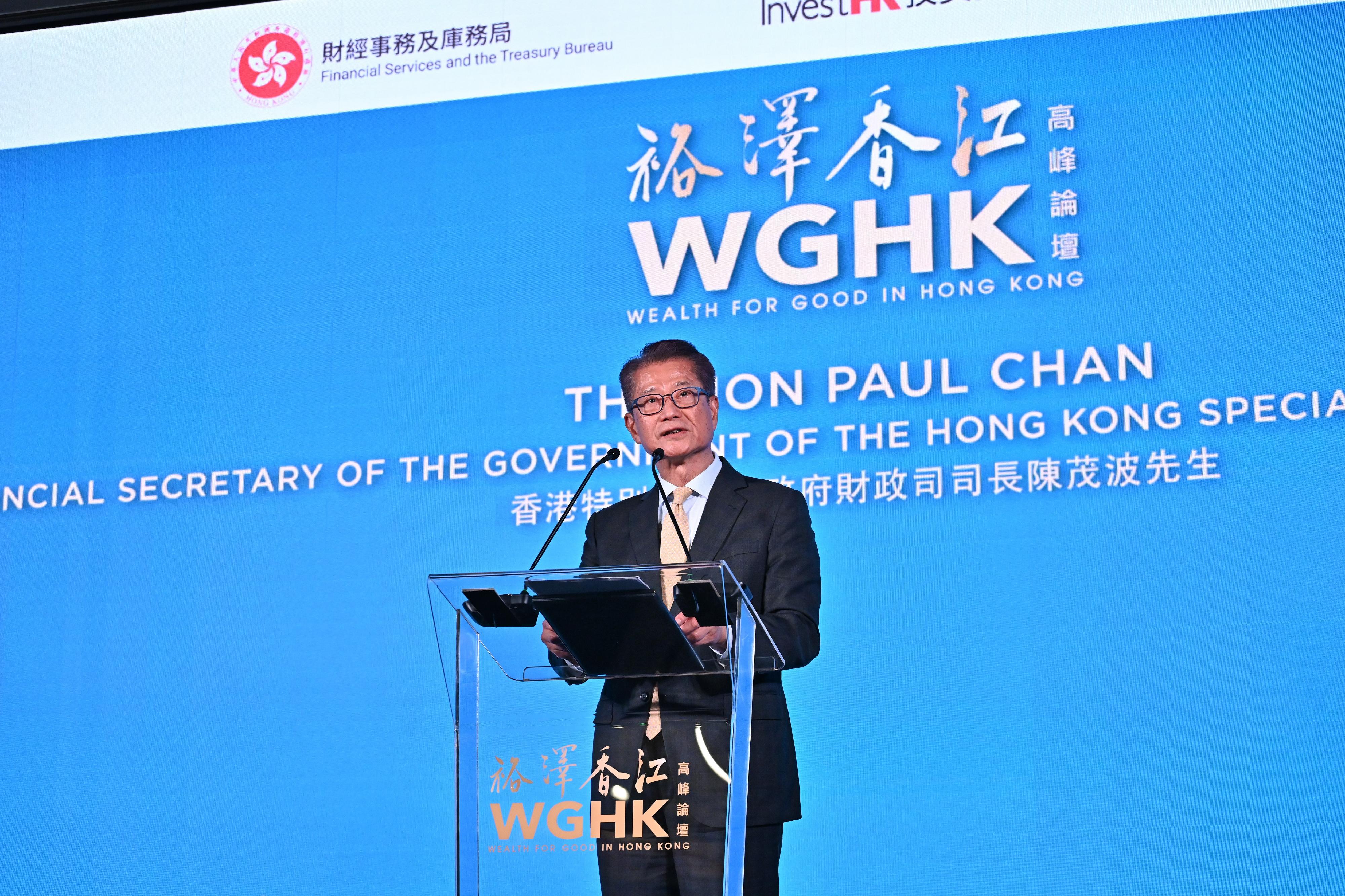
Speech by FS at Wealth for Good in Hong Kong Summit (English only) (with photo/video)

     Following is the speech by the Financial Secretary, Mr Paul Chan, at the Wealth for Good in Hong Kong Summit today (March 26):
 
Chris (Secretary for the Financial Services and the Treasury, Mr Christopher Hui), distinguished guests, ladies and gentlemen,
 
     Good afternoon.
      
     I am delighted to welcome you to the third Wealth for Good in Hong Kong Summit.
      
     Whether you are joining us for the first time or returning, I know you will enjoy your time here in Asia’s world city. And before long, it will feel like your city too.
      
     Family offices play a vital role in preserving family wealth and building a lasting legacy for future generations. The focus extends beyond making investments that provide sustainable, long-term financial returns. You are also visionaries, philanthropists and next-generation leaders committed to creating positive social and environmental impacts that benefit humanity.
      
     We share these values deeply. That’s why we launched this Summit two years ago, bringing together principals, key decision makers and senior executives of family offices worldwide, to discuss how we could  harness wealth for good together. 
      
     This year, we are excited to feature another impressive line-up of distinguished speakers from influential families and institutions, who will share insights on subjects ranging from tech and AI to philanthropy and culture. 
 
Hong Kong, premier location for family offices
 
     Allow me to take a couple of minutes to tell you why Hong Kong is an ideal place for family offices to realise their objectives and ambitions. 
      
     To begin with, Hong Kong is Asia’s premier financial centre, offering a wide range of investment opportunities that are particularly compelling right now.   
      
     Notably, the recent boom in the Hong Kong stock market underscores this potential. The Hang Seng index rose by some 20 per cent since the beginning of this year, building on an 18 per cent increase throughout 2024. This surge reflects investor optimism about the future of technology in China and highlights Hong Kong’s essential role in connecting regional opportunities with global investors, showcasing the significant returns our market can deliver.
      
     Beyond securities, Hong Kong boasts a dynamic ecosystem of angel investments, venture capital and private equity. Capital under management by private equity firms exceeded US$230 billion last year, making us the second largest in Asia, only after the Mainland. 
      
     Our asset and wealth management industry is thriving, fuelled by the affluent population of the Greater Bay Area and the influx of ultra-high-net-worth individuals into our city. We currently manage about US$4 trillion in assets, with two-thirds originating from outside Hong Kong. By 2028, we are on track to become the world’s largest cross-border wealth management centre.
            
     In the latest Global Financial Centres Index published last week, Hong Kong continues to rank third globally. Notably, we secured the top spot worldwide for “investment management”, “insurance” and “finance”, and came third in “banking” and “business environment”.   
      
     Above all, global capital feels at ease in Hong Kong. For compelling reasons. President Xi and the Central Authorities have affirmed on multiple occasions that the “one country, two systems” arrangement will remain in place over the long term.  
      
      This means Hong Kong will continue to uphold the common law system with a judiciary exercising powers independently; safeguard the free flow of capital, goods, information and people; maintain a freely convertible currency, and keep a simple and low tax system.
      
     And here’s the real gem – we have no capital gains tax, no estate tax, and no tax on dividends. In other words, you can freely invest without the usual financial hang-ups.
      
     Then, protection of capital and private property are enshrined in our Basic Law, along with our steadfast commitment to international obligations under the United Nations, in opposition to accepting decisions unilaterally imposed by other countries.
      
     With all these, not surprisingly, more than 2,700 family offices have already chosen Hong Kong as their home, with half of them managing assets of more than US$50 million.
      
     Here, family offices can leverage a robust network of world-class service professionals, including private bankers, legal experts, accountants and investment advisers to support your endeavours. Our professionals offer a distinctive combination of global perspective and local expertise in everything they do.
      
     This year, in addition to our existing tax concessions for single family offices, we will expand exemptions for funds, enhance concessions for family offices, and boost incentives for private equity.
      
     That, ladies and gentlemen, is an invitation for all of you to join us in shaping a future where wealth creates value for everyone.

Making a real impact
 
     Family offices aspire to achieve more than just financial returns. Through my encounters with many family principals and executives, I’ve witnessed your profound desire to create a lasting impact and a brighter future for generations to come.
      
     In this city, international foundations, charitable organisations and NGOs (non-governmental organisations) come together to form a vibrant philanthropy network that not only connects funding and meaningful projects, but also amplifies your efforts and fosters collaboration. 
      
     More than that, Hong Kong’s value proposition has an additional dimension: innovation and technology.
      
     We are investing heavily in our city’s economic future to propel Hong Kong’s development in innovation and technology. Two years ago, we outlined our vision for Hong Kong to become an international green tech and green finance centre.
      
     That endeavour is progressing well. Alongside our leadership position in green finance, Hong Kong’s green tech community is thriving. In our Science Park and Cyberport, there are some 300 green start-ups specialising in energy-efficient materials, carbon capture, EV infrastructure, and much more – all keen on addressing the world’s most pressing challenges with their groundbreaking technologies. Many of these start-ups have made successful strides into global markets, creating a significant and positive impact worldwide.
      
     In a world where AI is transforming production, business and consumption models and redefining the economic competitiveness, we have a clear vision to establish AI as a core industry. By applying and integrating AI across the community, we can unlock substantial benefits for humanity.
      
     We possess strong foundational research capabilities and attract some of the brightest talent from around the world. Uniquely positioned as a convergence point for data from both the Mainland and international sources, we leverage our close collaboration with sister cities in the Greater Bay Area to amplify our strengths.
      
     And we have developed a comprehensive strategy to drive the growth of the innovation and technology sector. The Hong Kong Investment Corporation, or HKIC, established with a capital of US$8 billion, plays a vital role in this strategy. This “patient capital” supports tech firms in their nascent stages, covering hard tech, biotech, and new energy. So far, it has invested and co-invested in over 90 of such projects, attracting $4 of long-term capital for every $1 invested. The HKIC looks forward to collaborate with family offices, creating dynamic partnerships that fuel our innovation ecosystem.
 
Art, sports and lifestyle
 
     Ladies and gentlemen, beyond business and finance, Hong Kong is blessed with a thriving art and culture scene. Consider Art Basel, which has become a hallmark event of this city. Opening this Friday, it will present more than 240 galleries from over 40 countries and regions, showcasing a dazzling array of contemporary art.
      
     Indeed, in 2023, we traded more than US$13 billion in art and antiques, all tax-free. Our airport will soon feature a bespoke art storage facility to support this vibrant market.  
      
     Let’s not forget the world-class M+ and Hong Kong Palace Museum, both located in our West Kowloon Cultural District.
      
     If sport is your passion, you’ll want to be here right through the weekend. The Hong Kong Sevens kicks off this Friday at the spectacular Kai Tak Sports Park, which boasts seating for 50,000 rugby-mad fans. Bigger house. Bigger party. So why not grab your friends and prepare for a weekend of wild tries and even wilder times!
 
Looking ahead together
 
     Ladies and gentlemen, whatever your passion, Hong Kong is where you want to be.
      
     Hong Kong is of the world: a meeting point for East and West, tradition and innovation. And it is for the world: a city where your ambitions can take flight and flourish, touching lives far beyond our shores.
      
     My thanks to our Summit organisers, the Financial Services and the Treasury Bureau and Invest Hong Kong, for making this event possible.
      
     And I wish you all good health and the best of family business in the year ahead.
      
     Thank you.

Photo  
read more

LCQ20: Health screening work conducted by Department of Health at various boundary control points

     Following is a question by the Hon Kenneth Fok and a written reply by the Secretary for Health, Professor Lo Chung-mau, in the Legislative Council today (March 26):

Question:

     There are views in the community that following the comprehensive lifting of immigration-related epidemic preventions and control measures, manpower deployment of the Department of Health (DH) to conduct health screening at various boundary control points (BCPs) is excessive, and that as the Government has already installed infra-red thermo-imaging machines at all BCPs, DH should actively explore leveraging artificial intelligence technology to enhance quarantine efficiency at BCPs. In this connection, will the Government inform this Council:

(1) whether the Government has reviewed the current staffing arrangements for health screening at various BCPs, and conducted regular assessments to ensure that the number of DH officers deployed at various BCPs is commensurate with needs, thereby avoiding potential wastage of manpower and public funds; if so, of the details; if not, the reasons for that;

(2) of the average daily number of officers deployed by DH to conduct body temperature screening of travellers at various BCPs in each of the past five years, with a breakdown by BCP as set out in the table below;
 

BCP 2020 …… 2024
       

(3) as it is learnt that the Government has installed body temperature screening facilities (including infra-red thermo-imaging machines) at all BCPs, of the relevant expenditure incurred in the past five years, including expenditure on the procurement of equipment, repair and maintenance, and operation;

(4) whether it has assessed the current operational status of the body temperature screening facilities at various BCPs (including whether their technical advantages have been maximised), and whether complementary measures have been adopted to reduce reliance on manual body temperature screening; whether the authorities have formulated plans to further enhance the effectiveness of the body temperature screening facilities at various BCPs; if so, of the details; if not, the reasons for that; and

(5) as it is learnt that mobile robots for smart fever screening developed by local innovation and technology companies have been trialed and used by government departments in recent years, whether the authorities have plans to introduce more advanced technologies (including smart body temperature screening systems) in the future and apply them at various BCPs, thereby achieving a better balance between manpower deployment and use of smart equipment, while at the same time enhancing screening efficiency and improving the arrangements for health screening work?

Reply:

President,

     In accordance with the power conferred by the Prevention and Control of Disease Ordinance of Hong Kong and with regard to the guidelines of the International Health Regulations, the Department of Health (DH) enforces various preventive measures at boundary control points (BCPs) to prevent the introduction or spreading of infectious diseases into or out of Hong Kong.  The Port Health Division under the DH carries out health screening work at each BCP (including conducting regular body temperature screening for arrivals and setting up health stations). Taking into account the design of each BCP and its traveller and vehicle flow, the Port Health Division deploys appropriate manpower to conduct body temperature screening for all arrivals; and performs, in accordance to the mechanism, further health assessments for travellers with confirmed fever or in need (such as travellers who self-reported being unwell) to understand their symptoms, travel history, contact history, etc., in order to make appropriate referrals and follow-up, including compulsory referral of persons with suspected infection of major infectious diseases to Hong Kong public hospitals for checking, suggesting other travellers with fever or in need to seek medical treatment at medical institutions with issuance of referral letters, and assisting persons in need to call for ambulance service for further treatment at Accident and Emergency Department. 

     The Hong Kong Special Administrative Region (HKSAR) Government has been maintaining close co-operation with entry-exit health inspection and quarantine authorities of the Mainland to safeguard the well-being and safety of residents and travellers of the two places. The Health Bureau and the General Administration of Customs of the People’s Republic of China (GACC) signed the Co-operation Arrangement for Entry-exit Health Inspection and Quarantine between the GACC and the Health Bureau of the HKSAR Government in 2023. Under the normalisation arrangements for epidemic prevention and control, the two parties agreed to focus on the health inspection and quarantine of their respective inbound personnel travelling between the HKSAR and the Mainland BCPs.

     The HKSAR Government will maintain close liaison with the relevant Mainland authorities and actively review the entry health inspection and quarantine arrangements (including temperature screening) from the public health perspective, taking into account factors such as cost-effectiveness and appropriateness.

     The reply, in consultation with the DH, to the question raised by the Hon Kenneth Fok’s questions is as follows: 

(1), (4) and (5) Ongoing health screening is an important element to safeguard public health and can help to identify potential infectious diseases to be imported into Hong Kong at an early stage. Currently, all BCPs between Hong Kong and the Mainland implement health screening measures for inbound travellers.

     The DH mainly deploys Infrared Thermal Imaging System at various BCPs to detect the body temperatures of multiple travellers simultaneously in order to reduce the manpower required for related work. However, drivers and all passengers in a cross-boundary private car can remain in the vehicle while passing through the kiosks of the Immigration Department, the Customs and Excise Department, and the DH without the need to get off from the vehicle or go to the traveller’s clearance hall.  Therefore, due to site constraints, the Infrared Thermal Imaging System cannot be used to measure the forehead temperature of drivers and passengers passing through the vehicle lanes. Therefore, the DH staff uses hand-held infrared thermometers to measure the body temperature of inbound passengers on board the vehicles at the DH vehicle kiosks. 

     The DH reviews the health screening arrangements from time to time and deploys appropriate manpower at various BCPs according to actual circumstances to provide appropriate services for inbound travellers. For instance, the extra personnel deployed during the COVID-19 epidemic with regard to actual need have been reduced after the epidemic, and the manpower at relevant BCPs has basically returned to the pre-epidemic level. Meanwhile, the DH also keeps a close eye on technological development and actively explores the adoption of other innovative technology with the co-operation of other departments at BCPs to reduce the manpower need for health screening and optimise the use of human resources.
 
(2) From 2020 to 2024, the average daily number of health screening shifts of the DH at various BCPs (some health screening posts involve more than one shift according to the operation of BCPs) are as follows:

 
  2020 2021 2022 2023 2024
Airport 270 244 226 125 122
Lo Wu 40 0 0 40 40
Lok Ma Chau Spur Line 30 0 0 30 30
Lok Ma Chau 90 90 111 94 94
Man Kam To 27 27 41 36 36
Sha Tau Kok 37 37 20 8 0
Shenzhen Bay 137 171 182 116 94
Hong Kong-Zhuhai-Macao Bridge 141 178 178 116 130
Heung Yuen Wai 28 28 28 68 58
Express Rail Link West Kowloon 6 6 31 51 51
Hung Hom 18 18 18 0 0
Macau Ferry Terminal 42 42 45 45 45
China Ferry Terminal 22 22 0 22 22
Total 888 863 880 751 722

     The DH redeploys health screening posts according to actual circumstances. For posts in some BCPs suspended operation would be redeployed to other BCPs.

     Health screening service of Kai Tak Cruise Terminal and Ocean Terminal were not included as they were only provided during stopover of cruises. 
 
(3) The Electrical and Mechanical Services Department is responsible for the procurement and maintenance of the Infrared Thermal Imaging System installed by the DH at various BCPs. The recurrent expenditure incurred in the past five financial years is as follows: 
 
2020-21 2021-22 2022-23 2023-24 2024-25
HK$ million
1.73 2.24 2.65 2.65 2.76
read more