image_pdfimage_print

Author Archives: hksar gov

Speech by STL at 22nd UITP Asia-Pacific Annual Meeting (English only)

     Following is the speech by the Secretary for Transport and Logistics, Mr Lam Sai-hung, at the 22nd UITP Asia-Pacific Annual Meeting today (November 2):

     Chairman Yap (Chairman of UITP Asia Pacific Division and Deputy Chief Executive of Land Transport Authority of Singapore, Mr Jeremy Yap), Chairman Dr Auyeung (Chairman of the MTR Corporation Limited (MTRCL), Dr Rex Auyeung), Permanent Secretary Dato Empaling (Permanent Secretary, Ministry of Transport Sarawak, Malaysia, Dato Ir Alice Jawan Empaling), distinguished guests, speakers, ladies and gentlemen,

     Good morning, and a warm welcome to all of you as we gather here in this tiny vibrant city. It is my pleasure to address you all today and discuss the integration of Hong Kong’s transportation network with the Greater Bay Area. I would like to take this opportunity to congratulate UITP and MTRCL for organising this significant UITP Asia-Pacific Annual Meeting, providing a valuable platform for industry experts and professionals to share knowledge and insights in the field of public transportation.

     Before delving into the topic, allow me to provide some context for those who may be less familiar with the Greater Bay Area. The Greater Bay Area, or the GBA in short, encompasses two special administrative regions, namely Hong Kong and Macao, and their nine neighbouring cities in the Guangdong Province of China. With a combined population of over 86 million and a GDP (gross domestic product) comparable to some of the world’s largest economies, the GBA has the potential to become a global economic powerhouse and presents significant opportunities for Hong Kong.

     In recent years, there has been a growing recognition of the importance of connectivity and collaboration among cities. Enhanced connectivity facilitates movement of goods, services, and people, creating opportunities for resource and talent exchange, driving economic growth, and improving quality of life. Businesses can expand their operations and tap into new markets, while scholars and entrepreneurs can foster collaboration and innovation in finance, technology, and research and development. Moreover, integration promotes cultural exchanges and strengthens social ties. By integrating with surrounding metropolises, a city can unlock its true potential and contribute to the development of the entire region.

     To realise the benefits of regional integration, robust transport infrastructure is a crucial prerequisite. Allow me to share the Hong Kong experience in connecting with the GBA to shed some lights on how cities can better connect and create synergies.

     In the past, travelling between Hong Kong and the Mainland was not as convenient as it is today. In 1970-80s, the journey to the Mainland was very circuitous in both the lack of decent transport infrastructure and the tedious CIQ (customs, immigration and quarantine) processes and it would take nearly a whole day to travel from Hong Kong to Guangzhou which is only 140 kilometres apart. Of course, the connectivity between Hong Kong and other GBA cities improved a lot in the past few decades following the improved road and railway network at both sides. However, it is only after the commissioning of two key cross-boundary transport infrastructures, namely the Hong Kong-Zhuhai-Macao Bridge and the High Speed Rail, that the connectivity between Hong Kong and the cities in the GBA has improved significantly in terms of journey time and in terms of the availability of the choice of transport modes.

     The 55 km-long Hong Kong-Zhuhai-Macao Bridge, an engineering marvel, is currently the longest bridge-cum-tunnel sea crossing in the world. It plays a strategic role in facilitating the economic development in Hong Kong, Macao, and the Western Pearl River Delta.  

     Previously, links among these places relied mainly on waterborne traffic. With the commissioning of the Bridge five years ago, the far end of the Western Pearl River Delta is now within a reachable three-hour commuting radius of Hong Kong. The travel time between Hong Kong International Airport and our neighbouring city Zhuhai, located at the other end of the Bridge, has been reduced from around four hours to just 45 minutes, and that between our Kwai Tsing Container Terminal and Zhuhai from 3.5 hours or so to about 75 minutes, allowing goods from the Western Pearl River Delta and beyond to make better use of Hong Kong’s airport and container ports and enhancing Hong Kong’s position as a trade and logistics hub.  

     The 26-km long Hong Kong Section of the Guangzhou-Shenzhen-Hong Kong High Speed Rail, which also celebrated its fifth anniversary in September, has also played a significant role in enhancing connectivity through linking up with the extensive national high-speed rail network. In this new era of high-speed rail travels, passengers can reach Futian, the new business centre in our neighbouring city, Shenzhen, in just 14 minutes. Previously, when taking the Intercity Through Train service to Guangzhou, the capital city of Guangdong Province, I could comfortably rewatch the football match of my favourite team I missed the night before during the two-hour ride, even if the teams went into the penalty shoot-out stage. Now, with the journey time shortened to 47 minutes, I can only wish for shorter stoppage time so I can at least finish the first half of the game. These improvements have transformed the vision of a “one-hour living circle” within the GBA into reality.

     As an engineering professional who was involved in the High Speed Rail project for over 10 years, I can attest to the challenges faced during the planning, design, construction, and operation stages. Prolonged negotiations, technological complexities, and political considerations were just a few to name. However, the benefits of these strategic infrastructure projects far outweigh the challenges. During the recent National Day and Mid-Autumn Festival long weekend last month, a record-breaking 107 000 passengers were on board the High Speed Rail trains to and from Hong Kong in one day, demonstrating the strong demand for convenient and efficient cross-boundary travel.

     We will never stay complacent. To fully leverage the potential of regional collaboration, we must continue to enhance transportation links and ensure seamless connectivity. A key aspect is to improve the last-mile connectivity within cities and across borders through providing and sustaining an efficient and well-integrated local transportation network. This includes enhancing the connectivity between different modes of transport, such as railway, buses and taxis, to facilitate smooth transfers for passengers.

     The terminus of the High Speed Rail Hong Kong Section in West Kowloon serves as a prime illustration of effective last-mile connectivity. Strategically located at the heart of our bustling metropolis, the station acts as a hub that connects two domestic railway lines, provides convenient access to the Airport Express, and is adjacent to a public transport interchange offering bus, minibus, and taxi services. This graceful integration of various transport modes provides passengers with seamless travel options. The sunken road network surrounding this beautiful station also solves significantly the long-standing road traffic problem in the vicinity of our famous shopping and tourist spots in Tsim Sha Tsui. Moreover, we have also dedicated six hectares of green open space at the station, revitalising it into an urban oasis for the public to enjoy.

     And there is even more. Construction of a major commercial complex with total floor area of about three million square feet at the topside of the West Kowloon Station is going full steam ahead for completion some two years later, providing high-value retail and office space at this prime location and synergising with the adjacent Union Square comprehensive development including the famous International Commerce Centre. This is but one of the many classic examples which demonstrates that a well-planned transport facility would not only provide a place for boarding and alighting, but also drive the development of neighbouring areas, creating economic and living circles centred around it.  

     Going forward, we aspire to build a new generation of Transport Interchange Hubs, or TIHs in short, at strategic locations based on a people-centric approach. The future Hung Shui Kiu Station is among one of the locations with great potential. Situated in the Hung Shui Kiu/Ha Tsuen New Development Area, this area is poised to become a Regional Economic and Civic Hub of our future Northern Metropolis. This new station will serve as a convergence point for multiple major railways, including the existing Tuen Ma Line, as well as the planned Hong Kong-Shenzhen Western Rail Link and the Hong Kong Island West-Hung Shui Kiu Rail Link. We aim to shape the Hung Shui Kiu Station into a new generation TIH that combines cross-boundary and local public transport services. This initiative will expand the coverage of the one-hour commuting network between Hong Kong and Shenzhen, connect with the corresponding transport network in other cities of the GBA, and better integrate Hong Kong into the overall development of our country.

     In addition to providing connections between different modes of transport, the new generation TIHs will prioritise the needs of people by incorporating park-and-ride facilities and dedicated parking spaces for bicycles and electric mobility devices, embracing smart city features, as well as providing a range of options for refreshments, shopping, and other necessary services.
 
     Exciting projects are on the horizon as well. In 2021, the governments of Hong Kong and Shenzhen established the Task Force for Hong Kong-Shenzhen Co-operation on Cross-Boundary Railway Infrastructure. This task force aims to jointly develop the concept of “GBA on the Rail” by advancing two landmark cross-boundary railway projects, namely the Hong Kong-Shenzhen Western Rail Link and the Northern Link Spur Line. The Hong Kong-Shenzhen Western Rail Link is an 18-km railway linking up the Hung Shui Kiu/Ha Tsuen New Development Area with Qianhai in Shenzhen, strengthening the connection between the Northern Metropolis in Hong Kong and the Guangzhou-Shenzhen innovation and technology corridor. With the support of road networks, the two areas will be jointly developed into a strategic hub of a transport corridor on the east bank of the Pearl River and provide another convenient option for residents and tourists travelling to and from the GBA.  

     Meanwhile, the proposed Northern Link Spur Line will pass through San Tin Technopole and the Hong Kong-Shenzhen Innovation and Technology Park in the Lok Ma Chau Loop and connect with the new Huanggang Port in Shenzhen. This new railway line will help strengthen the cross-boundary transport network and contribute to the collaboration between Hong Kong and Shenzhen on technology and innovation front. 

     In conclusion, the integration of Hong Kong’s transportation network with the GBA is a critical step towards unlocking the full potential of regional collaboration and economic development. The construction of key infrastructure projects like the Hong Kong-Zhuhai-Macao Bridge and High Speed Rail has significantly improved connectivity. Looking ahead, by focusing on the last-mile connectivity and continuing investment in new infrastructure projects, we can create a truly integrated and sustainable transport network that benefits both Hong Kong and the GBA.

     Ladies and gentlemen, I wish you all a fruitful and engaging discussion throughout this UITP Asia-Pacific Annual Meeting. Do enjoy your stay in Hong Kong. Do grasp your time to walk around and explore this tiny but beautiful city. Thank you.  read more

Hong Kong Customs in joint operation with FEHD seizes about 3.4 tonnes of suspected smuggled hairy crabs at Man Kam To Control Point (with photos)

     Hong Kong Customs and the Centre for Food Safety (CFS) of the Food and Environmental Hygiene Department (FEHD) mounted a joint operation at the Man Kam To Control Point on October 31 and seized about 3.4 tonnes of suspected smuggled hairy crabs with an estimated market value of about $2.3 million.

     Customs officers on that day intercepted an incoming goods vehicle at the control point. Upon inspection, the batch of suspected unmanifested hairy crabs was found mix-loaded with other properly declared goods on board the vehicle. 

     Furthermore, the seized hairy crabs did not come with health certificates issued by the relevant authorities of the exporting economies, and failed to comply with the requirements of the Shell Fish (Hairy Crab) Permit.

     An investigation is ongoing. A 49-year-old male goods vehicle driver is assisting the investigation.

     Smuggling is a serious offence. Under the Import and Export Ordinance, any person found guilty of importing or exporting unmanifested cargo is liable to a maximum fine of $2 million and imprisonment for seven years.

     Customs also reminds the trade not to import or put on sale hairy crabs with an unknown origin, and consumers should make purchases at reputable shops with the Shell Fish (Hairy Crab) Permit or relevant written permission granted by the FEHD.

     According to the Public Health and Municipal Services Ordinance, all food available for sale in Hong Kong, locally produced or imported, should be fit for human consumption. An offender is subject to a maximum fine of $50,000 and imprisonment for six months upon conviction. Moreover, under the Food Safety Ordinance, any person who, without reasonable excuse, does not register but carries on a food importation or distribution business commits an offence and is liable to a maximum fine of $50,000 and imprisonment for six months.

     Customs and the CFS will keep up close co-operation and intelligence exchanges, while joint operations will be conducted to combat illegal food import activities.

     Members of the public may report any suspected smuggling activities to Customs’ 24-hour hotline 2545 6182 or its dedicated crime-reporting email account (crimereport@customs.gov.hk) or online form (eforms.cefs.gov.hk/form/ced002/).

Photo  Photo  
read more

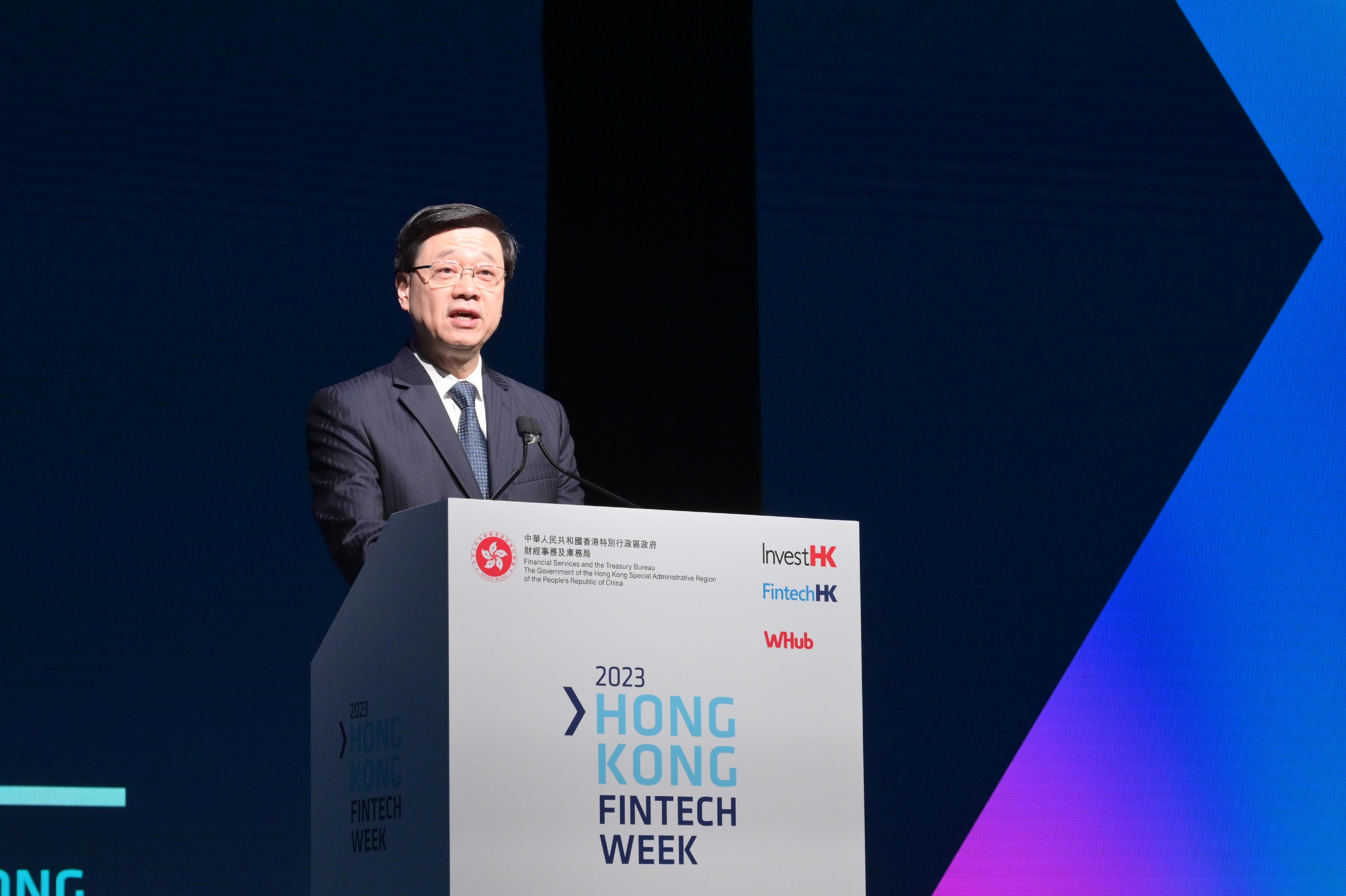
Speech by CE at Hong Kong FinTech Week 2023 (English only) (with photos/video)

     Following is the speech by the Chief Executive, Mr John Lee, at Hong Kong FinTech Week 2023 today (November 2):

Deputy Governor Zhang Qingsong (Deputy Governor of the People’s Bank of China), distinguished guests, ladies and gentlemen, and friends around the world,

     Good morning. A warm autumn welcome to FinTech Week – and to Hong Kong. 

     This week and this year’s Hong Kong FinTech Week, the eighth annual edition, features more than 500 speakers, 650 exhibitors and thousands of participants from over 90 economies, here in person and online everywhere. This is a flagship event of the Hong Kong SAR Government, and we aspire to bring together the brightest minds in the industry to a week of fintech activities. 

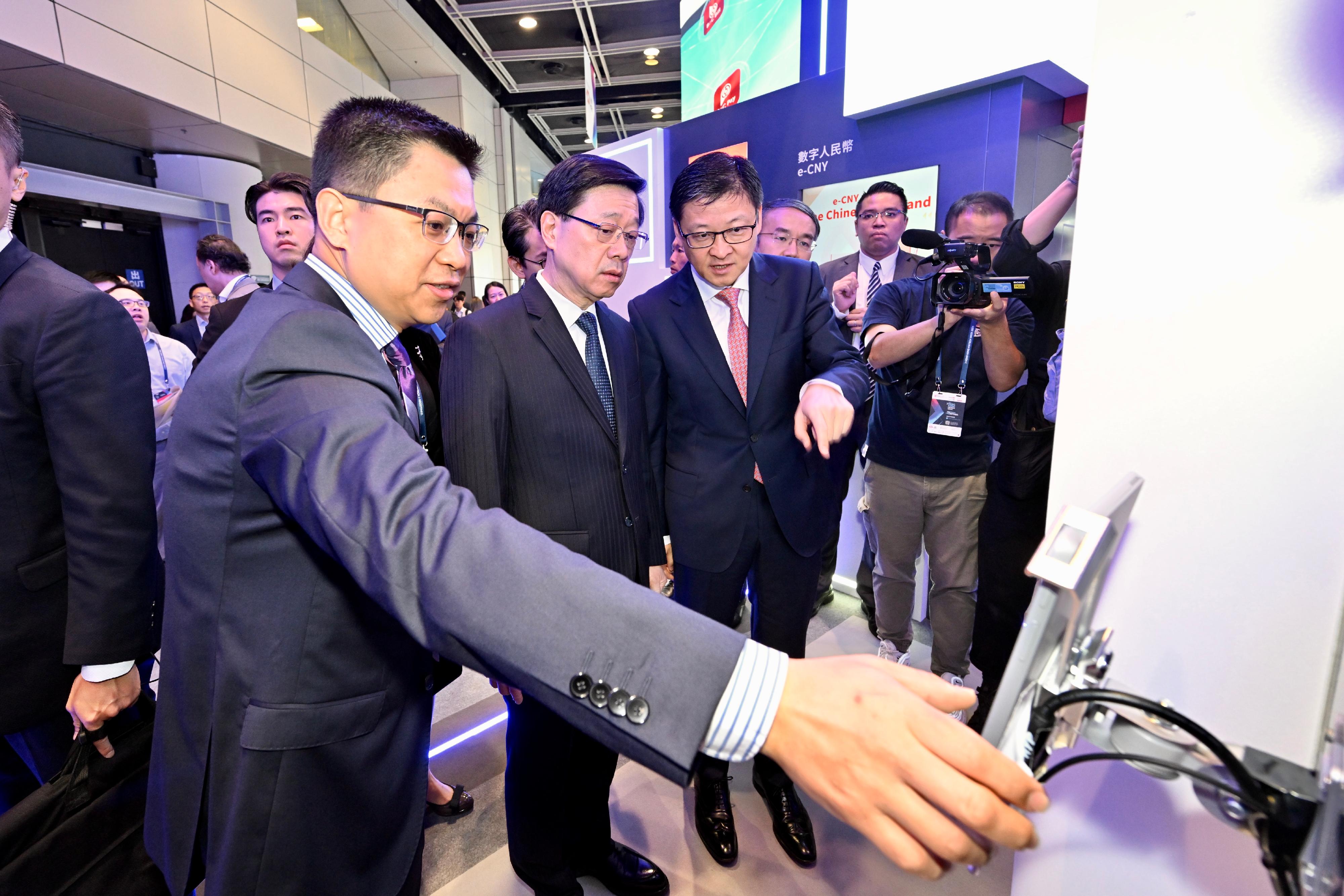
     The week-long events are themed “Fintech Redefined”, and will help to shape the future of fintech in every dimension. I had the opportunity of visiting some of our impressive array of exhibitors at your booths just now, and I must say I am encouraged by your passion in fintech, and in Hong Kong. 

     You’re here because Hong Kong is made for fintech companies, entrepreneurs and investors. We are one of the world’s leading financial centres and China’s major financial centre. No other economy can claim our unique advantage under the “one country, two systems” principle – which has empowered us to draw on, and create, opportunities from both our country and the world at large.  

     Firmly premised on the “one country” principle, “two systems” is an important source of impetus that ensures our connectivity and drives our development. We are blessed with an open and highly internationalised market, advanced infrastructure and communications support in all regards. We have internationally aligned regulatory regimes. We have long been a free port and separate customs territory. We champion free trade and the free flow of information and capital.

     Add to that the robust rule of law, and the fact that we are the only common law jurisdiction in China. You would know why Hong Kong is your fintech future. A truly redefined future.

     Our strengths in financial services are wide-ranging and multifaceted. Hong Kong is Asia’s asset and wealth management hub. Last year, we managed nearly US$4 trillion in assets. About two-thirds of that came from investors beyond Hong Kong.

     We are also the world’s largest offshore Renminbi business hub. We have about RMB1 trillion in deposits, and handle about 75 per cent of the world’s offshore Renminbi payment.  

     We are Asia’s green and sustainable finance leader. Last year, the green and sustainable debts issued in Hong Kong exceeded US$80 billion. Green and sustainable bonds arranged in Hong Kong accounted for more than one-third of the Asian market.

     These, and other achievements, reflect the prowess of Hong Kong’s financial sector and its potential – the opportunities here for us. And for you.

     Over the past year, I have led high-profile business delegations to Southeast Asia and the Middle East. From Thailand, Malaysia, Singapore and Indonesia, to Saudi Arabia and the United Arab Emirates, we shared our success stories and talked about Hong Kong’s return to the global stage after COVID-19. 

     ASEAN (Association of Southeast Asian Nations) is our second largest trading partner, for 13 years in a row. Our trade continues to grow, soaring almost 40 per cent since the signing, in 2017, of the free trade agreement (FTA) between ASEAN and Hong Kong. 

     Last year, 15 new offices with parent companies located in ASEAN opened in Hong Kong. Some 650 ASEAN local and regional offices and regional headquarters now call Hong Kong home. 

     The 10 member states of ASEAN are founding members of RCEP, the Regional Comprehensive Economic Partnership. In my meetings with ASEAN government leaders, they all reaffirmed their support of Hong Kong’s accession to RCEP, the world’s largest FTA.

     My officials have also been covering the ground around the globe. While keeping our close ties with our traditional partners in the European and American markets, we are also expanding our reach to markets under the Belt and Road Initiative, including those of Southeast Asia, Central Asia, the Middle East and Africa.

     We have been telling them that Hong Kong is fully in business, creating boundless and new opportunities. From promoting co-operation in finance and commerce, to innovation and technology, we are committed to offering the far-reaching rewards to different economies and their businesses that are looking for high-quality development. 

     As you know, I presented my second Policy Address a week ago. I announced a number of policy initiatives to boost growth and enhance Hong Kong’s competitiveness. Allow me, now, to highlight a few of those initiatives in financial services.

     In securities, we will take forward a number of reform measures. We will reduce the stamp duty on stock transfer, and market data fees. We will also look into how best to follow up on suggestions of a dedicated task force to boost market competitiveness, from trading under severe weather, to facilitating share repurchase by issuers. Other medium- and long-term measures on listing regime, market structure and trading will also be considered. 

     The goal is clear: to promote the sustainable development of the Hong Kong stock market.

     HKEX (Hong Kong Exchanges and Clearing Limited) will set up a new Integrated Fund Platform. It will focus on services related to fund subscription and redemption, settlement, the information portal and more. It will strengthen connectivity between Hong Kong’s fund industry and the Mainland’s financial markets in the long run, and boost Hong Kong’s competitiveness as an international hub for funds. The Secretary for Financial Services and the Treasury, Christopher Hui, will share the details with you very shortly.

     We will promote a better integration of fintech and green finance to fast-track our economy’s green transformation. We will expand green fintech and, in doing so, establish Hong Kong as a green fintech hub.  

     Next year, we will launch a dedicated proof-of-concept subsidy scheme for green fintech. It will provide early-stage funding support for the pre-commercialisation of green fintech innovations. It will also promote the development of technology-powered solutions.

     In June, HKEX launched the Hong Kong Dollar-Renminbi Dual Counter Model. It was created to advance the issuance and trading of Renminbi-denominated stocks in Hong Kong. 

     We will work closely with the Mainland authorities to include Renminbi counters under the Southbound Trading of Stock Connect and issue Mainland government bond futures in Hong Kong.  

     We will also liaise with the Mainland on the expansion of the mutual market access programme, including strengthening Bond Connect, as well as Stock Connect’s product offerings and trading system.

     Ladies and gentlemen, the Hong Kong SAR Government is committed to the continuing rise of fintech, and its expanding reach and influence in Hong Kong and beyond. We offer unparalleled opportunities for fintech businesses – for your businesses – to grow and thrive long down this 21st century of opportunities. 

     My thanks to the organisers, the Financial Services and the Treasury Bureau and Invest Hong Kong of the Hong Kong SAR Government, and our many other supporters for once again staging this key event.

     Next on our financial events calendar will be the Global Financial Leaders’ Investment Summit next week. It is heartening to note that 300 leaders in the financial field, many of whom being group chairmen or CEOs of the world’s top financial institutions, will be joining the high-powered Summit.

     And, if you can find the time, there’s a world of art, culture and entertainment, not to mention world-class hiking, biking and fine and fun dining here in Hong Kong. It’s everywhere you look and turn in Hong Kong, Asia’s world city.

     Enjoy this FinTech Week and I wish you the best of business. Thank you.

Photo  Photo  Photo  Photo  
read more

“Cheers!” Series 2023 to celebrate winter festive season with audiences

  The Leisure and Cultural Services Department’s “Cheers!” Series 2023 will be held from December to February next year, presenting eight fabulous visiting and local family entertainment programmes that include acrobatics, puppetry, music and theatre, to bring friends and family a heart-warming and fun-filled winter season. 

  The opening programme will be the Asian premiere of “Passenger” by The 7 Fingers from Canada, which tells the captivating stories of encounters, reunions and goodbyes of travellers in train transit through spectacular acrobatic performances. ALFA Theatre Pilsen from the Czech Republic will make its Hong Kong debut with “Zorro”, featuring traditional Czech marionettes with live band music and vocal accompaniment, and retell the legend of a superhero that combines elements of adventure, justice and comedy.

  Local puppetry troupes will also present a series of exciting performances in this winter season. Puppet musical “Sweetyland III A Whistle of Dreams” by Make Friends With Puppet tells the story of mischievous twins pursuing their dreams, while “The Whale in the Ground” by Fantasy Puppet Theatre invites children and adults to explore the underground world with Moly, a mole with a passion for archaeology.

  Acclaimed “The Snowman & The Bear” will return this winter with live orchestral accompaniment by the City Chamber Orchestra of Hong Kong, storytelling and singing, bringing audiences into a dreamlike, animated world through the big screen. The Hong Kong Oratorio Society will accompany music fans on Christmas Eve, performing a variety of classical Christmas vocal pieces and classic Christmas carols in the “A Christmas of Joy and Peace” concert.

  ”DO RE MI @ SuperBaby” by Jumbo Kids Theatre is a parent-child musical, in which musical genius Dr M creates a sonic paradise with little offbeat fairies through sounds and rhythms. At the family-oriented dance education theatre “Huh? It’s the ant rangers again?!” by Rice Journey Production, the audience will explore how the ants handle different challenges in their journey by following their little footprints.

  For programme dates, venues and ticket prices of “Cheers!” Series 2023, please see the Annex. Tickets are now available at URBTIX (www.urbtix.hk). For telephone bookings, please call 3166 1288. Package discounts will be available for ticket purchases with different stage shows in “Cheers!” Series 2023. For programme enquiries and discount schemes, please call 2268 7323 or visit www.lcsd.gov.hk/CE/CulturalService/Programme/en/f_entertainment/groups_1617.html. read more