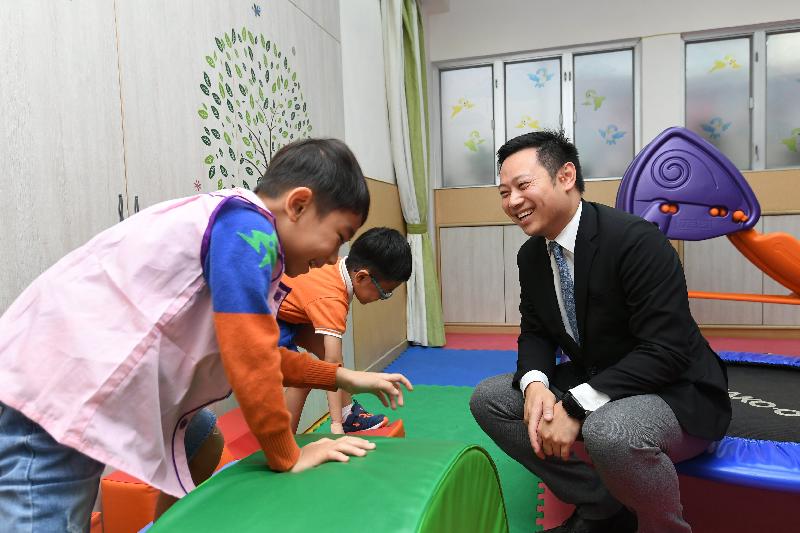
The Department of Health (DH) today (September 18) announced that the results of the Survey on Healthy Lifestyle of Preschool Students 2016/17 were satisfactory, with findings showing that lower class students of full-day classes at kindergartens and child care centres had been served an average of 1.2 servings of fruit, two servings of vegetables and 3.1 glasses of water, as well as conducted an average of 120 minutes of physical activity per day.
The DH also announced the launch of the Healthy Drinks at School Charter, which aims to enhance the school culture conducive to healthy eating and reduce the sugar intake of preschool students.
The Survey was conducted between November 2016 and March 2017, during which 380 schools and 3,639 parents of lower class students were interviewed to assess the diets and physical activity of preschool students during and after school. Most of the interviewed kindergartens and child care centres provided a conducive environment to healthy eating and physical activity for preschool students. Over 60 per cent had formulated a healthy eating school policy while around 80 per cent had formulated a physical activity school policy.
The Assistant Director of Health (Health Promotion), Dr Anne Fung, at a press conference today said, “Compared to a similar survey conducted by the DH in 2013, kindergartens and child care centres provided fewer instant drinks (not including milk formula) and used food as rewards for preschool students less frequently. However, more than half of the interviewed kindergartens and child care centres still provided full-cream or sweetened dairy products for their students. Fifty-one per cent provided instant drinks (not including milk formula) (a drop of 16 per cent compared to the 2013 survey), with half of them adding full-cream or other sweetened dairy products (49 per cent) or sugar (24 per cent) to those drinks. Forty-five per cent of staff members had used food such as biscuits, cookies, sweets and chocolate as rewards (a drop of 19 per cent compared to the 2013 survey).”
To reduce the sugar intake of preschool students from drinks, the DH has launched the Healthy Drinks at School Charter to be implemented from the 2018/19 school year. Kindergartens and child care centres signing the Charter, which is valid for three school years, have committed to encouraging young children to drink water and to make healthy drinks available to them. They have also vowed not to provide drinks with added sugar or with a relatively high sugar content, and not to use food as a reward. So far more than 300 kindergartens and child care centres have signed the Charter.
Dr Fung pointed out that excessive intake of sugar not only increases the risk of overweight and obesity in children, but also their chance of suffering from tooth decay. Children having sugary drinks will even develop a sweet tooth, which in turn hinders the development of a healthy eating habit. In addition, unhealthy foods with high sugar, high salt or high fat are usually used as rewards. She expressed the hope that the Charter can help create and enhance a school environment and culture conducive to healthy eating, as well as promote healthy drinks at school, thus urging more kindergartens and child care centres to sign the Charter.
The survey also found that parents’ knowledge on healthy eating and physical activity for preschool students requires improvement. Less than half of the interviewed parents knew that children aged 4 to 6 years should consume at least two servings of fruit per day, while only 15 per cent knew that children aged 2 to 6 years should perform at least 180 minutes of physical activity each day. On the other hand, 79 per cent parents knew about restriction of screen time for preschool students (an increase of 17 per cent compared to the 2013 survey), and the median duration of preschool students’ screen-time activity had been reduced from 80 minutes to 60 minutes.
Dr Fung noted that 94 per cent of preschool students had not consumed enough fruit and vegetables and over 70 per cent had less than 180 minutes of physical activity per day, while over 40 per cent of parents had used food as rewards. She advised parents to pay attention to their children’s daily intake of fruit and vegetables and whether they have performed sufficient physical activity. Parents should use rewards such as verbal encouragement or applause, or give extra parent-child activity time or offer small school supplies to their children instead of food, to ensure their healthy development.
She added, “Compared to students in full-day classes, those in half-day classes were served less fruit and vegetables in kindergartens and child care centres and performed less physical activity per day. Parents of students in half-day classes should pay special attention since the diets and physical activity of these students are mainly arranged by their family.”
To combat the threat of non-communicable diseases, the Government this year announced “Towards 2025: Strategy and Action Plan to Prevent and Control Non-communicable Diseases in Hong Kong”, setting out nine local targets to be achieved by 2025, which include halting the rise in prevalence of raised blood pressure, diabetes and obesity as well as attaining a 30 per cent relative reduction in mean population daily intake of salt/sodium. The DH will continue to adopt a multi-pronged approach to promote the adoption of healthy eating habits by the public to achieve the targets.
The survey results also revealed that the kindergartens and child care centres which had joined the StartSmart@school.hk Campaign (SSS Campaign) of the DH performed better in promoting healthy diet and physical activity at school than those that had not joined the campaign. Over 60 per cent of parents agreed that the SSS Campaign had enhanced their knowledge and concern on healthy eating and physical activity, and was effective in enhancing healthy eating and physical activity among their children.
Dr Fung said that the DH will continue to empower schools, school staff and parents in promoting healthy eating and physical activity by strengthening co-operation with kindergartens, child care centres and school sponsoring bodies through the SSS Campaign. A series of education materials such as videos and posters will also be produced.
The Controller of the Centre of Health Protection of the DH, Dr Wong Ka-hing, presented certificates of appreciation to representatives of 10 task force members of the SSS Campaign for their support and contribution to the Healthy Drinks at School Charter.
The territory-wide SSS Campaign was launched by the DH, the Education Bureau and the Leisure and Cultural Services Department in 2012, and is targeted at children aged 2 to 6 years. Using effective health education resources and training targeting kindergartens and child care centres, it aims to encourage and support parents and caregivers to create conducive environments to healthy eating and physical activity for preschool students in the school and at home, and to help preschool students cultivate a sustainable healthy lifestyle.
The public is welcome to visit the StartSmart@school.hk Campaign website (www.startsmart.gov.hk) to learn more about the Healthy Drinks at School Charter and health tips for preschool students. read more