image_pdfimage_print

Author Archives: hksar gov

LCQ2: Efficiency in policy implementation

     Following is a question by the Hon Paul Tse and a reply by the Secretary for Financial Services and the Treasury, Mr James Lau, in the Legislative Council today (October 31):
 
Question:
 
     In March this year, the Financial Secretary announced the rolling out of a Caring and Sharing Scheme, under which $4,000 will be disbursed to those members of the public who are not required to pay salaries tax for the preceding year, and for those members of the public whose benefits from concessions in salaries tax and rates are less than $4,000 in total, an amount of money will be disbursed to them to make up for the difference. The Government expected that the application arrangements for the Scheme would be announced before the end of this year and the Scheme would be open for applications in February next year at the earliest, but no progress has been heard so far. I have learnt that the office under the Working Family Allowance Office responsible for implementing the Scheme has yet to be set up, and the relevant computer programme is still under development. Quite a number of members of the public have complained that the slow implementation of the Scheme has given them an impression that the Government is quick to collect taxes but slow to disburse payments and that the administrative efficiency of the bureaucracy is too low. Regarding efficiency in policy implementation, will the Government inform this Council:
 
(1) whether the implementation progress of the Scheme (including the setting up of the office and the development of the computer programme) is behind schedule; whether it will expedite the relevant work so as to implement the Scheme as early as possible and to receive applications and disburse payments on an earlier date;
 
(2) whether, in the light of the situation that the implementation of the Scheme has taken an excessively long time and thereby has fallen short of the public’s expectation, the Government will comprehensively review its efficiency in policy implementation; and
 
(3) given that it has been announced in the Policy Address delivered recently that the Government will spend about $7 billion on the construction of a civil service college, whether it has plans to provide civil servants with specialised training courses in the areas of enhancing the efficiency of policy implementation, strengthening inter-departmental collaboration as well as avoiding the lack of coordination and shirking of responsibilities among various government departments, etc.?
 
Reply:
 
President,
 
     The Financial Secretary announced on March 23 this year the introduction of the Caring and Sharing Scheme to share the fruits of our economic success with more people in the community. A person who meets the relevant eligibility criteria may apply for a maximum of $4,000. The Working Family Allowance Office (WFAO) is responsible for implementing the Scheme and will accept applications from February 2019 at the earliest.
 
     Having consulted the relevant policy bureaux and departments, my reply to the questions raised by the Hon Paul Tse is as follows:
 
(1) and (2) Since the announcement of the Scheme in March this year, the WFAO has been actively undertaking the planning and preparatory work for the Scheme. First of all, a 24-hour telephone hotline has been established to receive public enquiries and a comprehensive list of frequently asked questions have been uploaded to the WFAO’s website to address questions about the Scheme from the public. Other tasks include formulating the mode of operation of the Scheme as well as developing operational manuals and guidelines, application procedures and payment arrangements, etc. Concurrently, the WFAO needs to put in place the relevant administrative arrangements including the setting up of a new office, the development of information technology (IT) systems and installation of office automation facilities, and the recruitment of some 700 additional contract staff with training provided to process an anticipated influx of applications of about 3 000 000 applicants at maximum, etc.
 
     To set up a new office, the WFAO has identified an office premises in the urban area, which is currently rented to another government department but will soon be vacated. The new office will handle applications under the Scheme. As for the development and installation of different IT systems, as well as manpower recruitment and training, the current progress has been largely satisfactory. The WFAO is now taking forward various tasks according to the planned schedule.
 
     After the announcement of the Scheme in March, the WFAO has been pursuing various tasks promptly in a proactive and pragmatic manner. It needs to recruit and train additional staff to cater for the anticipated influx of millions of applications. Moreover, to streamline the application process, computer systems with specific functions are required to facilitate verification by departments such as the WFAO, the Inland Revenue Department and the Land Registry, etc. In view of this, it will take some time for the WFAO to complete all the preparatory and administrative work so as to ensure smooth processing of applications and payment. Judging from the current progress, we expect that the Scheme will be open for applications from February 2019 at the earliest, which is in line with the planned schedule. The WFAO will announce the details of the application arrangement at the end of this year.
 
     All government departments have been pushing forward various policies proactively and in a concerted manner; and will continue to work together to enhance efficiency in governance with a view to facilitating the early implementation of initiatives beneficial to the public.
 
(3) Regarding the civil service college, the Chief Executive announced in her Policy Address this year that a new civil service college is expected to be completed in 2026. The new college with fully upgraded training facilities will provide enhanced training for civil servants in various areas so as to ensure that our civil servants keep improving with the latest changes and providing better quality services to the public. Pending the commissioning of the new college, the Civil Service Bureau will continue to enhance civil service training. The existing training programmes for civil servants have already covered areas on leadership development, public policy and public engagement, etc. Through case analysis and interactive learning, participating civil servants would gain more in-depth knowledge of the challenges in different policy areas and the ways to strengthen co-operation among various departments and would, in turn, enhance work efficiency and deliver outstanding performance in the Government’s roles as a service provider, regulator, facilitator and promoter.
 
     Thank you, President.  read more
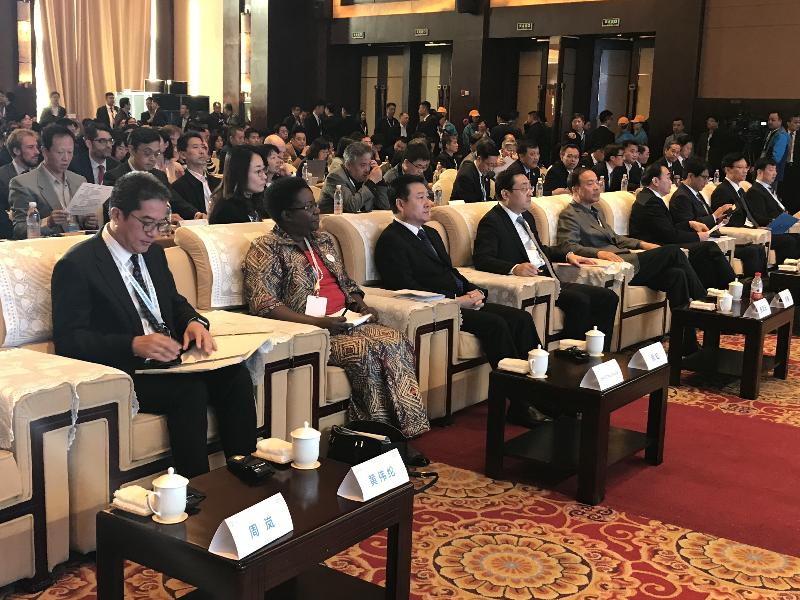
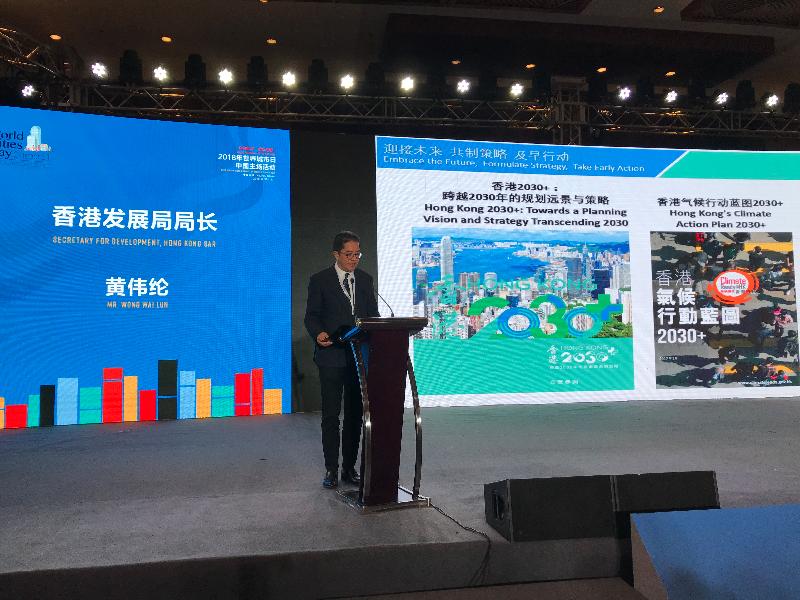
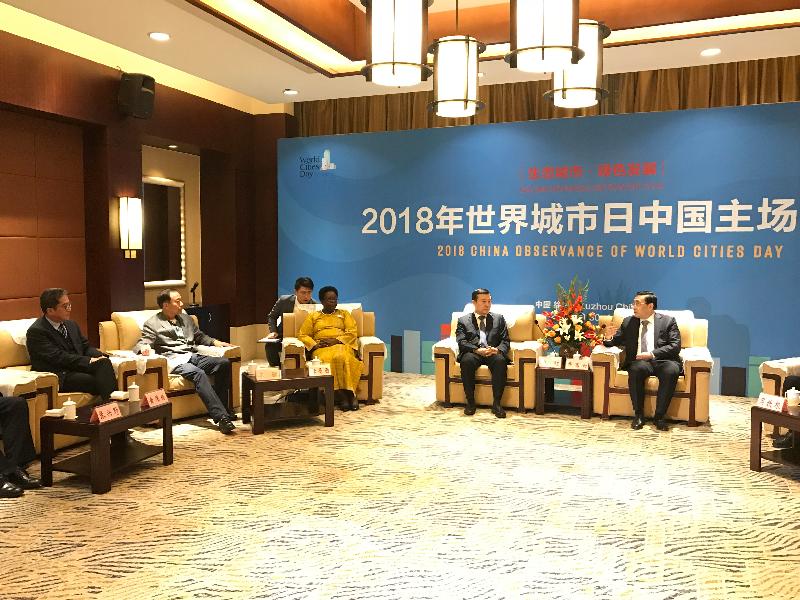
SDEV delivers keynote speech at 2018 World Cities Day Forum (with photos)

     The Secretary for Development, Mr Michael Wong, today (October 31) gave a keynote speech on green living and green cities at the 2018 World Cities Day Forum in Xuzhou, Jiangsu Province.

     In the keynote speech, Mr Wong introduced Hong Kong’s efforts in addressing the impact and challenges of urbanisation. He told participants at the forum how the Government enhances environmental capacity and promotes green living and sustainable development through innovative and meticulous town planning, engineering design and city management. 

     The 2018 World Cities Day Forum is organised by the United Nations Human Settlements Programme, the Ministry of Housing and Urban-Rural Development of the People’s Republic of China, and the People’s Government of Jiangsu Province. This year’s theme is “Building Sustainable and Resilient Cities”.

     On arrival at Xuzhou yesterday (October 30), Mr Wong attended the cultural exchange and welcome dinner. He also met with the Vice Governor of Jiangsu Province, Mr Fei Gaoyun; the Vice Minister of Housing and Urban-Rural Development, Mr Ni Hong; and the Special Envoy of the Executive Director of the United Nations Human Settlements Programme, Ms Christine Musisi, before the dinner.

     Mr Wong will return to Hong Kong this evening.

Photo  Photo  Photo  
read more

LC: CS presents Government Minute in response to Report of Public Accounts Committee No. 69A and No. 70

     Following is the speech (translated from Chinese) by the Chief Secretary for Administration, Mr Matthew Cheung Kin-chung, in presenting the Government Minute in response to the Report of the Public Accounts Committee No. 69A and No. 70 in the Legislative Council today (October 31):
 
President,
 
     Laid on the table today is the Government Minutes (GM) responding to Reports No. 69A and 70 of the Public Accounts Committee (PAC).
      
     When presenting Reports No. 69A and 70 on May 2 and July 11 to the Legislative Council (LegCo), the Chairman and Deputy Chairman of PAC offered comments and suggestion on two chapters in the two Director of Audit’s Reports, namely, “Administration of lump sum grants by the Social Welfare Department” and “Integrated education”.
      
     I welcome the Reports of PAC and am grateful for the time and effort that the Chairman and Members of PAC devoted to investigating these subjects. The Government accepts PAC’s various recommendations and sets out in detail the specific responses of the relevant bureaux/departments in the GM. Today, I would like to highlight the key measures that the Government has taken in the two important policy areas and the progress.
 
Administration of lump sum grants by the Social Welfare Department

Monitoring of non-governmental organisations with persistent underperformance
 
     Regarding “Administration of lump sum grants”, under the Lump Sum Grant Subvention System (LSGSS), the Social Welfare Department (SWD) has all along been monitoring subvented services of non-governmental organisations (NGOs) through the Service Performance Monitoring System (SPMS). Under the SPMS, SWD and NGOs jointly draw up Funding and Service Agreements (FSAs) on the subvented services to formulate service standards and assess service performance. NGOs are required to properly manage their service units to ensure compliance with the FSA requirements. Apart from requesting NGOs to submit quarterly statistical reports and annual self-assessment reports on a regular basis, SWD will also conduct service performance visits to subvented NGOs in every monitoring cycle (one cycle every three years), including review visits or surprise visits, so as to assess and monitor their service performance. If non-compliance is identified during the visit, SWD will require the NGOs concerned to submit an action plan for improvement and monitor their implementation of improvement measures.
      
     To enhance efforts in following up with service units with persistent underperformance, SWD set up in July 2017 a Service Performance Monitoring Committee to closely monitor the services with persistent underperformance and discuss appropriate measures with a view to taking timely follow-up actions.
      
Ensuring uninterrupted provision of quality services by NGOs with Lump Sum Grant deficit
 
     There are various reasons for NGOs to incur persistent operating deficits, such as staff wastage lower than the anticipated level, recruiting or retaining of staff by higher salaries with reference to the market situation, etc. Some NGOs have strategically used Lump Sum Grant (LSG) Reserves or its overall reserves to meet the needs of subvented services and maintain service quality.
      
     SWD will continue to review the Annual Financial Reports and annual audited financial statements submitted by NGOs to ascertain the soundness of their financial position. If NGOs incur persistent and huge deficits or utilise large sums of their reserves in service operation, SWD will also ascertain with them the underlying reasons, and give appropriate advice and conduct reviews, so that the NGOs concerned could maintain a healthy financial position and ensure sustainability and stability in the provision of the required subvented services.
 
Disclosure of remuneration packages for staff in the top three tiers
 
     The Government recognises that there is room for improvement in monitoring the remuneration of senior staff of subvented NGOs. On August 27, 2018, the Administration Wing issued an updated set of guidelines on the control and monitoring of remuneration practices in respect of senior executives in subvented bodies, under which policy bureaux are required to request subvented bodies that are not exempted from the requirements to submit their review reports on remuneration packages and disclose them to the public. SWD is currently discussing with NGOs on revising the requirements concerning the monitoring of remuneration of senior staff of subvented NGOs in the Lump Sum Grant Manual, and will inform NGOs within 2018 the specific arrangements and details for the submission of Review Reports on Remuneration Packages for Staff in the Top Three Tiers in accordance with those guidelines.
 
Handling of cost apportionment issues
 
     SWD has been addressing NGOs’ enquiries and offering advice and support to NGOs in relation to cost apportionment and separation of activities through designated liaison officers of the Subventions Branch, specified contact persons of the Finance Branch and the helpline.  SWD will clarify the principles of cost apportionment and discuss suitable apportionment options with every enquiring NGO based on its individual circumstances. SWD will continue to consult the sector on cost apportionment issues with a view to providing further guidelines.
 
Problem of staff turnover
 
     Human resource management, including recruitment and staff turnover, is in the realm of corporate governance of NGOs. SWD is very concerned about the manpower requirements in the sector. Staff turnover is subject to many factors, including remuneration packages, other employment opportunities, personal development, etc. Issues relating to the pay structure, staff turnover rate and vacancies in the sector will be examined in detail in the ongoing Review on Enhancement of LSGSS.
 
Review of the Lump Sum Grant Subvention System
 
     The Government set up the Task Force for Review on Enhancement of Lump Sum Grant Subvention System in November 2017 and the scope of the review covering eight areas was formally established in June 2018, including reviewing the use of LSG/Provident Fund reserves and financial planning, staffing establishment and subvention benchmarks, and enhancing NGOs’ public accountability and transparency, etc. The Task Force also conducts a number of sector consultation sessions and focus groups to listen to and collect the views of the stakeholders. The entire review is expected to be completed by mid-2020.
      
Integrated education
 
     Regarding “Integrated education”, the Government will allocate additional recurrent resources from the 2019/20 school year onwards to enhance the support to students with special educational needs (SEN). Specifically, the Education Bureau (EDB) will re-structure the Learning Support Grant, Intensive Remedial Teaching Programme and Integrated Education Programme. Under the restructured Learning Support Grant, the grant rate will be enhanced. Additional permanent teaching post(s) will also be provided to schools with a larger number of students with SEN. The EDB will also upgrade the special educational needs coordinator (SENCO) in these schools to a promotion rank to lead the additional teacher(s) to provide support for students with SEN more effectively. In addition, the EDB will continuously review and update the “Operation Guide on the Whole School Approach to Integrated Education” by stages to provide more specific guidelines to help school personnel and relevant professionals to determine the tier of support required by students with SEN and record their progress.
      
     To enhance early identification and support for students with SEN, EDB, Department of Health, Hospital Authority and SWD have established a cross-bureau/department collaboration mechanism. Under this mechanism, public sector primary schools and Direct Subsidy Scheme primary schools will obtain assessment information and progress reports of pre-school children with special needs promoted to Primary 1 (P1). This will facilitate schools in providing those students with appropriate support. The EDB will also continue to enhance the “Early Identification and Intervention Programme for Primary 1 Students with Learning Difficulties” so that timely support could be provided to P1 students in need.
      
     The School-based Educational Psychology Service (SBEPS) covers all public sector primary and secondary schools. For schools with a great number of students with SEN, the EDB has been gradually improving the ratio of educational psychologist (EP) to school to 1:4 under the Enhanced SBEPS. In the 2018/19 school year, the EDB extended the Enhanced SBEPS to about 120 primary and secondary schools. The target is to enhance the ratio of EP to school to 1:4 for about 60 per cent of public sector ordinary primary and secondary schools, and 1:6 for the remaining 40 per cent of schools by the 2023/24 school year. The EDB is liaising with the local tertiary institutions on feasible plans to increase the number of EP training places in order to meet the long-term manpower needs.
      
     President, I would like to thank the Chairman and all Members of PAC again for their efforts and guidance. EDB, SWD and relevant departments will strictly follow their responses in the GM and implement the improvement measures as soon as possible to ensure the proper use of public funds. 
      
     Thank you, President.
      read more

LCQ1: Handling confrontations on campuses of tertiary institutions

     Following is a question by the Hon Tony Tse and a reply by the Secretary for Education, Mr Kevin Yeung, in the Legislative Council today (October 31):

Question:

     In recent years, there were several incidents in which demonstrations staged on campus by students of tertiary institutions developed into confrontations. In those incidents, some students broke into and occupied offices or conference rooms of the institutions concerned, swearing at and jostling teaching staff, barring them from leaving, and even obstructing ambulance personnel from sending the injured to the hospital for treatment. There are comments that the failure of the institutions concerned to report such incidents to the Police in a timely manner caused the confrontations to escalate, thereby increasing the odds of teaching staff being subject to insults and injuries as well as emboldening trouble-makers in future to make bolder moves. In this connection, will the Government inform this Council:

(1) whether it knows the number of incidents in the past five years in which demonstrations on campuses of tertiary institutions developed into confrontations, as well as the number of teaching staff, security staff and other persons who sustained injuries in those confrontations;

(2) of the number of confrontations referred to in (1) which were handled by police officers; among such cases, the respective numbers of those which were reported to the Police by the institutions concerned and by other persons, and those in which the Police took the initiative to intervene; whether police officers are authorised to enter the campuses without prior consent of the institutions concerned to take law enforcement actions; if so, of the circumstances under which they will do so; and

(3) whether the Education Bureau and the Police will step up communication with and provide additional support to tertiary institutions, including assisting the institutions in reviewing the adequacy of their security measures and manpower on campus, as well as issuing guidelines on the circumstances under which the institutions and their teaching staff should report to the Police for assistance as well as those under which the Police should take the initiative to enter campuses to take law enforcement actions?

Reply:

President,

     The Education Bureau (EDB) noted a number of incidents of confrontation in post-secondary institutions in recent years, some of which involved students expressing their views in an irrational manner. The EDB expressed regret over such incidents and reiterated that any physical or verbal violence is unacceptable.

     Hong Kong is a free and open society. Anyone who wishes to voice his opinions should express them in a lawful and peaceful manner. While freedom of speech is protected by the Basic Law, the exercise of such freedom is not completely without restrictions. We need to respect the rights of others and abide by the law when exercising our freedom of speech. Freedom of speech, academic freedom and institutional autonomy should not be used as the disguise or excuses for advocating improper expressions or behaviour. The community, in particular, holds high expectations of tertiary students.   

     All University Grants Committee (UGC)-funded universities are autonomous bodies established pursuant to their own Ordinances. The UGC’s Notes on Procedures state that UGC-funded universities enjoy autonomy in the development of curricula and academic standards, selection of staff and students, initiation and conduct of research, internal allocation of resources, etc., and they are accountable for their decisions in these matters. The handling of incidents of protests and confrontations on campuses is also an internal affair of institutions. In view of the significant funding each university receives from the Government and members of the community, as well as the importance of higher education to the development of society as a whole, it is incumbent upon the Government and the community at large to have a legitimate interest in the operation of the universities. Therefore, while the Government and the UGC attach great importance to safeguarding institutional autonomy, universities are also expected to remain committed to transparency and accountability in their operation to ensure that universities’ activities and operation serve the best interests of students and the community.

     In face of the isolated incidents of protests and confrontations on campuses, the EDB believes that the institutions, which are equipped with good governance, are able to deal with the opinions of various stakeholders appropriately and ensure that the decisions made are in the best interests of students and the society. The institutions have the responsibility as well as the ability to deal with incidents that occur on their campuses properly, including isolated incidents of protests and confrontations. The EDB encourages the institutions to maintain close communication with students who should express their views in a rational manner through proper channels.
 
     My reply to the question raised by Hon Tony Tse is as follows:

(1) The EDB does not maintain data on incidents of protests which have developed into confrontations on the campuses of post-secondary institutions. In response to Members’ requests, we have made enquiries with various post-secondary institutions. According to the information provided by the institutions, over the past five years (i.e. from January 1, 2014 to October 15, 2018), there were 11 incidents of protests and confrontations on the campuses of local post-secondary institutions, in which a total of 14 teaching staff and two other persons were wounded.

(2) The Police do not maintain relevant statistical figures on post-secondary institutions. To these institutions’ best knowledge, assistance was rendered by police officers in four of the above 11 incidents, in which one case was reported to the Police by the institution, two were reported by the teaching staff and one was reported by other people.

     Post-secondary institutions are responsible for their own security matters, which are executed by their staff or security guards hired by them. With regard to the demonstrations on campuses, generally speaking, the Police will not intervene. It is only upon receipt of requests for assistance in handling incidents relating to public safety and public order, shall the Police, after liaising with the institutions, enter campuses to render assistance.

(3) Generally speaking, each institution has its own internal mechanism, rules and procedures to deal with emergency incidents that occur on its campus, including seeking assistance from law enforcement agencies as appropriate. Moreover, the Government also maintains contact with post-secondary institutions over various matters and offers them support and advice as and when necessary. In fact, the institutions have gained considerable experience over the years in handling incidents of confrontations with appropriate responses, demonstrating professionalism in ensuring that students can study in a safe and orderly environment, are taught professionally and are offered counselling as needed.

     The Police will continue to maintain close liaison with post-secondary institutions through district commanders or Police community relations officers. Where necessary and upon receipt of requests for assistance, the Police will, after liaising with the institutions, enter campuses to render appropriate assistance so as to ensure public safety and public order. read more

LCQ21: Advisory and statutory bodies

     â€‹Following is a question by Hon Jimmy Ng and a written reply by the Secretary for Home Affairs, Mr Lau Kong-wah, in the Legislative Council today (October 31):
 
Question:
 
     The Chief Executive stated in her Policy Address delivered in October 2017 that she had “called upon all policy bureaux to uphold the principle of meritocracy and cast their net wide in scouting for talents. Anyone with ability and the commitment to serve the community will stand a chance to join various statutory and advisory bodies and tender advice to the Government”. Regarding the statutory and advisory bodies (SABs) in Hong Kong, will the Government inform this Council:
 
(1) whether the Government compiled statistics in the past three years on the political affiliations of members of various SABs; if so, of the details; if not, the reasons for that; 

(2) as there are comments that as the society of Hong Kong has become increasingly diversified, the Government needs to listen to the views of various stakeholders in the process of policy formulation, whether the Government reviewed in the past three years the roles of SABs in policy formulation; if so, of the details; if not, the reasons for that; and 

(3) given that the Government has launched, one after another since last year, the Pilot Member Self-recommendation Scheme for Youth and the Member Self-recommendation Scheme for Youth, but only 15 advisory committees are covered by such schemes, representing 3 per cent of the approximately 490 SABs in Hong Kong, whether the Government will review the effectiveness of such schemes and introduce improvements, e.g. relaxing the age restriction as well as gradually opening up all SABs for self-recommendation by young people; if so, of the details; if not, the reasons for that? 
 
Reply:
 
President,
 
     My reply to Hon Jimmy Ng’s question is as follows.

(1) The Home Affairs Bureau (HAB) maintains the personal particulars of most members serving on advisory and statutory bodies (ASBs). Some of them have declared their political affiliation. But as such information is provided by individual members on a voluntary basis, we do not have comprehensive statistics on the political affiliation of all ASB members.

(2) As a key component in public administration, ASBs play an important role of assisting the Government in the consultation with stakeholders, formulation of policy objectives and performance of statutory functions. At present, there are about 490 ASBs in Hong Kong. The system of ASBs is multi-faceted, including various advisory boards and committees, public bodies, appeal boards and regulatory bodies. Through these bodies, various sectors of the community and relevant organisations may express their views at various stages in the making of policies and planning of public services by the Government.

     The appointments of individuals by the Government as non-official members to ASBs are based on merits. When appointing a member to serve on an ASB, the relevant bureau or department (B/D) takes into account the candidate’s ability, expertise, experience, integrity and commitment to public service, with due regard to the functions and nature of business of the ASB as well as the statutory requirements for the membership of the statutory body concerned.

     To gauge a wide range of public views, when appointing members to serve on these bodies, the Government will, apart from taking into account the needs of the ASB concerned, consider people of various background and experience, such as professionals, academics, businessmen as well as representatives from districts and related sectors. Apart from those appointed directly by the Government, some ASB members are identified through nomination, recommendation, appointment or election by the relevant institutions and professional organisations.

     The Government has been keeping a close watch over the arrangements on appointment of ASB members to make sure that such arrangements meet the needs of the community today. To enable ASBs to fully cater for the increasingly diversified society, the HAB, while upholding the principle of appointment by merits, has established guidelines for B/Ds on the appointment of members to ASBs to make sure that individuals from various sectors have the opportunity to serve the community through working in ASBs. According to the guidelines, B/Ds, as a general rule, shall not recommend appointment of a non-official member to serve on more than six ASBs at the same time or to serve on the same body for more than six years in the same capacity. This is to ensure a reasonable distribution of workload and a healthy turnover of members. Moreover, the Government has set a gender benchmark target of 35 per cent to enhance the participation of women in ASBs. To provide more opportunities for young people to participate in policy discussion and debate, the Government has set a target of increasing, within the current-term Government, the overall ratio of appointed youth members aged between 18 and 35 to 15 per cent.

(3) The Government creates, through various initiatives, a favourable environment for young people to join different ASBs for participating in public affairs. Such initiatives include the regularisation of the Pilot Member Self-recommendation Scheme for Youth (Pilot Scheme) launched last year to recruit regularly young people, who are aged between 18 and 35 and passionate about serving the community, to join more ASBs. Under the regularised Member Self-recommendation Scheme for Youth (MSSY), the Government will roll out two rounds of recruitment every year. The number of participating committees covering various policy areas will increase and exceed 15. The Pilot Scheme and the first phase of the regularised MSSY have received about 1 100 and 1 500 applications respectively. In addition to the seats open for recruitment under the Pilot Scheme and MSSY, the Government has invited those applicants attending the interviews to authorise the HAB to include their personal particulars in the Central Personality Index (CPI) database so that relevant B/Ds may retrieve the information for reference during their selection of candidates for appointment as members of ASBs. The number of young people in the CPI database was only about 940 before the launch of the Pilot Scheme (i.e. October last year), and the number has increased significantly to about 2 770 at present. The proportion of appointed youth members has also increased from 7.8 per cent as at the end of last year to the current level of 9 per cent and the progress is satisfactory. read more