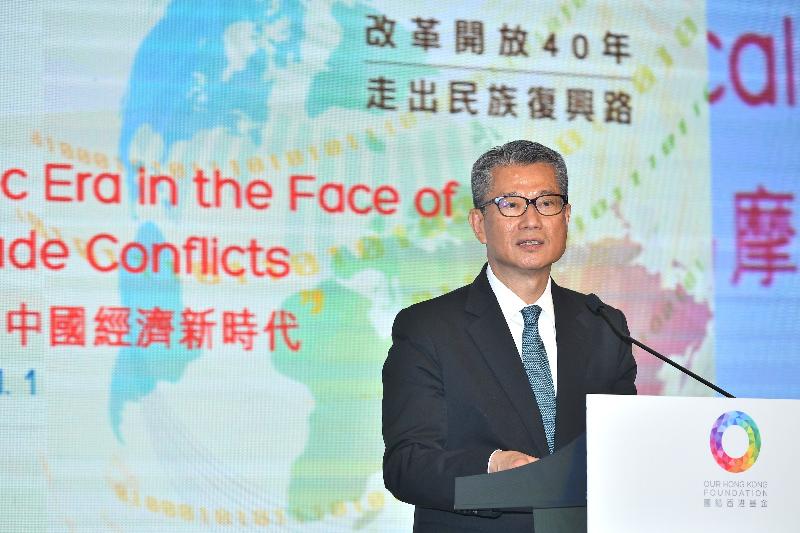
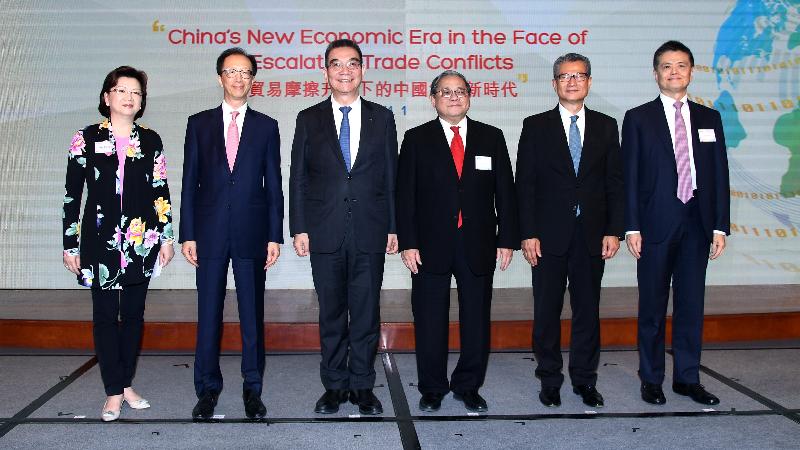
Following is the speech by the Financial Secretary, Mr Paul Chan, at China Masters Series: China’s New Economic Era in the Face of Escalating Trade Conflicts organised by the Our Hong Kong Foundation today (November 1):
Dr Victor Fung (Group Chairman of the Fung Group), Professor Lin (Director of the Institute of New Structural Economics of Peking University, Professor Justin Lin), distinguished guests, ladies and gentlemen,
Good afternoon.
It is my honour to be here today for this event, under the timely theme “China’s New Economic Era in the Face of Escalating Trade Conflicts”.
This year marks the 40th anniversary of China’s opening up and economic reform, which unleashed productivity growth and market vitality in many fields, bringing our country unprecedented prosperity. The Mainland economy, which maintained an impressive growth rate of almost 10 per cent per annum over the past four decades, is now the second largest economy in the world, with an annual GDP of over US$12 trillion or about US$8,800 on a per capita basis. The Mainland has evolved into a middle-income economy and entered a new era of economic development.
In this new era, the Mainland authorities are committed to developing the economy along the path of balanced, inclusive and sustainable growth. Meanwhile, the Mainland economy has been shifting from an extensive model, which relies more on the accumulation of factors of production, to an intensive one, which relies more on innovation and productivity growth. To promote high-quality development, Mainland authorities pledge to push forward supply-side structural reforms, particularly those relating to boosting market efficiency, increasing consumption, upgrading productivity, lowering business costs and containing financial risks. By harnessing the power of innovation and technology and unleashing the potential of consumption demand, these reforms will enable the Mainland to eventually attain the status of a high-income economy, while sustaining a medium-high rate of growth in the years to come.
Opening up plays a crucial role in facilitating the aforesaid economic reform. Experience over the past four decades proves that opening up has not only enabled foreign capital and technology to enter the Mainland, but also created a competitive environment that compels domestic economic reform, thereby achieving enviable growth. To pursue sustainable and high-quality development, it is essential that China sustains its opening up for global partnerships, so that benefits can be created and shared between the Mainland and its economic partners through trade, investment and more.
Since the Mainland started opening up 40 years ago, the rise of its economy has gone hand in hand with the wave of globalisation. Indeed, the forces of economic globalisation manifested in trade liberalisation through tariff reductions and removal of trade barriers have driven growth worldwide, benefiting many. Such economic success cannot be achieved without the support of the international community as it is built on a shared vision of openness and mutual respect on the part of every economy engaged in international trade and investment.
Unfortunately, this consensus for multilateralism is under threat lately. Protectionism has been on the rise, casting a shadow over the global economy. This became particularly obvious since last year, as the current US administration began to escalate trade conflict with its trading partners around the world, particularly the Mainland.
For a small and externally oriented economy like Hong Kong, a free and open trade environment is of vital importance. A strong and credible multilateral trading system, supported by the World Trade Organization, is of great value because it provides a predictable, rule-based framework to promote trade expansion and liberalisation, while preventing the vagaries of arbitrary and discriminatory actions by any economy. So we note with grave concern the escalating protectionist trends because they pose great challenges to the established rule-based multilateral trading system.
As the trade conflict between the US and the Mainland continues to escalate and the range of products subject to tariffs expands, Hong Kong’s economy would be affected, not only through the trade channel but also indirectly through weaker business confidence and dampened financial market sentiment. Aggravating the situation is the normalisation of US monetary policy and the shifts in international capital flow. The combined impact of these on us and the global economy will become even more apparent in the period ahead, especially if the trade conflict is prolonged and escalates further.
The Hong Kong SAR Government will continue to closely monitor this development and assist the trade by stepping up support measures, particularly for our small and medium-sized enterprises (SMEs), which are relatively vulnerable under the changing market conditions. We have already put forward special measures to enhance support to Hong Kong SMEs including protection against rising export credit risks, enhanced access to bank finance, and assistance in market development and diversification. We will continue to communicate with the trade closely to understand their concerns, and to provide more assistance if needed. We have also been monitoring very closely our banking system and the financial market. Our banking sector is very strong, extremely well capitalised and resilient. The stock market has been operating smoothly and stress tested to withstand extreme market conditions.
Protectionist moves in the form of raising tariffs and imposing trade barriers have brought uncertainties in international trade. I must say it is a big setback to the international trade system. Such moves also drag the pace of global economic growth and impede development towards an open global economy.
Countering this protectionist current, China reaffirms its full commitment to further opening up its economy. At this new historic juncture of its development, further reform and opening up are welcome, and indeed comforting to note, because they will boost new drivers of economic growth. In particular, the Mainland has rolled out concrete measures creating a more favourable business environment for foreign investors. Market access for foreign investors will be significantly eased in sectors such as finance, transportation, professional services, infrastructure, energy, resources, and agriculture. The Mainland has also continued to voluntarily reduce import tariffs, with the latest round of reductions starting today. Together with the tariff reductions which took effect earlier this year, the Mainland’s overall tariff level has been lowered to 7.5 per cent, half the level of 2001. To create a level playing field for companies of all kinds of ownership, be they Chinese or foreign-owned, Mainland authorities have, on many occasions, pledged to further widen market access, raise policy transparency and exercise fair and impartial regulation.
China’s policy of opening up is also reflected in its efforts to establish partnerships with other countries. The Belt and Road Initiative is a grand strategy adopted by our country to usher in a new phase of international co-operation, which is particularly important in face of rising protectionism in some advanced economies. The Initiative will deepen collaboration across economies along the Belt and Road region by strengthening economic and infrastructure connectivity and boosting cross-border flows of goods, services, capital and talents, to achieve win-win outcomes for all economies involved – all in the spirit of peace, co-operation, openness, inclusiveness, mutual respect and mutual benefit.
With the focused endeavour and unwavering commitment by Mainland authorities to widen reform and open up further, China’s door to the world is bound to open wider in the years to come. Hong Kong can contribute to national reform and development by playing our unique role as the pivotal gateway connecting the Mainland and the rest of the world.
Under the unique “one country, two systems” arrangement underpinned by a fine tradition of rule of law and independent judiciary, our competitive advantages, including an open and free market, a robust institutional framework, a low and simple tax regime and a deep pool of multicultural talent, Hong Kong will continue to serve as China’s international financial, trade, shipping and innovation and technology centre. Our participation in the Belt and Road Initiative and the Guangdong-Hong Kong-Macao Greater Bay Area development will allow Hong Kong to play an even more active role in the further two-way opening up of the Mainland.
At the same time, Hong Kong will benefit in such participation. As the Mainland becomes a more open, transparent, competitive and better-regulated market, top-quality, high-end service providers in Hong Kong can reap ample opportunities ahead. To fully realise the potential benefits arising from the Mainland’s continued reform and opening up, the Hong Kong SAR Government will play the role of “promoter” and “facilitator”, diversify our economic base, remove our supply-side constraints in land and manpower, and deepen our economic co-operation with the Mainland.
Ladies and gentlemen, the event today offers an excellent platform for us to discuss the new era that our country embraces amid the current global political and economic climate. I am sure that the insight of Professor Lin and the ensuing panel discussion are going to provide much food for thought. I wish you all a very rewarding afternoon.
Thank you very much.