image_pdfimage_print

Author Archives: hksar gov

Hong Kong’s role as gateway and important hub showcased at China International Import Expo (with photos/video)

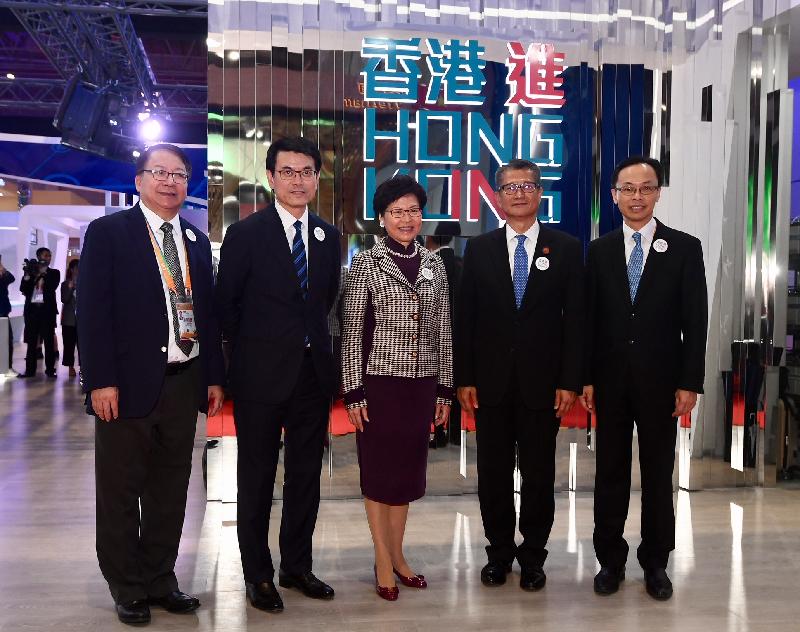
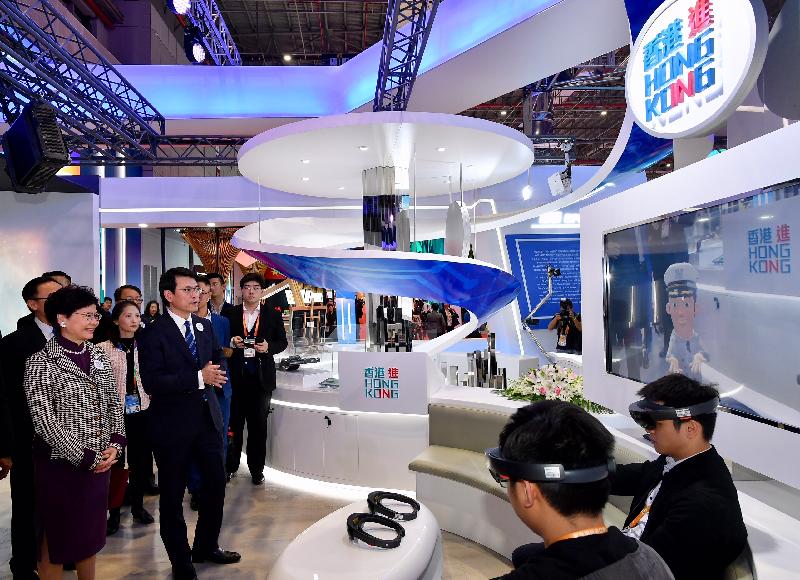
     To showcase its unique role as a strategic gateway and important hub for the opening up of the country, Hong Kong is actively participating in the inaugural China International Import Expo (CIIE) being held at the National Exhibition and Convention Center in Shanghai from today (November 5) to November 10, including setting up a Hong Kong Exhibition Area and joining the Enterprise and Business Exhibition.
 
     Themed “Hong Kong In”, the Hong Kong Exhibition Area is located inside the China Pavilion of the Country Pavilion for Trade and Investment. The theme represents the Hong Kong spirit which strives to make every endeavour to improve and excel, and symbolises Hong Kong’s role in assisting international products and services to go into the vast market of the Mainland. With local enterprises actively joining forces with the Mainland counterparts to participate in the Belt and Road Initiative, Hong Kong is the ideal platform for helping Mainland enterprises to “go global” and assisting international companies to enter the Mainland market.
 
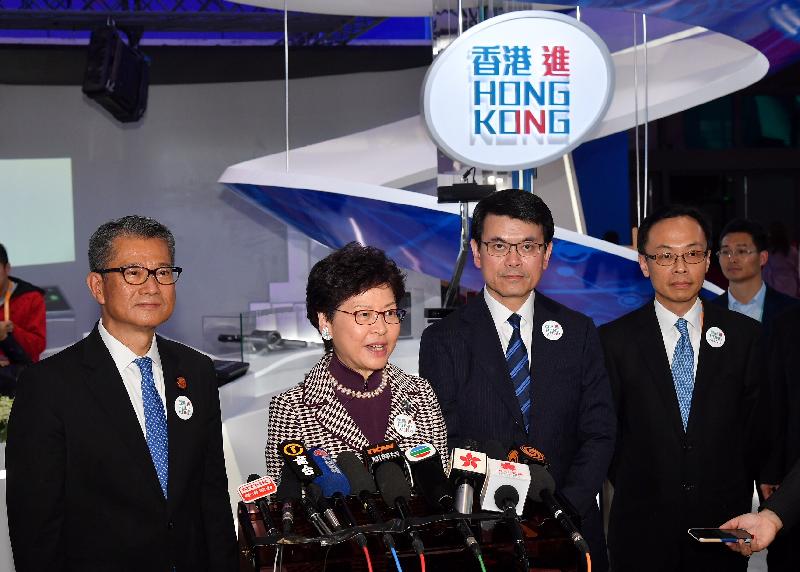
      The Chief Executive, Mrs Carrie Lam, attended the opening ceremony of the CIIE this morning, and introduced to President Xi Jinping the theme and content of the Hong Kong Exhibition Area during his visit to the China Pavilion. She also attended a banquet hosted by President Xi and his wife Peng Liyuan yesterday evening to welcome guests attending the CIIE.
 
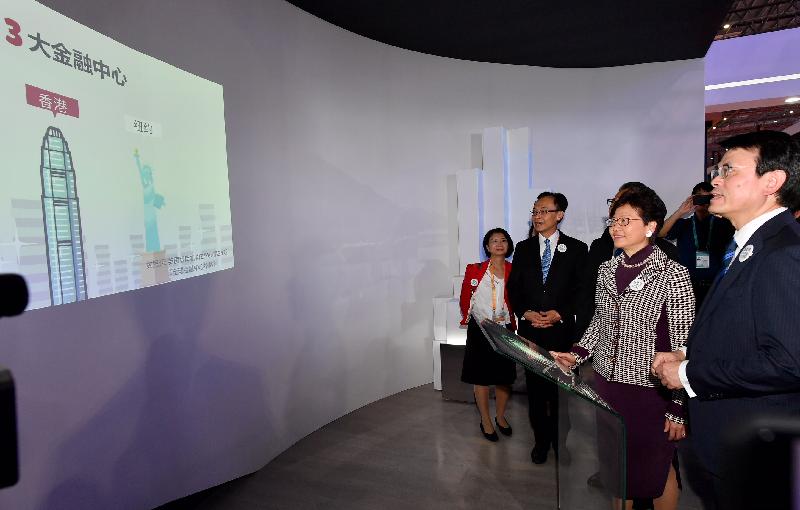
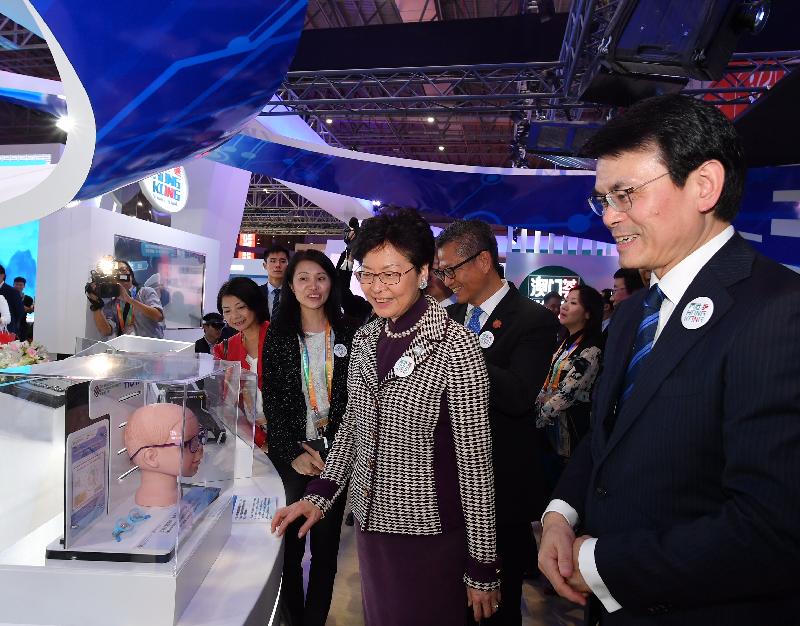
     The Hong Kong Exhibition Area introduces Hong Kong’s strengths, major infrastructure projects, popular tourist attractions, and innovation and technology products and inventions with the use of various multimedia technologies, such as a transparent projection touch screen, mixed reality, holograms, 3D mapping, an interactive magic book and a naked eye 3D display.
 
     Other themes featured include Hong Kong’s participation in the Belt and Road Initiative and the Guangdong-Hong Kong-Macao Greater Bay Area development, its contributions to the reform and opening up of the country, and the implementation of “one country, two systems” and the Basic Law.
 
     To showcase Hong Kong’s unique culture, “Daily Highlights” performances including a harmonica ensemble, an a cappella group, Chinese-Western music crossover, Cantonese opera excerpts and fashion shows are being held at the Hong Kong Exhibition Area. The Home Affairs Bureau has recruited more than 20 Hong Kong youth volunteers from Hong Kong and Shanghai to take part in the CIIE.
 
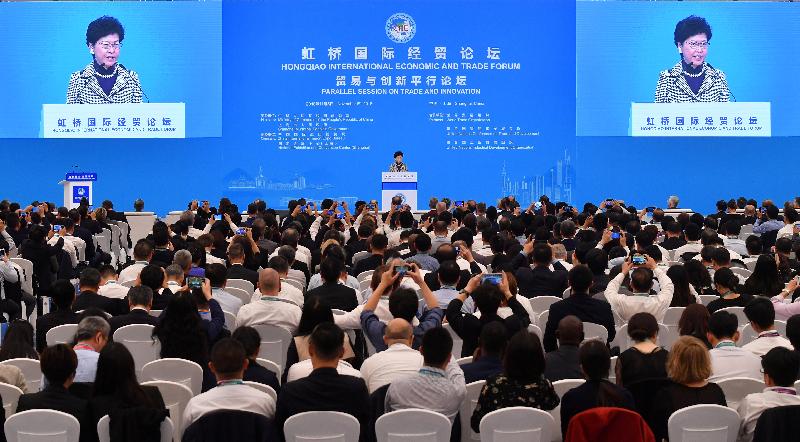
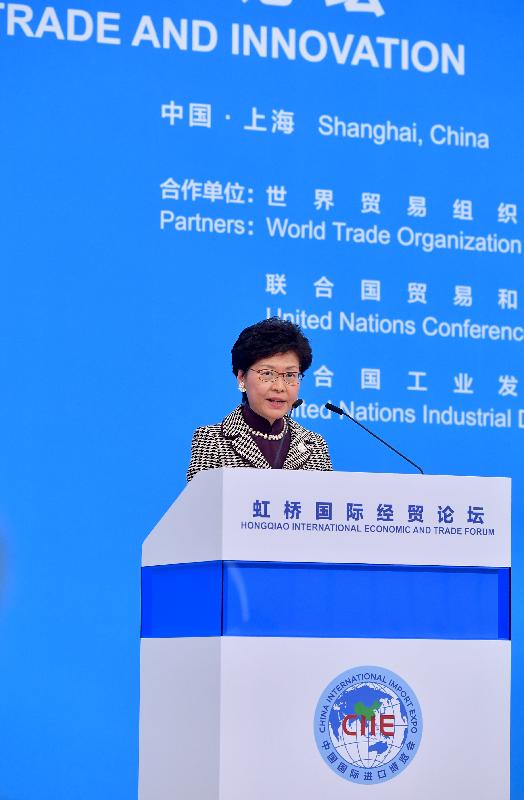
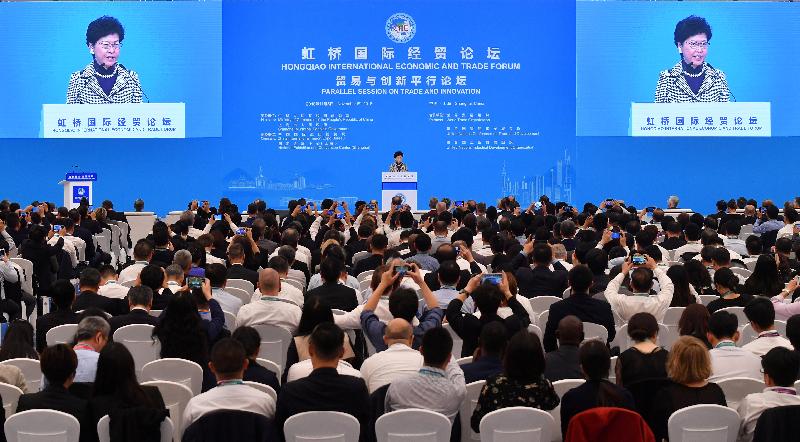
     In the afternoon, Mrs Lam delivered a keynote speech at a parallel forum themed “Trade and Innovation” under the Hongqiao International Economic and Trade Forum.
 
     “Technological advancement will no doubt drive growth in trade. At the same time, trade will create demand for products and services, which will in turn provide the incentive for innovation. The WTO’s World Trade Report 2018, focusing on how global commerce is being transformed by digital technologies, also sees great promise in the future of trade,” she said.
 
     “The potential is there for all to see, but in order to realise it, free trade has become ever more important. As world leaders gather here in Shanghai for the inaugural China International Import Expo, I believe that this is an excellent opportunity for us to re-affirm our commitment to free trade, and make sure that we and our future generations will be able to reap the full benefits of the Fourth Industrial Revolution,” she continued.
 
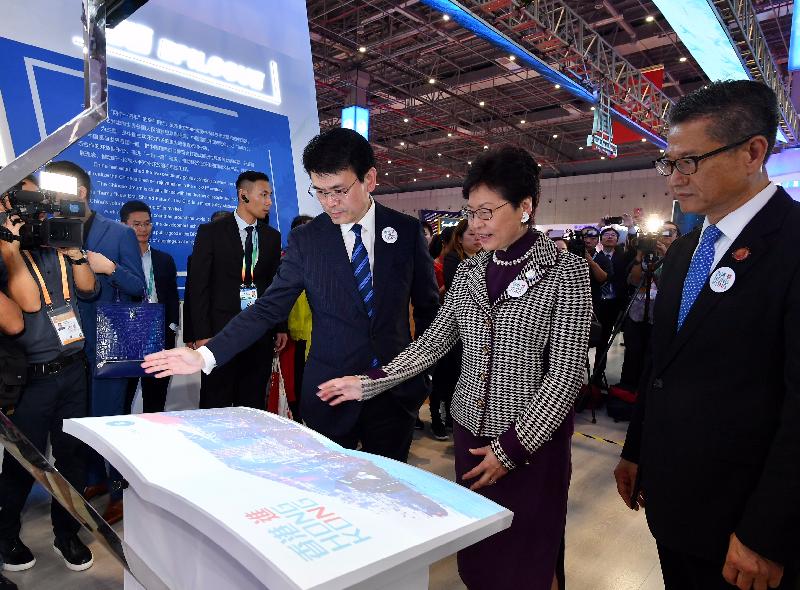
     Apart from the Hong Kong Exhibition Area, over 160 Hong Kong enterprises are exhibiting at the Enterprise and Business Exhibition covering both trade in goods and services to fully demonstrate Hong Kong’s quality products and professional services. Amongst the exhibitors are renowned local brands and a range of professional services, such as architecture, logistics, accounting, information and communication technology, marketing and professional licensing. Accompanied by the Secretary for Commerce and Economic Development, Mr Edward Yau, Mrs Lam toured the Enterprise and Business Exhibition and the Hong Kong Exhibition Area.
 
     Mrs Lam will also attend a dinner hosted by the Hong Kong Special Administrative Region Government for representatives of Hong Kong chambers of commerce and enterprises participating at the Enterprise and Business Exhibition.
 
     The Trade and Industry Department and the Hong Kong Trade Development Council will jointly hold the “Seminar on ‘Hong Kong’s Experiences for International Trade’: New Horizon·New Technology·New Model” tomorrow (November 6) where Mr Yau will deliver an opening address.
 
     The forum will feature industry experts from the innovation and technology, finance and legal sectors. They include the Group Chairman of the Fung Group, Dr Victor Fung; the Expert Partner of Sequoia China Fund, Mr Herbert Chia; the Chief Corporate Banking Officer of Bank of China (Hong Kong), Mr Lin Guangming; and Member of the Greater China Legal Affairs Committee of the Law Society of Hong Kong Mr Lawrence Yeung. They will explore issues including big data applications, support for cross-border enterprises provided by Hong Kong financial services and risk management by Hong Kong professional services, highlighting possible roles for the local services sectors in international trade.
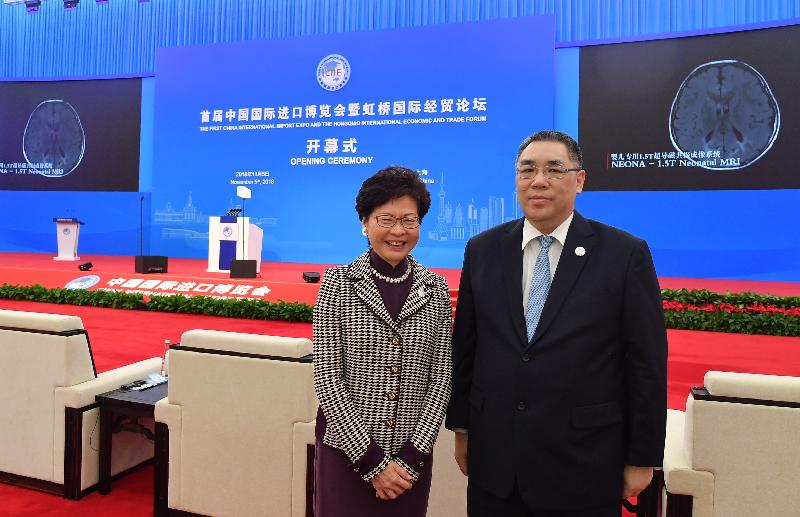
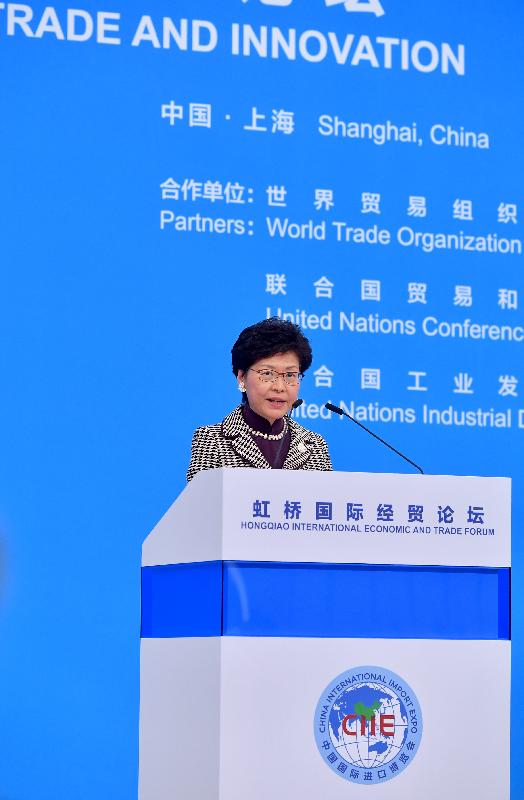
Photo  Photo  Photo  Photo  Photo  Photo  Photo  Photo  Photo  
read more

Speech by CE at Hongqiao International Economic and Trade Forum parallel session on “Trade and Innovation” in Shanghai (English only) (with photos/video)

     Following is the speech by the Chief Executive, Mrs Carrie Lam, at a parallel session of the Hongqiao International Economic and Trade Forum on the theme “Trade and Innovation” in Shanghai today (November 5):

Your excellencies, distinguished guests, ladies and gentlemen,
 
     Good afternoon. It’s a great pleasure to be here today for the inaugural China International Import Expo and the Hongqiao International Economic and Trade Forum. It’s an even greater personal pleasure for me to join this platform with several state leaders, especially speaking after the Prime Ministers of Croatia and Malta, as these two beautiful countries were within my trade portfolio when I headed the Hong Kong Economic and Trade Office based in London over a decade ago. The fact that Hong Kong, a 7.4 million- population economy in Asia, would like to reach out to so many countries thousands of miles apart is, I hope, a good indication of the importance we attach to free trade.

     This parallel session is on trade and innovation, and the topic – “Seizing the Opportunity of the Fourth Industrial Revolution and Promoting New Drivers for Trade Growth” – is certainly timely and promising. In his book “The Fourth Industrial Revolution” published in 2016, Professor Klaus Schwab, Founder and Executive Chairman of the World Economic Forum, reminded us that we are at the beginning of a revolution that is fundamentally changing the way we live, work, and relate to one another. By the same token, President Xi Jinping said in his speech in May this year, at the Academician Meeting of the Chinese Academy of Sciences and the Chinese Academy of Engineering, that science and technology have never as profoundly affected the country’s future and destiny and the people’s welfare as it has today.

     True, while the exact impact of technological advances such as AI, robotics, Internet of Things, big data, etc, has yet to be fully grasped, we are already seeing major changes, or disruptions, in how we conduct business, arrange transactions, make payments, and even interact with each other. These changes inevitably have placed unprecedented demands on governments and institutions charged with planning and managing the economy and looking after the welfare of the people, ranging from education to health care. Technology can and will create winners and losers. If governments don’t get it right, if we can’t stay on top of the innovation and technology curve, if we can’t ensure inclusion, our industries, our workers, our societies, will pay the price. Some shared understanding amongst governments is particularly crucial if we are to find collective win-win solutions.
 
     Hong Kong is acutely aware of the critical importance of innovation and technology in today’s world, and we are focusing on developing innovation and technology not only as a new driver for our economic growth, but also for applications in managing our city and looking after our elderly. I have therefore put in place an ambitious, eight-pronged strategy to drive Hong Kong’s innovation and technology movement three months after I took office last July. These include increasing resources for R&D; pooling together technology talent; providing investment funding; providing technological research infrastructure; reviewing existing legislations and regulations; opening up government data; promoting innovation in government procurement and strengthening popular science education. We are also moving ahead on a comprehensive Smart City Blueprint for Hong Kong. 
 
     We are investing heavily on the above. Over the past 15 months, the HKSAR Government has committed a total of US$10 billion to support the above-mentioned strategy. In addition, we have halved the profits tax rate to a single digit of 8.25 per cent to support SMEs and start-ups while incentivising private businesses to invest in R&D through super tax deductions. Our goal is to double Hong Kong’s R&D expenditure from the current 0.73 per cent to 1.5 per cent of our GDP within a period of five years. 
 
     We know that Hong Kong cannot do it all alone. Part of the funding committed is for setting up two research clusters, one for healthcare technology, the other for artificial intelligence and robotics at the Hong Kong Science Park. Institut Pasteur from France, the RWTH Aachen University of Germany as well as the Guangzhou Institute of Biomedicine and Health and the Institute of Automation in Beijing under the Chinese Academy of Sciences have already expressed interest in joining the clusters to strengthen collaboration with Hong Kong. 
 
     Equally important, we are strengthening our co-operation with Mainland China on innovation and technology. In September, we entered into a comprehensive Arrangement with the Ministry of Science and Technology of the nation, which will serve as an action guide and framework for us to take forward the various co-operation initiatives in such areas as scientific research, development of platforms, nurturing of talents and transfer of results.  
 
     There is also the Guangdong-Hong Kong-Macao Greater Bay Area, which comprises Hong Kong, Macao and nine other cities in the Guangdong province. Leveraging on Hong Kong’s unique strengths under “One Country, Two Systems” while emphasising on complementarity of the cities, Hong Kong is destined to play an important role in the Bay Area’s rise as Asia’s Silicon Valley. 
 
     Technological advancement will no doubt drive growth in trade. From railways and steamships to the computer, technology has long renewed trade and the economic and social growth it can stimulate. The technologies of this 21st century, from artificial intelligence and blockchain to the Internet of Things and so much more, will surely reshape and re-imagine global trade. The rise of e-commerce is a case in point. And we have heard from the World Bank President in his speech this morning on how e-commerce has helped to lift people out of poverty in a province in China. I am sure later on we will hear more from Jack Ma of Alibaba. Global retail e-commerce sales reached US$2.3 trillion last year, up 25 per cent over 2016. At the same time, trade will create demand for products and services, which will in turn provide the incentive for innovation. 
 
     The WTO’s “World Trade Report 2018,” focusing on how global commerce is being transformed by digital technologies, also sees great promise in the future of trade. The Report notes that trade could grow by 1.8 to two percentage points more a year until 2030, thanks to plummeting trade costs realised by new technology.    
 
     The potential is there for all to see, but in order to realise it, free trade has become ever more important. As a founding member of the World Trade Organization, Hong Kong has over the years been one of the freest and most open economies in the world. We have benefitted immensely from free trade for decades, which is instrumental in developing Hong Kong into the international trade and business centre as it is today. It is the reason why we continue to promote free trade, both by supporting the rule-based multilateral system, and expanding our network of free trade agreements. 
 
     We are naturally concerned by the unstable and fluctuating international trade environment, coupled with the rise of unilateralism in recent months.  As world leaders gather here in Shanghai for the inaugural China International Import Expo, I believe that this is an excellent opportunity for us to re-affirm our commitment to free trade, and make sure that we and our future generations will be able to reap the full benefits of the Fourth Industrial Revolution. I look forward to working with you all on that front. 
 
     I wish the China International Import Expo and the Hongqiao International Economic and Trade Forum every success. Thank you very much.

Photo  Photo  
read more

Transcript of remarks by STH

     Following is the transcript of remarks by the Secretary for Transport and Housing, Mr Frank Chan Fan, at a media session after attending the meeting of the Legislative Council Panel on Housing today (November 5): Reporter: T… read more

BFAC appreciates Government efforts in assisting trades to pursue I&T and R&D

The following is issued on behalf of the Business Facilitation Advisory Committee Secretariat:
 
     The Business Facilitation Advisory Committee held its 38th meeting today (November 5). At the meeting, members received a briefing from the Innovation and Technology Commission (ITC) on the various types of support available to the trade, and noted the World Bank’s Doing Business 2019 Report released on October 31.
 
     The ITC briefed the Committee on the different funding schemes under the Innovation and Technology Fund which can help boost innovation and technology (I&T) capability in the manufacturing and services industries. The Committee was also briefed on the enhanced tax deduction measure for research and development (R&D) expenditure. The measure aims to encourage more investment by enterprises in local R&D projects in order to promote R&D activities and groom relevant talents in Hong Kong. Members were supportive of the enhanced tax deduction measure. They also said they appreciated the Government’s continuous efforts in assisting the trades in the application of I&T, as well as in pursuing R&D with a view to enhancing their competitiveness.
 
     Regarding the Doing Business 2019 Report, the Chairman of the BFAC, Mr Wong Ting-kwong, said, “We are highly encouraged that Hong Kong moved one place up this year and was ranked the fourth on the ease of doing business globally. This is a recognition of the Government’s good work in business facilitation.” The Committee also expressed its appreciation of the commitment and achievements of the bureaux and departments in further enhancing their business licensing services under the “Be the Smart Regulator” Programme.
 
     The Committee also noted the work of its three task forces:
 
Wholesale and Retail Task Force (WRTF)
———————————————
* With effect from August 2018, operators selling prepacked ready-to-eat food requiring hot holding by means of vending machines were required to obtain a permit from the Food and Environmental Hygiene Department (FEHD). Appreciating the FEHD’s efforts in discussing with the trade before implementing the licensing control, the WRTF also supported the relevant control, which would help ensure food safety and protect public health.
 
* The Dutiable Commodities (Amendment) Ordinance 2018 will come into effect on November 30, 2018. Under the Ordinance, no person shall sell or supply intoxicating liquor to minors in the course of business, or sell intoxicating liquor through vending machines. The WRTF welcomed the legislation, which would protect young people from the influence of alcohol. It also appreciated the Department of Health’s efforts in preparing guidelines to facilitate the compliance of the trade, as well as its publicity work on the legislation through various channels.
 
Food Business and Related Services Task Force (FRSTF)
————————————————————–
* The FEHD, the Fire Services Department, the Buildings Department and the Independent Checking Unit of the Transport and Housing Bureau reviewed the food business licence application procedures and proposed to implement measures to help applicants obtain full licences in a timely manner. Relevant departments also reviewed the existing procedures on the processing of applications for layout plan alterations and proposed enhancement measures. The FRSTF welcomed the departments’ efforts to address the trade’s concern.
 
Task Force on Business Liaison Groups
——————————————-
* The Task Force on Business Liaison Groups noted that a number of facilitation measures will be implemented progressively in 2018-19, including facilitating the trade in applying for installation of improvised sprinkler systems in premises located in old composite buildings to meet licensing requirements, facilitating licence applications for purpose-built hotels, and providing greater flexibility for club operators to alter their seating layout to suit operational needs.
 
     Papers of the Committee meeting are available at www.gov.hk/en/business/supportenterprises/bf/advisory/index.htm for public access. read more