image_pdfimage_print

Author Archives: hksar gov

Scientific Committee on Vaccine Preventable Diseases reviews latest seasonal influenza situation and vaccine effectiveness

     The Scientific Committee on Vaccine Preventable Diseases (SCVPD) under the Centre for Health Protection (CHP) of the Department of Health today (January 30) held a meeting to review the latest situation of the local 2018/19 winter influenza season and the effectiveness of the seasonal influenza vaccine (SIV) for the current season.
 
​     At the meeting, the SCVPD noted that while the local influenza activity remains elevated, the percentage that tested positive for seasonal influenza viruses among the respiratory specimens received by the CHP’s Public Health Laboratory Services Branch has decreased from 30.10 per cent in the week ending January 19 to 25.48 per cent in the week ending January 26. The number of influenza-like illness (ILI) outbreaks has dropped markedly from the peak of 211 recorded last week to 21 in the first four days of this week (as of January 29).
 
​     Meanwhile, the overall admission rate with principal diagnosis of influenza in public hospitals decreased from 1.53 to 1.15 cases per 10,000 of the population from the week ending January 19 to that ending January 26. Among children aged below 6, the rate went down from 10.94 to 7.65 cases per 10,000 of the population in the corresponding period.
 
​     During the same period, the rate of the ILI syndrome group at accident and emergency departments slightly decreased from 254.1 (per 1,000 coded cases) to 246.1, while the average daily number of laboratory confirmed influenza cases in public hospitals dropped steadily from an average of 312 per day during January 16 to 22 to 234 during January 23 to 29.
 
​     At today’s meeting, members also examined the latest data on the vaccine effectiveness of the SIV for the current season. The SCVPD noted that the circulating influenza A viruses were so far antigenically similar to the vaccine components of the 2018/19 SIV.
 
​     The CHP has continued to collaborate with private medical practitioners participating in its sentinel surveillance system to collect data to estimate the vaccine effectiveness of SIV in the current influenza season. Preliminary results showed that SIV offers approximately 60 per cent protection against laboratory-confirmed influenza infections in local primary care setting in the 2018/19 season. The CHP will continue to collect data from the private medical practitioners in this season to monitor the vaccine effectiveness of SIV.
 
​     At the meeting, members also listened to a presentation by the University of Hong Kong on the findings of a recent hospital-based study on effectiveness of SIV against influenza hospitalisation in children in Hong Kong. The early season estimate revealed that influenza vaccination effectiveness was about 90 per cent, meaning that the chance of being hospitalised due to influenza was reduced by 90 per cent in children who had received the influenza vaccine when compared to those who had not received the vaccine this season.
 
​     The SCVPD reaffirmed that the SIV for the current season is highly effective in preventing influenza in both out-patient and in-patient settings. Also, the SCVPD noted that the majority of severe influenza cases had not received the SIV for this season. As the local seasonal influenza activity is expected to remain elevated in the period ahead, members agreed that people aged 6 months or above who have not yet received the SIV for this season are recommended to get vaccinated against seasonal influenza for personal protection as soon as possible, in particular, children, people aged 50 to 64 years, the elderly and those with underlying illnesses.
 
​     For more information, the public may call the CHP’s hotline (2125 2125) or visit the CHP’s Vaccination Schemes page. read more

LCQ22: Concentrations of ozone in air

     Following is a question by the Hon Kenneth Leung and a written reply by the Secretary for the Environment, Mr Wong Kam-sing, in the Legislative Council today (January 30):
 
Question:
 
    According to a paper of the Environment Bureau, it is forecast that in 2025, the concentrations of ozone (O3) in air in most areas of Hong Kong will exceed the relevant level of the Air Quality Objectives (AQOs) and be higher than the existing level. Under the prevailing AQOs, the number of days on which the maximum daily 8-hour mean concentration of O3 in air exceeds 160 µg/m3 (number of exceedances) should not be more that nine per calendar year, whereas the number of exceedance allowed under the guidelines of the World Health Organization (WHO) is zero. In addition, the findings of a study conducted by the University of Hong Kong has indicated that increasing the numbers of exceedances allowed for air pollutant concentration levels will cause the annual mean concentrations of air pollutants to exceed the WHO’s standards, and lead to adverse health effects. In this connection, will the Government inform this Council:
 
(1) of the (i) highest maximum daily 8-hour mean concentration and the number of exceedances in respect of O3, and (ii) the annual mean and long-term changes of O3 concentration, as recorded by each air quality monitoring station in Hong Kong in each of the past five years;
 
(2) whether it will tighten the prevailing AQOs in relation to O3 concentration, and reduce the number of exceedances allowed in respect of O3 concentration to zero as prescribed in WHO’s guidelines, as well as formulate a more stringent emission reduction policy to reduce the concentration of O3 in air; if so, of the details; if not, the reasons for that;
 
(3) whether it knows the O3 emission trend as recorded by the Guangdong-Hong Kong-Macao Pearl River Delta Regional Air Quality Monitoring Network in each of the past five years, and the annual mean concentration level of O3 last year; a list of the air quality monitoring stations of the Network, with the locations of such monitoring stations marked on a map;
 
(4) given that O3 is formed by the chemical reactions of nitrogen oxides (NOx) and volatile organic compounds (VOC) in air under sunlight, of the respective emissions of NOx and VOC, their major contributors and emission trends in Hong Kong, in each of the past five years;
 
(5) whether it will expand the existing air quality monitoring network, with a view to monitoring the air quality of Hong Kong more effectively; if so, of the details; if not, the reasons for that; and
 
(6) of the existing air pollution control measures targeted at O3, VOC and NOx respectively (including the schemes undertaken solely by the Hong Kong Government and those in collaboration with the Guangdong Provincial Government); whether it has assessed the effectiveness of such measures on a regular basis; if so, of the details?
 
Reply:
 
President,
 
    Ozone (O3) is a complicated regional air pollution problem. It is not directly emitted from pollution sources but formed by chemical reactions amongst various air pollutants in the ambient air. O3 is mainly formed by photochemical reactions of nitrogen oxides (NOx) (including nitric oxide (NO) and nitrogen dioxide (NO2)) and volatile organic compounds (VOC) under sunlight. On the other hand, O3 can be consumed by having chemical reactions with NO to form NO2. In recent years, local measures have been implemented to reduce vehicular NOx (comprising mainly NO and some NO2) emissions, which also led to less O3 consumption in urban and roadside areas, and hence a rise in O3 level in these areas. This phenomenon is similar to those experienced by many other cities when tackling their air pollution problems. To reduce our local O3 concentration, continuous reduction in NOx and VOC emissions in the whole region including Hong Kong is necessary.
 
    My reply to the question raised by the Hon Kenneth Leung is as follows:
 
(1) Over the past five years (i.e. 2014 to 2018), the ambient and roadside concentrations of major air pollutants including respirable suspended particulates (RSP or PM10), fine suspended particulates (FSP or PM2.5), NO2 and sulphur dioxide (SO2) in Hong Kong have dropped by 20 per cent to 45 per cent, indicating the effectiveness of the emissions reduction measures implemented in recent years. That said, due to relatively high regional background O3 concentrations and reduction in local vehicular emissions of NO, the ambient and roadside O3 concentrations have shown a rising trend for the same period. Figures on the annual highest 8-hour average O3 concentrations, the compliance with the Air Quality Objectives (AQO) for O3, and the annual average O3 concentrations at each general and roadside air quality monitoring station (AQMS) from 2014 to 2018 are set out in Annex 1.

(2) and(6) Regarding the AQO for O3, the “Introduction” chapter of the World Health Organisation (WHO) Air Quality Guidelines (WHO AQGs) clearly states that the air quality standards set in each country will vary according to specific approaches to balancing risks to health, technological feasibility, economic considerations and other political and social factors.
 
    The WHO AQGs do not provide recommendations on the number of allowable exceedances when formulating the guideline values of the concerned air pollutants (including O3). In view of the fact that air quality may violate the standards owing to uncontrollable circumstances such as extreme weather, Chapter 8 of the WHO AQGs states that when the air quality standards are set to be legally binding, governments could quantify the compliance criteria through establishing the number of allowable exceedances. The WHO AQGs have also quoted the number of allowable exceedances for the 8-hour O3 standard set by the European Union at 25 times per year and the allowable exceedances for the 24-hour NO2 standard set in South Africa at three times per year as examples to illustrate that the numbers of allowable exceedances for different air pollutants concentration limits vary among different places.
 
    Hong Kong’s prevailing AQO for 8-hour O3 is set at the Interim Target-1 level of the WHO AQGs, and the number of allowable exceedance is set at nine times per year. We have established a general air quality monitoring station (AQMS) in Tap Mun where there is no local air pollution source, with a view to monitoring the regional background air pollution. The annual concentrations of O3 recorded at Tap Mun AQMS have been staying at the highest level in the territory over the past years, while the number of exceedances for the maximum 8-hour O3 concentration has also been the highest amongst the AQMSs. This shows that Hong Kong has been affected by regional O3 pollution, particularly when the regional O3 concentration rises to high level under enhanced photochemical activities (e.g. due to influence of the subsiding air of a tropical storm resulting in fine and hot weather with light wind) resulting in exceedances of the AQO. The predicted air quality modelling results show that the O3 concentration in Tap Mun in 2025 would be similar to the current level. The implementation of various emission reduction measures will further reduce the emission of NO, leading to less O3 to be consumed by NO in the urban area. As a result, the air quality modelling results predict that O3 concentration in the urban areas of Hong Kong will be increased slightly in 2025. Therefore, we consider that, at this stage, there is no room to tighten the AQO for O3 or reduce the number of allowable exceedances.

    To tackle the O3 pollution, the Government is implementing a two-pronged strategy – to reduce the local O3 precursors (i.e. NOx and VOC), as well as to strengthen regional cooperation.
 
    Key measures to reduce local NOx emissions include tightening emissions from power plants, progressively phasing out about 82 000 pre-Euro IV diesel commercial vehicles by the end of 2019, subsidising the franchised bus companies to retrofit eligible Euro II and Euro III franchised buses with selective catalytic reduction (SCR) devices, and tightening the vehicle emission standard to Euro VI in phases, etc. Key measures to reduce VOC emissions include controlling VOC contents of regulated products (e.g. paints, adhesives, sealants, consumer products, printing inks, etc.), tightening emission standards of vehicles and strengthening the emissions control on petrol and liquefied petroleum gas (LPG) vehicles.
 
    We will continue to pursue new initiatives to reduce NOx and VOC emissions. These include conducting a review on “The Seventh Technical Memorandum for Allocation of Emission Allowances in Respect of Specified Licences” for power plants this year with a view to further tightening their emissions; preparing to progressively phasing out about 40 000 Euro IV DCVs by the end of 2023, tightening the emission standards for newly registered motorcycles to Euro IV in 2020, tightening the emission standards for light buses to Euro VI in 2021, and fully subsidising franchised bus companies in conducting trials to retrofit Euro IV and Euro V franchised buses with enhanced SCR systems; as well as reviewing the feasibility to further tightening the VOC limits of regulated architectural paints.
 
    The Hong Kong SAR government has been collaborating with Guangdong authorities to improve the regional air quality. In 2012, the Hong Kong and Guangdong governments set the 2015 emission reduction targets and the 2020 emission reduction ranges for four major air pollutants (including NOx and VOC) in the Pearl River Delta Region. At the end of 2017, both sides confirmed the attainment of emission reduction targets in 2015 and finalised the reduction targets for 2020 (see Annex 2). Both governments have been working hard to push forward the next phase of Guangdong-Hong Kong emission reduction cooperation and have set up a science team to jointly carry out a study on post-2020 air pollutant emission reduction targets and concentration levels for Hong Kong and Guangdong, with a view to formulating a regional emission reduction plan beyond 2020.

     Due to the complicated formation and transport mechanism of O3 and the variety of VOC species and sources, both governments have strengthened scientific studies on O3 and VOC in order to further understand the O3 formation in the region and help formulate the effective control measures. Both sides are adding the real time VOC monitoring in the regional air monitoring network in phases and plan to set up a 3-dimensional air pollutant monitoring network by using Light Detection And Ranging (LIDAR) to measure the concentrations of O3 and suspended particulates at heights, so as to understand their formation and transportation. In 2017, the Environmental Protection Department (EPD) had also set up a supersite at Cape D’Aguilar to use advance equipment to collect data for scientific study and better understanding of the formation of regional pollution including O3 and fine suspended particulates, and help devise policy to tackle the pollution problems.

(3) Figures on the annual average concentrations of O3 from 2013 to 2017 (Note 1), site information and spatial distribution of monitoring stations of Guangdong-Hong Kong-Macao Pearl River Delta Regional Air Quality Monitoring Network are set out in Annex 3. Similar to that in Hong Kong, the O3 concentrations recorded in the monitoring network showed an upward trend from 2013 to 2017.
 
Note 1: 2018 data is under preparation and hence not available.

(4) The EPD compiles the Hong Kong Air Pollutant Emission Inventory every year to analyse the distribution and trends of major air pollution sources in Hong Kong. The emission inventories for 2017 and 2018 are still under preparation. The total emissions (Note 2) of NOx and VOC from 2012 to 2016 are tabulated in Annex 4.
      
Note 2: Excluding emissions from hill fires.
 
     The emissions of NOx and VOC in 2016 decreased by 20 per cent and 9 per cent respectively, compared with 2012. Vessels, power plants and vehicles were the top three sources of NOx emissions, accounting for 37 per cent, 29 per cent and 18 per cent of total NOx emissions in 2016, respectively, whereas non-combustion sources (such as hair spray and adhesive), vehicles and vessels were the top three sources of VOC emissions, accounting for 58 per cent, 18 per cent and 17 per cent of total VOC emissions, respectively.

(5) The EPD operates an air quality monitoring network (AQMN) in Hong Kong with 13 general AQMSs and three roadside AQMSs. The primary objectives of setting up the AQMN are to collect data for assessing the impact of air pollution on the public, facilitate the formulation of air quality management strategy and evaluate its effectiveness. To achieve these objectives, the EPD makes reference to internationally recognised guidelines (such as that of the United States Environmental Protection Agency) in the design of the AQMN and site selection of the monitoring stations. A stringent quality control and quality assurance system is also in place to ensure the data are highly accurate, reliable, representative and internationally comparable. Factors considered in designing the AQMN include the spatial distribution of AQMSs in the network, coverage of existing AQMSs, types of development areas, local population, the distribution of traffic flow and pollution sources, the need to monitor regional air pollution levels, topography and local development plans.
 
     The EPD conducts annual review on the AQMN based on established mechanisms and international guidelines to confirm the functionality and representativeness of the AQMN. Pursuant to the 2015 AQMN review, having considered the uniqueness of the topography and future population and development plans of the North District and Southern District , the EPD plans to set up a general air quality monitoring station each at North District and Southern District. The construction work for the two stations will start in mid-2019 and the stations are expected to commence trial run at the end of this year or early next year. By then the total number of general air quality monitoring stations in Hong Kong would be increased to 15. The EPD will conduct regular review to continue to improve the AQMN. read more

LCQ20: Combatting illegal parking

     Following is a question by the Hon James To and a written reply by the Secretary for Transport and Housing, Mr Frank Chan Fan, in the Legislative Council today (January 30):

Question:

     Some members of the local communities have relayed that the problem of illegal parking in various districts across the territory has been worsening.  Besides, in locations where schools, tutorial schools and interest class studios stand in great numbers, the problem of illegal stopping and waiting of private cars at bus stops or in other restricted zones for picking up and setting down students is serious, thus causing traffic congestion.  In this connection, will the Government inform this Council:

(1) of the respective numbers of vehicles (i) newly registered and (ii) deregistered in each of the past 10 years, with a tabulated breakdown by class of vehicles; whether it will take measures to suppress the growth rate and number of vehicles;

(2) of the respective numbers of (i) publicly and (ii) privately operated public parking spaces across the territory in each of the past five years; the estimated additional numbers of those two types of parking spaces in each of the coming five years (with a tabulated breakdown by District Council (DC) district and class of vehicles);

(3) of the number of parking spaces needed to be provided in Hong Kong, as calculated using the relevant standards in the Hong Kong Planning Standards and Guidelines, as well as the actual number of parking spaces and the ratio of such number to the number of vehicles at present; whether it has plans to amend the relevant standards to raise the number of parking spaces needed to be provided for various types of facilities; if so, of the details; if not, the reasons for that;

(4) given that some residents in the Kai Tak Development Area have relayed that they are forced to park illegally due to a shortage of parking spaces in the area, whether the Government, when planning for the area, had planned for the number of parking spaces to be provided in the light of the expected demographic characteristics of the area (including residents’ income levels); if so, of the details; if not, the reasons for that; whether it will include this factor in its planning considerations when planning for new development areas and urban renewal projects in future; if so, of the details; if not, the reasons for that;

(5) whether the number of fixed penalty notices (FPNs) issued last year by the Police for illegal parking varied greatly among various districts; if so, of the reasons for that;

(6) as it has been reported that illegal parking has been rampant round the clock (a) in the vicinity of Hing Wah Street, Sham Shui Po and (b) at the roads near the “Four-Little-Dragon” private housing estates in Lai Chi Kok, blocking one to two traffic lanes, of (i) the number of patrol operations conducted and the average number of illegally parked vehicles found during each operation, and (ii) the number of FPNs issued by the Police in each of the past six months for illegal parking in these two locations; of the measures, other than taking law enforcement actions, put in place to combat illegal parking in these two locations;

(7) of the current number of illegal parking black spots in Hong Kong (with a tabulated breakdown by DC district);

(8) of the number of FPNs issued in each of the past 12 months by the Police to those drivers who had caused traffic congestion, with a tabulated breakdown by DC district and traffic offence;

(9) as it is learnt that at the section of Sham Mong Road outside Habour Green in the Yau Tsim Mong District, the section of Larch Street outside the centre of the Hong Kong Children’s Choir in Tai Kok Tsui, and the section of Wai Tsui Crescent outside the entrance of Hong Kong Shue Yan University in Island East, the problem of illegally stopping and waiting of private cars at bus stops or in restricted zones is serious during the hours of going to and finishing classes each day, of (i) the number of patrol operations conducted and the average number of vehicles involving illegal stopping and waiting found during each operation, and (ii) the number of FPNs issued by the Police, in each of the past six months for illegal stopping and waiting of vehicles in these three locations; apart from stepping up patrol operations, of the Police’s other measures to strengthen their efforts in combating illegal stopping and waiting of vehicles in the three locations;

(10) of the current number of black spots for illegal stopping and waiting of vehicles in Hong Kong (with a tabulated breakdown by DC district); and

(11) whether it will consider introducing a system of tiered penalty levels (i.e. the more severe the problem of illegal parking and illegal stopping and waiting of vehicles at a road section is, the higher the penalty imposed in respect of such traffic offences at the road section will be) so as to enhance the deterrent effect; if so, of the details; if not, the reasons for that; whether it will study the introduction of a points system for these two types of offences so as to enhance the deterrent effect; if so, of the details; if not, the other measures put in place to combat such offences?

Reply:

President,

     My replies to various parts of the Hon James To’s question are as follows:

(1) The numbers of vehicles first registered and deregistered in each of the past 10 years with a breakdown by class of vehicles are tabulated at Annex 1 and Annex 2 respectively.

     The Government’s transport policy is underpinned by public transport. We encourage the public to make good use of the public transport network for their journeys as far as possible and minimise reliance on private cars. In fact, the continuous increase in private car fleet size is a major factor contributing to road traffic congestion.  The Government attaches great importance to tackling road traffic congestion problems and is exploring and taking forward by phases a host of short, medium and long term measures recommended by the Transport Advisory Committee (TAC) earlier in its Report on Study of Road Traffic Congestion in Hong Kong, including containing the growth of private car fleet size.

(2) The number of public parking spaces provided by the Government and parking spaces provided at privately-operated car parks available for public use across the territory in each of the past five years (with a breakdown by District Council district and class of vehicles) is tabulated at Annex 3.  As for the projection on the supply of public parking spaces in future, we estimate that in 2019 about 512 additional public parking spaces will be provided by the Government and about 1 692 additional parking spaces will be provided at privately-operated car parks available for public use (including 85 motorcycle, 2 095 private car and 24 commercial vehicle parking spaces).  Since the provision of new parking spaces is contingent on the results of district consultation and progress of individual development projects, the Transport Department (TD) does not compile specific projection on the supply of parking spaces beyond 2019.

(3) The standards concerning parking spaces as stipulated in the Hong Kong Planning Standards and Guidelines (HKPSG) aim to provide guidelines for individuals and organisations participating in development projects in respect of the parking requirements for development projects.  Such standards apply to parking spaces designated for own use of the development projects only.  The TD will require the developer of a development project to provide an appropriate number of public parking spaces separately, having regard to the parking needs in the vicinity of the development project and other factors.

     As of October 2018, the ratios of the number of licensed private cars (including van-type light goods vehicles) and goods vehicles in Hong Kong and the number of parking spaces available for their use are approximately 1:1.1 and 1:0.65 respectively, meaning that on average there are 1.1 parking spaces for each licensed private car (including van-type light goods vehicles) and 0.65 parking space for each goods vehicle. 

     As set out in the Chief Executive’s 2018 Policy Address, the Government will continue to launch measures to alleviate traffic congestion, including striving to make available parking spaces.  The Government will follow the principle of “single site, multiple uses” to provide public car parking spaces in suitable Government, Institution and Community facilities and public open space projects so as to make full use of the sites.  In addition, the TD is conducting a consultancy study to assess the parking demand of commercial vehicles (CVs), and will formulate short, medium and long term measures to address the demand for parking spaces and loading/unloading bays for CVs, including considering the feasibility of revising the respective standards in the HKPSG for parking spaces and loading/unloading bays for CVs.

(4) The TD has been providing advice on the number of parking spaces to be provided in new development projects and redevelopment projects in various districts (including the Kai Tak Development) in accordance with the standards stipulated in the HKPSG.  This helps ensure the provision of suitable number of parking spaces in these development projects for their own use in accordance with the standards stipulated in the HKPSG.  Pursuant to the standards and guidelines set out in the HKPSG concerning the provision of parking spaces, the number of parking spaces to be provided for a residential development project is determined on the basis of certain parameters in respect of the project (e.g. flat sizes of the residential development, distance between the residential development and railway stations, and the development density), which, to a certain extent, reflect the demographic characteristics of the residential development.  For example, bigger flat sizes of the residential development will generally mean that the average household size should be larger, and hence the household income and the ratio of private car ownership should be higher.  The Government is actively pursuing a number of measures to increase the provision of parking spaces, including requiring developers for new developments to provide parking spaces at the higher end of the range under the HKPSG.

(5) The Hong Kong Police Force (the Police) issue fixed penalty notices (FPNs) against illegal parking offences in accordance with the Fixed Penalty (Traffic Contraventions) Ordinance (Cap. 237). The number of FPNs issued in 2018 by police region is tabulated at Annex 4.  Since July 10, 2017, the Police have stepped up its enforcement operations against illegal parking.  As part of the sustained efforts to combat illegal parking in all districts, vehicles causing serious obstruction to traffic flow and danger to other road users will receive FPNs without prior warning.  In 2018, the Police issued approximately 2.01 million FPNs against illegal parking in accordance with Cap. 237, an increase of 9 per cent as compared to that in 2017, which reflect the determination and effectiveness of the Police action in combating illegal parking.  The Police will take appropriate enforcement actions according to the actual traffic situation on site, manpower resources and the prevailing operational priorities in different districts.  Hence, the number of FPNs against illegal parking varied among different police regions.

(6) The Police do not maintain statistics regarding the number of patrols conducted against illegal parking, the number of illegally parked vehicles and the number of FPNs issued on specific road sections.

     Apart from stepping up law enforcement by the Police, the TD is concerned about the impact of illegal parking on traffic circulation and road safety.  The TD has put in place feasible traffic management measures in the vicinity of Hing Wah Street, Sham Shui Po and the “Four-Little-Dragon” private housing estates in western Kowloon having regard to specific local circumstances. Examples of such measures include designating “No-stopping Restriction Zone” (including the restricted zone at Hing Wah Street West northbound, Sham Shing Road eastbound and Sham Mong Road eastbound from 7am to midnight, and a 24-hour restricted zone at Sham Shing Road westbound) to prohibit kerbside loading/unloading activities during specified hours.  The TD has also imposed yellow boxes at busy road junctions (such as at the junction of Sham Shing Road and Hing Wah Street West) to prevent blockages which cause traffic congestion. 

     Moreover, the TD has implemented a number of measures to address the parking needs in the district.  For instance, night-time parking spaces for goods vehicles and coaches have been provided on suitable roads (including Lai Chi Kok Road near Fat Tseung Street and Tan Lai Street).  As for parking spaces for motorcycles, the TD has been actively exploring the feasibility of providing additional motorcycle parking spaces at suitable places underneath footbridges/flyovers, and one of the places being considered is Tung Chau Street near Fat Tseung Street (underneath the West Kowloon Corridor).  The TD also endeavours to identify suitable temporary sites for use as temporary public car parks.  There are currently three temporary public car parks in the vicinity, including one near Po Lun Street bus depot, one near Lai Po Road / Sham Mong Road and one at the junction of Lai Chi Kok Road / Yuet Lun Street / Tsing Sha Highway.

(7) and (10) The Police have been closely monitoring illegal parking as well as stopping and waiting of vehicles in all districts, and will take stringent enforcement actions against vehicles causing serious obstruction to traffic flow and posing danger.  However, since the Police and TD currently have not defined what constitutes a “black spot” of illegal parking and stopping and waiting of vehicles, no information could be provided on the number of “black spots” of illegal parking and stopping and waiting of vehicles in different districts.

(8) In 2018, the number of FPNs issued by the Police against illegal parking offences under Cap. 237 and those issued against the six congestion-related offences under the Fixed Penalty (Criminal Proceedings) Ordinance (Cap. 240) by month, police region and offence are tabulated at Annex 4 and Annex 5 respectively.  The Police do not maintain statistics broken down by District Council districts.

(9) The Police do not maintain statistics regarding the number of patrols conducted against illegal stopping and waiting of vehicles, the number of vehicles illegally stopping and waiting, and the number of FPNs issued on specific road sections.

     Apart from stepping up law enforcement by the Police, the TD has designated Sham Mong Road outside Harbour Green as “No-stopping Restriction Zone” from 7am to midnight to prohibit kerbside loading/unloading activities during the specified hours so as to prevent obstruction to traffic.  The section of Larch Street between Tong Mi Road and Fir Street is also designated as Public Light Bus Restricted Zone, prohibiting loading/unloading activities from 7am to 7pm  Moreover, the section of Larch Street between Fir Street and Lime Street is designated as “No-stopping Restriction Zone” from 7am to 7pm to prevent vehicles staying, thereby causing obstruction. 

     The TD has been monitoring traffic conditions in the vicinity of the Hong Kong Shue Yan University.  Traffic congestion occurring at this road section was mainly caused by private cars picking up or dropping off students during school peak hours.  The TD and the Police have met with representatives of nearby schools to discuss traffic conditions in the area and conducted site inspection.  During the discussion, the TD and the Police suggested that the time at which schools start and finish should be co-ordinated, and that students should be encouraged to make use of school buses or public transport for commuting.  These can help ease the traffic load on the roads because of fewer private cars that carry students to/from schools using the roads at the same time.  Furthermore, the Police has, where necessary, deployed officers to direct traffic on site during the time before and after school in order to ease the traffic during school peak hours.

(11) The Government introduced legislative amendments into the Legislative Council (LegCo) in February 2017, proposing to increase the penalty charges for illegal parking offences under Cap. 237 and six congestion-related offences under Cap. 240 by 50 per cent to strengthen the deterrent effect.  However, LegCo objected to the increase of penalty charges for illegal parking offences under Cap. 237, and only passed the increase of fixed penalty charges of five congestion-related offences under Cap. 240 by 25 per cent to $400 and $560 respectively.  The amendments took effect on June 1, 2018.  We will continue to discuss with LegCo and stakeholders to follow up the proposal on increasing the penalty charges of congestion-related offences and strengthening the deterrent effect. 

     In addition, the Government has been actively examining the application of new technologies to assist frontline officers in taking enforcement actions against traffic contraventions, as well as enhancing enforcement efficiency and strengthening the deterrent effect.  The Energizing Kowloon East Office of the Development Bureau has been collaborating with the Police since 2018 to conduct a Proof of Concept Trial on the “Kerbside Loading and Unloading Bay Monitoring System” in Kwun Tong.  The Proof of Concept Trial on “Illegal Parking Monitoring System” is also being conducted since November 2018.  The systems for the trials concerned are developed by the consultants engaged, in which video analytics technology are used to monitor illegal parking activities.  If the systems are proven to be practicable, the Government will consider installing such systems at suitable locations to facilitate the Police to combat illegal parking.

     In addition to the trials being conducted by the Energizing Kowloon East Office to demonstrate the potential use of video analytics technology for traffic enforcement purposes, the Police will conduct another trial to explore the implementation of such technologies for actual enforcement operation by mounting cameras on suitable selected lampposts that provide good vantage points and making use of video analytics technology for certain traffic offences, including illegal stopping of vehicle at a bus stop. read more

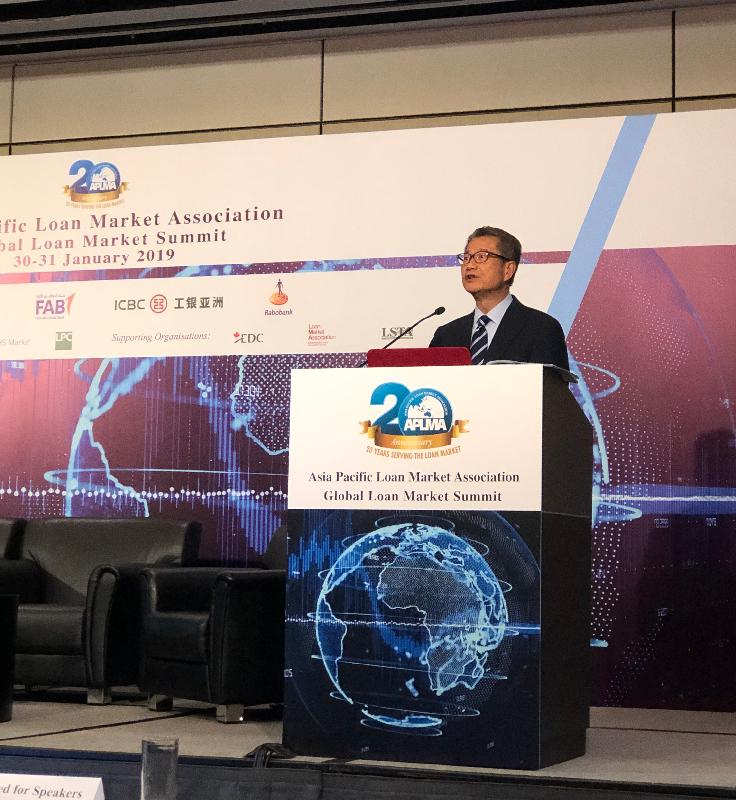
Speech by FS at Global Loan Market Summit (English only) (with photo)

     Following is the speech by the Financial Secretary, Mr Paul Chan, at the Global Loan Market Summit of the Asia Pacific Loan Market Association (APLMA) today (January 30):
 
Phil (Chairman of the APLMA, Mr Phil Lipton), Andrew (Chief Executive Officer of the APLMA, Mr Andrew Ferguson), distinguished guests, ladies and gentlemen,
 
     Good afternoon. 
 
     I’m pleased to be here for this year’s Global Loan Market Summit, the 7th annual Summit of the Asia Pacific Loan Market Association. My thanks to the Association for giving me this welcome opportunity to speak to you.
 
     My congratulations as well to the Association, which celebrates its 20th anniversary this year. This is definitely a milestone in the Association’s continuous contribution to Hong Kong’s financial services sector in the past two decades.
 
     I’m grateful for your good work in promoting the growth and liquidity in the primary and secondary loan markets of Hong Kong and the region as a whole. I’m grateful too, for your continuing support of best practices in the syndicated loan market.
 
     In Andrew’s clear and compelling address, we noted the resilience of the syndicated loan market. Resilience has long been a way of life and business for Hong Kong. Our resilience, our adaptability and our compelling knack for creating connections have served Hong Kong well over the years and the decades. And I have no doubt that they will see us through the challenges of today, and help us all excel tomorrow.
 
     I note that financial technology (fintech) and green finance are among the key themes of this year’s Summit. They are also central policy goals of the HKSAR Government.
 
     And I’m pleased to say that our fintech sector is fast emerging, fast expanding. 
 
     Currently, our fintech cluster has grown into a vibrant community of over 500 companies including start-ups, stationing in our Cyberport, Science Park and private co-working spaces dotted all over the city. 
 
     International players such as the Accenture Fintech Innovation Lab, Deloitte Asia Pacific Blockchain Lab and the Floor from Israel have established a notable presence in Hong Kong. Tencent also signed an agreement with Science Park just yesterday to enhance co-operation in the development and application of fintech in Hong Kong.  
 
     Hong Kong is undoubtedly an ideal launch pad for those seeking a future in fintech. This is evidenced by the investment in Hong Kong-based fintech companies – which exceeded US$500 million in 2017, doubling the amount in 2016.
 
     The Government is determined to keep this fintech momentum rolling. Allow me to highlight a few of the latest fintech developments in the city:
 
     The Hong Kong Monetary Authority (HKMA) launched in last September the Faster Payment System which provides full connectivity of retail payments. It connects banks and shared-value facility operators, enabling the public to transfer funds instantly in both Hong Kong dollars and Renminbi, anytime, anywhere, using only mobile phone numbers or email addresses.
 
     HKMA will start to issue virtual banking licences in this quarter, providing the Hong Kong public with more efficiency and more banking choices.
 
     A Banking Made Easy initiative was introduced in September 2017 to reduce regulatory friction to enable banks to provide better customer experience in the online banking environment.
 
     The Fintech Career Accelerator Scheme has been launched since December 2016 with a view to expanding the fintech talent pool in Hong Kong. 
 
     The banking sector’s Open Application Programming Interface framework is also being implemented this year in phases, enabling collaboration between banks and third-party service providers on offering innovative and integrated financial services.
 
     To step up cross-border collaboration in fintech, we have entered into fintech co-operation agreements with regulators or governments in the UK, Singapore, Dubai and Shenzhen, just to name a few. The Hong Kong FinTech Week, which took place in last November in both Hong Kong and Shenzhen, was the world’s first cross-border fintech event. More than 8,000 business leaders, start-ups, investors, regulators, investors and more from over 50 countries and regions had joined us.
 
     On top of fintech, we are also committed to realising a smart green Hong Kong.
 
     As a global financial centre and the world’s offshore Renminbi business hub, Hong Kong has what it takes to fast-track the development of green finance, to become a premier financing centre for Mainland and international companies looking to raise funds for their green projects. 
 
     To that end, the Government has taken several measures to jump-start the market for green bonds. 
 
     The Hong Kong Quality Assurance Agency launched its Green Finance Certification Scheme last year, providing third party conformity assessments for issuers on their green debt instruments. Last June, we launched a Green Bond Grant Scheme to subsidise green bond issuers making use of this certification scheme to encourage more corporate green bond issuance in Hong Kong.
 
     In the next 10 months, we will issue our first government green bond under the Government Green Bond Programme, which has a borrowing ceiling of HK$100 billion. 
 
     And for the promotion of our bond market in general, we launched a Pilot Bond Grant Scheme last year to offer grants to first-time issuers here to cover part of their issuance expenses. We also offered tax exemptions to invest income and trading profits arising from qualifying debt instruments to encourage investor participation in the bond market. In fact, in the first half of 2018, we have already attracted 15 issues of Green Bond in Hong Kong raising an aggregate amount of US$8 billion.
 
     I am now preparing the Government Budget for 2019/20. If you have suggestions on how we could better promote the development of our bond market or green finance, please do not hesitate to let me know.
 
     Just last month, China celebrated the 40th anniversary of its reform and opening up. That historic development has profoundly changed the nation, and the lives of its people. And we can all be proud of the continuous role that Hong Kong has played in the process. But more than a contributor, we have been a grateful beneficiary of China’s landmark reform and opening up as well.
 
     Going forward, the continuing reform and opening up of China will offer Hong Kong tremendous opportunities, particularly under the Belt and Road Initiative and the Guangdong-Hong Kong-Macao Greater Bay Area development plan.
 
     Hong Kong is uniquely well positioned to be the financing hub for Belt and Road infrastructure projects. Project owners can look to Hong Kong to raise capital and seek financing through a variety of means, from IPOs to post-listing arrangements, bond issuances, syndicated loans and more. 
 
     In this regard, HKMA has set up an Infrastructure Financing Facilitation Office to facilitate infrastructure investment and financing. The Securities and Futures Commission has issued guidelines setting out how infrastructure project companies can be listed on our Stock Exchange. In fact, we are also ideally suited to be the risk management, corporate treasury services and professional services hub for mega infrastructure projects as well.
 
     As for the Greater Bay Area development, it is an ambitious plan encompassing Hong Kong, Macao and nine cities in the Guangdong Province. The Greater Bay Area brings together a collective population of nearly 70 million. While it accounts for only 5 per cent of the Mainland’s population, the Greater Bay Area is responsible for 12 per cent of the nation’s GDP, amounting to about US$1.5 trillion – that is equivalent to the GDP of Korea or Australia. We see tremendous opportunities for Hong Kong’s financial services in this development. 
 
     On asset and wealth management, we are working to make Hong Kong a more attractive domicile for funds. We have put in place a legal framework for open-ended fund companies, providing an alternative choice for fund structure. We are also looking into the introduction of a limited partnership regime for private equity funds in Hong Kong. And we have introduced a bill into the Legislative Council offering profits tax exemption to onshore funds, in addition to offshore funds, so that all funds regardless of structure, size or purpose can enjoy tax exemption.
 
     We will also expand our fund distribution network and deepen the Connect arrangements. Currently, mutual recognition of funds arrangements have been reached with the Mainland, Switzerland, France, the UK and Luxembourg. Together with Stock Connects and Bond Connect, Hong Kong is a unique gateway between international markets and investors and their counterparts in the Mainland, while helping in the internationalisation of the Renminbi. 
 
     In anticipation of more Mainland companies going global and the Greater Bay Area developing into the international innovation and technology hub of China, we implemented a new listing regime last April to allow companies in the emerging and innovative sector with weighted voting rights structures, as well as pre-revenue pre-profit biotech companies, to list on the Stock Exchange. In doing so, the attractiveness and competitiveness of Hong Kong’s listing platform is further enhanced. Last year, we topped the world again in terms of funds raised through IPOs. This is the sixth occasion in the past 10 years.
 
     In short, ladies and gentlemen, Hong Kong will continue to do what it has done, for so long and so well. And that’s building the connections and platforms that create opportunities. The opportunities that help Hong Kong companies and the companies that work with us excel. 
 
     Speaking of excelling, the APLMA Awards will be announced tonight. I know it will be a very special evening. Allow me to congratulate this year’s winners, without naming names.
 
     And with the Year of the Pig less than a week away, I wish the Asia Pacific Loan Market Association, and each and every one of you here and your family, a happy, healthy and prosperous Chinese New Year.
 
     Thank you.
 

Photo  
read more