image_pdfimage_print

Author Archives: hksar gov

SED on school-based management and handling of school complaints

     Following is the transcript of remarks by the Secretary for Education, Mr Kevin Yeung, after officiating at the inauguration ceremony of the Academy for Leadership in Teacher Education at the University of Hong Kong today (March 13).
 
Reporter: (concerning TWGHs Leo Tung-hai Lee Primary School) Can you explain why the Bureau did not follow up on the complaint regarding the same school last year in July? Is such a mechanism giving too much power to the school and will the government try to be more hands-on in the management of schools to avoid abuse of power by the school management?
 
Secretary for Education: As I explained, school-based management is a mechanism that we think that it’s better for some of the school’s daily operations and decisions to be managed at the school level through the school board (Incorporated Management Committee) i.e. with participation of different stakeholders including the school sponsoring bodies, parents, teachers and alumni as well. We believe that some of the decisions, especially involving the teaching and learning and the daily operations, that would be better handled by the school level rather than being handled at the government level. That said, all the complaints relating to the Education Ordinance and the Codes of Aid will be handled by the Education Bureau in accordance with the requirements in the law. Also, all complaints from the staff or teachers against the schools, especially for example the board or the principals, if they complain to us, we will handle the case according to our internal procedures. In handling the case, we sometimes have to seek information from the schools otherwise we won’t have all the available information to make a good judgement, so simply asking the school for more information does not imply that we have let the school to handle the complaint totally and in the past we had not shirked our responsibility at all.
 
(Please also refer to the Chinese portion of the transcript.) read more
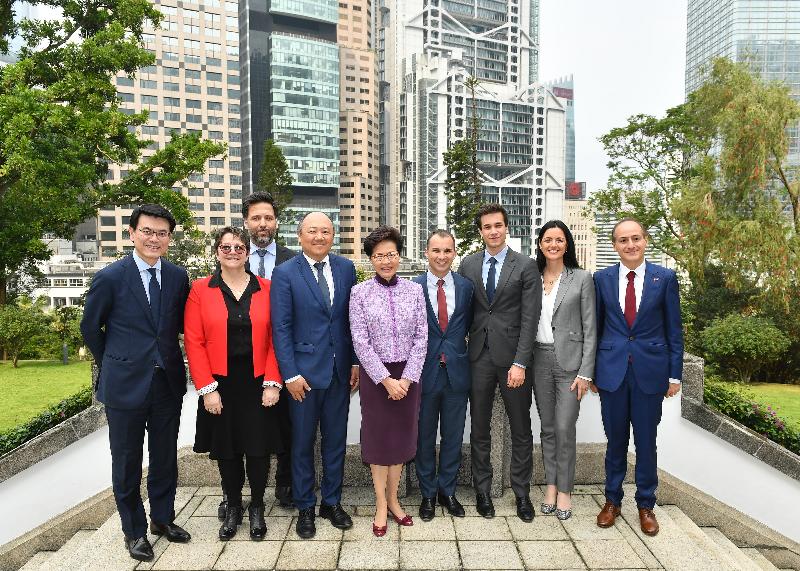
CE meets members of National Assembly of France (with photo)

     The Chief Executive, Mrs Carrie Lam, accompanied by the Secretary for Commerce and Economic Development, Mr Edward Yau, met with the President of the France-China Friendship Group of the National Assembly of France, Mr Buon Huong Tan, Vice Presidents of the National Assembly Ms Carole Bureau-Bonnard and Mr Hugues Renson, and three members of the National Assembly at Government House this afternoon (March 13). The Consul General of France in Hong Kong and Macau, Mr Alexandre Giorgini, also attended the meeting.

     Mrs Lam said she was pleased to meet again with Mr Tan and members of the National Assembly. She welcomed their visit after making the invitation during her trip to France last June, so that they could learn about Hong Kong’s latest developments. Mrs Lam said her visit to France last year was a great success. Aside from meeting the France-China Friendship Group of the National Assembly of France, she also called on the French Prime Minister, the Minister of Foreign Affairs and people from different sectors to highlight Hong Kong’s advantages and development opportunities, thus laying the foundation for further collaboration between Hong Kong and France. She said she believed that the visits and exchanges made in Hong Kong by members of the National Assembly in the coming few days would help strengthen the links between the two places and offer co-operation in further areas.

     Noting that one of the major events in her trip to France last year was to attend the joint promotion seminar on the Guangdong-Hong Kong-Macao Greater Bay Area co-organised by the governments of Guangdong, Hong Kong and Macao, Mrs Lam said she was pleased to learn that people from the French political and business sectors had a strong interest in this key national development strategy. Pointing out that the Outline Development Plan for the Guangdong-Hong Kong-Macao Greater Bay Area was promulgated last month, she said Hong Kong will play a vital role, especially in leveraging its advantages to establish an international innovation and technology (I&T) hub in the Greater Bay Area. Adding that France has some of the world’s top universities and a solid foundation in scientific research, she expressed the hope that Hong Kong would continue to strengthen co-operation with France in I&T to jointly seize the huge opportunities presented by the development of the Guangdong-Hong Kong-Macao Greater Bay Area. In addition, she said that Hong Kong is striving to strengthen its role as a cultural hub and she looks forward to enhancing co-operation in culture and arts with France.

Photo  
read more

CHP investigates case of invasive meningococcal infection

     The Centre for Health Protection (CHP) of the Department of Health is today (March 13) investigating a case of invasive meningococcal infection, a communicable disease transmitted by direct contact with droplets from carriers or infected persons.

     The case involves a 29-year-old man with good past health, who had presented with fever, vomiting, headache and neck pain since March 9. He was admitted to Caritas Medical Centre on March 11 and was subsequently transferred to the Intensive Care Unit for further management on the same day. His clinical diagnosis was septic shock. The patient is now in a stable condition.

     His blood specimen tested positive for Neisseria meningitidis upon laboratory testing.

     Initial enquiries revealed that the patient had travelled to Shenzhen during the incubation period. His home contacts have remained asymptomatic so far. The CHP’s investigation is continuing.

     “Meningococcal infection is caused by a bacterium known as meningococcus. It is mainly transmitted by direct contact through respiratory secretions, including droplets from the nose and throat, from infected persons. The incubation period varies from two to 10 days, and is commonly three or four days,” a spokesman for the CHP said.

     The clinical picture may vary. Severe illness may result when the bacteria invade the bloodstream (meningococcaemia) or the membranes that envelop the brain and spinal cord (meningococcal meningitis).

     Meningococcaemia is characterised by sudden onset of fever, intense headache, purpura, shock and even death in severe cases. Meningococcal meningitis is characterised by high fever, severe headache and stiff neck followed by drowsiness, vomiting, fear of bright light, or a rash. It can cause brain damage or even death. The brain damage may lead to intellectual impairment, mental retardation, hearing loss and electrolyte imbalance. Invasive meningococcal infections can be complicated by arthritis, inflammation of the heart muscle, inflammation of the posterior chamber of the eye or chest infection.

     Meningococcal infection is a serious illness. Patients should be treated promptly with antibiotics.

     To prevent meningococcal infection, members of the public are advised to take heed of the following measures:
 

  • Wash hands with liquid soap and water properly, especially when they are dirtied by respiratory secretions, e.g. after sneezing, and clean hands with alcohol-based handrub when they are not visibly soiled;
  • Cover the nose and mouth while sneezing or coughing, hold the spit with a tissue, dispose of nasal and mouth discharges in a lidded rubbish bin, and wash hands immediately;
  • Avoid crowded places;
  • Avoid close contact with patients who have fever or severe headache;
  • Travellers to high-risk areas may consult doctors for meningococcal vaccination; and
  • Travellers returning from high-risk areas should seek medical advice if they become ill and should discuss their recent travel history with their doctor.
     
     The public may visit the CHP’s website for more information on meningococcal infection.  read more

CHP investigates case of severe paediatric enterovirus infection

     The Centre for Health Protection (CHP) of the Department of Health is today (March 13) investigating a case of severe paediatric enterovirus (EV) infection, and again urged the public and institutions to maintain strict hand, personal and environmental hygiene.

     The case involves a 1-month-old baby boy with good past health, who has presented with fever since March 8. He was taken to the Accident and Emergency Department of Alice Ho Miu Ling Nethersole Hospital
on March 8 and was admitted for further management on the following day. The patient has all along been in a stable condition.

     His cerebrospinal fluid specimen tested positive for EV upon laboratory testing. The clinical diagnosis was meningitis.

     Initial enquiries revealed that the patient had no recent travel history. His mother had developed sore throat since March 7. She sought medical attention and had recovered. Other home contacts have remained asymptomatic so far. Investigations are ongoing.

     A spokesman for the CHP said that as EV infection is transmitted by direct contact with nose and throat discharges, the public should be vigilant and observe the following preventive measures:
 

  • Wash hands before eating and after going to the toilet and changing diapers;
  • Cover the mouth and nose when coughing and sneezing;
  • Maintain good ventilation; and
  • Thoroughly clean toys or appliances which are contaminated by nasal or oral secretions.

     Children suffering from EV infection should stay at home and avoid contact with other children until they have recovered.

     The public may visit the CHP’s page on hand, foot and mouth disease and EV71 infection for more information. read more

Company and directors fined and sentenced to suspended imprisonment for wage offences, non-payment of annual leave pay and default on Labour Tribunal award

     Express Service Company Limited and its two directors were prosecuted by the Labour Department (LD) for failing to pay wages and annual leave pay to an employee and defaulting on the sum awarded by the Labour Tribunal (LT). The company and its directors earlier pleaded guilty at Eastern Magistrates’ Courts and were sentenced today (March 13). The company was fined a total of $26,500, while its directors were each sentenced to fourteen days’ imprisonment, suspended for two years. The company and its director were also ordered to pay an outstanding sum of about $160,000.

     The company failed to pay one employee his wages and annual leave pay as required by the Employment Ordinance (EO). The company also failed to pay the employee the awarded sum of about $160,000 within 14 days after the date set out by the terms of the LT award. The two directors were convicted for their consent, connivance or neglect in the above offences.  

     “The ruling helps disseminate a strong message to all employers and responsible officers of companies that they have to pay wages and termination payments to employees within the time limit stipulated in the EO and the awarded sums according to the LT or Minor Employment Claims Adjudication Board,” a spokesman for the LD said.

     “The LD will not tolerate these offences and will spare no effort in enforcing the law and safeguarding employees’ statutory rights,” the spokesman added. read more