image_pdfimage_print

Author Archives: hksar gov

Special traffic arrangements for race meeting in Happy Valley

     Special traffic arrangements will be implemented in Happy Valley today (March 27). The arrangements will come into effect one and a half hours before the start of the first race and will last until the crowds have dispersed after the race meeting.

A. Traffic arrangements before the commencement of the first race

1. Road closure

     Southbound Wong Nai Chung Road between Queen’s Road East and the up-ramp outside Hong Kong Jockey Club (HKJC) will be closed except for vehicles heading for Aberdeen Tunnel.

2. Traffic diversions

– Southbound Wong Nai Chung Road between Village Road and the up-ramp outside HKJC will be re-routed one way northbound;
– Vehicles from eastbound Queen’s Road East heading for Wan Chai and Happy Valley will be diverted to turn left to Morrison Hill Road;
– Traffic along southbound Morrison Hill Road heading for Happy Valley will be diverted via Sports Road and Wong Nai Chung Road;
– Traffic along Queen’s Road East cannot turn right to Wong Nai Chung Road except for vehicles heading to Aberdeen Tunnel;
– Traffic from Cross Harbour Tunnel heading for Queen’s Road East will be diverted via the down-ramp leading from southbound Canal Road flyover to Morrison Hill Road to turn right at the junction of Wong Nai Chung Road and Queen’s Road East; and
– Traffic from Cross Harbour Tunnel heading for Happy Valley or Racecourse will be diverted via the down-ramp leading from southbound Canal Road flyover to Canal Road East, southbound Morrison Hill Road, Sports Road and Wong Nai Chung Road.

B. Traffic arrangements before the conclusion of race meeting

     1. Road closure

     The following roads will be closed from 35 minutes before the start of the last race:

– The up-ramp on Wong Nai Chung Road outside HKJC leading to Aberdeen Tunnel;
– Southbound Wong Nai Chung Road between Queen’s Road East and the up-ramp leading to Aberdeen Tunnel;
– Southbound Wong Nai Chung Road between Village Road and the Public Stands of HKJC;
– Westbound Leighton Road between Wong Nai Chung Road and Canal Road East; and
– Southbound Morrison Hill Road between Leighton Road and Queen’s Road East.

In addition, southbound Wong Nai Chung Road between the up-ramp leading to Aberdeen Tunnel and the Public Stands of HKJC will be closed from about 10 minutes before the start of the last race.

2. Traffic diversions
     
     The following traffic arrangements will be implemented from 35 minutes before the start of the last race:

– Eastbound Queen’s Road East at its junction with Morrison Hill Road will be reduced to one-lane traffic heading for northbound Canal Road flyover;
– Vehicles from Cross Harbour Tunnel heading for Wan Chai will be diverted via the down-ramp leading from Canal Road East, U-turn slip road beneath Canal Road flyover, Canal Road West and Hennessy Road;
– Vehicles from Cross Harbour Tunnel heading for Happy Valley will be diverted via the down-ramp leading from Canal Road East, eastbound Leighton Road and Wong Nai Chung Road;
– Traffic on southbound Morrison Hill Road will be diverted to turn left to eastbound Leighton Road;
– Traffic along southbound Morrison Hill Road heading for Happy Valley will be diverted via eastbound Leighton Road and Wong Nai Chung Road; and
– Traffic along westbound Leighton Road will be diverted to Wong Nai Chung Road.

C. Learner drivers prohibition
     
     Learner drivers will be prohibited to turn left from Caroline Hill Road to Leighton Road between one and a half hours before the start of the first race and one hour after the last race. In addition, learner drivers will be prohibited from accessing the following roads within the above period of time:

– Shan Kwong Road between Yik Yam Street and Wong Nai Chung Road;
– Village Road between its upper and lower junctions with Shan Kwong Road;
– Percival Street between Hennessy Road and Leighton Road;
– Canal Road East; and
– The service road leading from Gloucester Road to Canal Road flyover.

D. Suspension of parking spaces

     Parking spaces on southbound Wong Nai Chung Road between Sports Road and Blue Pool Road will be suspended from 11am to 7pm during day racing, from 4.30pm to 11.59pm during evening racing, and from 5pm to 11.59pm during night racing.

     Any vehicles found illegally parked within the precincts of the above affected areas will be towed away without prior notice.

     Actual implementation of road closure and traffic diversion will be made by the Police at the time depending on traffic conditions in the areas. Motorists should exercise tolerance and patience, and follow the instructions of Police on site. read more

Transcript of CE’s Press Conference (with photos/video)

     The Chief Executive, Mrs Carrie Lam, held a press conference this afternoon (March 26) on the interim report of the Commission of Inquiry into the Construction Works at and near the Hung Hom Station Extension under the Shatin to Central Link Project, the toll adjustment proposal for traffic rationalisation among the three road harbour crossings, and the proposed amendments to the Fugitive Offenders Ordinance and the Mutual Legal Assistance in Criminal Matters Ordinance.  Joining her were the Secretary for Security, Mr John Lee; the Secretary for Transport and Housing, Mr Frank Chan Fan; the Permanent Secretary for Transport and Housing (Transport), Mr Joseph YT Lai; and the Deputy Law Officer (Mutual Legal Assistance) of the Department of Justice, Ms Linda Lam. Following is the transcript of remarks at the press conference:
 
Reporter: Mr Lee has just mentioned an example that a sexual offender has committed a crime in Japan and fled back to Hong Kong, I wish to ask Mr Lee the opposite. If a Mainland offender has committed similar crimes in Hong Kong and fled back to the Mainland. As I understand, because the Mainland law is the same as the Taiwanese law they prevent extraditing their own nationals. This could not be solved under the current proposal even if there is a legislative change. This is similar limitation under the current examples that there is no guarantee of transfer of a sentenced person, let say in Mainland or Taiwan, as well as there are no visits by Hong Kong officials across the border? As you mentioned you’re open to changes or are you going to take these ideas on board or could the Government guarantee in future transfer dealing with the Mainland, Hong Kong would be on an equal footing with Mainland China? Thank you.
 
Secretary for Security: Thank you for the question. First of all, I would like to emphasize that we should not confuse the long-term arrangement with case-by-case arrangement. And what I am proposing now is a universal standard that will be applicable to all jurisdictions around the world beyond the 20 with which Hong Kong has signed a long-term agreement. So I wish to emphasize that the long-term agreement with the Mainland, the negotiation and discussion, still continue. I have said very clearly that it is the principal surrender method for fugitives to be surrendered under a long-term agreement. And the special arrangement on a case-by-case basis is a supplementary, or in layman’s term, a stopgap measure so that we can deal with what we think appropriate cases with a jurisdiction, with which we have no long-term agreement. So it’s important that we don’t confuse the two things – long-term agreement and case-by-case arrangement. That’s the first thing.
 
     In my discussion with my colleagues in the Mainland, I understand that they do not have to make any amendments of the law to consider a request by, say Hong Kong, for such a case-by-case arrangement with that. But I’m not emphasising that making this model – a model that is to be applicable to all jurisdictions. It is not tailored made for any particular jurisdiction. So let me repeat that once again. The third point is that the amendment of our two laws is to amend our domestic laws so that we can do something which we cannot do now. So I’m trying to get the bill through LegCo so that the restrictions that have been put on the Hong Kong Government prohibiting us to be able to deal with this Taiwan case is lifted. This is basically to take away the chain that has put on my feet so that I can decide when there is a case which I think is appropriate to be dealt with whether I will deal with it or not.
      
     As I have said very clearly, we have the full discretion to consider or not to consider any requests made by a particular jurisdiction. One last point I would like to make is, as I have mentioned there are two purposes – one is to deal with the Taiwan murder case, the other is to plug the loophole in our system. Hong Kong Government can only try its best to ensure justice is done. And no reason to suspect that any jurisdiction would not like to see offenders of serious crimes can escape justice. And we have indeed received requests three times from the Taiwan side. We have already started communication. I sincerely believe, with everybody trying hard, we can ensure that justice is done to the Taiwan case. So that everybody will be seeing that we are doing a right thing not just to the deceased family but to the overall international commitment.      
 
Reporter: Regarding the removing of white-collar crimes from the proposal, does it mean that the Government didn’t think it through before you planned to begin work to amend the extradition legislation? And in light of the international and widespread concerns to this controversial amendment, will you consider scrapping the entire proposal for good and concentrate on working out a proper deal with Taiwan instead, because it’s been said by many legal experts that there’s no loopholes in existing laws? And, on the tunnel toll proposal, this is the second time the Government withdrew the motion, and who should be responsible for the failure to lobby lawmakers into accepting this deal that you think is good for Hong Kong and finally landed the Government into this embarrassing position? And finally, the CoI (Commission of Inquiry) has concluded that Hung Hom Station is safe. Secretary, can you tell us once again, will the Government rush to open the Shatin to Central Link and what would you hope the people will take from this report? Thank you.
 
Chief Executive: I’ll answer the second question on the tunnel tolls and invite Secretary for Security and Secretary for Transport and Housing to address the first and the third one. As I have explained, it is part of our governance style that we will confront the problems and the issues that have been causing a lot of anxiety to Hong Kong people, and traffic congestion as a result of overuse of the Cross-Harbour Tunnel as well as the Eastern Harbour Tunnel is a problem that we’ve faced for a while, while at the same time the Western Harbour Tunnel does have some spare capacity, especially after the opening of the Central – Wan Chai Bypass. We have worked out this package of proposals and spent quite a lot of time to convince a commercial company, the Western Harbour Tunnel company, to accept this package.
 
     You asked who is responsible. I don’t think it’s a matter of responsibility. It’s a matter that there are issues, whether we like it or not, that we cannot come to a full consensus to enable the Government to move forward, especially a proposal which ultimately requires voting in the Legislative Council. While tomorrow’s government motion is a non-binding motion, what we need to follow up, if we were to implement this package, is to amend the subsidiary legislation, which needs to go back to Legislative Council for voting; and we need to apply for funding, rather significant funding, from the Finance Committee of the Legislative Council. We have to be very certain that we have broad-based consensus and support before we move forward. Otherwise, we’ll be wasting a lot of people’s time and keeping this commercial company in suspense on what is going to happen afterwards. This is exactly what we are doing.
 
     On two occasions we have withdrawn, but they are for different reasons. The first withdrawal was because of the Central – Wan Chai Bypass launching, which in the initial days had not been as smooth as we believed because it was only partial. We don’t want Legislative Council members to debate on the government motion without an accurate and comprehensive scenario in front of them. They may come to some misunderstanding about the impact of the Central – Wan Chai Bypass in this particular package. So we withdrew that first motion and allowed a bit of time for the Central – Wan Chai Bypass to come into full commissioning. And now we have the full situation in front of us, the impact of the Central – Wan Chai Bypass, so we want to put this to the Legislative Council again. And I would say this is really the first time, on a substantive basis, that we invite members of the Legislative Council to vote. Then comes a very realistic situation that we are doing extensive, intensive lobbying – as Frank Chan has mentioned, over 30 occasions of discussing with members of the Legislative Council – and we know very well from those discussions and from their comments to the media that we will not have enough votes, and that is by quite a wide margin. In order not to waste the valuable time of the Legislative Council, we have decided to withdraw this motion from tomorrow’s agenda. I feel the whole process is a very conscientious process on the part of the Government to try to solve a problem, but at the same time we respect the views of individual Legislative Council members and we will accept the consequence that this package is not going to be implemented, but we will then turn our efforts and attention to other measures to address the traffic congestion issue in Hong Kong.
 
Secretary for Security: Thank you Chief Executive. When we make the first proposal to Legislative Council, we have cautiously made sure certain things must happen and exist. That is the foundation of our law and system regarding surrender of fugitives, which has been in operation smoothly for almost 22 years. This system and the whole laws regarding it must be preserved as much as possible. That is exactly what I have said earlier that for all long term arrangements, that the whole system and the law remain there. All the safeguards, all the principles, are there.
 
     Then the second question is: the law as it is written, has not been practicable in allowing for case-by-case surrenders, which is proven by the Taiwan case. How should we address it? So we should consider whether we will allow this so that we have zero surrender on case by case basis because of the limitation of the law and its incapability. I thank the Chief Executive for highlighting the consensus in our government. It is a controversial subject. I listen to views. There are of course views that I can act on. And there are also views that I think I have difficulties in acting on. But that is the process that I would thank for anybody who has provided views to me, whether it is in support or in opposition, whether there are alternative methods. And I have explained at least why I think I cannot act on what you have asked me one alternative suggestion. I will continue to explain why other suggestions in the opinions that received by me may not be the reason why I do not think that they can be acted on when we discuss it in LegCo (Legislative Council). But I make a cautious decision. I calculated all factors before I come to this decision. It is not an easy decision, but it is a cautious, careful, and serious decision, having taking account into all factors, different views and what we want to achieve and ensuring that the foundation of the present system of surrender fugitives is positively maintained. So I hope that I can make use of other opportunities to explain more about the details of the bill which will be gazette on Friday.                          
 
Secretary for Transport and Housing: As far as railway service is concerned, safety always comes first. This is the Government’s clear and loud position and also public aspiration and expectation. There is no reason to speculate that the Government would rush for the opening of the Shatin to Central Link. We would make sure that everything is safe before we would allow the railway to operate, rest assured.
 
Secretary for Security: Can I add one more point which is your question about whether there is a loophole in the system. I would not like to debate what terminology one should use, but if there is a case which everybody agrees that we should do and we cannot act on it, to deal with it, to me that is a loophole I must address. Thank you.  
 
(Please also refer to the Chinese portion of the transcript.) 

Photo  Photo  
read more

Update on measles cases

     The Centre for Health Protection (CHP) of the Department of Health (DH) is today (March 26) investigating five additional cases of measles infection of which three involved workers at the Hong Kong International Airport (HKIA). The CHP reminded the public again that vaccination is the most effective way to prevent measles.
 
​     As at 4pm today, three cases affecting workers of the HKIA which involved two females and one male were recorded. The first case involves a 41-year-old woman with good past health, who developed rash on March 21. She consulted private doctors on March 22 and 23. She sought medical advice at Princess Margaret Hospital (PMH) on March 23 and was admitted for treatment. Her respiratory specimen tested positive for measles virus upon laboratory testing. She is in a stable condition. The patient’s measles vaccination history is unknown. She had no travel history during the incubation period or communicable period.
 
​     The second case involves a 25-year-old woman with good past health, who developed cough on March 21 and rash on March 23. She consulted a private doctor on March 23. She sought medical attention at Hong Kong Baptist Hospital on the following day and was transferred to PMH for admission and treatment. Her respiratory specimen tested positive for measles virus upon laboratory testing. She is in a stable condition. She reported to have measles vaccination and had no travel history during the incubation period or communicable period.
 
​     The third case involves a 23-year-old man with good past health, who developed fever on March 20 and rash on March 22. He attended North Lantau Hospital on March 23 and was transferred to PMH for admission and treatment on the same day. His respiratory specimen tested positive for measles virus upon laboratory testing. He is in a stable condition. He reported to have measles vaccination. He travelled to Macao and Zhuhai during the incubation period but had no travel history during the communicable period.

     The Controller of the CHP, Dr Wong Ka-hing, at a press conference today said, “Since an outbreak emerged at the airport last week, the CHP has attached great importance to the infection control measures at the airport, in particular the measles vaccination for people working at the airport who are non-immune to measles. The CHP has been closely monitoring and improving the operation and arrangements of the measles vaccination stations at the airport. To facilitate people who need the vaccination, the DH has deployed extra manpower to provide an additional time slot starting today. It is expected that the service capacity can be increased from 700 to 1 300 vaccinations daily.”

​     The measles vaccination exercise at the airport aims to protect those working at the airport who are non-immune to measles. The target group refers to people working at the airport who are:

(1) Non locally-born or those born in Hong Kong from 1967 to 1984; and
(2) Have not received two doses of measles vaccination; and
(3) Have not been infected with measles before.

​     From today to March 29, the arrangements of the vaccination stations at the airport are as follows:
 

Venue: Port Health Office Health Post (South Arrival Apron Passenger Vehicle Lounge, Level 4, Terminal 1)
Multi-function Room, HKIA Tower (Level 5, Terminal 2)
Hours: 10am to 1pm
2pm to 5pm
6pm to 9pm (New time slot)
 
​     Dr Wong said, “The CHP will closely monitor and review the vaccination progress for people working at the airport. We will continue to closely liaise with the Airport Authority to explore ways to further enhance the vaccination arrangements. Arrangements after March 29 will be announced in due course.”

​     Around 787 persons received measles vaccination at the vaccination station as at 5pm today, bringing the cumulative number of vaccinations given to 1 655. A hotline (2125 1122) is set up for public enquiries and operates from 9am to 5.45pm daily. As of 5pm today, the hotline received a total of 1 024 enquiries.
 
     Dr Wong said, “On the supply of measles vaccines in Hong Kong, the DH has maintained close liaison with the vaccine suppliers to strive for a steady supply for the Hong Kong Childhood Immunisation Programme and the vaccination exercise at the airport. We learnt that the vaccine suppliers will import extra quantities of measles vaccines as soon as possible and we will continue to communicate with the suppliers with a view to addressing the local demand.”

     Separately, the CHP is investigating two other cases of measles infection. The fourth case affected a 43-year-old woman, with good past health, who developed fever on March 13 and rash on March 17. She attended a Chinese medicine clinic on March 13. She sought medical attention at Tin Shui Wai Hospital on March 13, 16 and 18 and was transferred to Pok Oi Hospital for admission and treatment on March 18. Her respiratory specimen tested positive for measles virus upon laboratory testing. She is in a stable condition. Her measles vaccination history is unknown. She travelled to Shenzhen during the incubation period but had no travel history during the communicable period.

     The fifth case involves a 39-year-old man with good past health. He developed fever on March 17 and rash on March 22. He sought medical advice at a school clinic on March 22 and 23 and was referred to the Queen Elizabeth Hospital on March 23 where he was admitted for management. His respiratory specimen tested positive for measles virus upon laboratory testing. He is in a stable condition. The patient reported to have received measles vaccination. He had no travel history during the incubation period or communicable period.

​     According to the patients, all of them did not have contact with measles patients during the incubation period. Their home contacts have remained asymptomatic so far and have been put under medical surveillance.

​     Upon notification of the cases, the CHP immediately commenced epidemiological investigations and conducted relevant contact tracing. Initial investigations revealed that no contact has shown measles-related symptoms so far. No high risks contacts such as immunocompromised persons, young children aged below one and pregnant women are identified among the contacts. The public places the patients visited during the communicable period are listed in the appendix.

​     Information of the confirmed measles cases in 2019 with their case summary is uploaded onto the CHP website.

​     Separately, the CHP was notified by the Centers for Disease Control and Prevention of the United States (US) of two measles cases confirmed in the US in which the patients took flights involving Hong Kong. The CHP’s contact tracing is ongoing. The flights taken by the two patients are listed in the appendix.

​     A spokesman for the CHP explained, “Measles is a highly infectious disease caused by the measles virus. It can be transmitted by airborne droplets spread or direct contact with nasal or throat secretions of infected persons, and, less commonly, by articles soiled with nose and throat secretions. A patient can pass the disease to other persons from four days before to four days after the appearance of skin rash.”

​     The spokesman reminded, “The incubation period of measles ranges from seven days to up to 21 days. Contacts who are not immune to measles may develop relevant symptoms, such as fever, skin rash, cough, runny nose and red eyes, in the incubation period. They should observe if they develop such symptoms in the period. If symptoms arise, they should wear surgical masks, stop going to work or school and avoid going to crowded places. They should avoid contact with non-immune persons, especially persons with weakened immunity, pregnant women and children aged below one. They should also report their symptoms and prior travel history to the healthcare workers so that appropriate infection control measures can be implemented at the healthcare facilities to prevent any potential spread.”

​     “Vaccination is the most effective way to prevent measles. Members of the public who are planning to travel to places with high incidence or outbreaks of measles should review their vaccination history and past medical history, especially people born outside Hong Kong who might not have received measles vaccination during childhood. The history of measles vaccination in Hong Kong is available in the CHP’s measles thematic page. Those who have not received two doses of measles-containing vaccines, with unknown vaccination history or with unknown immunity against measles are urged to consult their doctor for advice on vaccination at least two weeks before departure,” the spokesman said.
 
​     Besides being vaccinated against measles, members of the public should take the following measures to prevent infection:
 
• Maintain good personal and environmental hygiene;
• Maintain good indoor ventilation;
• Keep hands clean and wash hands properly;
• Wash hands when they are dirtied by respiratory secretions, such as after sneezing;
• Cover the nose and mouth while sneezing or coughing and dispose of nasal and mouth discharge properly;
• Clean used toys and furniture properly; and
• Persons with measles should be kept out of school till four days from the appearance of rash to prevent spread of the infection to non-immune persons in school.

     For more information on measles, please visit the CHP’s measles thematic page. For outbreak news of measles outside Hong Kong or the latest travel health advice, please visit the website of DH’s Travel Health Service. read more

CE meets Auditor General of National Audit Office (with photo)

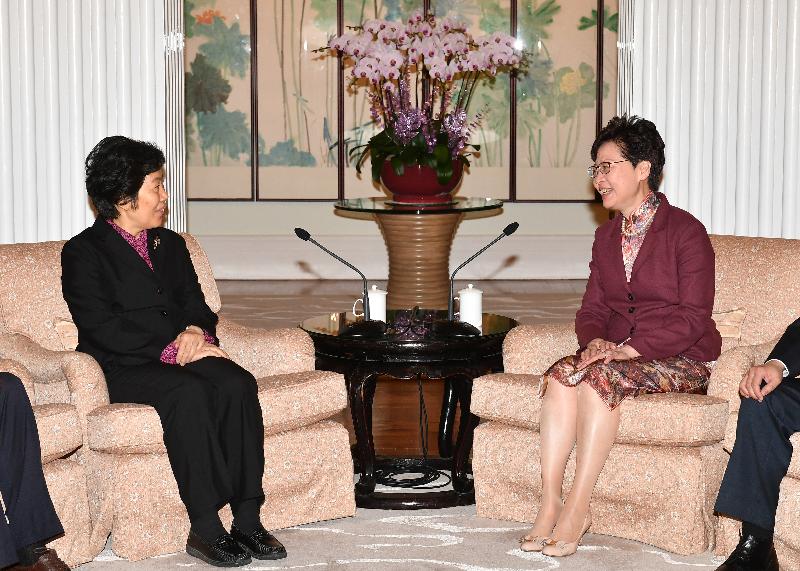
     The Chief Executive, Mrs Carrie Lam, met the Auditor General of National Audit Office (NAO), Ms Hu Zejun, at Government House this afternoon (March 26). The Secretary for Constitutional and Mainland Affairs, Mr Patrick Nip, and the Director of Audit, Mr John Chu, also attended the meeting.
      
     Mrs Lam welcomed Ms Hu’s visit to Hong Kong, noting that it is the first time for the Chief Executive of the Hong Kong Special Administrative Region (HKSAR) to receive the NAO Auditor General in Hong Kong and that both of them are the first woman to take up their respective positions, making the meeting exceptionally meaningful.
      
     Mrs Lam said that, with the rising national power and international influence of the country, the status of the NAO in international auditing has been further consolidated. Thanking the NAO for allowing members of the Audit Commission of the HKSAR to participate in the meetings of the International Organization of Supreme Audit Institutions and the Asian Organization of Supreme Audit Institutions as members of the delegation of the People’s Republic of China after Hong Kong’s return to the motherland, she expressed the hope that the NAO will continue its support for the HKSAR’s work and provide more opportunities for it to contribute in international affairs. She also expressed the hope that the two places will further strengthen exchanges and co-operation in the field of auditing in the future. 

Photo  
read more