image_pdfimage_print

Author Archives: hksar gov

LCQ19: Making good use and combating abuses of public rental housing resources

     Following is a question by the Hon Andrew Wan Siu-kin and a written reply by the Secretary for Transport and Housing, Mr Frank Chan Fan, in the Legislative Council today (April 3):
 
Question:
 
     Regarding the work of the Housing Department (HD) to make good use and combat abuses of public rental housing (PRH) resources, will the Government inform this Council:
 
(1) of HD’s staffing establishment for the investigations of suspected abuses of PRH resources and the expenditure involved, in each of the past five years;
 
(2) whether HD will (i) establish a dedicated team and allocate additional manpower and other resources needed to step up its investigations into cases of PRH tenants suspected of concealing their assets outside Hong Kong, and (ii) raise the penalties for the act of concealment, so as to enhance the deterrent effect;
 
(3) as some principal tenants of PRH have applied for deleting their household members with higher income from the tenancy to avoid their household income exceeding the limits, of the number of applications received by HD in each of the past five years for deleting household members from the PRH tenancy;
 
(4) of the number of tenants whose tenancy was terminated by HD in each of the past five years for the reason that their household income or net assets had exceeded the limits;
 
(5) of the number of appeals lodged in the past five years with the Appeal Panel (Housing) by PRH tenants against HD’s termination of their tenancy, together with a tabulated breakdown by reason of tenancy termination (e.g. failure to truthfully declare income or assets and household members in the tenancy not living in the units concerned); and
 
(6) of the number of under-occupation households at the end of each of the past five years which were not arranged to move to smaller PRH units due to a shortage of such units?
 
Reply:
 
President,
 
     I set out below my reply to the question raised by the Hon Andrew Wan Siu-kin:
 
(1) & (2) The Public Housing Resources Management Sub-section (PHRM) under the Housing Department (HD) is responsible for handling work relating to tenancy abuses of Public Rental Housing (PRH) under the Hong Kong Housing Authority (HA). Such work includes conducting investigation on cases related to the occupancy situation of PRH tenants and suspected false declaration, as well as enhancing public awareness of the importance of optimising public housing resources through publicity and education. The concerned work is part of the routine duties of PHRM, we are therefore unable to provide the relevant breakdown of the establishment and expenditure.
 
     According to the Housing Ordinance, PRH tenants are obliged to ensure that all declared information is true and correct. If PRH tenants make false declaration knowingly in respect of any information furnished in the declaration form, they shall be guilty of an offence and shall be liable on conviction to a fine and imprisonment. Furthermore, HA may, in accordance with its prevailing policy, invoke the Housing Ordinance to terminate the Tenancy Agreement of PRH tenants, irrespective of whether such tenant is prosecuted or convicted of the offense.
 
     HA will review the workflows and manpower need of the concerned work from time to time, and, if necessary, deploy additional resources and adjust the prevailing mechanism.
 
(3) There are various reasons for deletion of individual member in PRH households. For the past five years (i.e. from 2014 to 2018), the total number of approved cases for deletion were about 36 200, 33 900, 33 800, 41 100 and 41 500 respectively. HA does not have the breakdown of the number of deletion cases for which the reason was “avoiding household income exceeding the limit”.
         
(4) HA revised the Housing Subsidy Policy and Policy on Safeguarding Rational Allocation of Public Housing Resources (the Well-off Tenants Policies) (Note) in 2017. HA issued Notice-to-Quit to 579 households in the declaration cycle in October 2017 and April 2018, reasons of which include they possess private domestic property in Hong Kong; their income or assets exceed the relevant limits; and they choose not to declare. In the past five years (i.e. 2014 to 2018), HA recovered an annual average of about 280 PRH units on grounds of income or net assets value exceeding the relevant prescribed limits.
 
(5) In the past 5 years (i.e. from 2014 to 2018), the number of appeal cases received by the Appeal Panel (Housing) with breakdown by category is set out in Annex.
 
(6) Under-occupied PRH households may not be arranged for transfer due to various reasons, such as factors relating to the tenants’ personal or family circumstances (e.g. being allowed for deferred transfer due to having disabled/elderly family members or have family member deceased) and may not be directly related to the shortage of smaller PRH units. HA does not possess statistics requested in the question.
 
Note: Starting from the declaration cycle in October 2017, households whose household income exceeds 5 times the PRH income limits (PRHILs), or total household net asset value exceeds 100 times the PRHILs, or who have domestic property in Hong Kong, will be required to vacate their PRH units. read more
LCQ16: Regulation of financial technology applications

     Following is a question by the Hon Dennis Kwok and a written reply by the Secretary for Financial Services and the Treasury, Mr James Lau, in the Legislative Council today (April 3):
 
Question:
 
     In November last year, the Securities and Futures Commission (SFC) announced a new regulatory approach for virtual assets aiming to bring virtual asset portfolio managers and distributors of virtual asset funds within the scope of SFC’s regulation, which includes imposing licensing conditions on such managers and exploring regulation of virtual asset trading platform operators. In addition, the SFC launched in September 2017 the SFC Regulatory Sandbox to provide a confined regulatory environment for qualified firms to conduct regulated activities utilising financial technologies (Fintech). Regarding the regulation of Fintech applications, will the Government inform this Council:
 
(1) whether it has plans to amend the legislation to bring the trading activities of virtual currencies within the scope of regulation by the SFC; if so, of the details; if not, the reasons for that;
 
(2) of the measures in place to prevent lawbreakers from conducting money laundering activities and other illegal activities through the trading of virtual currencies, which are currently not regulated by the law;
 
(3) whether it knows the regulatory actions which the SFC has taken against relevant managers and distributors since the new regulatory approach was announced;
 
(4) whether it knows if the SFC Regulatory Sandbox has conducted trials on activities on crowdfunding platforms; if the Sandbox has, of the results and operation; whether it will amend the existing legislation to facilitate the launch in Hong Kong of new types of crowdfunding activities conducted by utilising Fintech; if so, of the details and timetable; if not, the reasons for that;
 
(5) whether it knows if the SFC Regulatory Sandbox has currently included, in its scope of regulation and study, the securities dealing activities conducted through artificial intelligence; if the Sandbox has, of the results; if not, the reasons for that; and
 
(6) of the following details of the trials which the SFC Regulatory Sandbox has conducted or is conducting (set out by product in the table below):

(i) the commencement date of the trial,
(ii) the end date of the trial,
(iii) the reasons for ending the trial,
(iv) whether legislative amendments were/are involved,
(v) (if legislative amendments were/are involved) the details of the amendments, and
(vi) (if legislative amendments were/are not involved) the reasons for amendments not being involved?
 

Product on trial (i) (ii) (iii) (iv) (v) (vi)


Reply:
 
President,
 
(1) The financial regulators in Hong Kong have been keeping a close watch on the development of virtual assets activities in order to prevent the potential risks involved. If the structure, facts and circumstances of individual virtual asset fall under the definition of “securities” or “future contracts” in the Securities and Futures Ordinance (Cap 571), they are subject to the regulation of Hong Kong securities laws. For individuals or institutions that are dealing in or advising on such virtual assets, or managing or marketing a fund investing in such virtual assets, they are required to be licensed by or registered with the Securities and Futures Commission (SFC).
 
     As far as Initial Coin Offerings are concerned, if the digital tokens that are offered or sold are “securities”, including shares, debentures and collective investment schemes, as defined in the Securities and Futures Ordinance, such activities will be regulated under the Ordinance. The SFC published a statement in September 2017 to reiterate and clarify the relevant regulatory regime.
 
     As regards virtual assets trading platforms, pursuant to the power under the existing law, the SFC announced in November 2018 an exploratory regulatory approach under the sandbox environment to observe the operations of platform operators who are willing to be supervised by the SFC on a voluntary basis. Such arrangement enables the SFC to explore whether it is suitable to regulate and grant license to virtual assets trading platforms. The new regulatory approach announced in November 2018 also brings firms which manage or intend to manage portfolios investing in virtual assets and distributors of virtual assets under its regulatory net, so as to regulate the funds at the fund management level and/or fund distribution level.
 
     We will continue to maintain contact with overseas regulators through active participation in meetings of relevant international organisations, such as the International Organization of Securities Commissions and the Financial Stability Board, to ensure that we could devise a suitable mechanism in good time to address the potential risks arising from virtual assets activities.
 
(2) Virtual assets activities are potentially vulnerable to crimes such as money laundering and frauds. Such offences are already regulated by existing legislation regardless of whether they involve virtual assets activities.

     In terms of the risks of money laundering and terrorist financing, the Organized and Serious Crimes Ordinance (Cap 455), the Drug Trafficking (Recovery of Proceeds) Ordinance (Cap 405) and the United Nations (Anti-Terrorism Measures) Ordinance (Cap 575) stipulate that any individuals shall, on any occasion, report any suspicious activities in relation to money laundering or terrorist financing to the Joint Financial Intelligence Unit set up by the Hong Kong Police Force and the Customs and Excise Department. The Anti-Money Laundering and Counter-Terrorist Financing Ordinance (Cap 615) imposes that financial institutions and designated non-financial businesses and professions should, when establishing or continuing business relationships with customers, strictly comply with the relevant statutory requirements relating to customer due diligence and record-keeping to prevent money laundering and terrorist financing.

     As regards frauds and deceptions under the name of virtual assets investments, they are regulated under the Theft Ordinance (Cap 210) with a maximum sentence of 14-year imprisonment.

     The Government, relevant regulators and the Investor and Financial Education Council have rolled out a series of initiatives to remind investors of the risks associated with virtual assets activities.

(3) The SFC has not initiated any regulatory or enforcement actions since its announcement of the new regulatory approach for virtual assets in November 2018. In the event of taking any regulatory or enforcement action, the SFC will, following the established practice, suitably disclose its actions through a press release or a statement, subject to its secrecy obligations.

(4) At present, there is no dedicated piece of legislation governing crowd-funding activities in Hong Kong. Depending on the structures and features of relevant crowd-funding activities, some (such as equity crowd-funding and peer-to-peer lending) may be subject to the provisions of the Securities and Futures Ordinance and/or the Companies (Winding Up and Miscellaneous Provisions) Ordinance (Cap 32). The SFC has been adopting a “technology-neutral” regulatory approach. If crowd-funding platforms which apply innovative technologies and business model that requires testing, they may be placed in the SFC Regulatory Sandbox and subject to the SFC’s close supervision. The SFC has placed two crowd-funding platforms involving the application of innovative technologies in the Regulatory Sandbox at the moment and has been, on a trial basis, monitoring their operation through granting of licences, with the condition that they can provide services to professional investors only.

(5) Many licensed corporations have been making use of algorithms and artificial intelligence in dealing in securities. While dealing in securities is, as always, regulated by the SFC under the Securities and Futures Ordinance, the SFC is open to testing the application of artificial intelligence and other innovative technologies in such regulated activities under the Regulatory Sandbox. To-date, the SFC has not received any application to include this type of operational model into the Regulatory Sandbox for study.

(6) The specific arrangements for including qualified firms involving the application of innovative technologies in the Regulatory Sandbox would depend on the circumstances of an individual case. Depending on the actual circumstances of the trial (e.g. once a qualified firm has demonstrated that its services are reliable and its internal control procedures have adequately addressed any risks identified), it may apply to exit the Regulatory Sandbox and end the study at a suitable time. Unless relevant statutory exemptions apply, the SFC cannot disclose specific information about individual licensed corporation, including its testing arrangements and performance in the Regulatory Sandbox due to secrecy obligations. Overall speaking, since the relevant trials and testings are still in progress, we have yet to come to a final conclusion on the outcome, including whether there is a need to make legislative amendments. read more

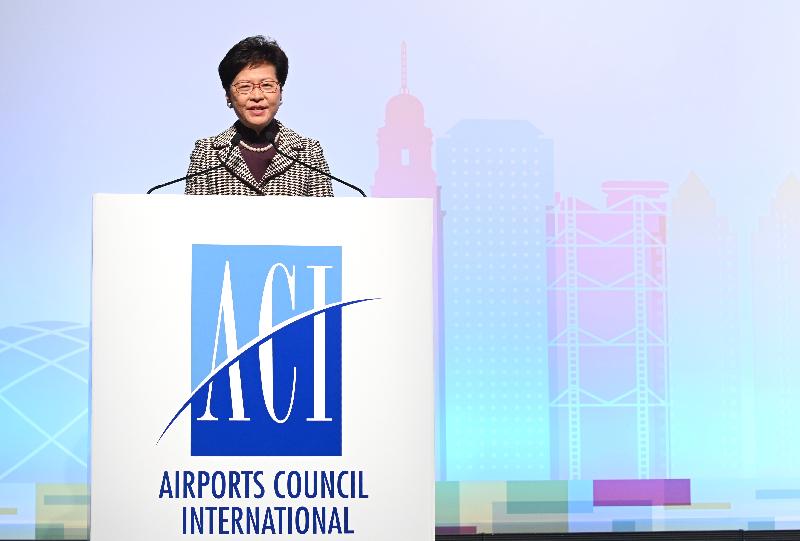
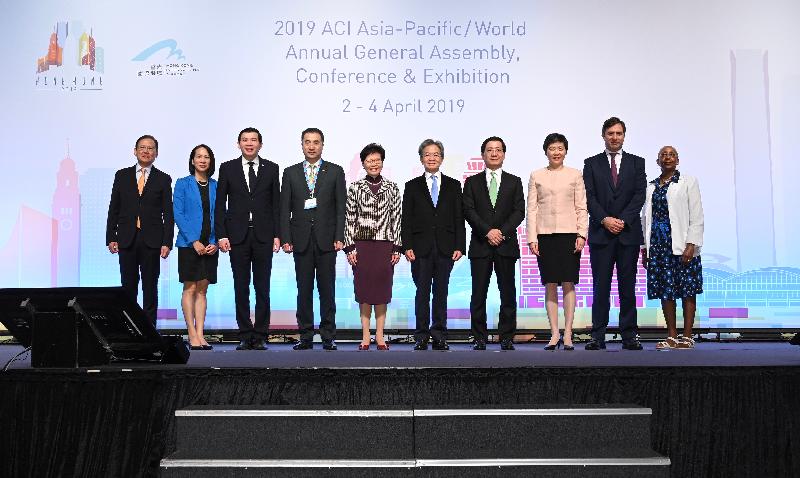
Speech by CE at 2019 ACI Asia-Pacific/World Annual General Assembly, Conference & Exhibition (English only) (with photos)

     Following is the speech by the Chief Executive, Mrs Carrie Lam, at the 2019 Airports Council International (ACI) Asia-Pacific/World Annual General Assembly, Conference & Exhibition today (April 3):
 
Martin (Chair, ACI World Governing Board, Mr Martin Eurnekian), Mr Lee (President, ACI Asia-Pacific, Mr Lee Seow Hiang), Dr Liu (Secretary General, International Civil Aviation Organization, Dr Liu Fang), Jack (Chairman of the Airport Authority Hong Kong, Mr Jack So), Fred (Chief Executive Officer of the Airport Authority Hong Kong, Mr Fred Lam), Dr Dong (Deputy Administrator of the Civil Aviation Administration of China, Dr Dong Zhiyi), ladies and gentlemen,
 
     Good morning. We are honoured to be hosting for the very first time the Airports Council International’s World General Assembly, one of the highlights in the global aviation industry’s annual calendar. This event brings to Hong Kong hundreds of the global aviation industry’s leaders. On behalf of the Hong Kong SAR Government, let me extend to you a very warm welcome.
 
     Being the headquarters for ACI Asia-Pacific, which represents over 100 members operating nearly 600 airports in 49 countries and regions, Hong Kong is well placed for ACI’s Annual General Assembly. Our world-class airport, the Hong Kong International Airport, is amongst the best in the world. Last year, our airport achieved recording-breaking performance by handling more than 74 million passengers and over 5 million tonnes of cargo and air mail. That made Hong Kong the world’s busiest cargo airport for the eighth year in a row. We are, as well, the world’s third-busiest international passenger airport.
 
     Aviation leaders are coming at a time when we are gearing up to play an even more important role in the airport business. The construction of a three-runway system for the Hong Kong International Airport began in August 2016, with commissioning of the third runway scheduled for 2022. Together with a new passenger building, a new automated people mover, a new baggage handling system and expansion of the existing Terminal 2 into a full-service processing terminal, this whole three-runway system will come into operation in 2024. When it’s up and flying, the revamped airport will be able to accommodate 620 000 flight movements annually, welcoming about 100 million passengers and handling some 9 million tonnes of cargo a year.
 
     Realising those numbers will set the entire Hong Kong aviation sector soaring to unprecedented heights. No less important, it will benefit our entire community. Our Airport Authority expects that the three-runway system will create some 123 000 jobs directly, plus another 165 000 jobs either indirectly or through induced employment.
 
     Hong Kong International Airport connects with more than 220 destinations worldwide. That includes over 50 cities in Mainland China, one of the world’s fastest-emerging aviation markets. Mainland aviation has been a particular focus here recently, thanks to the promulgation of the Outline Development Plan for the Guangdong-Hong Kong-Macao Greater Bay Area. The Greater Bay Area brings together a cluster of nine cities in the Guangdong Province, together with Hong Kong and Macao, the two Special Administrative Regions of the People’s Republic of China. A collective economic powerhouse in the making, the Greater Bay Area currently has a population of 70 million and a combined GDP of US$1.6 trillion.
 
     The Greater Bay Area development is premised on the complementarity of the respective advantages of the 11 cities in the region. In Hong Kong’s case, amongst other things, we will play the leading role as an international aviation hub. Blessed by the Outline Development Plan, as well as the “one country, two systems” principle, Hong Kong will strive to maintain our airport’s leading status in the region, and enhance our services through innovative measures, such as inter-modal code-sharing services. 
 
     The recent expansion of the intermodal code-sharing arrangement will bring about plentiful opportunities in the years ahead. It enables travellers to use the same air ticket to continue with their journeys to different Mainland destinations or vice versa by ferries, coaches or trains. The Intermodal Transfer Terminal project, to be completed by 2022, will provide passengers with hassle-free connections from the Hong Kong-Zhuhai-Macao Bridge to our boarding gates.
 
     Our airport is also embracing autonomous vehicles, robotic-serving devices, facial recognition technology and much more. It’s determined, as well, to become the world’s first airport equipped with a 5G communications network.
 
     Innovative technology demands equally innovative talent. In that regard, the Hong Kong International Aviation Academy, established in 2016, has already trained more than 10 000 industry participants. The programme, I should add, works not only with Hong Kong people but aviation industry students and practitioners around the world. In particular, the Academy can help train students from countries along the Belt and Road and contribute to their capacity building.
 
     With our airport sitting right at the heart of the “double gateway” connecting to the Greater Bay Area at one end and to the world at the other, Hong Kong offers seamless air-to-land and air-to-sea connections with a huge number of nearby destinations. It makes perfect sense to leverage on the unique advantage of our airport to foster a wider network of inter-related business activities. Indeed, our vision is to engineer our city’s airport to become an Aerotropolis with high economic efficiency and diversified employment opportunities, so as to enhance Hong Kong’s position as an international business centre. The development of this Aerotropolis is in line with worldwide trends, and we are embarking on various novel and exciting developments to make this happen. 
 
     Our SkyCity is one of the key economic locomotives, which will spin off enormous opportunity with the infrastructural developments in the proximity. We envisage the SkyCity to become one of the largest commercial developments in Hong Kong providing a full suite of hotel, retail, dining and entertainment facilities. It is destined to be a destination of its own – serving local residents as well as visitors from overseas and the Greater Bay Area. 
 
     There is more – this very facility where I am standing right now, the AsiaWorld-Expo, is exploring its next phase of development to meet the growing demand for exhibitions and events. A high-end logistics centre covering an area of approximately 5.3 hectares at the southern cargo area of the airport is also being developed, which is expected to be in operation in 2023. Looking further ahead, the topside of the Hong Kong Boundary Crossing Facilities island of the Hong Kong-Zhuhai-Macao Bridge will be put to good use. There will be tremendous synergies among these developments in the making of our visionary Aerotropolis.
 
     In short, ladies and gentlemen, there are exciting times ahead for our airport. I would invite you all to come visit again in future, and see for yourselves how we turn all these promises and visions into reality.
 
     My thanks once again to the ACI for choosing Hong Kong as the host for this annual assembly. I wish you all the best of business at the conference and a very enjoyable stay in Hong Kong. Thank you very much.

Photo  Photo  
read more

LCQ13: Environmental hygiene problems caused by wild birds

     Following is a question by the Hon Mrs Regina Ip and a written reply by the Secretary for Food and Health, Professor Sophia Chan, in the Legislative Council today (April 3):
 
Question:
 
     I have received complaints from many members of the public that there are from time to time people feeding wild pigeons in public places, resulting in wild pigeons congregating and depositing large quantities of droppings, which has seriously affected environmental hygiene and posed health hazards to members of the public. The spots where wild pigeons congregate include an area underneath the flyover outside Mount Sterling Mall at Mei Foo Sun Chuen and the open space nearby (especially at dusk), and a footpath on Sha Kok Street adjacent to Sha Kok Estate (with more than 200 wild pigeons congregating at the most). Although the Sha Tin District Council has all along been requesting, in the past decade or so, the relevant government departments to take measures to tackle the problem of wild pigeons congregating, the situation has not been improved. In this connection, will the Government inform this Council:
 
(1) of the number of complaints received by the authorities in each of the past three years about bird droppings causing environmental hygiene problems, with a breakdown by District Council district;
 
(2) whether the authorities will step up law enforcement efforts and inspections to curb the acts of feeding wild birds; if so, of the details; and
 
(3) apart from installing Internet Protocol cameras at the spots concerned to curb the acts of feeding wild birds, of the measures adopted by the authorities in the past three years to prevent wild birds congregating and the effectiveness of such measures; whether they will consider installing netting at those spots to prevent entry by wild birds; if so, of the details?
 
Reply:
 
President,
 
     People who dirty public places by feeding birds, e.g. leaving residual feed on the ground, will contravene section 4(1) of the Public Cleansing and Prevention of Nuisances Regulation (Cap. 132BK). The Food and Environmental Hygiene Department (FEHD) may take enforcement actions against the offenders under the Fixed Penalty (Public Cleanliness and Obstruction) Ordinance (Cap. 570).
 
     My reply to the Member’s questions is as follows:
 
(1) The FEHD received 372, 478 and 474 complaints in 2016-17, 2017-18 and 2018-19 (as at February 2019) respectively against people who dirtied public places by feeding birds. The breakdown by District Council district is as follows:
 

District 2016-17 2017-18 2018-19
(as at February 2019)
Central and
Western
41 45 66
Wan Chai 37 61 49
Eastern 51 53 48
Southern 28 19 11
Islands 2 5 10
Yau Tsim
Mong
30 53 54
Sham Shui Po 51 47 50
Kowloon City 12 28 47
Wong Tai Sin 9 11 7
Kwun Tong 22 20 15
Kwai Tsing 6 14 8
Tsuen Wan 2 5 4
Tuen Mun 5 6 7
Yuen Long 21 42 33
North 0 5 2
Tai Po 12 11 19
Sha Tin 20 23 9
Sai Kung 23 30 35
Total 372 478 474
 
(2) and (3) The FEHD has set up 19 dedicated enforcement teams (DETs), primarily responsible for stepping up enforcement actions against various public cleanliness offences (including dirtying public places by feeding birds), and additional DETs will be set up in 2019. On top of regular enforcement actions, the FEHD arranges blitz prosecution by DETs to curb the illegal acts of dirtying public places by feeding birds.
 
     Apart from providing routine street sweeping and washing services, the FEHD would increase the frequency of street washing and disinfect public places where wild birds congregate with diluted bleach solution as appropriate, so as to maintain environmental hygiene.
 
     The proposal of installing fencing is subject to the decision of the venue management concerned. If feeding activities persist, the installation of fixed fencing may not necessarily be an effective solution for mobile feeding behaviors as birds will still congregate in the vicinity of the fenced-off areas. The way to tackle the problem at its root is to promote the public awareness of refraining from feeding birds through enhanced public education.
 
     The FEHD has been making appeals through various channels, including erecting warning signs and distributing pamphlets to the public to advise them to refrain from feeding and thus gathering wild birds in order to maintain environmental hygiene.
 
     In addition, the Agriculture, Fisheries and Conservation Department (AFCD) will continue to remind the public not to feed birds through various channels, including broadcasting new Announcements in the Public Interest on television and radio and microfilms on media platforms. A dedicated website (nofeeding.afcd.gov.hk) has been launched to enhance publicity. Furthermore, the AFCD has produced new banners, posters and pamphlets for displaying at locations where birds gather as well as for posting and distribution by government departments and private housing estates, and will continue to conduct roving exhibitions at different districts. read more