image_pdfimage_print

Author Archives: hksar gov

Speech by CE at Hong Kong ICT Awards 2019 Awards Presentation Ceremony (English Only) (with photos/video)

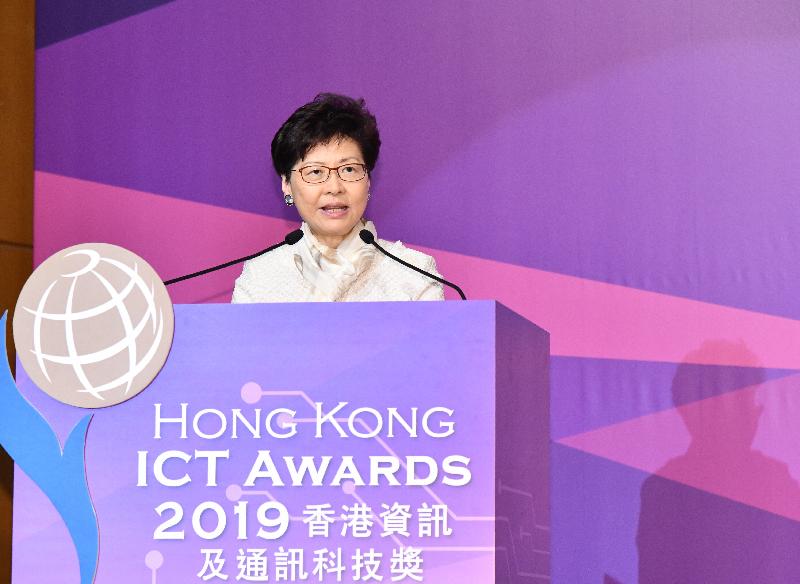
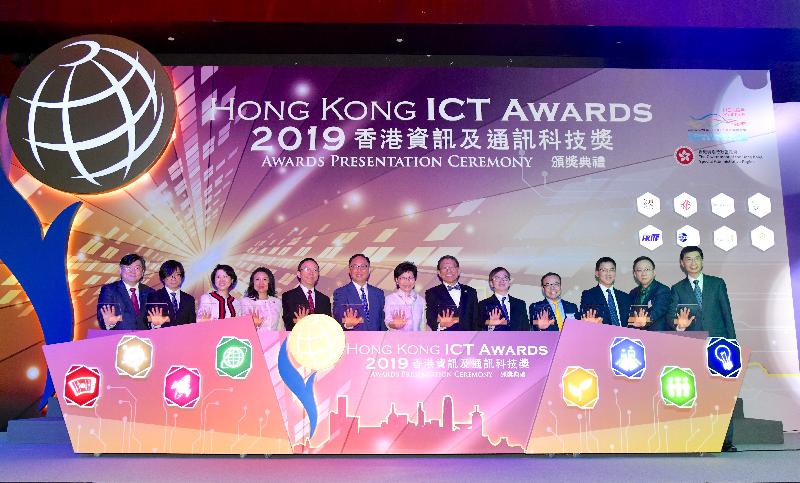
     Following is the speech by the Chief Executive, Mrs Carrie Lam, at the Hong Kong ICT Awards 2019 Awards Presentation Ceremony this evening (April 4):
 
Professor Tuan (Chairman of the Hong Kong ICT Awards 2019 Grand Judging Panel, Professor Rocky Tuan), distinguished guests, ladies and gentlemen,
 
     Good evening. It’s a pleasure to be here once again for the annual Hong Kong Information and Communications Technology Awards Presentation Ceremony. This year marks the 13th edition of the event.

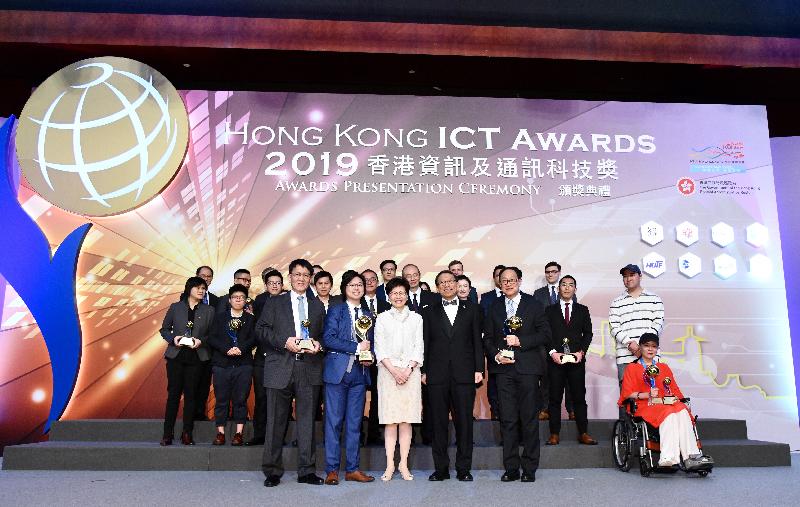
     Let me say upfront how much I enjoyed meeting the grand award winners earlier this evening. It was a welcome opportunity to see the faces behind Hong Kong’s future. One among them will take home the “Award of the Year” honour, and I look forward to presenting that much anticipated award in just a few minutes.

     During my chats just now with the award winners, it struck me just how much the ICT Awards reflect Hong Kong’s business and community life. The award categories include digital entertainment, fintech, start-ups, smart business, smart living, smart mobility, smart people and student innovation. In short, there is very little in the Hong Kong economy and community, in our business and social lives, that doesn’t look to technology for its future and its success.

     That is why my Government has invested about HK$100 billion in innovation and technology (I&T) programmes and initiatives, from promoting R&D to boosting our research, technology and science infrastructure and nurturing talent. That commitment is slowly paying off, and this gala evening may just underline that.

     Tonight, the spotlight is on ICT, a critical I&T pillar and a key contributor to such sectors as fintech, healthcare, robotics and artificial intelligence. ICT is also a core component in many smart city applications. In the 2019-20 Budget, we allocated HK$6 billion to boost our ICT system’s hardware and to develop talent. We also set aside HK$5.5 billion for the expansion of Cyberport, including its Smart-Space, which will offer more opportunities for start-ups.

     Actually, I recently paid a visit to Smart-Space 8. It’s located in a revitalised industrial building in Tsuen Wan, created under the Government’s Space Sharing Scheme for the Youth. There I had the pleasure of meeting a number of young entrepreneurs, and I’m pleased to see one of them among this evening’s award winners. Rest assured, we will continue to create such facilities for our start-ups and, no less important, enhance R&D opportunities in our universities.

     This year’s budget, let me add, allocated HK$500 million for the establishment of information technology Innovation Labs and related activities in all publicly funded secondary schools. Our goal is to stimulate students’ interest in I&T, particularly in such areas as artificial intelligence, blockchain, cloud computing and data analytics, and encourage the talented students to pursue a career in those fields.

     Speaking of careers for young people, the Guangdong-Hong Kong-Macao Greater Bay Area will vastly expand career opportunities, especially for our young people in the coming years and decades. That includes the I&T sector. To start with, the Greater Bay Area, with a population of 70 million and a collective GDP worth some US$1.6 trillion, represents a huge market for our I&T innovations. Further, the Mainland cities in the Greater Bay Area are renowned for their advanced manufacturing capability, while Hong Kong’s deep and liquid capital market provides an excellent platform for raising funds. The Greater Bay Area will therefore be the perfect place for innovators to turn their idea into products and services. In addition, we have put in place various support schemes for our young entrepreneurs. Just last month, the Guangdong province announced that they would offer young entrepreneurs from Hong Kong and Macao the same training, capital and rental support as those available to Guangdong young people. We are grateful to the Guangdong Provincial Government for this initiative, which will provide an extra incentive for our young people to pursue a career in the Greater Bay Area.

     In short, ladies and gentlemen, we are living in an era of opportunity. With their innovative products and services, this year’s award winners have shown that they have all it takes to succeed. I challenge them to continue their commitment to I&T excellence, and create a better future for all of us.

     Finally, my thanks to the committees and judging panels of this year’s ICT Awards. I am grateful as well to the organisers of the eight award categories and to many others for their considerable time and effort in making this year’s Hong Kong ICT Awards a resounding success.

     I wish you all a very enjoyable evening. Thank you very much.

Photo  Photo  Photo  Photo  
read more

Update on number of dengue fever cases

     The Centre for Health Protection (CHP) of the Department of Health today (April 4) reported the latest number of cases of dengue fever (DF), and again urged the public to maintain strict environmental hygiene, mosquito control and personal protective measures both locally and during travel.

     From March 15 to April 3, the CHP recorded four imported DF cases. The patients had been to Cambodia (one case), Fiji (one case), Myanmar (one case) and multiple countries (one case, who had been to Indonesia and Singapore) during the incubation period.

     As of yesterday (April 3), 35 cases had been confirmed this year, all of which were imported cases. The cases were mainly imported from Indonesia (seven), Malaysia (seven) and Thailand (six). 

     DF remains endemic in some areas of Asia and beyond. The latest figures for 2019 revealed that 13 677 cases had been recorded in Thailand, 2 278 in Singapore (since December 30, 2018) and 66 in Japan.  In the Americas, the latest figures indicated that 229 064 and 8 759 cases were filed in Brazil and Mexico respectively in 2019.

     The public should take heed of the following advice on mosquito control:
 

  • Thoroughly check all gully traps, roof gutters, surface channels and drains to prevent blockage;
  • Scrub and clean drains and surface channels with an alkaline detergent compound at least once a week to remove any deposited mosquito eggs;
  • Properly dispose of refuse, such as soft drink cans, empty bottles and boxes, in covered litter containers;
  • Completely change the water of flowers and plants at least once a week. The use of saucers should be avoided if possible;
  • Level irregular ground surfaces before the rainy season;
  • Avoid staying in shrubby areas; and
  • Take personal protective measures such as wearing loose, light-coloured, long-sleeved tops and trousers and apply insect repellent containing DEET to clothing or exposed parts of the body when doing outdoor activities.
    
     To reduce the risk of infections spread by mosquitoes, apart from general measures, travellers returning from areas affected by DF and Zika virus infection should apply insect repellent for 14 days or at least 21 days respectively upon arrival in Hong Kong. If feeling unwell, seek medical advice promptly and provide travel details to the doctor. DEET-containing insect repellents are effective and the public should take heed of the tips below:
 
  • Read the label instructions carefully first;
  • Apply right before entering an area with risk of mosquito bites;
  • Apply on exposed skin and clothing;
  • Use DEET of up to 30 per cent for pregnant women and up to 10 per cent for children*;
  • Apply sunscreen first, then insect repellent; and
  • Re-apply only when needed and follow the instructions.
 
* For children who travel to countries or areas where mosquito-borne diseases are endemic or epidemic and where exposure is likely, those aged 2 months or above can use DEET-containing insect repellents with a DEET concentration of up to 30 per cent.

     The public may refer to the CHP’s tips for using insect repellents for details. 
  read more

Update on measles cases

     The Centre for Health Protection (CHP) of the Department of Health (DH) is today (April 4) investigating seven additional cases of measles infection of which two are workers at Hong Kong International Airport (HKIA).

​     As at 4pm today, two cases involving HKIA workers, one male and one female, were recorded. The first case involves a 23-year-old man with good past health, who developed fever since March 30 and rash since April 1. He sought medical attention at the Accident and Emergency Department (AED) at Prince of Wales Hospital (PWH) on March 31 and the AED at North Lantau Hospital (NLH) on the next day, and was transferred to Princess Margaret Hospital (PMH) for admission and treatment on the same day. A laboratory test of his respiratory specimen was positive for the measles virus. He has been in a stable condition. He had received three doses of measles vaccinations. He had no travel history during the incubation period or the communicable period.

     The second case involves a 24-year-old woman with good past health, who developed rash since April 2. She sought medical attention at a general practitioner and attended the AED at PWH on the same day and was admitted for treatment. A laboratory test of her respiratory specimen was positive for the measles virus. She has been in a stable condition. She had received three doses of measles vaccination. She had travelled to Taipei during the incubation period but had no travel history during the communicable period.
    
     Meanwhile, the CHP is investigating five other case of measles infection. The third case involves a 31-year-old man with good past health, who developed fever and rash since March 30. He sought medical attention at a general practitioner on the same day and attended the AED at Tin Shui Wai Hospital (TSWH) on the next day and was transferred to Pok Oi Hospital for admission and treatment. A laboratory test of his respiratory specimen was positive for the measles virus. He has been in a stable condition. He reported to have measles vaccination. He had travelled to Shenzhen during the incubation period and the communicable period.
 
     The fourth case involves a 31-year-old man with good past health, who developed fever since March 30 and rash since April 2. He sought medical attention at a general practitioner on April 2. He then attendedthe AED at Queen Mary Hospital  on April 2 and 3 respectively and was admitted for treatment on April 3. A laboratory test of his respiratory specimen was positive for the measles virus. He has been in a stable condition. He reported to have measles vaccination. He had travelled to Vietnam during the incubation period but had no travel history during the communicable period.
 
     The fifth case involves a 22-year-old man with good past health, who developed fever since March 30 and rash since April 1. He sought medical attention at the AED at Caritas Medical Centre and then at the AED at PMH on April 2 and was admitted for treatment at PMH on the same day. A laboratory test of his respiratory specimen was positive for the measles virus. He has been in a stable condition. He had received one dose of measles vaccination. He had travelled to Japan during the incubation period and had travelled to Macao during the communicable period.
 
     The sixth case involves an 11-month-old baby boy with good past health, who developed fever since March 28 and rash since April 1. He was taken to the AED at United Christian Hospital on April 1 for medical attention and was admitted for treatment. A laboratory test of his respiratory specimen was positive for the measles virus. He has been in a stable condition. The patient is not yet suitable for measles vaccination. He had lived in Shenzhen during the incubation period and had no travel history during the communicable period.

       The seventh case involves a 2-year-old girl with good past health, who developed fever on March 30 and rash since March 31. She was taken to the AED at TSWH for medical advice on March 31 and was transferred to PMH for admission and management on the next day. A laboratory test of her respiratory specimen was positive for the measles virus. She has been in a stable condition. She had received one dose of measles vaccination. She had no travel history during the incubation period but had travelled to Shenzhen during the communicable period.
 
     According to all patients, they did not have contact with measles patients during the incubation period. Their home contacts have remained asymptomatic so far and have been put under medical surveillance.

​     Upon notification of the cases, the CHP immediately commenced epidemiological investigations and conducted relevant contact tracing. Initial investigations revealed that no contact has shown measles-related symptoms so far. Investigations are ongoing. The public places the patients visited during the communicable period are listed in the appendix.

     “The incubation period (the period from infection to appearance of illness) of measles ranges from seven days to 21 days. Members of the general public who have visited the public places listed in the appendix during the period should observe if they develop relevant symptoms, such as fever, skin rash, cough, runny nose and red eyes in seven to 21 days (the medical surveillance period). If symptoms arise, they should wear surgical masks, stop going to work or school and avoid going to crowded places. They should also avoid contact with non-immune persons, especially persons with weakened immunity, pregnant women and children aged below 1. Those suspected to have been infected are advised to seek medical attention as early as possible and reveal relevant contact history of measles to healthcare professionals,” a spokesman for the DH said.

     Upon confirmation of measles outbreak, the DH has implemented control measures at the airport including vaccination and blood testing services. A total of 93 persons received measles vaccination at the vaccination stations as at 5pm today, bringing the cumulative number of vaccinations given to 7,878. Eight blood samples have been collected today. The DH will notify the participants individually of the serology results. A hotline (2125 1122) has been set up for public enquiries and operates from 9am to 5.45pm daily. As of 5pm today, the hotline had received a total of 2,824 enquiries.

     From tomorrow to next Friday (April 5 to 12), the vaccination quota for the measles vaccination station at the airport remains at 500 doses daily. Vaccination to eligible airport staff will be provided to the following target groups:

(1) Born in or after 1967, and have not received two doses of measles vaccination, and have not been infected with measles before, and with evidence of living with infants under 1 year old or living with pregnant women; or

(2) Have laboratory evidence of testing not positive against measles antibody (IgG).

     Details of evidence are as follows:

(a) Supporting documents for living with infants under 1-year-old: for example birth certificate, discharge summary or vaccination card of the infant
(b) Supporting documents for living with pregnant women: for example, positive pregnancy tests or antenatal follow-up cards of the pregnant women
(c) Supporting documents for laboratory evidence: for example blood results from the DH’s measles serology test or any laboratory within the past 12 months

       The venue and operation hours of the airport vaccination station are as follows:
   

Venue: Multi-function Room, HKIA Tower (Level 5, Terminal 2)
Hours: April 5 to 12
10am to 1pm
2pm to 6pm
 
     As for the blood test service, the DH will continue with the provision of a measles serology test service for airport staff to identify those who need the measles vaccination. From next Monday to Friday (April 8 to 12), the DH will provide blood test service daily to around 100 airport staff who were born in or after 1967, with priority to be given to staff belonging to target group (1). The blood test service will be suspended from tomorrow to Sunday (April 5 to 7).
 
     The venue and operation hours of the airport blood test station are as follows:
   
Venue: South side before the Immigration Hall at Level 3 of Terminal 2 (non-restricted area)
Hours: April 8 to 12

10am to 1pm
2pm to 6pm
 
  read more

HyD wins Gold Award of Hong Kong ICT Awards 2019 – Smart Mobility Award (Smart Transportation Stream) (with photos)

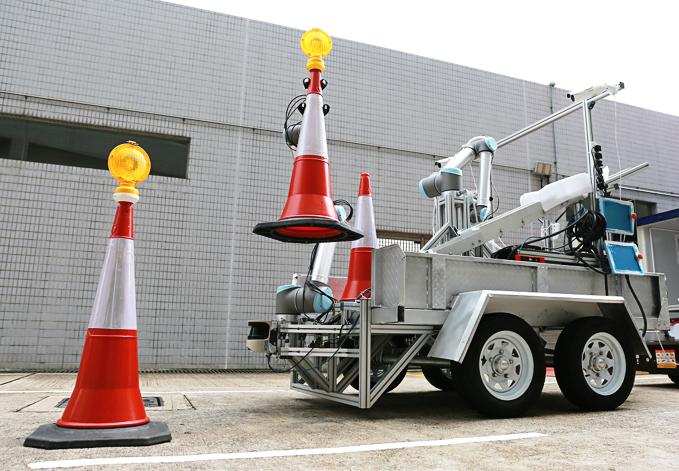
     The intelligent robotic system, the development of which was initiated by the Highways Department (HyD) and which was co-invented and successfully built by the HyD and the Hong Kong Productivity Council (HKPC), won the Gold Award of the Hong Kong ICT Awards 2019 – Smart Mobility Award (Smart Transportation Stream) today (April 4). The intelligent robotic system possesses full cognitive abilities to understand its surroundings and uses automated robot arms to place and collect traffic cones and lanterns on public roads. The Hong Kong ICT Awards aim at recognising and promoting outstanding information and communications technology (ICT) inventions and applications, thereby encouraging innovation and excellence among Hong Kong’s ICT talents and enterprises to meet social needs. 
 
     The HyD always attaches great importance to safety in road works, accords first priority to the safety of engineering site staff and has been striving to enhance safety protection for carrying out road works on public roads. Given that the engineering site staff may face higher risk when setting up and collecting traffic cones and lanterns on public roads late at night, the HyD has therefore been striving to study the use of advanced technology to adopt an automated approach to replace the engineering site staff in carrying out relevant works under more dangerous situations in order to protect their safety. To this end, the HyD and the HKPC have co-invented the automated intelligent robotic system suitable for use under the road conditions in Hong Kong.
 
     The HyD and the HKPC have successfully verified the concept, and designed and built the intelligent robotic system, fitted with cameras, sensors and robotic arms, with full cognitive abilities to understand its surroundings to place and collect traffic cones and lanterns on public roads. The system is the first of its kind in the world. The HyD and the HKPC are currently carrying out detailed design for the formal application of the intelligent robotic system in road works. Upon completion of design and assembly, site trials will be carried out with a view to commencing its use on public roads in the near future.

Photo  Photo  
read more