image_pdfimage_print

Author Archives: hksar gov

Speech by FS at FinTech Forum of Internet Economy Summit 2019 (English only) (with photos/video)

     Following is the speech by the Financial Secretary, Mr Paul Chan, at the FinTech Forum of the Internet Economy Summit 2019 this morning (April 16):
 
George (Chairman of the Board of Directors of Cyberport, Dr George Lam), Mr Zhong (Chief Operating Officer of Bank of China (Hong Kong), Mr Zhong Xiangqun), government colleagues, distinguished guests, ladies and gentlemen,
 
     Good morning.
 
     It is a pleasure to join you for today’s FinTech Forum at the fourth annual Internet Economy Summit. 
 
     Like the past three events, this year’s Summit is packed with intelligence and insight from an international gathering of expert speakers, who like myself, have faith in the promise of the digital economy.
 
     Technology is bringing unprecedented opportunities as well as challenges to our financial services – and the customers they court with their innovative offerings. The title of today’s forum, “The New Era of Finance Redefined”, has aptly pointed this out.
 
     As one of the world’s leading international financial centres, Hong Kong is blessed with a strategic location, the “one country, two systems” unique arrangement and ever-growing economic collaboration with the Mainland of China.
 
     Moreover, Hong Kong has a remarkably enabling environment for the development of fintech. After all, we boast a highly efficient infrastructure in information and communications technology, transparent and reassuring financial regulation, the free flow of capital, talent and information, the rule of law underpinned by independent judiciary, and a government committed to a fintech future. 
 
     The results, to date, are clear and compelling. Hong Kong is home to over 550 fintech companies and start-ups. Celebrated innovation laboratories and accelerator programmes such as Accenture FinTech Innovation Lab, Deloitte Asia Pacific Blockchain Lab and the Floor from Israel have also established a presence here.
 
     Investment in our fintech sector is equally impressive. Over the past five years, fintech companies here have raised over US$1.1 billion, compared favourably with those based in Japan, Australia or Singapore.
 
     The Hong Kong SAR Government is determined to keep this momentum going and be its staunch backer. Indeed, fintech is one of our top priorities, and we’ve rolled out a wealth of fintech programmes and initiatives.
 
     Last September, we launched the Faster Payment System. It connects banks and stored-value facilities – the so-called “e-wallets” – enabling the public to transfer funds instantly, in both Hong Kong dollars and Renminbi, anytime, anywhere. You need only use a mobile phone number or an email address as an account proxy.
 
     As of the end of February, the Faster Payment System had recorded more than 2.5 million registrations, processing over 8.7 million transactions in all. A very fast start, I’d say.
 
     At the same time, we introduced the common QR code standard for retail payments. It helps merchants, especially SMEs, use a single QR code to accept various payment schemes. 
 
     In January, the first phase of the Open Application Programming Interface framework for banks got going. In enabling collaboration with technology firms, it offers more innovative financial services.
 
     Our Securities and Futures Commission last year released regulatory guidelines to impose licensing conditions on companies managing, or intending to manage, portfolios that invest in virtual assets. The Commission is now exploring whether it is suitable to and, if so, how it might regulate virtual asset trading platforms.
 
     As George noted in his address, the Hong Kong Monetary Authority has started granting virtual bank licences last month. This is a milestone for Hong Kong opening up the possibility for our banking sector to offer a new kind of customer experience.
 
     I’m sure the emergence of virtual banks will help SMEs and boost the competitiveness of the entire banking sector, and transform the banking experience for customers.
 
     Insurtech is the future as well. And we must all plan for it. Last year, the Insurance Authority launched a Fast Track scheme. It expedites applications by insurance companies, in or from Hong Kong, looking to use digital distribution channels solely in carrying out their businesses.
 
     The first virtual insurer under the Fast Track scheme was granted a licence last December. I am sure more will follow. 
 
     The Hong Kong Federation of Insurers has also launched two Insurtech initiatives: the Motor Insurance DLT-based Authentication System or MIDAS, a blockchain application to help authenticate motor insurance cover notes, and the Insurance Fraud Prevention Claims Database. This helps detect insurance fraud through artificial intelligence and big data means. It will prove particularly beneficial in cases involving multiple claims and syndicates.
 
     In trade finance, a blockchain-based platform was developed by a consortium of 12 banks here last October. Called eTradeConnect, it enables participating banks to digitise and share trade documents, automate processes, reduce the risk of fraud and improve overall trade finance processes. 
 
     The Hong Kong Monetary Authority is now exploring connecting eTradeConnect with more overseas initiatives.
 
     Ladies and gentlemen, there’s more, indeed much more, to come with fintech. The key is in making it work for the financial services sector, for business in general and, no less of course, for the end user. For all of us, in short.
 
     My thanks to the China Internet Development Foundation and Cyberport for organising this year’s Internet Economy Summit, and for the many other organisations that lent their invaluable support to this important, and innovative, annual gathering. 
 
     I wish you all a very rewarding day and the best of business in the digital economy. 
 
     Thank you very much.
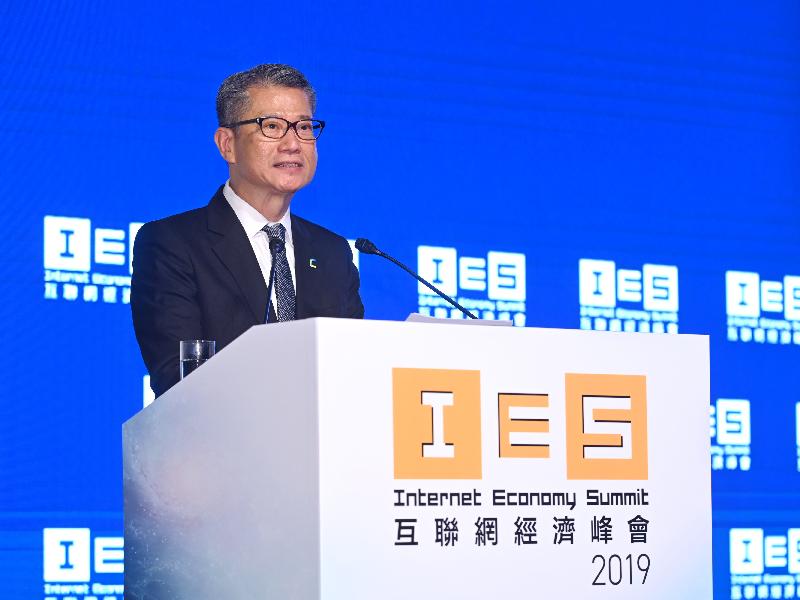
Photo  Photo  
read more

Hong Kong Customs combats unfair trade practices at ginseng and dried seafood shop

     Hong Kong Customs yesterday (April 15) arrested two male directors and one male salesperson of a ginseng and dried seafood shop suspected to have applied a false trade description in the sale of American ginseng, in contravention of the Trade Descriptions Ordinance (TDO).

     Customs earlier received information alleging that salesmen of a ginseng and dried seafood shop in Mong Kok used a gift to attract a customer and further claimed that American ginseng was being sold at a specific price. After the goods were sliced, the salesmen revealed that the American ginseng was priced per tael. The price was 16 times different from expected.

     After investigation, Customs officers yesterday arrested three men, aged between 27 and 42.

     Investigation is ongoing and the arrested men have been released on bail pending further investigation.

     Customs will continue to step up inspection and enforcement with the coming of the Labour Day Golden Week period.

     Customs reminds traders to comply with the requirements of the TDO and consumers to purchase products from reputable shops. Consumers should also be cautious about the unit price and ask for more information, including the total price of the goods selected, before making a purchase decision.

     Under the TDO, any person who in the course of any trade or business applies a false trade description to any goods commits an offence. The maximum penalty upon conviction is a fine of $500,000 and imprisonment for five years. The management staff will also be liable if the offence is committed with their consent or connivance or is attributed to their neglect.

     Members of the public may report any suspected violations of the TDO to Customs’ 24-hour hotline 2545 6182 or its dedicated crime-reporting email account (crimereport@customs.gov.hk). read more

Hong Kong Film Development Council welcomes measures by relevant Central authorities to further facilitate entry of Hong Kong film industry into Mainland market

The following is issued on behalf of the Hong Kong Film Development Council:
      
     The Hong Kong Film Development Council (FDC) welcomed the five relaxation measures agreed by the relevant Central authorities, to further facilitate Hong Kong films and film practitioners entering the Mainland market.

     The Chairman of the FDC, Dr Wilfred Wong, said, “Removing the restriction on the number of Hong Kong practitioners participating in a Mainland film production would encourage the Hong Kong film industry to more actively participate in Mainland film productions, thereby contributing more to the Mainland’s film industry; removing the restriction on the percentage of Hong Kong artistes, the requirement for Mainland-related plots in Hong Kong-Mainland co-productions (co-productions) and the fees for establishing co-productions with the Mainland authority, would provide further facilitation for making of co-productions.
      
     In addition, allowing Hong Kong films to participate in Mainland’s film awards would raise the reputation and recognition of Hong Kong films in the Mainland market, while the incentive scheme for distribution and promotion would encourage Hong Kong film companies to promote outstanding Mainland films and co-productions, thereby helping expand markets for film industries of the two places.”
      
     Dr Wong said that the FDC is grateful for the support to the Hong Kong film industry by the relevant Central authorities and the HKSAR Government.  The FDC will follow up with the HKSAR Government and the industry on implementation details.
      
     Over the years, the FDC has funded about 60 film productions and identified 40 new directors through various film production subsidy schemes (e.g. “Film Production Financing Scheme” and “First Feature Film Initiative”) under the Film Development Fund (FDF).  The “Sponsorship for the Sale and Distribution of Hong Kong Films (Cantonese Version) in the Mainland” scheme and the “Sponsorship for Local Films Nominated to Participate in Film Festival Overseas” scheme under the FDF have also funded about 100 Hong Kong films to expand into the Mainland and overseas markets.  The FDC will continue to support the further development of Hong Kong film industry through the FDF.    read more

Illegal worker jailed

     A Nepalese illegal worker holding recognisance form was jailed by Shatin Magistrates’ Courts yesterday (April 15).
 
     During a joint operation conducted by the Immigration Department (ImmD), the Hong Kong Police Force and the Labour Department codenamed ” Powerplayer ” on November 7, 2018, enforcement officers raided a hair salon in Yau Ma Tei. A male Nepalese illegal worker, aged 25, was arrested. When intercepted, he was found working as a hairdresser. Upon identity checking, he produced for inspection a recognisance form issued by the ImmD, which prohibits him from taking employment. Further investigation revealed that he was a non-refoulement claimant. Two employers suspected of employing the illegal worker was also arrested and the investigation is ongoing.
 
     The illegal worker was charged at Shatin Magistrates’ Courts yesterday with taking employment after landing in Hong Kong unlawfully and remaining in Hong Kong without the authority of the Director of Immigration or while being a person in respect of whom a removal order or deportation order was in force. He pleaded guilty to the charge and was sentenced to 18 months’ imprisonment.
 
     The ImmD spokesman warned that, as stipulated in section 38AA of the Immigration Ordinance, illegal immigrants or people who are the subject of a removal order or a deportation order are prohibited from taking any employment, whether paid or unpaid, or establishing or joining in any business. Offenders are liable upon conviction to a maximum fine of $50,000 and up to three years’ imprisonment. The Court of Appeal has issued a guideline ruling that a sentence of 15 months’ imprisonment should be applied in such cases.
     
     The spokesman reiterated that it is a serious offence to employ people who are not lawfully employable. The maximum penalty is imprisonment for three years and a fine of $350,000. The High Court has laid down sentencing guidelines that the employer of an illegal worker should be given an immediate custodial sentence. According to the court sentencing, employers must take all practicable steps to determine whether a person is lawfully employable prior to employment. Apart from inspecting a prospective employee’s identity card, the employer has the explicit duty to make enquiries regarding the person and ensure that the answers would not cast any reasonable doubt concerning the lawful employability of the person. The court will not accept failure to do so as a defence in proceedings. It is also an offence if an employer fails to inspect the job seeker’s valid travel document if the job seeker does not have a Hong Kong permanent identity card. The maximum penalty for failing to inspect such a document is imprisonment for one year and a fine of $150,000.
 
     Under the existing mechanism, the ImmD will, as a standard procedure, conduct initial screening on vulnerable persons, including illegal workers, illegal immigrants, sex workers and foreign domestic helpers, who are arrested during any operation, with a view to ascertaining whether they are trafficking in persons (TIP) victims. When any TIP indicator is revealed in the initial screening, the officers will conduct a full debriefing and identification by using a standardised checklist to ascertain the presence of TIP elements, such as threat and coercion in the recruitment phase and the nature of exploitation. Identified TIP victims will be provided with various forms of support and assistance, including urgent interference, medical services, counselling, shelter, temporary accommodation and other supporting services. The ImmD calls on TIP victims to report crimes to the relevant departments. read more