image_pdfimage_print

Author Archives: hksar gov

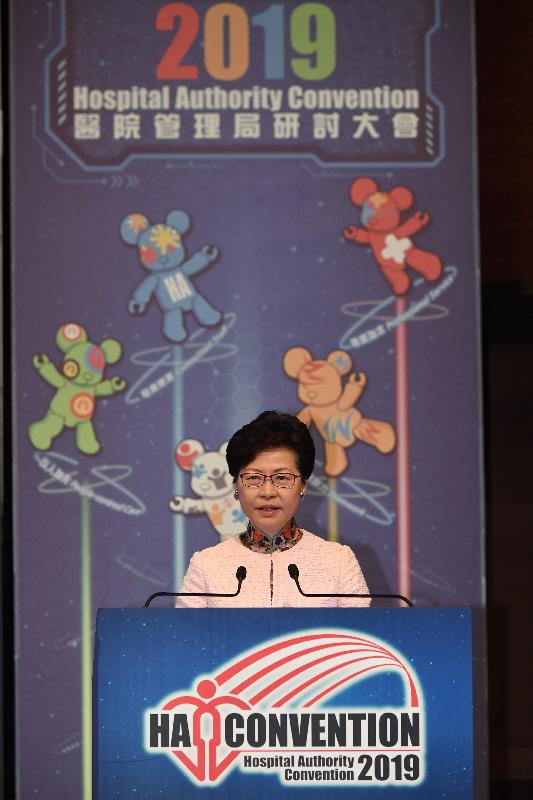
Speech by CE at Hospital Authority Convention (English only) (with photo)

     Following is the speech by the Chief Executive, Mrs Carrie Lam, at the Hospital Authority Convention today (May 14):
 
Vice Minister Wang Hesheng (Vice-minister of the National Health Commission); Professor John Leong (Chairman of the Hospital Authority (HA)); Dr PY Leung (Chief Executive of the HA), doctors, nurses, health professionals, distinguished guests, ladies and gentlemen,
 
     Good morning. It’s a pleasure to join you today for the opening ceremony of this year’s Hospital Authority (HA) Convention, the 25th edition. While I attended previous HA Convention as Chief Secretary for Administration, this is indeed my first HA Convention as Chief Executive of the Hong Kong Special Administrative Region. Let me first congratulate the Hospital Authority on reaching this milestone.
      
     For those who have heard me speak on the subject of health policy on previous occasions, you may recall my passion and compliment of Hong Kong’s healthcare system. I’m proud to say that our healthcare system has been ranked as the most efficient in the world among the 56 economies covered by Bloomberg Health Care Efficiency Index published last September. It means that the people of Hong Kong can enjoy equitable access to quality healthcare services at affordable prices. Such impressive results cannot be achieved without the dedication and commitment of each and every colleague in the public health system, particularly the Hospital Authority which takes care of the lion’s share of inpatient services, together with the support of the entire healthcare professional community. 

     However, this valuable system much treasured by the people of Hong Kong is facing some formidable challenges. Along with our aging population and longer lifespan, we are dealing with a rise in chronic, lifestyle-based diseases. And access to health knowledge through the internet raises people’s awareness of what they may look for from our service providers. That has created higher public expectations and surging demand for even better services, straining our healthcare system. 

     My Government is committed to the sustainable development of our public healthcare system. In 2019-20, our estimated recurrent government expenditure on public healthcare services will increase by nearly 11 per cent to more than HK$80 billion. We are also committed to progressively increasing the Hospital Authority’s recurrent funding under a new arrangement, responding both to population growth and demographic challenges. In the current financial year, the recurrent subvention provided for the Hospital Authority totals nearly HK$70 billion, representing an increase of 8.3 per cent over that of last year. 

     I just heard John talking about the two bottlenecks in the delivery of healthcare services, which I totally agree. On the hardware side, I should add that the first 10-year hospital development plan, with a budget of nearly HK$200 billion, is in full swing. We are also working with the Hospital Authority on our second 10-year hospital development plan. It will cover another 19 projects, involving around HK$270 billion.

     While hardware and funding are important, it is our devoted team of doctors, nurses, allied health professionals, and supporting staff in the Hospital Authority that we treasure most. Since taking office, I have visited several public hospitals. Despite the heavy patient load and overcrowdedness in our hospitals, I was impressed by the staff’s dedication and professionalism. Allow me to take this opportunity to once again express my gratitude, on behalf of the Government and the people of Hong Kong, to Hospital Authority colleagues, especially the front-line staff, for their hard work in coping with the heavy workload. The Government is doing all we can to alleviate their pressure, but I would say that the manpower bottleneck is even more difficult than the hardware bottleneck. In addition to longer-term measures like increasing our medical student intake which would take time to realise its effect, we have pledged to give the Hospital Authority full support and facilitation for improving remuneration and promotion opportunities for its staff so as to attract and retain talent.

     We are also trying to bring in reinforcements. Over the past couple of weeks, stakeholders of the medical profession in Hong Kong have been actively working towards a common goal – to attract more non-locally trained specialist doctors to serve in Hong Kong to help address the manpower shortages in the public sector. We welcome the decision of the Medical Council of Hong Kong last week in waiving the assessment for non-locally trained specialist doctors before getting full registration, which is a good start. We will monitor the effectiveness of the measure, while at the same time continue our discussion with stakeholders to explore further options. 

     Beyond increasing healthcare expenditure and enhancing our healthcare infrastructure, beyond ensuring a sustainable flow of fresh talent, we must recalibrate our long-term direction. In particular, we need to redirect our healthcare focus from treatment in public hospitals to prevention and management within the community itself. This is the reason why we are so keen to promote primary healthcare. 

     When it comes to primary healthcare, we are focused on reducing hospital re-admissions, rectifying the common practice in which accident and emergency services are considered the first point of contact in medical consultation. We need, instead, to strengthen policy coordination and cross-sector collaboration service provision at the district level. Boosting the health consciousness of the community is essential to making this a reality.  

     To that end, my Government is introducing a new District Health Centres’ model. The objective is to enhance district-based primary healthcare through medical-social collaboration and public-private partnerships. The first District Health Centre, in our Kwai Tsing District, will begin operation in the third quarter of this year. It will provide a variety of primary healthcare services, but its emphasis will be on prevention. That means targeting health promotion and education, health assessment, chronic disease management and community rehabilitation. The hope is that this district model of health management will reduce the use of hospital services in the long run. Taking into account the experience gained from the first Kwai Tsing Centre, we will progressively, and hopefully quickly, set up centres in all other districts. 

     Now let me turn to innovation and technology, which is also a focus of this year’s Convention. Indeed, innovation and technology is having an impact on every aspect of our life, healthcare very much included. I believe that Hong Kong has what it takes to do well in innovation and technology, including our world-class universities and strong research and development capabilities. My Government has identified innovation and technology as a major policy priority, and has been doing all we can in promoting its development. Some HK$100 billion has been allocated for various policies and programmes since I became Chief Executive in July 2017. We have identified health technology as the focus of one of our major initiatives in setting up research clusters at the Hong Kong Science Park. That choice is obvious given our two high quality medical schools, centralisation of inpatient service in one single provider – the Hospital Authority, and hence good access to big data as well as accredited centres for clinical trials, etc.   

     Data availability is one of the aspects I am giving a push within Government through the Steering Committee on Innovation and Technology that I chair. I am pleased to have the Hospital Authority as a partner in the provision of clinical data for healthcare-related research. In December 2018, the Hospital Authority launched its Data Collaboration Lab. It gives researchers a freer hand in exploring the Hospital Authority’s patient data for research ideas and the testing of promising hypotheses. Researchers will also collaborate with the Hospital Authority in projects that improve clinical and healthcare services and promote innovation in healthcare. I am delighted to know that six projects, led by researchers from Hong Kong universities, have been selected in the plan’s first stage, covering a number of diseases and clinical work, including stroke, hepatitis, hip fractures, the development of data-driven algorithms, etc. I am hopeful that these and other projects in the future will bring us fresh insight into healthcare and contribute to Hong Kong’s research and development success. 

     Genomic medicine is another medical discipline that warrants our attention. Given the huge potential of genomic medicine in screening, diagnosis and precision medicine, my Government has established a steering committee led by Professor Raymond Liang to study strategies for developing genomic medicine. I have also announced the introduction of the Hong Kong Genome Project in my Policy Address last year, under which about HK$1.2 billion would be allocated to perform up to 50 000 whole genome sequencing in six years. An expert working group is now examining the project framework, and we will set up the Hong Kong Genome Institute to coordinate the implementation of the project in partnership with the Hospital Authority, universities, research sectors and other key stakeholders. I am confident that with the Hospital Authority’s full support for the project, patients could benefit from the scientific advancement in genome sequencing. 

     The Hospital Authority is also working on a Strategic Service Framework for genetic and genomic services. And I’m pleased to say that Professor Sue Hill, NHS England’s Chief Scientific Officer, will be offering her invaluable experience in this development. Professor Hill is the mastermind behind the genome sequencing project in the United Kingdom and genomic medicine services in the NHS. She will address this morning’s plenary session, as well as tomorrow morning’s Symposium on “Genomic Care in the Era of Big Data.” 

     Professor Hill is one of some 90 prominent speakers taking part in more than 50 sessions over these next two days of discussion, intelligence and insight. They will showcase the latest research excellence, while helping to boost healthcare for patients and the communities they live in. That will no doubt be for the benefits for all of us. 

     Ladies and gentlemen, I wish you all a very rewarding Hospital Authority Convention and, for our visitors, a memorable stay in Hong Kong, where the world connects and excels. And this being the last Hospital Authority Convention convened by Dr PY Leung, who has been working with me since 30 years ago when we were in the health policy area, I wish to thank him on behalf of the Hong Kong SAR Government, and wish him every success in his future endeavours. Thank you very much.
Photo  
read more

CE to attend Hong Kong/Guangdong Co-operation Joint Conference and visit Greater Bay Area cities

     The Chief Executive, Mrs Carrie Lam, will lead a Hong Kong Special Administrative Region Government delegation to attend the 21st Plenary of the Hong Kong/Guangdong Co-operation Joint Conference in Guangzhou on May 16. She will then visit three cities of the Guangdong-Hong Kong-Macao Greater Bay Area, namely Foshan, Zhaoqing and Jiangmen, and attend the first Guangdong-Hong Kong-Macao Greater Bay Area media summit.

     On arrival in Guangzhou, Mrs Lam will attend the Hong Kong/Guangdong Co-operation Joint Conference together with the Chief Secretary for Administration, Mr Matthew Cheung Kin-chung; the Secretary for Constitutional and Mainland Affairs, Mr Patrick Nip; the Secretary for the Environment, Mr Wong Kam-sing; the Secretary for Home Affairs, Mr Lau Kong-wah, and the Secretary for Innovation and Technology, Mr Nicholas W Yang. This being the first Hong Kong/Guangdong Co-operation Joint Conference held after the promulgation of the Outline Development Plan for the Guangdong-Hong Kong-Macao Greater Bay Area, both sides will deliberate on the implementation of the Outline Development Plan and further collaboration between Guangdong and Hong Kong, with a view to setting out clearly the way forward and goals.
 
     In the afternoon, she and Mr Nip will start the visit to the Greater Bay Area cities, during which she will meet with leaders of the Foshan, Zhaoqing and Jiangmen Municipal Governments, as well as conducting visits to youth innovation and entrepreneurship bases and facilities of various industries including innovation and technology, medical services and culture. She will also learn about the urban planning of the cities and inspect transportation infrastructure during the visit.

     Mrs Lam and Mr Nip will attend the opening ceremony of the Guangdong-Hong Kong-Macao Greater Bay Area media summit in Guangzhou on May 19 and return to Hong Kong the same day.

     During Mrs Lam’s absence, the Financial Secretary, Mr Paul Chan, will be Acting Chief Executive until Mr Cheung returns to Hong Kong in the afternoon on May 16, when he will take over the role. read more

Fintech collaboration between Hong Kong Monetary Authority and Bank of Thailand (with photo)

The following is issued on behalf of the Hong Kong Monetary Authority:
 
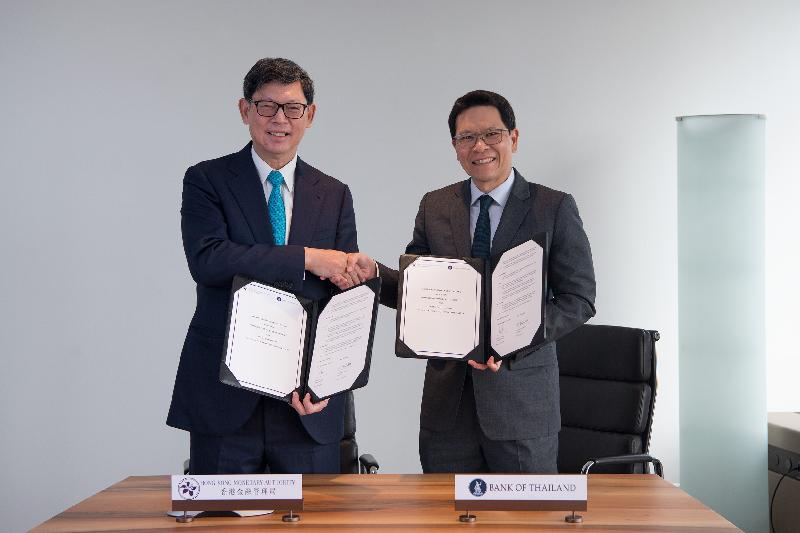
     The Hong Kong Monetary Authority (HKMA) and the Bank of Thailand (BOT) entered into a Memorandum of Understanding (MoU) on May 12 to foster collaboration between the two regulatory authorities in promoting financial innovation.
 
     The MoU was signed between the Chief Executive of the HKMA, Mr Norman Chan, and the Governor of the BOT, Mr Veerathai Santiprabhob, in Basel. Under the MoU, the HKMA and the BOT may collaborate on referral of innovative businesses, information and experience sharing, and joint innovation projects. One potential collaboration under consideration by the two authorities is a joint research project on Central Bank Digital Currency (CBDC), to which the two authorities may apply the knowledge and experience they gained from their respective CBDC research studies, namely Project LionRock[1] of the HKMA and Project Inthanon[2] of the BOT.
 
     Mr Chan said, “The HKMA and BOT are long-time partners in a number of important financial initiatives. Today I am pleased to have signed a fintech MoU with Governor Santiprabhob to take our collaboration to the next level. The signing of this MoU not only demonstrates our mutual interests in developing collaborative fintech initiatives, but also underlines our on-going efforts in cross-border collaboration between central banks in promoting innovation and enhancing experience sharing. The HKMA looks forward to working together with the BOT and seeing the positive outcome from our joint effort.”
 
     Mr Santiprabhob said, “I could not agree more with Chief Executive Norman that this MoU is a significant step in the fintech collaboration between the BOT and the HKMA. The synergies from our collaboration will lead to productive outcomes that will benefit us all. I believe there is huge potential to enhance quality of financial services by leveraging on technological advancement, and it is our responsibilities as regulators to create an ecosystem that is conducive to innovations. The BOT looks forward to working closely with the HKMA in turning great ideas into innovative practical solutions that will ultimately improve people’s lives.”
 
[1] Project LionRock was conducted by the HKMA in collaboration with the three note-issuing banks in Hong Kong, the Hong Kong Interbank Clearing Limited and the R3 consortium. The study aims to better understand the feasibility, implications, benefits and challenges of implementing a CBDC on a Distributed Ledger Technology (DLT) platform through exploring its use in domestic inter-bank payments, corporate payments at wholesale level, and delivery-versus-payment of debt securities settlement.

[2] Project Inthanon was conducted by the BOT in collaboration with R3 and eight participating banks with the goal to develop and test a proof-of-concept for domestic wholesale fund transfer using wholesale CBDC. The project explores the potential in using DLT to enhance Thailand’s financial infrastructure and to encourage collaborative learning among involved parties.

Photo  
read more

Sharing knowledge on clinical advances at Hospital Authority Convention

The following is issued on behalf of the Hospital Authority:

     Around 100 distinguished Mainland, overseas and local speakers will share their knowledge and insights on various health topics of interest with more than 5,000 healthcare and academic professionals at the two-day annual Hospital Authority (HA) Convention 2019, which is taking place today and tomorrow (May 14 and 15).
 
     The HA Convention 2019 is focusing on the HA’s core values, namely “People-centred Care”, “Professional Service”, “Committed Staff” and “Teamwork”. It aims to promote the sharing of knowledge and experience on clinical advances and approaches to modern healthcare service, and facilitate exploration and discussion of contemporary concepts among healthcare professionals and stakeholders.
 
     The HA Convention 2019 was officially opened this morning by the Chief Executive of Hong Kong Special Administrative Region, Mrs Carrie Lam; Vice Minister of the National Health Commission, Professor Wang He-sheng; the Secretary for Food and Health, Professor Sophia Chan; the Chairman of the HA, Professor John Leong; and the Chief Executive of the HA, Dr Leung Pak-yin.
 
     In his welcome address, Professor Leong expressed his gratitude to the Government for its forward-looking commitment in the public healthcare sector. “For 2019/20, the HA will receive recurrent subvention of HK$68.8 billion, which is double that of a decade ago. The Government has further substantiated its supportive stance by setting aside HK$10 billion to set up a public healthcare stabilisation fund, providing contingency resource backup for HA in case of pressing emergent needs.”
 
     Professor Leong also highlighted the 10-year Hospital Development Plan, which will enhance the hospitals’ hardware. “These visionary plans will involve a total of 35 projects including new hospitals and expansion and redevelopment of existing hospitals to deliver some 14 000 additional beds.
 
     “While building hardware is essential, sustaining our human capital is another critical factor. The HA will continue to implement various recruitment drives and we hope to gradually relieve the frontline stress on our hospitals,” he said.
 
     Professor Leong added that staff engagement was a major priority of the HA. “Embracing participatory planning and management, we proactively involve frontline staff in formulating measures for service development and enhancements.
 
     “Apart from linking with staff, empowering them is also important. With the Government’s designated training fund in recent years, we are able to further enhance our training opportunities for strengthening our staff’s competence and widening their perspectives.
 
     “On top of staff engagement and empowerment, effective organisational performance also requires good corporate governance. I am most pleased to see that the Board has strengthened its leading and managing role in the oversight of the HA’s massive operation and in steering key corporate strategies, directions and policies.”
 
     During his keynote address, entitled “Summing Up – Moving On”, Dr Leung summarised the HA’s achievements and experience and also envisaged the HA’s journey ahead.
 
     “Throughout our history, the HA has been working with the Government in providing a comprehensive and seamless healthcare service to the population in a sustainable and affordable manner. Over the years, a variety of service modernisation and quality improvement initiatives were put in place with investment in people, technology, infrastructure and partnership.”

     Facing the challenge of increasing service demand, Dr Leung said, “According to the latest projection, Hong Kong’s population will increase from 7.4 million in mid-2018 to a peak of 8.22 million in 2043, and the percentage of population aged 65 and above will double from 17 per cent to around 34 per cent. The rapid pace and immense magnitude of the increase in service demand arising from the growing and ageing population present a formidable challenge to the HA.”
 
     Dr Leung said that the HA has been proactively exploring alternative ways to meet and manage the demand to cope with the rapidly rising service demand, as well as reviewing service delivery models to optimise efficiency, streamline services and improve integration and coordination for good patient care.
 
     Deliberating on various means to attract and retain staff, Dr Leung added that the HA would remain open to new initiatives to strengthen the workforce, yet stay prudent in safeguarding the high quality and standards of the healthcare system by adopting practicable and sustainable new measures.
         
     “The Government has also allocated an additional recurrent funding of more than $700 million to the HA this year to boost staff morale and retain talent. With the implementation of various enhanced human resource initiatives, we do believe that the workforce situation will gradually improve in the years ahead.”
 
     Alongside the hardware improvement brought by the two 10-year Hospital Development Plans that will largely meet the projected service demand up to 2036, Dr Leung envisaged an era of technology-driven healthcare.
 
     “We will continue to adopt information technology innovations as key enablers for modernising care delivery in order to alleviate the ever-increasing demand on public healthcare services. With a ‘Smart Hospital’ vision in mind, the HA will continue to enhance its information technology solutions and innovations for improving patient experience and service efficiency.”
 
     Dr Leung said that the HA would also help deliver information technology systems in support of future service delivery to bridge the public and private healthcare information gap; and enhance corporate information technology systems relating to various functions including human resources, finance management as well as capital works planning.
 
     “Reaping the benefits of our in-house developed Clinical Management System, the HA has set up a Data Collaboration Lab to provide a secured collaboration platform between the HA and the research community to access the HA’s clinical data and conduct data collaboration projects,” said Dr Leung, adding that it could help improve services and ultimately promote healthcare innovation.
 
     In his concluding remarks, Dr Leung said he believed that with the solid foundation and experiences gained from the past, the unwavering support of the Government. the insightful guidance of the HA Board, the dedicated team of professional and healthcare staff in the HA, and the strong allies made during all these years, the next HA generation would stand firm in meeting new challenges and safeguarding the patient-centred public healthcare system in Hong Kong. read more

Special traffic arrangements for race meeting in Happy Valley tomorrow

     Special traffic arrangements will be implemented in Happy Valley tomorrow (May 15). The arrangements will come into effect one and a half hours before the start of the first race and will last until the crowds have dispersed after the race meeting.

A. Traffic arrangements before the commencement of the first race

1. Road closure
     
     Southbound Wong Nai Chung Road between Queen’s Road East and the up-ramp outside Hong Kong Jockey Club (HKJC) will be closed except for vehicles heading for Aberdeen Tunnel.

2. Traffic diversions

– Southbound Wong Nai Chung Road between Village Road and the up-ramp outside HKJC will be re-routed one way northbound;
– Vehicles from eastbound Queen’s Road East heading for Wan Chai and Happy Valley will be diverted to turn left to Morrison Hill Road;
– Traffic along southbound Morrison Hill Road heading for Happy Valley will be diverted via Sports Road and Wong Nai Chung Road;
– Traffic along Queen’s Road East cannot turn right to Wong Nai Chung Road except for vehicles heading to Aberdeen Tunnel;
– Traffic from Cross Harbour Tunnel heading for Queen’s Road East will be diverted via the down-ramp leading from southbound Canal Road flyover to Morrison Hill Road to turn right at the junction of Wong Nai Chung Road and Queen’s Road East; and
– Traffic from Cross Harbour Tunnel heading for Happy Valley or Racecourse will be diverted via the down-ramp leading from southbound Canal Road flyover to Canal Road East, southbound Morrison Hill Road, Sports Road and Wong Nai Chung Road.

B. Traffic arrangements before the conclusion of race meeting

1. Road closure

     The following roads will be closed from 35 minutes before the start of the last race:

– The up-ramp on Wong Nai Chung Road outside HKJC leading to Aberdeen Tunnel;
– Southbound Wong Nai Chung Road between Queen’s Road East and the up-ramp leading to Aberdeen Tunnel;
– Southbound Wong Nai Chung Road between Village Road and the Public Stands of HKJC;
– Westbound Leighton Road between Wong Nai Chung Road and Canal Road East; and
– Southbound Morrison Hill Road between Leighton Road and Queen’s Road East.
     
     In addition, southbound Wong Nai Chung Road between the up-ramp leading to Aberdeen Tunnel and the Public Stands of HKJC will be closed from about 10 minutes before the start of the last race.

2. Traffic diversions

     The following traffic arrangements will be implemented from 35 minutes before the start of the last race:
     
– Eastbound Queen’s Road East at its junction with Morrison Hill Road will be reduced to one-lane traffic heading for northbound Canal Road flyover;
– Vehicles from Cross Harbour Tunnel heading for Wan Chai will be diverted via the down-ramp leading from Canal Road East, U-turn slip road beneath Canal Road flyover, Canal Road West and Hennessy Road;
– Vehicles from Cross Harbour Tunnel heading for Happy Valley will be diverted via the down-ramp leading from Canal Road East, eastbound Leighton Road and Wong Nai Chung Road;
– Traffic on southbound Morrison Hill Road will be diverted to turn left to eastbound Leighton Road;
– Traffic along southbound Morrison Hill Road heading for Happy Valley will be diverted via eastbound Leighton Road and Wong Nai Chung Road; and
– Traffic along westbound Leighton Road will be diverted to Wong Nai Chung Road.

C. Learner drivers prohibition

     Learner drivers will be prohibited to turn left from Caroline Hill Road to Leighton Road between one and a half hours before the start of the first race and one hour after the last race. In addition, learner drivers will be prohibited from accessing the following roads within the above period of time:

– Shan Kwong Road between Yik Yam Street and Wong Nai Chung Road;
– Village Road between its upper and lower junctions with Shan Kwong Road;
– Percival Street between Hennessy Road and Leighton Road;
– Canal Road East; and
– The service road leading from Gloucester Road to Canal Road flyover.

D. Suspension of parking spaces

     Parking spaces on southbound Wong Nai Chung Road between Sports Road and Blue Pool Road will be suspended from 11am to 7pm during day racing, from 4.30pm to 11.59pm during evening racing, and from 5pm to 11.59pm during night racing.

     Any vehicles found illegally parked within the precincts of the above affected areas will be towed away without prior notice.

     Actual implementation of road closure and traffic diversion will be made by the Police at the time depending on traffic conditions in the areas. Motorists should exercise tolerance and patience, and follow the instructions of Police on site. read more