image_pdfimage_print

Author Archives: hksar gov

LD urges employers and employees to make prior work arrangements for typhoons and rainstorms

   As Typhoon Warning Signal No. 8 (T8) will soon be in force, the Labour Department (LD) today (July 31) reminded employers to make work arrangements for staff during and after typhoons and rainstorms. 
 
     An LD spokesman said, “In drawing up and implementing the work arrangements, employers should give prime consideration to employees’ safety and the feasibility for employees to travel to and from their workplaces. Employers should also give consideration as much as possible to the situations faced by individual employees, such as their place of residence and the road and traffic conditions in the vicinity, and adopt a sympathetic and flexible approach with due regard to their actual difficulties and needs.
 
     “Under special situations, if it is necessary for employees to report for duty under adverse weather conditions, employers should work out arrangements for their transportation, safety, meal and rest place, etc. If public transport services are suspended or limited when T8 or above is in force, employers should provide safe transport services for employees travelling to and from workplaces, or grant them an extra travelling allowance.”
 
     The spokesman also reminded employers to observe the statutory liabilities and requirements under the Employment Ordinance, the Occupational Safety and Health Ordinance, the Factories and Industrial Undertakings Ordinance, the Employees’ Compensation Ordinance and the Minimum Wage Ordinance.
 
     The LD has recently revised the “Code of Practice in Times of Typhoons and Rainstorms”, which provides a reference for employers and employees on the work and resumption of work arrangements in the event of the Government issuing the new post-super typhoon announcement on “extreme conditions”, as well as the major principles, the framework, the reference guidelines and information on relevant legislation for reference in drawing up the work arrangements under adverse weather conditions. The booklet can be obtained from branch offices of the Labour Relations Division or downloaded from the department’s webpage (www.labour.gov.hk/eng/public/wcp/Rainstorm.pdf). read more
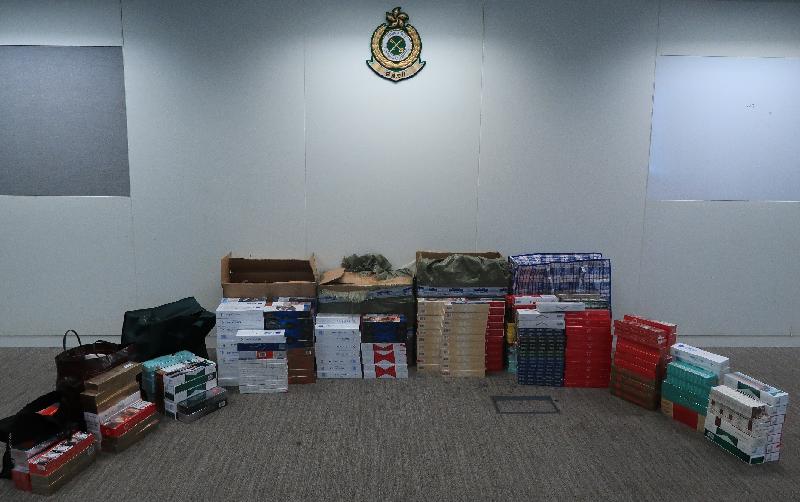
Hong Kong Customs combats illicit cigarette activities (with photo)

     Hong Kong Customs stepped up enforcement action against illicit cigarette activities between June and July and seized about 900 000 suspected illicit cigarettes with an estimated market value of about $2.5 million and a duty potential of about $1.7 million across the territory.

     During the operation, Customs officers detected 98 illicit cigarette cases including 32 cases of storage and distribution and 66 cases of peddling. Sixty four men and 28 women, aged between 20 and 85, were arrested and a private car suspected to be in connection with the case was detained.

     Customs will continue to combat illicit cigarette activities at all fronts through a multi-pronged approach.

     Under the Dutiable Commodities Ordinance, anyone involved in dealing with, possession of, selling or buying illicit cigarettes commits an offence. The maximum penalty upon conviction is a fine of $1 million and imprisonment for two years.

     Members of the public may report any suspected illicit cigarette activities to Customs’ 24-hour hotline 2545 6182 or its dedicated crime-reporting email account (crimereport@customs.gov.hk).

Photo  
read more

CHP investigates case of Shiga toxin-producing E. coli infection

     The Centre for Health Protection (CHP) of the Department of Health is today (July 31) investigating a case of Shiga toxin-producing Escherichia coli (STEC) infection, and hence reminded the public to maintain good personal, food and environmental hygiene against intestinal infections.

     The case involves a one-year-old boy with good past health, who has presented with diarrhoea and fever since July 7. He was admitted to a private hospital on July 15 and was discharged on July 20. The patient has been in a stable condition all along.

     His stool specimen grew STEC upon laboratory testing.

     The CHP’s initial enquiries revealed that the patient had no travel history during the incubation period. Investigations are ongoing.

     “Escherichia coli (E. coli) is a bacterium that is commonly found in the gut of humans and warm-blooded animals. Most strains of E. coli are harmless. Some strains, however, such as STEC, can produce powerful toxins and cause severe food-borne disease. The most recognised serogroup of STEC is E. coli O157:H7,” a spokesman for the CHP explained.

     Preventive measures for STEC infection are similar to those recommended for other food-borne diseases. The public are advised to observe good personal and food hygiene:
 

  • Adopt the 5 Keys to Food Safety in handling food, i.e. Choose (choose safe raw materials), Clean (keep hands and utensils clean), Separate (separate raw and cooked food), Cook (cook thoroughly) and Safe Temperature (keep food at a safe temperature) to prevent food-borne diseases;
  • Wash hands properly with liquid soap and water before handling food, after handling raw meat or poultry and before eating, and after going to the toilet or changing diapers;
  • Cook food and boil water thoroughly before consumption. When cooking or reheating, the core temperature of the food should reach at least 75 degrees Celsius;
  • Avoid consumption of unpasteurised milk or undercooked food; and
  • Consult your doctor immediately if you have symptoms of STEC infection, particularly bloody diarrhoea.

     The public may visit the CHP’s STEC page for more information. read more