image_pdfimage_print

Author Archives: hksar gov

Employers and employees should take precautions against heat stroke

     As the Hong Kong Observatory has issued the Very Hot Weather Warning, the Labour Department (LD) reminds employers and employees to take appropriate precautions to prevent heat stroke when working in a hot or humid environment.
 
     Heat stroke could occur if an employee works in a hot or humid environment for prolonged periods of time, as the body may fail to regulate its temperature by effective heat dissipation through sweating.
 
     The symptoms of heat-related illnesses include feeling thirsty, fatigue, nausea, vomiting, headache, dizziness, muscle spasm or even mental confusion, and loss of consciousness or convulsion in severe cases.
 
     Construction workers, cleaning workers, kitchen workers and porters, for example, are more prone to heat stroke as they may be working for long hours in such an environment, especially if appropriate preventive measures have not been taken.
 
     The LD reminds employers to arrange for a suitable assessment of the risk of heat stress in the work environment and take appropriate preventive measures. The LD has produced two leaflets entitled “Checklist for Heat Stress Assessment at Construction Sites” and “Checklist for Heat Stress Assessment at Outdoor Cleansing Workplaces” respectively. Employers engaged in construction or outdoor cleaning work are advised to refer to these checklists in assessing the risk of heat stress at their workplaces. As for heat stress assessment at a workplace in general, employers can refer to a booklet entitled “Risk Assessment for the Prevention of Heat Stroke at Work” produced by the LD.
 
     The LD also reminds employers and employees to take the following precautions to prevent heat stroke:
 
Employers
———
(1) Take heed of the weather report and adopt shift work arrangements for employees to reduce their exposure to the hot environment, or arrange appropriate rest breaks for them during very hot periods;
(2) Avoid working under direct sunlight and set up temporary sunshade wherever possible;
(3) Provide cool potable water for employees at all times during work. If necessary, provide drinks containing electrolytes for employees to replenish loss of salt during profuse sweating;
(4) Minimise physical demands by using tools or mechanical aids at work;
(5) Increase air flow by enhancing ventilation or air-conditioning as appropriate;
(6) Isolate heat-generating facilities at the workplace and use insulating materials to minimise heat dissipation to the other work areas; and
(7) Provide relevant information and training for employees on heat stroke such as preventive measures and first aid treatment.
 
Employees
———
(1) Wear clothing made of suitable materials (for example, cotton) that is loose-fitting and light-coloured to help heat dissipation, minimise heat absorption and allow sweat evaporation;
(2) Wear a wide-brimmed hat when working outdoors;
(3) Drink plenty of water or other appropriate beverages with electrolytes to replenish the fluids and salt lost through sweating; and
(4) Whenever there are any symptoms of heat-related illnesses, rest in a cool or shady place and drink water, and inform supervisors to take appropriate actions immediately.
 
     Some employees may have difficulty in adapting to a hot working environment owing to their own health conditions. Employers should take this into account and consider the recommendations of their doctors when assigning work to these employees.
 
     In addition to the publications on risk assessment, the LD has produced a leaflet entitled “Prevention of Heat Stroke at Work in a Hot Environment” for the public. The publications can be obtained free of charge from the offices of the Occupational Health Service of the LD, or downloaded from the department’s webpage at www.labour.gov.hk/eng/public/content2_9.htm.
 
     The LD organises occupational health talks in public places and at its own training venues regularly to raise employers’ and employees’ awareness of occupational health. Details of health talks on the prevention of heat stroke at work in a hot environment in August and September are as follows:
 
(A)
Dates: August 13, 15 and 26 and September 5, 17 and 27
(am);
August 20 and 29 and September 9 and 24
(pm)
Time: Half-day
Venue: Occupational Safety and Health Training Centre of the Labour Department, 13/F, Kolour·Tsuen Wan I, 68 Chung On Street, Tsuen Wan, New Territories
 
(B)
Dates: August 9 and 27
Time: Half-day, morning
Venue: Occupational Safety and Health Centre of the Labour Department, G/F,
Kwun Tong Community Health Centre Building, 60 Hip Wo Street, Kwun Tong
(MTR Kwun Tong Station Exit A1)
 
(C)
Date: August 26
Time: 3pm to 4.30pm
Venue: Lecture Hall, Hong Kong Space Museum, 10 Salisbury Road,
Tsim Sha Tsui, Kowloon (MTR Tsim Sha Tsui Station Exit E)

     For enrolment or enquiries about these occupational health talks, please call 2852 4040 or 2361 8240 (for talks organised at the Occupational Safety and Health Centre). Moreover, the LD also provides an outreach health education service and occupational health nurses will, on invitation, disseminate occupational health information at workplaces at a convenient time. Please contact the nursing officer at 2852 4062 for details. All these health talks are free of charge. read more
Company and its director fined for failure to pay wages

     Domani GS Limited and its director were prosecuted by the Labour Department (LD) for failing to pay wages in accordance with the Employment Ordinance (EO). The company and its director pleaded guilty at Eastern Magistrates’ Courts today (August 5) and were each fined $28,000 for a total of $56,000. In addition, the company and the director were ordered to pay an outstanding sum of about $150,000 to the employee concerned.

     The company failed to pay one employee’s wages totalling about $240,000 within seven days after the expiry of the wage periods as required by the EO. The director concerned was prosecuted and convicted for his consent, connivance or neglect in the above offences committed by the company.

     “The ruling helps disseminate a strong message to all employers, directors and responsible officers of companies that they have to pay wages to employees within the time limit stipulated in the EO,” an LD spokesman said.

     “The LD will not tolerate these offences and will spare no effort in enforcing the law and safeguarding employees’ statutory rights,” the spokesman added. read more

Transcript of remarks by CE at media session

     Following is the transcript of remarks by the Chief Executive, Mrs Carrie Lam; together with the Chief Secretary for Administration, Mr Matthew Cheung Kin-chung, the Financial Secretary, Mr Paul Chan, and relevant Directors of Bureau at a media session today (August 5):
 
Chief Executive: Friends of the media and citizens of Hong Kong, the recent protests and marches have seen escalated violence, and these worrying acts have gone beyond the fugitive offenders bill, particularly when I have already announced some time ago that the bill is dead. Such extensive disruptions in the name of certain demands or unco-operative movement have seriously undermined Hong Kong’s law and order and are pushing our city, the city we all love and many of us helped to build, to the verge of a very dangerous situation.
 
     As a result of these widespread disruptions and violence, the great majority of Hong Kong people are now in a state of great anxiety. Some of them do not know whether they could still take some forms of public transport while others are right now being blocked on the way to work. The Government will be resolute in maintaining law and order in Hong Kong and restoring confidence. We all love Hong Kong and have made different contributions to its stability and prosperity over the years. This is the time for us to rally together to set aside differences and bring back order and say no to chaos and violence.
 
Reporter: Mrs. Lam, just now you mentioned a minority of people challenging national sovereignty. You said the bill was already suspended and you said the IPCC has already agreed to look into all the police handling, but I’m afraid you might have missed the point because the protest has continued precisely because the majority of Hong Kong people, including business groups, wanted you to completely withdraw the bill and set up a COI (Commission of Inquiry), not just on the police but on the whole controversy. So my question was, what are stopping you from taking those actions? And, No. 2, just now you said Hong Kong is in serious crisis. It’s not just about the bill. So precisely, what would you do to deal with that crisis apart from issuing condemnations and singling out the police to bear all the blame of the people? Thank you
 
Chief Executive: First of all, we have never singled out the force to bear the blame. The police force is safeguarding Hong Kong’s law and order, and ensuring Hong Kong’s continued safety. This is what they have achieved over many years of hard work, to become Asia’s finest. That is true and I am very sad every time I meet with the Commissioner that the force is under extreme pressure in enforcing the law during very difficult situations. So I also appeal to the media to have a bit more understanding of the difficulties faced by the police during this very difficult period.  The same harassment and threats that I have just described have been extended to the families of the policemen. We should all be very worried about this sort of situation.
 
     Now coming back to your question about the demands, we have said, we have responded to those demands. Some people may not agree with our response but we have considered every factor involved and come up with the response that we have made. And this is a very strongly worded response as far as the bill is dead.  There’s absolutely no room politically for us to trigger the exercise to amend the ordinances. But what is in front of us is Hong Kong’s stability, Hong Kong’s future and escalated violence. If we continue to allow these violent protestors to make use of the fugitive offenders bill and these demands to conceal their ulterior motives, that is going to push Hong Kong to the verge of a very dangerous situation. And I’m sure you know and it has been made very blatantly recently, either on the social media or through some of the violent protestors, that those ulterior motives are going to destroy Hong Kong, to risk “One Country, Two Systems” and also to proceed with what they call “revolution”. This is something of extreme importance that I hope every one of us will know.
 
Reporter: What would you do about this crisis? My question was what would you do about this crisis apart from condemning the people? What would you do?
 
Chief Executive: The only way to deal with violence is not to do anything to give rise to more violence,or to give more pretext for some of the protestors to resort to more violence. The only way to deal with this is to rely on the rule of law, which is the most important core value of Hong Kong, and that requires the police, and maybe other law enforcement agencies, enforcing the law against people who breach the law, and also the prosecution authority to make sure that justice is done. And ultimately, we will all look to the courts, which are independent in Hong Kong, to arbitrate and decide on these cases.
 
Reporter: To what extent are you to blame for this fiasco without end and why have you not resigned?
 
Chief Executive: I have already described our work in amending the Fugitive Offenders Ordinance as a failure, but I have to reiterate, as I did with our overseas officials and friends visiting Hong Kong in the last two months, that exercise was well intended. The exercise was intended to plug a loophole and to ensure that Hong Kong stands in a robust manner to co-operate with international agencies and other jurisdictions to tackle serious crimes together. What we have not done well is, especially in light of very extensive smearing and misleading representations of this exercise, is to explain in a more effective manner the objectives of this exercise and to engage more and perhaps also to listen more so that if there need to be some adjustments to the proposals we could accommodate those adjustments in time. That is something that I, the Secretary for Justice and the Secretary for Security have admitted in public. But what is now in front of us is an extremely serious matter, and that is Hong Kong’s continued safety, security and of course, prosperity and these are all important elements that the Hong Kong people value very much. We are still very proud of Hong Kong possessing these core values and being an international financial and business centre that is attractive to overseas investors, so it is for all of us to join hands, to rally together, to say no to the chaos and the violence that we are seeing. Thank you.
 
Reporter: Why did you not resign?
 
Chief Executive: Actually, this question has also been answered many times. I’m taking responsibility for what we have done because I’m the Chief Executive of the Hong Kong Special Administrative Region. If the amendment exercise has given rise to the problems, and now more problems because the nature of these violent protests has changed, it is the time for me to continue to lead my team to address those problems and try to bring Hong Kong out of the current difficult situation. I don’t think at this point in time resignation of myself or some of my colleagues will provide a better solution. But we will continue to adopt what I have described on July 1 as a style of governance that will enable us to listen more, to engage more and to do more that will meet the wishes of the people of Hong Kong.
 
Reporter: You say protesters have … 40,000 civil servants protested on Friday, as well as members of the finance sector. What would you say those people who are, you know, white collar workers, who are peaceful, who have demonstrated in a way … every sector turned against you today, what do you say to those people who are not, you know, thoroughly …?
 
Chief Executive: Thank you very much. Hong Kong values freedoms that include freedom of expression, freedom of assembly, freedom of media reporting. If individual sectors and members of that sector want to express a view to the Government, we respect that expression and we will listen. But unfortunately, as I have stressed time and again, the crisis now in front of us is not about individual aspirations or about the bill. It is about Hong Kong’s security and safety and whether we could restore in time the law and order that not only the 7.4 million Hong Kong people value a lot but I am sure individual sectors who still have a stake in this society would like us to defend. Let me make this plea again: please rally together and  set aside differences and support the restoration of law and order as soon as possible.
 
(Please also refer to the Chinese portion of the transcript.) 
  read more

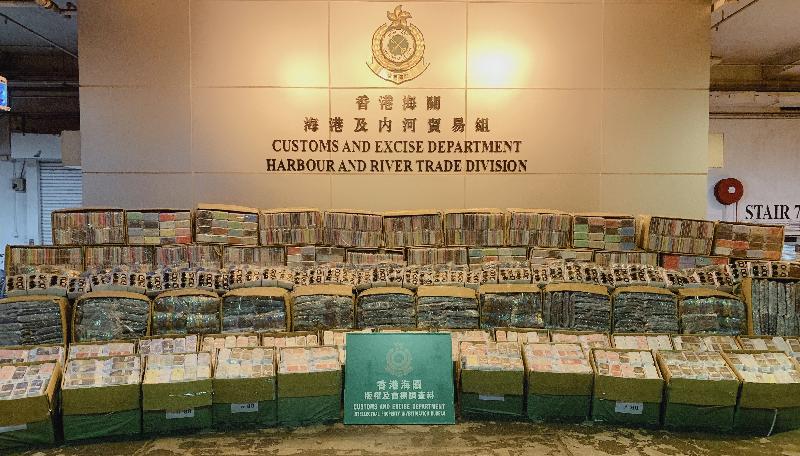
Hong Kong Customs seizes suspected counterfeit and smuggled goods (with photo)

     Hong Kong Customs seized about 320 000 items of suspected counterfeit and smuggled sunglasses and mobile phone cases with an estimated market value of about $6 million from a container at the Customs Cargo Examination Compound of the River Trade Terminal in Tuen Mun on August 1.

     Through risk assessment, Customs officers inspected a Uruguay-bound 40-foot-long container that arrived in Hong Kong from Nansha, Guangdong. The suspected counterfeit and smuggled goods were seized from the container as a result.

     Investigation is ongoing.

     Under the Trade Descriptions Ordinance, any person who imports or exports any goods to which a forged trademark is applied commits an offence. The maximum penalty upon conviction is a fine of $500,000 and imprisonment for five years.

     Under the Import and Export Ordinance, any person found guilty of importing or exporting unmanifested cargo is liable to a maximum fine of $2 million and imprisonment for seven years.

     Members of the public may report any suspected counterfeiting and smuggling activities to Customs’ 24-hour hotline 2545 6182 or its dedicated crime-reporting email account (crimereport@customs.gov.hk).

Photo  
read more