Missing man in Hung Hom located
A Mainland man who went missing in Hung Hom has been located. Chen Shulin, aged 65, went missing after he left a hotel on Hung Lok Road on August 15 morning. His family made a report to Pol… read more


A Mainland man who went missing in Hung Hom has been located. Chen Shulin, aged 65, went missing after he left a hotel on Hung Lok Road on August 15 morning. His family made a report to Pol… read more
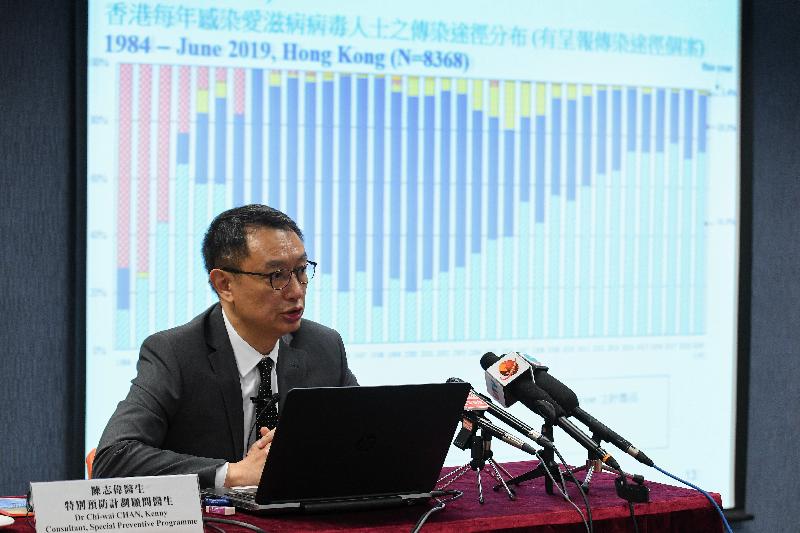
A total of 137 additional cases of Human Immunodeficiency Virus (HIV) infection were reported to the Centre for Health Protection (CHP) of the Department of Health (DH) in the second quarter of 2019, bringing the cumulative total of reported HIV infections to 9 998 since 1984.
Reviewing the latest HIV/Acquired Immune Deficiency Syndrome (AIDS) situation in Hong Kong at a press conference today (August 27), the Consultant (Special Preventive Programme) of the CHP, Dr Kenny Chan, said that sexual transmission remained the major mode of HIV transmission and stressed the importance of consistent and proper use of condoms in reducing the risk of contracting HIV.
“HIV is the cause of AIDS and, without treatment, about half of HIV-infected people will progress to AIDS within 10 years. On the contrary, early HIV treatment with antiretroviral drugs helps prevent AIDS and its complications. It also makes a significant contribution towards improving the quality of life and prolongs survival of those infected,” Dr Chan said.
“Members of the public with a history of unsafe sex should take an HIV antibody test early. They can call the DH’s AIDS Hotline (2780 2211) for a free, anonymous and confidential HIV test. HIV-positive people should seek specialist care as soon as possible,” he continued.
He supplemented that the DH has all along been promoting early HIV testing. At-risk populations, including men who have sex with men (MSM), are recommended to have at least annual testing, irrespective of any individually assessed risk of infection. As an additional approach to conventional HIV testing services, HIV self-testing refers to a process in which a user collects his/her own specimen, performs testing and interprets the result. Of note, Dr Chan emphasised that the HIV self-test only serves as a preliminary test and users of any self-test should seek further confirmation by conventional testing if positive. In addition, members of the public should only use qualified test kits. The public may visit the DH website (www.21171069.com/en/get_hiv_tested/self_testing.html) for related information.
The DH is planning a study of using self-tests for MSM to expand testing coverage. The study will examine the feasibility and acceptability of using a web-based system that allows ordering of HIV test kits and uploading of test results. Confirmatory testing will be provided to those who have self-tested positive. Medical care will also be provided for the infected patients.
Of the 137 HIV cases, involving 116 males and 21 females, reported in the second quarter, 70 acquired the infection via homosexual or bisexual contact, 25 via heterosexual contact and one via drug injection. The routes of transmission of the remaining 41 cases have yet to be determined due to incomplete information upon notification.
The new cases were mainly reported by four major sources: public hospitals, clinics and laboratories (68 cases); private hospitals, clinics and laboratories (22 cases); DH AIDS Unit (19 cases); and the DH’s Social Hygiene Clinics (19 cases). Also, 90 of the HIV-infected people (66 per cent) have already received HIV specialist services at the DH or the Hospital Authority.
In addition, 33 new cases of AIDS were reported in this quarter, of which 20 cases (61 per cent) were attributed to homosexual or bisexual contact, and 10 cases (30 per cent) were related to heterosexual contact. The route of transmission of three cases (9 per cent) has yet to be determined due to incomplete information upon notification. As well in this quarter, the most common AIDS-defining illness was Pneumocystis pneumonia, a kind of chest infection.
Since 1985, a cumulative total of 2 051 confirmed AIDS cases have been reported in Hong Kong.
The public may visit the following pages for more information on HIV/AIDS: the DH’s Virtual AIDS Office (www.aids.gov.hk), the Red Ribbon Centre (www.rrc.gov.hk), the AIDS Hotline website (www.27802211.com) and the Gay Men HIV Information website (www.21171069.com).
The Centre for Health Protection (CHP) of the Department of Health today (August 27) reported a suspected case of Middle East Respiratory Syndrome (MERS), and again urged the public to pay special attention to safety during travel, taking due consideration of the health risks in the places they visit. The case is detailed below:
| Sex | Male |
| Age | 61 |
| Affected area involved | Saudi Arabia |
| High-risk exposure | Nil |
| Hospital | Kwong Wah Hospital |
| Condition | Stable |
| MERS-Coronavirus preliminary test result | Negative |
Two women were fined $6,000 and $10,000 at the Eastern Magistrates’ Courts today (August 27) for contravening the Hotel and Guesthouse Accommodation Ordinance. The women were also fined $1,000 and $2,000 for the period in which the offences continued.
The courts heard that in January and April this year, officers of the Office of the Licensing Authority (OLA), the Home Affairs Department, inspected two suspected unlicensed guesthouses on Paterson Street in Causeway Bay. During the inspections, the OLA officers posed as lodgers and successfully rented rooms in these guesthouses on a daily basis.
According to the OLA’s records, these guesthouses did not possess licences under the Ordinance on the days of inspection. The women responsible for managing the premises were charged with contravening section 5(1) of the Ordinance.
Furthermore, OLA officers inspected a licensed guesthouse on Paterson Street in Causeway Bay in March this year. The officers found that the actual layout of the premises deviated from the registered drawings and the alteration had not been approved by the Hotel and Guesthouse Accommodation Authority. Conditions 3 and 17 of the licence were breached. Therefore, the woman responsible for managing the premises was charged with contravening section 21(3)(a) of the Ordinance.
A department spokesman stressed that operating or managing an unlicensed guesthouse is a criminal offence and can lead to a criminal record. Upon conviction, the offender is liable to a maximum fine of $200,000 and two years’ imprisonment.
The spokesman appealed to anyone with information about suspected unlicensed guesthouses to report it to the OLA through the hotline (Tel: 2881 7498), by email (hadlaenq@had.gov.hk), by fax (2504 5805) using the report form downloaded from the OLA website (www.hadla.gov.hk), or through the mobile application “Hong Kong Licensed Hotels and Guesthouses”. read more
Police today (August 27) appealed to the public for information on a man who went missing in Kwun Tong. Choi Shui-yick, aged 81, went missing after he was last seen on Cha Kwo Ling Road on … read more