image_pdfimage_print

Author Archives: hksar gov

CFS urges public not to consume three kinds of brownies imported from Japan with possible presence of mould

     The Centre for Food Safety (CFS) of the Food and Environmental Hygiene Department today (August 28) urged the public not to consume three kinds of prepackaged brownies imported from Japan, irrespective of batches, as there might be mould in the products.

     Product details are as follows:

(1) Product name: Walnut Brownie
Brand: Muji
Country of origin: Japan
JAN code: 4550002874162

(2) Product name: Earl Grey Brownie
Brand: Muji
Country of origin: Japan
JAN code: 4550002874186

(3) Product name: Caramel Brownie
Brand: Muji
Country of origin: Japan
JAN code: 4550002874179

     A spokesman for the CFS said, “The CFS, through its routine Food Incident Surveillance System, noted that Muji (Japan) is recalling the abovementioned products due to the possible presence of mould in the products.”

     The spokesman said that upon learning of the incident, the CFS immediately followed up with Muji (Hong Kong) Company Limited. According to information provided by the company, it had imported the affected products which were put on sale at its outlets. The company had already removed from shelves and stopped sale of the affected products, and initiated a recall. Members of the public may call the company’s hotline at 2694 9309 during office hours for enquiries about the recall.

     The CFS will continue to follow up on the incident and take appropriate action. An investigation is ongoing. read more
CHP investigates case of severe paediatric enterovirus infection

     The Centre for Health Protection (CHP) of the Department of Health is today (August 28) investigating a case of severe paediatric enterovirus (EV) infection, and again urged the public and institutions to maintain strict hand, personal and environmental hygiene.

     The case involves a 4-year-old girl, with underlying illnesses, who presented with fever since August 21. She was taken to the Accident and Emergency Department of Kwong Wah Hospital for medical attention on August 22 and was admitted on the same day for management. The patient is now in critical condition.

     Laboratory tests of her rectal swab were positive for EV. The clinical diagnosis was meningoencephalitis.

     Initial enquiries revealed that the patient had no travel history during the incubation period and her home contacts have remained asymptomatic so far. Investigations are ongoing.

     A spokesman for the CHP said that as EV infection is transmitted by direct contact with nose and throat discharges, the public should be vigilant and observe the following preventive measures:
 

  • Wash hands before eating and after going to the toilet and changing diapers;
  • Cover the mouth and nose when coughing and sneezing;
  • Maintain good ventilation; and
  • Thoroughly clean toys or appliances which are contaminated by nasal or oral secretions.

     Children suffering from EV infection should stay at home and avoid contact with other children until they have recovered.

     The public may visit the CHP’s page on hand, foot and mouth disease and EV71 infection for more information.  read more

Hong Kong Customs mounts operation against illicit heat-not-burn products (with photos)

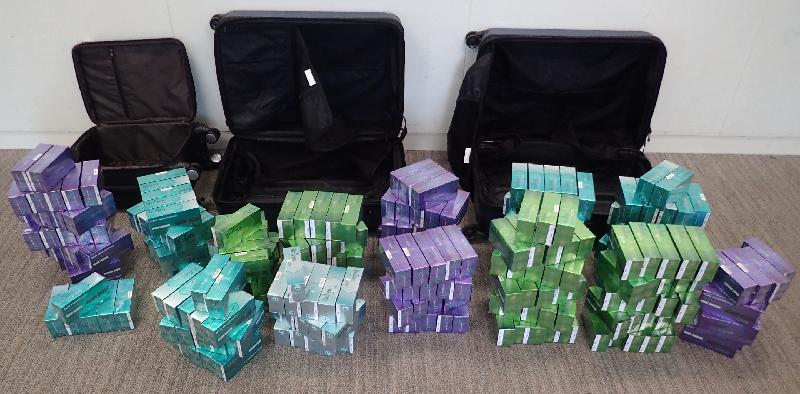
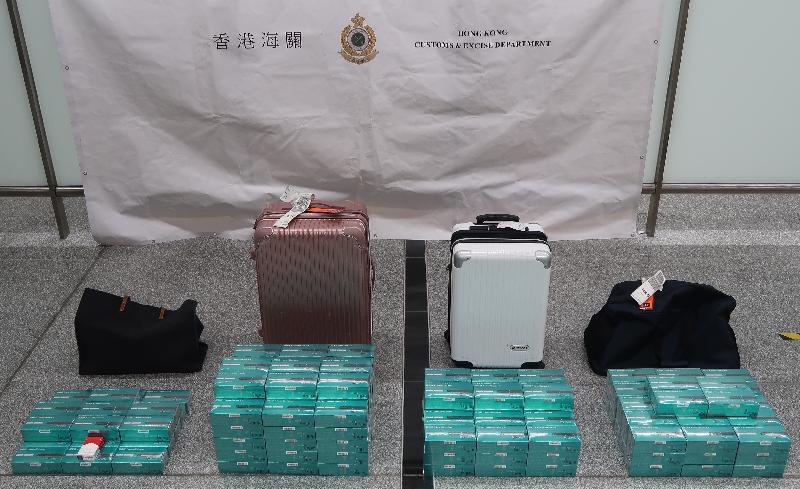
     â€‹Hong Kong Customs mounted an operation codenamed “Glacier” last week, aiming to combat smuggling of illicit heat-not-burn (HNB) products. Until yesterday (August 27), Customs arrested nine men aged between 27 and 60. About 440 000 suspected illicit HNB products with an estimated market value of about $1.3 million and a duty potential of about $800,000 were seized. 

     Through risk assessment, Customs officers intercepted four incoming passengers arriving from Quanzhou in Fujian and Japan at Hong Kong International Airport and seized about 140 000 suspected illicit HNB products from their personal baggage.

     Also, Customs officers smashed four storage and distribution centres of illicit HNB products in Chek Lap Kok, Yau Ma Tei, Mong Kok and Kwun Tong. About 300 000 suspected illicit HNB products were seized.

     Customs believes that an HNB product smuggling syndicate was smashed.

     The “Glacier” operation is ongoing.

     Customs reminds members of the public that under the Dutiable Commodities Ordinance (DCO), tobacco products are dutiable goods to which the DCO applies. All HNB products containing tobacco in content are also dutiable goods subject to the control of the DCO. Any person who imports, possesses, sells or buys dutiable commodities without a valid licence commits an offence. The maximum penalty upon conviction is a fine of $1 million and imprisonment for two years.

     Members of the public may call the Customs’ hotline at 2815 7711 to enquire whether a specific tobacco or smoking product is under the regulation of the DCO. They may also report any suspected violation of the DCO to Customs’ 24-hour hotline at 2545 6182 or its dedicated crime-reporting email account (crimereport@customs.gov.hk).

Photo  Photo  
read more

Suspected MERS case reported

     The Centre for Health Protection (CHP) of the Department of Health today (August 28) reported a suspected case of Middle East Respiratory Syndrome (MERS), and again urged the public to pay special attention to safety during travel, taking due consideration of the health risks in the places they visit. The case is detailed below:
 

Sex Male
Age 27
Affected area involved Dubai, United Arab Emirates
High-risk exposure Camel ride
Hospital Princess Margaret Hospital
Condition Stable
MERS-Coronavirus preliminary test result Negative

     “Travellers to the Middle East should avoid going to farms, barns or markets with camels; avoid contact with sick persons and animals, especially camels, birds or poultry; and avoid unnecessary visits to healthcare facilities. We strongly advise travel agents organising tours to the Middle East to abstain from arranging camel rides and activities involving direct contact with camels, which are known risk factors for acquiring MERS-CoV,” a spokesman for the CHP said.

     Locally, the CHP’s surveillance with public and private hospitals, with practising doctors and at boundary control points is firmly in place. Inbound travellers and members of the public who recently visited the Middle East and developed fever or lower respiratory symptoms within 14 days will be classified as suspected MERS cases. They will be taken to public hospitals for isolation and management until their specimens test negative for MERS-CoV.

     Travellers to affected areas should maintain vigilance, adopt appropriate health precautions and take heed of personal, food and environmental hygiene. The public may visit the MERS pages of the CHP and its Travel Health Service, MERS statistics in affected areas, the CHP’s Facebook Page and YouTube Channel, and the World Health Organization’s latest news for more information and health advice. Tour leaders and tour guides operating overseas tours are advised to refer to the CHP’s health advice on MERS. read more