Tag Archives: Government

image_pdfimage_print

Press release: Report 05/2017: Near miss between a train and a track worker at Shawford

RAIB has today released its report into a near miss between a train and a track worker at Shawford on 24 June 2016.

Summary

At 12:22 hrs on 24 June 2016, a train travelling at about 85 mph (137 km/h) narrowly missed striking a track worker near Shawford station, Hampshire. The track worker and a controller of site safety (COSS) had gone onto the railway to locate a reported rail defect. The track worker was not injured but was badly shaken by the incident. After making an emergency stop, the train driver reported the incident and was fit to continue his journey.

The immediate cause was that the track worker had become distracted while he was standing on a line on which trains were running. This happened because there was a breakdown in safety discipline and vigilance when the COSS and track worker went onto the railway. Firstly, they did not implement the required safe system of work for going onto the railway at Shawford. Secondly, the track worker crossed the railway without the permission of the COSS. Thirdly, the track worker was distracted and stopped on an open line when crossing back. The RAIB found a similar breakdown in safety discipline and vigilance when it investigated a fatal accident at Newark North Gate (report 01/2015). It is probable that the track worker’s alertness and decision making were affected by fatigue, because he had slept in his car all week to avoid making long journeys to and from home each day. A possible underlying factor was that the rail testing and lubrication section within the Network Rail delivery unit involved was not resilient to any loss of resources or sudden increase in workload. Although not causal to the incident, the RAIB also observed that the way in which the section carried out safe system of work planning for its staff was not compliant with Network Rail’s processes, and neither the COSS nor the track worker reported their involvement in the incident at the time.

Recommendations

In addition to a previous recommendation and learning point from the Newark North Gate accident, which also address the key issue of the breakdown in safety discipline and vigilance in this incident, the RAIB has made three new recommendations, addressed to Network Rail. The first relates to the management of fatigue for staff needing to make long journeys before and after a shift. The second relates to making the rail testing and lubrication section of the delivery unit more able to accommodate a short-term loss of resource and peaks in workload. The third recommendation calls for Network Rail to consider the reasons why its management arrangements on Wessex Route did not detect and rectify the non-compliances with the processes for managing the safety of people working on or near the line. The investigation also identified six learning points about: reminding staff of the importance of following existing rules and procedures; how the early use of the train’s horn by drivers to give an urgent warning can avert an accident if track workers on their line do not acknowledge the first horn warning; and the timely reporting of operational incidents.

Notes to editors

  1. The sole purpose of RAIB investigations is to prevent future accidents and incidents and improve railway safety. RAIB does not establish blame, liability or carry out prosecutions.
  2. RAIB operates, as far as possible, in an open and transparent manner. While our investigations are completely independent of the railway industry, we do maintain close liaison with railway companies and if we discover matters that may affect the safety of the railway, we make sure that information about them is circulated to the right people as soon as possible, and certainly long before publication of our final report.
  3. For media enquiries, please call 01932 440015.

Newsdate: 23 March 2017

PDF, 4.12MB, 51 pages

If you use assistive technology (such as a screen reader) and need a version of this document in a more accessible format, please email enquiries@raib.gov.uk. Please tell us what format you need. It will help us if you say what assistive technology you use.

read more

Welsh team set to compete at Special Olympics, thanks to Welsh Government and Disability Sport Wales funding

The event will take place from 7-12 August and is the country’s largest multi-sports event for athletes with intellectual disabilities. The funding will help towards the costs of sending a team from Wales to compete at the Games.
The Special Olympics National Games are held every four years and enable children and adults to compete at a national level.  Around 2,600 athletes will come together from across the country to compete in 19 sports. 

Minister for Social Services and Public Health, Rebecca Evans said:

“I am pleased to be able to provide this funding, which will enable around 200 Welsh athletes to compete at the Special Olympics National Games.  Training for, and participating in, events such as this one, can offer  enormous benefits – not only in terms of improving people’s health and wellbeing, but also in building self-confidence.”


Economy Secretary Ken Skates said:

“It’s vital that Wales is represented at National Games such as these, building on our rich sporting history and recent success stories. I’m delighted that Welsh Government funding has helped ensure a strong Welsh presence and look forward to us playing a big part in a successful Games.”
Pippa Britton, Chair, Disability Sport Wales said:

“I am delighted that Disability Sport Wales is once again able to support Special Olympics Team Wales to attend their National Games. This event is a pinnacle moment for any athlete, providing them with opportunities to compete and engage with competitors from across the UK.
“We are very proud of the efforts of the Team and have no doubt that they will represent Wales with great distinction when they take the stage later this summer.

“We wish them all the very best of luck.”


Jeff Savory Chair & Head of Delegation Special Olympics Wales said:

“We would like to thank Disability Sport Wales and The Welsh Government for their support to the Special Olympics Wales Team. The Special Olympics GB National Summer Games are the flagship event in the 4 year cycle of Special Olympics in GB.  This event also is the qualifying event for the 2019 World Games which is to be held in  Abu Dhabi. “I know that every athlete will do their best to bring the silverware HOME to Wales.”

read more

Ofcom consultation

I receive a great deal of correspondence from my constituents about poor service from telephone and internet companies. I am aware how much delays in getting repairs done, missed appointments and starting a new service costs in terms of time and money.

I have received the communication below from the Chief Executive of Ofcom. They are consulting on proposals to require phone and broadband to pay automatic compensation in this cases. The consultation ends on 5 June and you can access it at: https://www.ofcom.org.uk/consultations-and-statements/category-1/automatic-compensation

“Ofcom has today set out new proposals to require phone and broadband companies to pay automatic compensation – either a cash payment, or a credit on a bill – to customers who suffer slow repairs, missed appointments or delays to starting new services.

When a customer’s landline or broadband goes wrong, that is frustrating enough without having to fight to get fair compensation from the phone company. So we are proposing new rules to force providers to pay money back to customers automatically, whenever repairs or installations don’t happen on time, or when people wait in for an engineer who doesn’t turn up. This would mean customers are properly compensated, while providers will be incentivised to work harder to improve their service.

Compensation payments would be set by Ofcom, and designed to reflect the degree of harm suffered by consumers. Here is how Ofcom’s automatic compensation scheme would work:
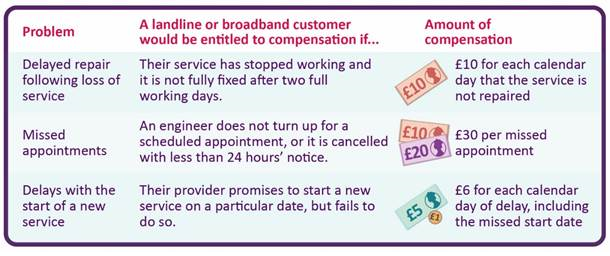
We estimate that our plans would mean up to 2.6 million additional customers could receive up to £185m in new compensation payments each year. Currently, there are 7.2m instances where landline or broadband customers suffer delayed repairs, missed appointments or delays to new installations. Financial compensation from companies, totalling around £16.3m, is currently paid out in 1.1m of these cases.

Around one-third of small and medium-sized enterprises choose residential landline and broadband services and would also benefit from our compensation proposals.

We are consulting until 5th June and plan to publish a statement at the end of the year”.

With best wishes

Helen

read more