Tag Archives: China

image_pdfimage_print

Frozen confection sample detected with coliform bacteria and total bacterial counts exceeding legal limit

     â€‹The Centre for Food Safety (CFS) of the Food and Environmental Hygiene Department announced today (June 9) that a sample of frozen confection was found to contain coliform bacteria and total bacterial counts exceeding the legal limits. The CFS is following up on the incident.

     A spokesman for the CFS said, “The CFS collected the above-mentioned sample from a retail shop in Sha Tin for testing. The test result showed that the sample contained 170 coliform bacteria per gram and 75 000 bacteria per gram, exceeding the legal limits.”

     “The CFS has informed the retail shop concerned of the irregularity. The retailer shop has already stopped selling and discarded the affected product according to the CFS’s advice. The CFS has also provided health education on food safety and hygiene to the person-in-charge and staff of the retail shop, and requested it to carry out thorough cleaning and disinfection. Prosecution will be instituted should there be sufficient evidence,” the spokesman said.

     Under the Frozen Confections Regulation (Cap. 132AC), frozen confection for sale should not contain more than 100 coliform bacteria per gram or more than 50 000 bacteria per gram. The maximum penalty for offenders is a fine of $10,000 and three months’ imprisonment upon conviction. The fact that the coliform count and the total bacterial count exceeded the legal limit indicated that the hygienic conditions were unsatisfactory, but did not mean that consumption would lead to food poisoning.

     The CFS will continue to follow up on the incident and take appropriate action to safeguard food safety and public health. read more
Sample of prepackaged frozen giant scarlet shrimps detected with mercury exceeding legal limit

     The Centre for Food Safety (CFS) of the Food and Environmental Hygiene Department today (June 9) announced that a sample of prepackaged frozen giant scarlet shrimps imported from Spain was detected with mercury, a metallic contaminant, at a level exceeding the legal limit. The CFS is following up on the incident. Members of the public should not consume the affected batch of the product. The trade should also stop using or selling the affected batch of the product immediately if they possess it.

     Product details are as follows:

Product name: Frozen Giant Scarlet Shrimp
Place of origin: Spain
Pack Lot: FCCAR25114
Best-before: April 2027
Importer: Classic Fine Foods (Hong Kong) Limited

     “The CFS collected the above-mentioned sample at the import level for testing under its routine Food Surveillance Programme. The test result showed that the sample contained mercury at a level of 0.85 parts per million (ppm), exceeding the legal limit of 0.5 ppm,” a spokesman for the CFS said.

     The spokesman said that the CFS had informed the importer concerned of the irregularity and instructed it to stop sale and remove from shelves the affected product. The importer concerned has initiated a recall according to the CFS’ instructions. Members of the public may call the importer’s hotline at 2612 2066 during office hours for enquiries about the recall. The CFS is also tracing the source and distribution of the product concerned. 

     “Mercury may affect the nervous system, particularly the developing brain. At high levels, mercury can affect foetal brain development, and affect vision, hearing, muscle co-ordination and memory in adults,” the spokesman added. 

     According to the Food Adulteration (Metallic Contamination) Regulations (Cap. 132V), any person who sells food with metallic contamination above the legal limit is liable upon conviction to a fine of $50,000 and imprisonment for six months.

     The CFS will alert the Spanish authorities and the trade, continue to follow up on the incident and take appropriate action. An investigation is ongoing. read more

LegCo to consider Housing (Amendment) Bill 2025

The following is issued on behalf of the Legislative Council Secretariat:
 
     The Legislative Council (LegCo) will hold a meeting on Wednesday (June 11) at 11am in the Chamber of the LegCo Complex. During the meeting, the Second Reading debate on the Housing (Amendment) Bill 2025 will resume. If the Bill is supported by Members and receives its Second Reading, it will stand committed to the committee of the whole Council. After the committee of the whole Council has completed consideration of the Bill and its report is adopted by the Council, the Bill will be set down for the Third Reading.

     The Second Reading debates on the Buildings Energy Efficiency (Amendment) Bill 2025 and the Road Traffic (Amendment) Bill 2025 will also resume. If the Bills are supported by Members and receive their Second Reading, they will stand committed to the committee of the whole Council. After the committee of the whole Council has completed consideration of the Bills and their reports are adopted by the Council, the Bills will be set down for the Third Reading.

     On Members’ motions, Dr David Lam will move a motion on “Comprehensively promoting healthcare financing reform and making optimal use of public and private healthcare resources”. The motion is set out in Appendix 1. Mr Edward Leung, Mr Tang Ka-piu, Dr Hoey Simon Lee and Mr Chan Pui-leung will move separate amendments to Dr Lam’s motion.
 
     Mr Sunny Tan will move a motion on “Stimulating the vigorous development of Hong Kong’s small and medium enterprises with new quality productive forces and actively dovetailing with the country’s high-quality ‘going global’ strategy”. The motion is set out in Appendix 2. Mr Erik Yim will move an amendment to Mr Tan’s motion.
 
     Members will also ask the Government 22 questions on various policy areas, six of which require oral replies.
 
     The agenda of the above meeting can be obtained via the LegCo Website (www.legco.gov.hk). Members of the public can watch or listen to the meeting via the “Webcast” system on the LegCo Website. To observe the proceedings of the meeting at the LegCo Complex, members of the public may call 3919 3399 during office hours to reserve seats. read more

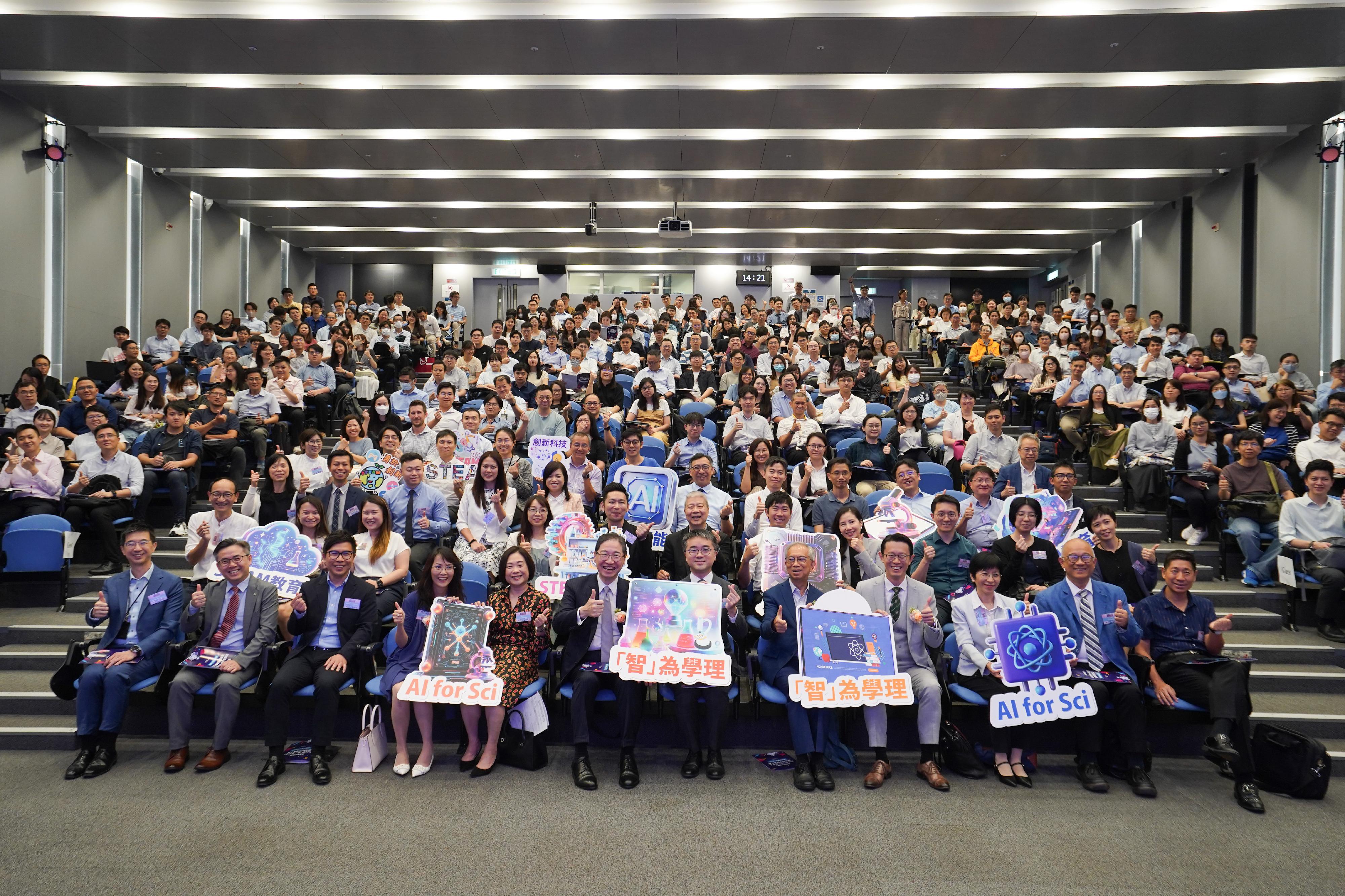
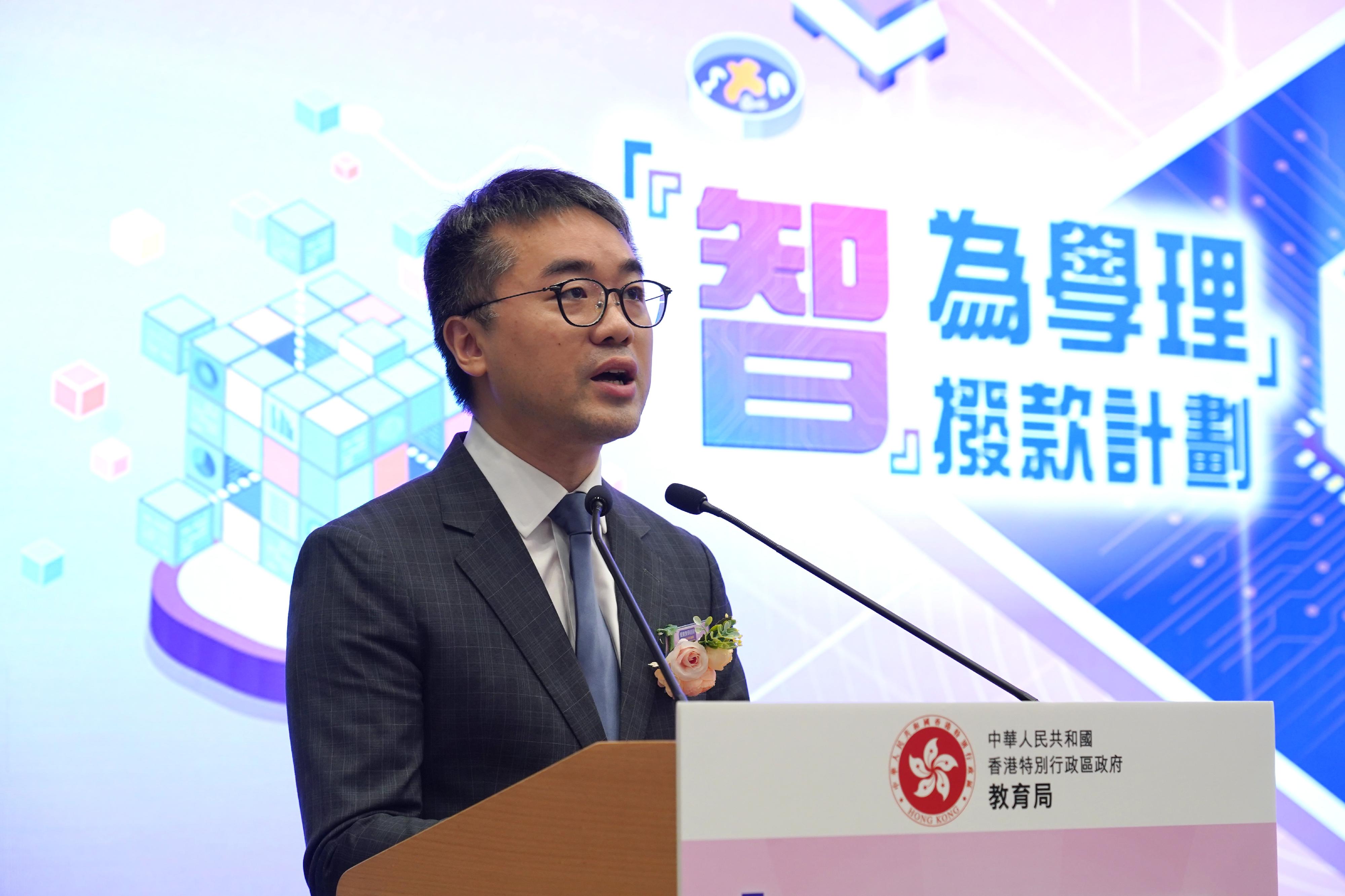
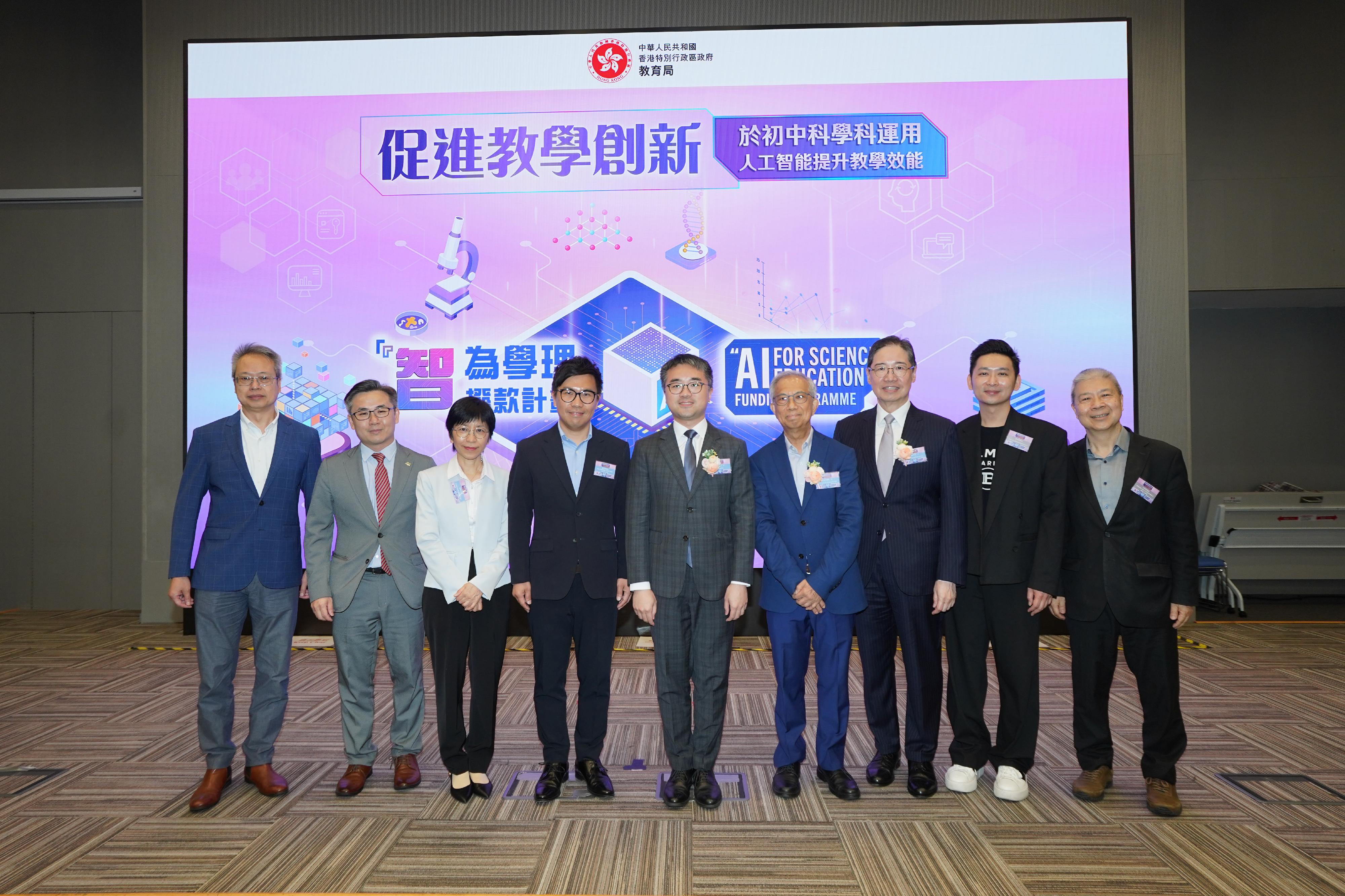
EDB holds sharing session on “Use of Artificial Intelligence for Enhancing Teaching Effectiveness in Science (Secondary 1-3)” and launch of AI for Science Education Funding Programme (with photos)

     The Education Bureau (EDB) today (June 9) held a sharing session on the “Use of Artificial Intelligence for Enhancing Teaching Effectiveness in Science (Secondary 1-3)” to explore and share how AI can be used to foster pedagogical innovations, thereby enhancing teaching effectiveness, and the launch of the AI for Science Education Funding Programme at the Education Bureau Kowloon Tong Education Services Centre.

     The Under Secretary for Education, Dr Sze Chun-fai, officiated at the launch with the chairpersons of the Committee on Professional Development of Teachers and Principals, the Quality Education Fund (QEF) Steering Committee, the Association of Principals of Government Secondary Schools, the Hong Kong Subsidized Secondary Schools Council, and the Hong Kong Direct Subsidy Scheme Schools Council. Speaking at the event, Dr Sze said that in order to tie in with the national strategy of invigorating the country through science and education, and the promotion of digital education development in recent years, the Chief Executive has put forward a number of key initiatives to step up the promotion of digital education in the 2024 Policy Address.

     He said that under the AI for Science Education Funding Programme, the QEF would provide funding of $100,000 to each applicant school for arranging professional training for teachers, implementing AI-empowered classroom teaching, promoting the application of AI in different learning scenarios, as well as enhancing adaptive learning among students. The programme has received an overwhelming response, with over 220 publicly funded secondary schools participating, reflecting that the school sector is actively seizing the opportunity to make good use of AI to assist teaching.

     Dr Sze said that the EDB will continue to arrange AI-related training for teachers and support schools in developing AI-empowered teaching through various measures, such as producing learning and teaching examples and arranging sharing by experts, with a view to promoting pedagogical innovations and enhancing students’ learning effectiveness. He expressed his hope for schools, teachers, different stakeholders and the EDB to work together to continuously explore the myriad possibilities of integrating AI into teaching, and to provide students with personalised and more forward-looking learning experiences.

     During the sharing session, experts and scholars delivered keynote speeches on how to use AI to provide adaptive learning and conduct scientific inquiries to help inspire participants from theory to practice. Participating teachers also shared their school-based experiences on using AI platforms in junior secondary science, demonstrating how AI technology can be used to enhance teaching effectiveness. In addition, the event also featured an “AI × Science” demonstration session for participants to experience firsthand the application of AI in science teaching, creating a lively atmosphere. The sharing session attracted over 300 participants, including representatives from tertiary institutions, secondary school principals and teachers to witness the achievements and future potential of AI-empowered teaching.

     For details on the sharing session and the AI for Science Education Funding Programme, please visit the programme’s webpage (www.edb.gov.hk/aiforsci).

Photo  Photo  Photo  
read more