Tag Archives: China

Home and Youth Affairs Bureau launches HYAB Youth Start-up Internship Programme 2025

     The Home and Youth Affairs Bureau (HYAB) has partnered with the Hong Kong Cyberport Management Company Limited (Cyberport) and the Hong Kong Science and Technology Parks Corporation (HKSTP) to launch the HYAB Youth Start-up Internship Programme 2025 (the Programme) today (January 22) to provide young people with internship opportunities at local start-ups.
      
     The HYAB is committed to promoting youth development. In 2021, the HYAB launched the Programme on a pilot basis. Following the success of the pilot programme, the HYAB regularised and expanded the Programme in 2023 in collaboration with Cyberport and the HKSTP. The Programme provides internship placements at start-ups for young people every year, with a view to fostering their interest in pursuing a career in innovation and technology (I&T), and nurturing talent for the industry in support of Hong Kong’s overall direction of promoting I&T development.
      
     Under the new round of the Programme, Cyberport and the HKSTP will provide 200 internship placements of three to six months funded by the HYAB, covering various disciplines such as data analysis, fintech, biotech, artificial intelligence applications, business development, marketing and design, etc. The participating companies can engage interns on a full-time, part-time or mixed basis. Applicants should be aged between 18 and 30, are (i) a full time post-secondary student (including sub-degree, undergraduate, or postgraduate) holding a Hong Kong permanent identity card; or (ii) a local full-time post-secondary student (including sub-degree, undergraduate, or postgraduate) holding a Hong Kong identity card. Apart from internship placements, Cyberport and the HKSTP will also arrange a series of training and entrepreneurial experience activities and visits to start-ups in Mainland cities of the Guangdong-Hong Kong-Macao Greater Bay Area.
      
     Details of the Programme and information about the internship placements are now available on the dedicated webpages of Cyberport and the HKSTP. Interested young people should submit applications to companies via the electronic application system on the webpages. Upon receipt of the applications, participating companies will conduct assessments to select suitable applicants to take forward the internship arrangements.
 

Co-organiser Dedicated webpage of the Programme
Cyberport www.cyberport.hk/en/about_cyberport/ysip
HKSTP www.hkstp.org/en/talent/early-career-and-internship/hyab-youth-start-up-internship-programme
  read more

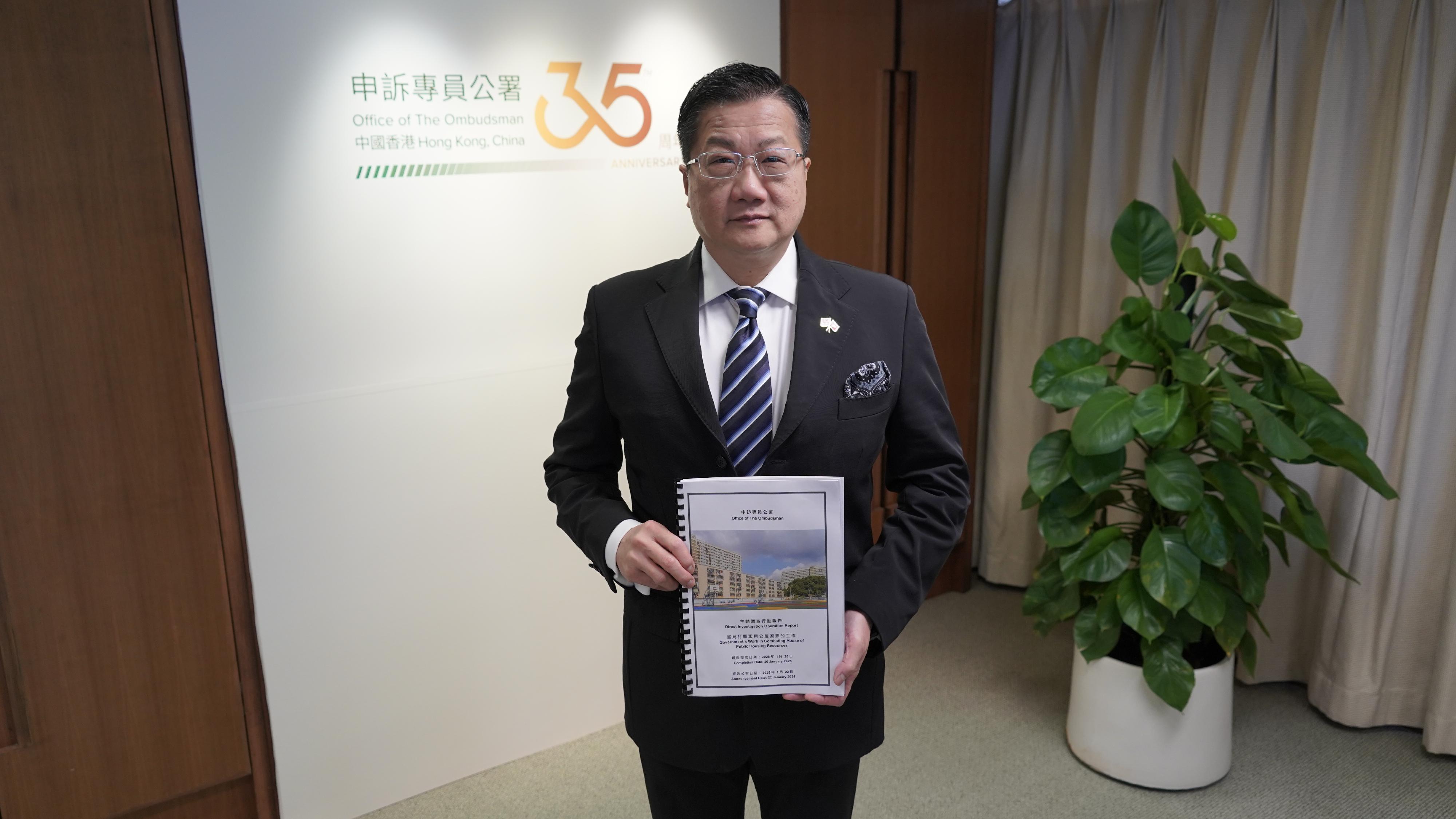
Ombudsman announces results of direct investigation operation into Government’s work in combating abuse of public housing resources (with photos)

The following is issued on behalf of the Office of The Ombudsman:

     The Ombudsman, Mr Jack Chan, today (January 22) announced the completion of a direct investigation operation into the Government’s work in combating the abuse of public housing resources, with 31 major recommendations for improvement made to the Hong Kong Housing Authority (HKHA) and the Hong Kong Housing Society (HKHS).

     The current-term Government has done a lot of work on housing policy. By adopting important strategies of enhancing speed, efficiency, quantity and quality, the Government has endeavoured to increase the supply of public rental housing (PRH) and shorten the waiting time for applicants. These measures have yielded significant results and deserve full recognition. In addition to increasing supply, combating PRH abuse is another key area of the Government’ work. In recent years, various sectors of the community have formed a strong consensus supporting the Government in stepping up efforts to combat PRH abuse and increase penalties. The public unanimously recognises that precious PRH resources should be used rationally and focused on people and families with urgent housing needs.  

     Mr Chan said, “Housing has always been an issue of great concern to the people of Hong Kong. The Office is pleased that the current-term Government has adopted a determined attitude with a range of deepening reform measures to assist members of the public in need of housing to move to PRH and effectively shortening the waiting time, which is a manifestation of its firm commitment to the principle of Improve People’s Livelihood in Pursuit of Happiness. 

     “After the Office initiated the direct investigation operation, the HKHA and the HKHS have taken the initiative to seriously review and implement the enhanced Well-off Tenants Policy. New measures to step up combating PRH abuse are also introduced in succession, such as exploring amendments to the Housing Ordinance for greater deterrent effect, establishing a data matching and verification mechanism with the Land Registry (LR), and launching the Report Public Housing Abuse Award. In respect of the new mechanism established between the HKHA and the LR, the land search fee has been significantly reduced, with the average fee per search dropping significantly from $640 to around $4. The HKHA has compared in batches about 358 000 cases of tenants’ declarations of their residency status and ownership of residential properties in Hong Kong with the information in the LR, with a view to more effectively detecting applicants and tenants who have withheld information on their properties. It precisely demonstrates that on the front of combating abuse and ensuring the rational use of PRH resources, the Office is highly aligned with the Government in both principles and actions, working together to address the urgent needs of those who have waited a long time for PRH, thereby enhancing the public’s sense of happiness and contentment. 

     “Since the current-term Government took office in July 2022, the Housing Department (HD) has recovered more than 7 000 flats on the grounds of abuse or breaches of tenancy terms. The number of recovered flats has already exceeded the total number of flats in a large estate. The results are remarkable and deserve recognition and commendation from the community. I would like to recognise the positive attitude, correct approach and remarkable results of the HKHA and the HKHS in combating PRH abuse. 

     “To go the extra mile, there is still room for improvement on the part of the HKHA and the HKHS to ensure that their administrative work against PRH abuse is more precise, comprehensive and effective. 

     “I believe that most PRH tenants are law-abiding and good citizens; however, the minority of tenants who abuse public housing must not be tolerated by the Government. Having carefully examined the work of the HKHA and the HKHS in combating PRH abuse, the Office has made a number of recommendations, covering the applicable scope by the HKHS for the full implementation of the Well-off Tenants Policy, detection of abuse relating to ‘income and assets declaration’ and ‘occupancy status’, routine home visits, and the feasibility of increasing the deterrent effect with heavier penalties imposed on PRH abuse. The Office is pleased to note that the HKHA and the HKHS have generally accepted our improvement recommendations.”

     The Ombudsman’s major recommendations for improvement to the HKHA and the HKHS include: 
 

  • remind estate management office staff to stringently scrutinise the particulars in the declaration forms submitted by tenants, to be more vigilant in clarifying suspicious or incomplete information, and to be more proactive in obtaining tenants’ relevant information from other government departments or organisations where necessary;
  • review whether there is any duplication of resources or the possibility of revamping the arrangement of routine home visits and other measures against PRH abuse, thereby ensuring that the measures for combating PRH abuse are complementary and more effective as a whole;
  • explore ways to enhance communication with Mainland and Macao authorities and agencies, and establish channels, as far as practicable, for more convenient access to information about tenants’ property ownership on the Mainland or in Macao;
  • consider formulating specific incentive schemes to motivate staff members of property services agents and security services contractors to participate in combating PRH abuse;
  • explore any possibilities for imposing heavier penalties on tenants for non-law-breaching PRH abuse cases, where the HKHA and the HKHS can still impose additional sanctions through administrative measures to achieve greater deterrence;
  • step up the collection and analysis of data relating to the crackdown on PRH abuse to gain a more comprehensive understanding of the actual situation, analyse the effectiveness of work, and adjust relevant strategies and enhancement measures; and
  • consider conducting a land search on all PRH applicants through the data matching and verification mechanism established with the LR before confirming their eligibility for PRH allocation, rigorously screening them for any domestic property ownership in Hong Kong, and randomly selecting cases for in-depth investigation during the waiting period of PRH applicants, to intercept PRH abuse at the source.

     The Ombudsman’s major recommendations for improvement to the HKHA include:
 
  • draw on experience and comprehensively review its strategies and policies to raise the prosecution rate, and explore ways to identify and collect sufficient evidence for prosecution within the limitation of time for prosecution, thereby enhancing deterrent effect and cost efficiency to the extent that tenants who have been abusing PRH will voluntarily surrender their flats.

     The Ombudsman’s major recommendations for improvement to the HKHS include: 
 
  • conduct a renewed study on the full implementation of the Well-off Tenants Policy, seek legal advice and seriously explore ways to cover all tenants of its rental estates under the policy as soon as possible;
  • remind all staff to strictly adhere to the practice of issuing the Notice-to-Quit outright to tenants in serious breach of the tenancy agreement without prior warning, and review the implementation of the new practice in a timely manner;
  • review the existing arrangements for accepting appointments for routine home visits; and
  • consider liaising with the Social Welfare Department to set up a notification mechanism in the same way as the HKHA.

     The full investigation report is available on the website of the Office of The Ombudsman at www.ombudsman.hk for public information.
Photo  Photo  
read more

LCQ1: Supporting employment of youth with special educational needs

     Following is a question by the Dr the Hon Ngan Man-yu and a reply by the Secretary for Labour and Welfare, Mr Chris Sun, in the Legislative Council today (January 22):
 
Question:
 
     It has been reported that many youth with special educational needs (SEN youth) are facing employment difficulties. Regarding supporting the employment of SEN youth, will the Government inform this Council:
 
(1) whether it has compiled statistics on data relating to the employment of SEN youth of various age groups in the past three years, including the employment rates, salary levels, job categories, academic backgrounds and time taken for seeking employment, and analysed the comparison between such data and the corresponding data for youth as a whole during the same period;
 
(2) of the measures in place to support the employment of SEN youth, together with a breakdown of such measures by the government department concerned and stage of life development (i.e.‍ studying, job seeking, early stage of employment and career development); whether it has assessed and reviewed the effectiveness of such measures, including the division of work among different government departments and the relevant collaborations facilitating interfaces; if so, of the details; if not, the reasons for that; and
 
(3) whether it has considered joining hands with enterprises and different sectors of the community to establish a platform supporting the employment of SEN youth, so as to encourage enterprises to create employment and internship positions suitable for SEN youth, thereby enabling them to learn and apply their skills in the actual working environment and lay a solid foundation for their smooth integration into the employment market in the future; if so, of the details; if not, the reasons for that?

Reply:
 
President,
 
     In response to the Dr the Hon Ngan Man-yu’s question, having consulted the Education Bureau (EDB) and the Home and Youth Affairs Bureau (HYAB), our reply is as follows:

(1) The Government does not compile statistics on the numbers of youth with special educational needs (SEN) in employment of different age groups. 

     As regards the numbers of school leavers with SEN, from 2021/22 to 2023/24 school years, the numbers of Secondary Six school leavers with SEN were approximately 3 700, 4 200 and 4 200 respectively. Among them, the number of those being employed by November of the next school year was approximately 200 per year. The majority of the rest continued to study locally. 
 
     From 2021/22 to 2023/24 school years, there were 513, 548 and 572 Secondary Six graduates in special schools respectively. Among them, 14, 25 and 38 were employed in September of the next school year; 175, 152 and 164 pursued further studies (including vocational training); 148, 200 and 213 received vocational rehabilitation or day training services.
 
     Based on the information provided by students from individual post-secondary institutions, from 2021/22 to 2023/24 school years, there were approximately 2 900, 3 600 and 4 200 students with SEN enrolled in the University Grants Committee (UGC)-funded and non-UGC-funded full-time locally-accredited sub-degree and undergraduate programmes respectively.
 
     As regards the numbers of employed youth with disabilities, from 2022 to 2024, the Selective Placement Division (SPD) of the Labour Department (LD) recorded 2 412, 2 406 and 2 300 placements respectively. Among them, 874, 794 and 762 placements involved youth with disabilities aged 29 or below respectively.

(2) As regards support at schools, the EDB requires ordinary secondary schools to assist students with SEN in choosing suitable pathways for further studies and careers through life planning education, and to provide students who will soon graduate and their parents with guidance in further studies and careers. A website is also set up to provide relevant information. The EDB also collaborates with different business corporations through the Business-School Partnership Programme to provide students, including those with SEN, with diversified career exploration activities. 
    
     Special schools design school-based curricula such as community training, workplace practicum and pre-vocational training for students to nurture their independent living skills, and provide additional training such as interviewing skills, vocational skills assessments, social etiquette, work attitude, etc, based on students’ individual abilities.
 
     The HYAB and the Youth Development Commission implement the Funding Scheme for Youth Life Planning Activities to subsidise non-governmental organisations (NGOs) in collaboration with secondary schools, in organising life planning projects such as thematic talks, workplace visits and job attachments. The Scheme gives priority to projects that are designed based on the needs of designated groups of students, for example students with SEN. In school years 2022-25, the HYAB has sponsored 26 NGOs in collaboration with over 400 secondary schools, including 13 special schools and five schools for social development.
 
     As regards post-secondary institutions, the UGC has provided additional funding of $67.5 million through the Special Grant for Enhancing Support for Students with SEN for universities to take forward three key objectives: (i) improving the educational experiences of students with SEN; (ii) enhancing staff training; and (iii) promoting an inclusive campus. They cover activities that help students join the community and develop their careers in the future, as well as to make early preparations for their way forward upon graduation.
 
     With respect to vocational and professional education and training, the Vocational Training Council (VTC) adopts a whole-school approach to assist students with SEN, including providing additional teaching staff to conduct academic guidance, tutorial groups, and individual coaching to enhance their learning skills more effectively.
 
     The Labour and Welfare Bureau (LWB) subsidises the Shine Skills Centres under the VTC to offer vocational training programmes and ancillary services to persons with disabilities (including youth with SEN) aged 15 or above who are assessed as having potential for open employment.
 
     For persons with disabilities who are not able to take up open employment (including youth with SEN), the Social Welfare Department (SWD) subvents NGOs to operate sheltered workshops, integrated vocational rehabilitation services centres, integrated vocational training centres, etc, for providing vocational rehabilitation and training services.
 
     As regards support for job-seeking, the SPD of the LD provides employment services, including employment counselling, job matching and referral, to job seekers with disabilities (including youth with SEN) who are fit for open employment. The SPD also implements the Work Orientation and Placement Scheme, under which eligible employers engaging each job seeker with disabilities is eligible for a maximum allowance of $60,000 during the nine-month subsidy period.
 
     The SWD also subvents NGOs to provide supported employment training. The relevant Funding and Service Agreement states that organisations are required to provide services such as job attachment, job training and counselling, etc.
 
     In addition, the Employees Retraining Board provides around 70 dedicated courses that assist persons with disabilities (including youth with SEN) in entering or re-entering the employment market. Trainees who complete placement-tied courses will be arranged with placement follow-up services for six months.

(3) Since 2013, the LWB has launched the Talent-Wise Employment Charter and Inclusive Organisations Recognition Scheme to encourage organisations of different sectors to adopt measures to promote internship and employment of persons with disabilities. The Chief Executive announced in the 2024 Policy Address the introduction of the Caring Employer medal, commending employers who actively engage persons with disabilities. 

     In addition, the SWD implements the Enhancing Employment of People with Disabilities through Small Enterprise Project (3E Project) that subsidises NGOs to set up small enterprises/businesses, thereby directly creating more employment opportunities for persons with disabilities (including youth with SEN).
 
     The LD will also continue to liaise with employers from different industries to enhance their understanding of the work capabilities of persons with disabilities and the ways to get along with them, as well as to provide suitable job vacancies for persons with disabilities (including youth with SEN). read more

LCQ19: Purchasing private premises by Government for provision of welfare facilities

     Following is a question by the Hon Lee Chun-keung and a written reply by the Secretary for Labour and Welfare, Mr Chris Sun, in the Legislative Council today (January 22):
 
Question:

     Following the announcement in the 2019-2020 Budget of an allocation of $20 billion for the Government to purchase private premises over some three years for the provision of welfare facilities, the Government has openly invited owners of potentially suitable non-domestic premises available for sale to submit sale proposals. In this connection, will the Government inform this Council:

(1) as there are views relaying that after submitting their sale proposals, owners are unable to know whether the proposals submitted are being assessed or have been rejected, whether the Government Property Agency (GPA) will, after owners have submitted their sale proposals, inform them of the process relating to the assessment of the sale proposals, and notify them in a timely manner that they have successfully proceeded to the various stages of assessment; if so, of the details; if not, the reasons for that;

(2) as there are views relaying that the process of assessing the aforesaid sale proposals is lengthy (which usually takes 18 to 36 months), whether the GPA will undertake to set a time limit for processing each sale proposal; and

(3) given that at present, the GPA only provides email address and fax number on its website for owners to submit sale proposals, whether the GPA will provide an inquiry hotline or email address for those who have submitted proposals to enquire about the relevant matters; if so, of the details; if not, the reasons for that?

Reply:

President,

     In June 2020, the Government obtained funding approval from the Finance Committee of the Legislative Council to implement the Purchase of Welfare Premises initiative with the aim of purchasing premises from the private property market for the provision of welfare facilities.

     The Government Property Agency (GPA) is identifying suitable premises for purchase through various channels, including an open invitation for sale proposals from private owners or their agents (the property owners) of their premises (also known as “listings”); directly approaching property owners of target premises; identifying premises through newspaper advertisements, websites of developers/owners or estate agents; and conducting site visits in targeted districts.

     A reply to the various parts of the question raised by the Hon Lee Chun-keung is as follows:

(1) After receiving basic listing information from property owners (i.e. property address, floor area, asking price, and contact information), the GPA will review whether the listings meet the basic requirements specified by the Social Welfare Department (SWD) for different welfare facilities in various districts. The GPA will then forward the listing information to the SWD for consideration. If the SWD determines that the listings are suitable upon preliminary assessment, the GPA will contact the relevant property owners for follow-up actions, which include making enquiries, requesting further information and arranging site inspections. The SWD will conduct a comprehensive assessment on the listed properties, taking into account factors such as the availability of suitable fire safety and barrier-free access facilities, whether the size and location meet operational needs, and the compatibility of nearby land uses with welfare purposes. The GPA will proceed with price negotiations and discuss other terms of purchase with property owners for properties assessed suitable by the SWD. The foregoing process is generally consistent with market practice and the property owners are aware of the stage of negotiation in which their properties are.

     As the Government invites property listings from property owners in its capacity as a purchaser, property owners, after submitting their sale proposals, are free to negotiate the sale of their properties with other potential purchasers simultaneously.

(2) The time required to complete the entire assessment process, negotiations and purchase varies, depending on the specific circumstances of the property listed for sale and other relevant factors. For example, the entire process will take additional time if the property requires removal/improvement works to be carried out to comply with statutory orders issued by the relevant authorities, or if planning permission or lease modifications are needed for the property to be converted for welfare use, or if clarification of the rights and responsibilities for the building’s common areas and facilities is required, etc. To ensure that the purchased property caters for the needs and achieves value for money, it is not suitable to set a processing deadline for each sale proposal.

(3) Property owners may contact the GPA regarding listings and other related matters via email on the GPA’s website at pw-add@gpa.gov.hk. Depending on the nature and complexity of the matters, the GPA will in general provide a reply within 10 calendar days and contact the property owners directly by phone or other means including meeting if needed. read more