Tag Archives: China

image_pdfimage_print

LCQ8: Public bicycle parking spaces

     Following is a question by the Hon Stanley Li and a written reply by the Secretary for Transport and Logistics, Ms Mable Chan, in the Legislative Council today (June 11):

Question:

     Some members of the public are of the view that the Government should take measures to ensure that public bicycle parking spaces in the New Territories are put to good use. In this connection, will the Government inform this Council:

(1) of the total number of public bicycle parking spaces provided by the Government in the New Territories South East (broken down by Legislative Council election geographical constituency) as at the end of last year, as well as the government departments responsible for the management of such parking spaces and the total area occupied by such parking spaces;

(2) as it is stipulated in the existing legislation that no bicycle shall be parked in a parking place for a continuous period of more than 24 ‍hours, of the follow-up mechanism adopted by government departments against bicycles parked overtime at public bicycle parking spaces (including the frequency of follow-up actions and the ways to handle such bicycles); whether the Government has reviewed the existing arrangements for the management of public bicycle parking spaces; if so, of the details; if not, the reasons for that;

(3) of the specific procedures of the inter-departmental joint operations taken by the Government against bicycles which have been parked for a long period of time, or which are unclaimed or abandoned at public bicycle parking spaces (including the government departments involved and the frequency of such operations); the number of such joint operations, the number of bicycles handled and the expenditure incurred for such operations in the past three years; whether it had assessed the effectiveness of such operations, and of the relevant assessment standards;

(4) of the number of complaints received by the Government in the past three years about public bicycle parking spaces in the New Territories South East being occupied for a long period of time or being used for stacking non-cycling articles, as well as the details of the measures taken by the Government in respect of such cases, including the specific division of work and collaborative mechanism among the law enforcement departments involved, and whether it has kept follow-up records in respect of the cityscape and hygiene problems arising from such cases; and

(5) whether the Government has considered using the New Territories South East as a pilot district to provide covered “smart bicycle parking spaces” (e.g. those equipped with anti-theft devices, surveillance devices, electronic locks and sensors, etc) on a monthly or hourly basis under the user pays mode, and making reference to the experience of other regions in the management of smart parking spaces to explore suitable options to enhance the management of public bicycle parking spaces in Hong Kong; if so, of the details; if not, the reasons for that?

Reply:

President,

     It is the Government’s policy to foster a “bicycle-friendly” environment where road safety considerations and circumstances permit by adding cycling tracks and related facilities in new development areas and new towns as well as improving existing facilities (including bicycle parking facilities), with a view to facilitating the public use of bicycles for recreational or short-distance commuting purposes, thereby reducing the use of mechanised transport. In response to the question raised by the Hon Stanley Li, our reply in consultation with the related departments is provided as follows:

(1) As of the end of 2024, the Government is managing and providing about 10 000 public bicycle parking spaces, with a total area of about 11 000 square meters in the Legislative Council New Territories South East geographical constituency. The aforementioned parking spaces are generally managed by the Transport Department (TD), the Housing Department, the Food and Environmental Hygiene Department (FEHD), and the Leisure and Cultural Services Department.

(2) and (3) According to the Road Traffic (Parking) Regulations (Cap. 374C), on public roads with street lighting, bicycles can only be parked at a designated bicycle parking place. Any person who parks a bicycle in a bicycle parking place for a continuous period of more than 24 hours commits an offence and is liable to a fine at level 1 (currently $2,000).

     At present, related departments (including the District Offices under the Home Affairs Department, the District Lands Offices, the TD, the Hong Kong Police Force (HKPF) and the FEHD) conduct joint operations as necessary based on actual circumstances and needs to remove illegally parked or abandoned bicycles. In the past three years (from 2022 to 2024), a total of 331 joint operations were conducted by the related departments, with over 20 000 illegally parked bicycles from public bicycle parking spaces being removed. The increase in the number of joint operations year by year and the slight decrease in the average number of bicycles cleared per operation have reflected the improved enforcement strength and the deterrent effect. The relevant breakdown is as follows:
 

Year Number of joint operations Number of bicycles cleared Average number of bicycles cleared per operation
2022 89 5 969 67
2023 111 7 278 66
2024 131 7 646 58
Total 331 20 893

     The joint operations and enforcement actions are conducted by relevant departments in accordance with established procedures and empowered by relevant legislations. More specifically, the TD and the HKPF will issue and post notices respectively regarding the temporary suspension of the relevant bicycle parking spaces at least 14 days prior to the joint operation. Since such areas are no longer designated public bicycle parking space during the suspension period, any bicycle parked there may be regarded as unauthorised occupation of government land. On the effective day of suspension (generally two days before the joint operation), the HKPF will cover the bicycle parking signage and close off the area. The relevant District Lands Office will post statutory notice on each bicycle still present within the operation area under the Land (Miscellaneous Provisions) Ordinance (Cap. 28) and post notices at appropriate places, requiring the persons concerned to remove the bicycles by a specific date (i.e. the day of operation); otherwise the bicycles will be removed. On the day of joint operation, the FEHD will assist in removing the remaining bicycles parked in the area with notices posted, and hand them over to the local District Lands Office for taking over and disposal; the persons concerned cannot get back the bicycles. The bicycle parking spaces will be re-opened for public use after the operation.

     The expenditures of joint operations are absorbed by the overall resources of the respective departments, and have not been separately identified.

(4) In the past three years, in respect of bicycle parking spaces in the New Territories South East, the Lands Department has received a total of 292 and 1 572 complaints about illegal bicycle parking in Sai Kung District and Sha Tin District respectively; and the FEHD has not received any complaint regarding the public bicycle parking spaces under FEHD’s management being locked or with non-bicycle items piling up. As aforementioned, the Government conducted over 300 joint operations in the past three years; and if the FEHD detects accumulation of refuse in public bicycle parking spaces, immediate cleaning by contractors will be arranged.

(5) The Government has been committed to promoting the development of a smart city and has introduced intelligent technologies in various aspects to enhance service quality and public convenience. With the promotion and co-ordination of the Government, some private development projects have introduced “smart bicycle parking systems”, while some have improved management quality by offering indoor bicycle parking spaces. The Government is studying to include bicycle parking spaces as ancillary facilities within land uses, requiring new development projects to provide sufficient bicycle parking spaces according to their land use and scale. These facilities, like other ancillary facilities, will be managed and maintained by the land developer or the responsible party to improve the facilities’ overall quality and further foster a “bicycle-friendly” environment. Regarding public bicycle parking spaces, given the relatively high construction and maintenance costs of “smart bicycle parking systems”, the Government will utilise facilities that are designed to be more effective and user-friendly, such as double-deck parking racks, and will give priority to allocating resources for more pressing transport infrastructure projects for now. Meanwhile, we will continue to keep in view the technological development of “smart bicycle parking systems”, and assess their applicability in Hong Kong’s public bicycle parking spaces in a timely manner. read more
LCQ7: Draining pipe testing with dye powder

     Following is a question by the Hon Steven Ho and a written reply by the Secretary for Environment and Ecology, Mr Tse Chin-wan, in the Legislative Council today (June 11):
 
Question:
 
     It has been reported that on February 15 this year, the water of Tuen Mun River turned red extensively, causing panic among members of the public. The Government’s initial investigation revealed that there was draining pipe testing with red dye powder. Upon arrival of the Government’s investigating officers at the scene, they found that the river water had resumed normal and no fish deaths were found. They collected water samples on the same day for testing and found that the water quality indicators remained normal as well. However, it is learnt that similar incidents also occurred on Lam Tsuen River in Tai Po and Shing Mun River in Tai Wai in August 2023 and November 2022 respectively, which have aroused widespread concern in the community. In this connection, will the Government inform this Council:
 
(1) of the number of the aforesaid similar incidents in the past five years, as well as the government department(s) involved in the investigation of each incident, the average manpower involved, the time taken for the investigations and the public expenditure involved;
 
(2) as there are views that although the test results have indicated that the aforesaid incident has not caused impact on the environment, water quality and fish for the time being, the incident has still caused panic among members of the public, whether the Government will take further actions to follow up the incident, so as to enhance protection for the public; and
 
(3) whether the Government has formulated detailed guidelines on draining pipe testing with dye powder at present; if so, of the details, including whether non-compliance with the relevant guidelines will constitute any offence or attract penalty; if not, whether it will consider formulating the guidelines and enhancing the relevant notification mechanism, so as to avoid causing misunderstanding or panic among members of the public in the event of an incident?
 
Reply:
 
President,
     
     The reply to the question raised by the Hon Steven Ho is as follows:
 
(1) and (2) In the past five years, the Environmental Protection Department (EPD) received a total of 21 cases of inquiries related to dye test. Upon receiving relevant complaints, the EPD will promptly dispatch personnel to conduct investigation on site, including measuring the dissolved oxygen content and pH level in the water, as well as collecting water samples for further testing to determine the cause of water coloration and whether pollution has occurred. The EPD will also check in the vicinity of the site concerned for any fish deaths or other unusual circumstances, and trace the source of pollution along the stormwater drains. Depending on individual circumstances, the Drainage Services Department (DSD) may also assist in the tracing investigation. If illegal discharges of wastewater are found, the EPD will take appropriate enforcement actions in accordance with the law. The investigation of water coloration incidents is part of the EPD’s integrated enforcement efforts and the duration of investigation may also vary depending on the location and scope of individual case. Therefore, there is no breakdown of the expenditure involved.
 
     To foster protection to the general public, the EPD will respond to inquiries from complainants and the media as soon as there are preliminary results of the investigation, in order to enhance information transparency and alleviate public concerns. Depending on individual circumstances, the EPD may also return to the site the day after collecting water samples to inspect whether there have been any changes and to further follow-up as required.
 
(3) Conducting dye tests is an effective method to check the sewer systems for misconnections to stormwater drains or leakage. When the EPD personnel conduct tests to examine sewer misconnection issues, they will use the minimum amount of dye possible to reduce the impact on nearby rivers and bays.
 
     For the trades and private buildings, as well as housing estates, the EPD, the Buildings Department (BD), and the Food and Environmental Hygiene Department (FEHD) have developed relevant guidelines for dye tests for pipe testing respectively (which can be downloaded from the websites of the EPD, the BD and the FEHD). Through promotion and education, we also remind the trades, including property management companies and building contractors, about the precautions and pollution prevention measures associated with dye tests. These include strictly adhering to the recommendations of the dye manufacturers during testing, arranging for personnel supervision, and notifying the property management company of the testing site and nearby residents in advance to avoid giving rise to public concerns. The above guidelines are administrative measures. However, we must emphasise that the dye used is a biodegradable and non-toxic substance, and does not affect water quality. In this regard, conducting dye test does not violate the Water Pollution Control Ordinance (Cap. 358).
 
     Regarding the notification mechanism, we understand that dye test may lead to public misunderstanding. Therefore, the DSD will issue notifications on its website before conducting regular dye tests to inform the public about the arrangements for these dye tests. The purpose of these regular tests is to ensure the integrity of the submarine outfalls of sewage treatment plants. Since conducting dye tests on submarine outfalls requires a larger amount of dye and involves a wider area, it is more likely to attract public attention.
      
     Based on the complaint and specific circumstances of the case, the EPD occasionally needs to use dye tests to check on sewage misconnection issues or carry out enforcement actions. Yet these circumstances would involve a smaller amount of dye used and a smaller impact area which in general would not cause any impact. read more

LCQ10: Facilitation measures for cross-boundary goods vehicles

     Following is a question by the Hon Yim Kong and a written reply by the Secretary for Transport and Logistics, Ms Mable Chan, in the Legislative Council today (June 11):

Question:

     It has been reported that the Government will announce the details of Southbound Travel for Guangdong Vehicles within this year, and only non-commercial small passenger vehicles will be allowed to apply under the first phase of implementation. Some members of the logistics and transport industries expect the Government to make good use of the Hong Kong-Zhuhai-Macao Bridge and take the opportunity of implementing Southbound Travel for Guangdong Vehicles to enhance the relevant policy on Guangdong/Hong Kong cross-boundary Mainland goods vehicles, so as to further consolidate Hong Kong’s role as the prominent hub for the Guangdong-Hong Kong-Macao Greater Bay Area, and to drive the development of the Hong Kong International Airport (the airport), container terminals, and the entire logistics industry. In this connection, will the Government inform this Council:

(1) whether the Government will, in the course of formulating the policy on Southbound Travel for Guangdong Vehicles, discuss with the Mainland authorities the enhancement of the relevant policy on cross-boundary Mainland goods vehicles (including the quota system coordinated by the governments of Guangdong and Hong Kong), so as to facilitate cross-boundary goods vehicles in travelling between the Mainland and Hong Kong; if so, of the details, including the expected time of announcing the relevant policy;

(2) whether the Government will enhance the application process for southbound cross-boundary Mainland goods vehicles or introduce new measures, e.g. making reference to the existing system of “closed road permits” while streamlining the application process therein, such that a certain number of Mainland goods vehicles will be allowed to reach designated major cargo hubs in Hong Kong (including the cargo terminals of the airport and container terminals) directly via designated routes; and

(3) whether the Government will make reference to the experience of other places (e.g. the “Green Card system” (a kind of cross-border motor insurance card system) in Europe) and promote a mutual recognition mechanism for motor insurance among Guangdong, Hong Kong and Macao, so as to achieve “one insurance policy for all”?

Reply:

President,

     The Transport and Logistics Bureau (TLB) attaches great importance to the development of modern logistics, and is committed to developing Hong Kong into an international smart logistics hub. To this end, the Government promulgated the Action Plan on Modern Logistics Development in 2023, which proposed to enhance Hong Kong’s role as the gateway and key transshipment hub for cargoes to and from the Greater Bay Area (GBA) by improving multimodal transport. In particular, cross-boundary land freight transport is a major mode of freight transport between Hong Kong and other cities in the GBA, as well as an important component of the “rail-sea-land-river” intermodal transport system between Hong Kong and the Mainland. On the other hand, cross-boundary goods vehicles are also a major means for transporting daily supplies and are of crucial importance to the livelihood of Hong Kong people. Hence, the TLB has always placed strong emphasis on improving cross-boundary land freight transport arrangements. In handling matters related to cross-boundary goods vehicles, the TLB always adheres to the policy principle of “maintaining capacity and stability” and takes into account the views of different stakeholders, so as to ensure smooth operation and adequate capacity of cross-boundary land freight transport, thereby providing staunch support for strengthening and enhancing Hong Kong’s status as an international maritime centre, international aviation hub and international logistics hub.

     Having consulted the Financial Services and the Treasury Bureau, and the Transport Department (TD), our reply to various parts of the Hon Yim’s question is as follows:

(1) and (2) Cross-boundary goods vehicles are subject to the regulation of the quota system which is agreed and jointly administered by the governments of Guangdong and Hong Kong. If the Mainland goods vehicles need to apply for Hong Kong permit/licence, holders of the Mainland goods vehicle quotas must first apply to the relevant Mainland authority for the Mainland Approval Notice (commonly known as MAN) for their goods vehicles. The quota holders should also apply to the TD for vehicle approval and vehicle examination for their goods vehicles; upon passing the vehicle examination, they could proceed with vehicle registration and licensing as well as apply for Closed Road Permit (CRP). The TD would issue CRPs according to the approved boundary crossing(s) recorded on the MAN so that cross-boundary goods vehicles concerned could ply between Guangdong and Hong Kong via the designated boundary crossing(s). Besides, drivers from the Mainland driving the goods vehicles concerned should hold a full Hong Kong driving licence for the corresponding vehicle class(es) (such as light, medium or heavy goods vehicles). From 2022 to April 2025, the number of cross-boundary goods vehicles with valid CRPs maintained at about 10 000, among which goods vehicles from the Mainland have increased.

     Guangdong and Hong Kong have been maintaining close liaison, and will review and enhance relevant facilitation measures for cross-boundary goods vehicles as appropriate subject to the development of freight logistics, local traffic capacity and trade’s responses in both places. Guangdong and Hong Kong also keep reviewing the number of quotas for cross-boundary goods vehicles from time to time. If the Mainland authorities seek to increase the quotas, Hong Kong will expedite the vetting with enhanced efficiency. Besides, the TD has enhanced the arrangement of vehicle approval for cross-boundary goods vehicles with a view to completing the relevant process with enhanced speed. In general, if all the documents required are in order and accurate, the time needed for completion of vehicle approval, examination, registration and licensing, as well as CRP application has been greatly shortened to as fast as three to four weeks.

(3) The Insurance Authority has been in discussion with relevant authorities and the insurance industry on the insurance arrangement for cross-boundary vehicles, with a view to providing facilitation and appropriate insurance products. Take Northbound Travel for Hong Kong Vehicles as an example, the Government has at the same time implemented the “unilateral recognition” arrangement for cross-boundary motor insurance, which allows Hong Kong private cars driving into Guangdong via the Hong Kong-Zhuhai-Macao Bridge to extend the coverage of their third-party liability insurance purchased from Hong Kong insurers to the Mainland, thereby eliminating the need for separate policies in both places and facilitating travel between Guangdong and Hong Kong. The Government will continue to monitor the development of the cross-boundary freight and logistics industry, and review the relevant measures in a timely manner. read more

Hongkong Post to issue “Intangible Cultural Heritage – Paper Crafting Technique” special stamps (with photos)

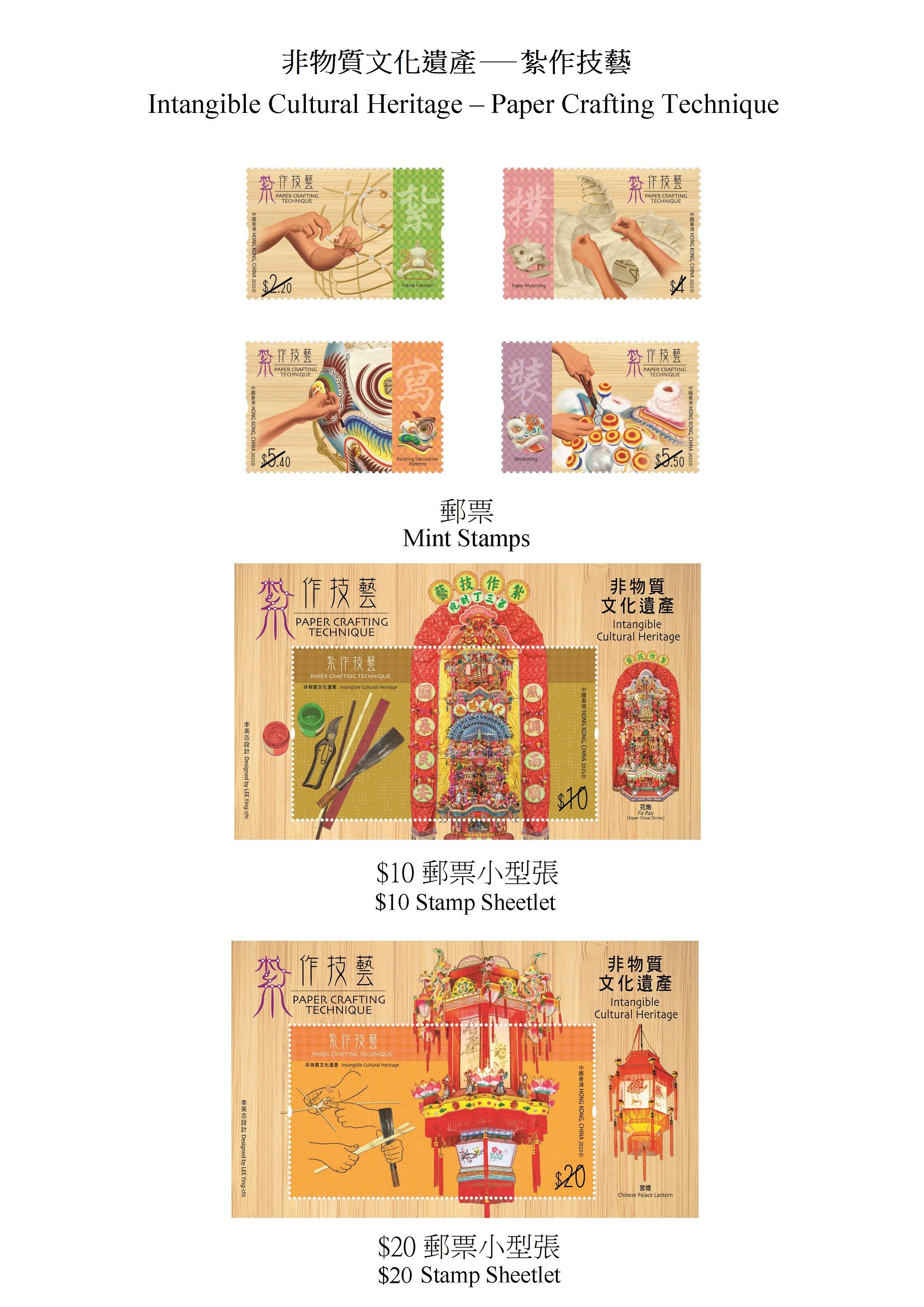
     â€‹Hongkong Post announced today (June 11) that a set of special stamps and associated philatelic products on the theme of “Intangible Cultural Heritage – Paper Crafting Technique” will be released for sale on June 26 (Thursday).
      
     Inscribed onto the first Representative List of the Intangible Cultural Heritage of Hong Kong in 2017, the paper crafting technique is a folk art with a long history. Utilising materials such as bamboo, bamboo splints, iron wires, rice paper strips and fabric, paper craft masters create a variety of products through four major steps, namely frame creation, paper mounting, painting decorative patterns and decorating. These paper craft products are used for folk festivals, as decorations, or as offerings in religious ceremonies.
      
     To promote this intangible cultural heritage of Hong Kong, Hongkong Post will issue a set of four stamps, two stamp sheetlets and associated philatelic products on the theme of “Intangible Cultural Heritage – Paper Crafting Technique” to enhance public knowledge of this traditional craftsmanship.
      
     Official first day covers for “Intangible Cultural Heritage – Paper Crafting Technique” will be on sale at all post offices and Hongkong Post’s online shopping mall ShopThruPost (shopthrupost.hongkongpost.hk) from tomorrow (June 12). This set of special stamps and associated philatelic products will be on sale at all post offices and ShopThruPost from June 26, while serviced first day covers affixed with the special stamps will be available at philatelic offices only.
      
     A hand-back date-stamping service will be provided on June 26 at all post offices for official first day covers/souvenir covers/privately made covers bearing the first day of issue indication and a local address.
      
     Information about this set of special stamps and associated philatelic products is available on the Hongkong Post Stamps website (stamps.hongkongpost.hk).

Photo  Photo  Photo  
read more

LCQ16: Hong Kong Authorized Economic Operator Programme

     Following is a question by the Hon Frankie Yick and a written reply by the the Secretary for Commerce and Economic Development, Mr Algernon Yau, in the Legislative Council today (June 11):

Question:
 
     According to the information of the Customs and Excise Department, since the launch of the Hong Kong Authorized Economic Operator Programme, about 90 enterprises have become Authorized Economic Operators (AEOs), and their goods transported to the 16 economies with which Hong Kong has entered into AEO mutual recognition arrangements (MRAs) can enjoy customs facilitation arrangements, which is instrumental in facilitating seamless cross-boundary movement of goods. However, there are views that the current rate of enterprise participation in the Programme and the coverage of the Programme are not extensive enough. In this connection, will the Government inform this Council:
 
(1) of the volume and value of imported and exported goods involving Hong Kong AEOs in the past three years, as well as their respective percentages in the total volume and value of such goods;
 
(2) as there are views that in order to enhance the efficiency of the import and export of local and Mainland goods, Hong Kong must further extend the coverage of the MRA network, of the progress of the authorities’ entering into MRA agreements with more economies; and
 
(3) as there are views that apart from enabling enterprises to enjoy speedy customs arrangements, being accredited as the AEOs also helps enhance the management standards of enterprises, and the Mainland has even set up training bases to encourage more enterprises to become the AEOs, of the measures put in place by the Government to encourage more local enterprises to become the AEOs?
 
Reply:
 
President,
 
     Having consulted the Customs and Excise Department (C&ED), the reply to the question raised by the Hon Frankie Yick is as follows:
 
     The volume and value of imported and exported goods involving Hong Kong Authorized Economic Operators (AEOs) in the past three years, along with their respective percentages in the total volume and value of imported and exported goods, are shown below:
 

Year Volume of imported and exported goods involving Hong Kong AEOs (consignment) Percentage in Hong Kong’s total volume of imported and exported goods
2022 1.78 million 1.79%
2023 3.14 million 3.11%
2024 3.52 million 4.04%
 
Year Value of imported and exported goods involving Hong Kong AEOs ($) Percentage in Hong Kong’s total value of imported and exported goods
2022 842 billion 8.89%
2023 1,073 billion 12.15%
2024 1,318 billion 13.90%
 
     At present, Hong Kong has ratified AEO mutual recognition arrangements (MRAs) with 16 economies, ranking fourth globally in terms of the number of MRAs after Mainland China, Korea and the United States. The C&ED has been proactively expanding the global network of AEO MRAs with good progress made in recent years. It has signed action plans for AEO MRAs with eight economies including Türkiye, Saudi Arabia, Cambodia, the Philippines, the United Arab Emirates, Laos, Peru and Chile, marking a significant step towards the conclusion of the MRAs by both sides. The C&ED is now actively engaged in discussions and follow-up work with the customs administrations of these economies regarding the MRAs.
 
     Looking ahead, the C&ED will continue its efforts to expand the MRA network by actively liaising with Hong Kong’s major trading partners and dovetailing with the national development strategy on the Belt and Road Initiative. Priority will be given to discussing the MRAs with Belt and Road economies, including member states of the Association of Southeast Asian Nations, the Cooperation Council for the Arab States of the Gulf, and economies in the South American and African regions, with a view to benefitting more enterprises.
 
     To encourage local enterprises to become Hong Kong AEOs, the C&ED has continuously collaborated with the industry, major chambers of commerce and relevant partners to organise different types of publicity and promotional events, including briefing sessions and exhibition booths, to enhance enterprises’ understanding of the Hong Kong AEO Programme. Last year, the C&ED set up exhibition booths and hosted thematic seminars at major events, such as the Belt and Road Summit jointly organised by the Belt and Road Office and the Hong Kong Trade Development Council (HKTDC), as well as the Asian Logistics, Maritime and Aviation Conference organised by the Hong Kong Special Administrative Region Government and the HKTDC, with a view to fostering exchanges with different fields and industries. In addition, the C&ED has been disseminating the latest information on the developments of local and global AEO programmes through its website and social media channels, so as to extend the reach of its publicity and promotional efforts as well as strengthen communication and engagement with stakeholders.
 
     To further enhance the appeal of the Hong Kong AEO Programme, the C&ED has been actively seeking co-operation with various organisations to offer more benefits to the AEOs. For instance, the C&ED collaborates with the Hong Kong Export Credit Insurance Corporation to provide Hong Kong AEOs with free buyers’ credit checks to help them cope with market risks. In addition, the C&ED signed the Memorandum of Understanding (MoU) on Enhancing AEO Co-operation in the Greater Bay Area among Mainland, Hong Kong and Macao Customs under the AEO MRAs with the General Administration of Customs of the People’s Republic of China and the Macao Customs Service in 2023. Through such initiatives as the mutual referral mechanism on AEO applications, enhanced joint publicity and staff training, the MoU deepens the co-operation among the three customs administrations and supports enterprises of the three places to seize development opportunities in the Guangdong-Hong Kong-Macao Greater Bay Area. read more