Tag Archives: China

image_pdfimage_print

Government gazettes compulsory testing notice

     The Government has exercised the power under the Prevention and Control of Disease (Compulsory Testing for Certain Persons) Regulation (Cap. 599J) and published in the Gazette a compulsory testing notice, which requires any person who had been present at the specified premises during the specified period to undergo a COVID-19 nucleic acid test by December 30.

     A spokesman for the Food and Health Bureau (FHB) said today (December 25), “Upon contact tracing by the Centre for Health Protection (CHP), a number of confirmed cases not epidemiologically linked to each other were recently found in certain places within a short period of time. Members of the public who had been to the relevant places might be subject to higher infection risks. The Government has published a compulsory testing notice under Cap. 599J, which requires persons who had been to the specified premises during the specified period to undergo testing immediately.”

     Details are as follows:

     Any person who had been present at Lotus Tower Block 2, Kwun Tong Garden Estate, 297 Ngau Tau Kok Road, Kwun Tong for more than two hours at any time during the period from December 5 to December 25, 2020 (including but not limited to visitors, residents and workers)

     Persons subject to compulsory testing may choose to undergo testing as below:

1. To obtain a deep throat saliva specimen collection pack from any of the 121 post offices, vending machines set up at 20 MTR stations or 47 designated general outpatient clinics (GOPCs) of the Hospital Authority and return the specimen to the designated specimen collection points (see the distribution points and time, and the specimen collection points and time at www.coronavirus.gov.hk/eng/early-testing.html);

2. To self-arrange testing provided by private laboratories recognised by the Department of Health (see the list at www.coronavirus.gov.hk/pdf/List_of_recognised_laboratories_RTPCR.pdf);

3. To attend any community testing centres (see the list at www.communitytest.gov.hk/en/);

4. To visit any mobile specimen collection stations (see the list and target groups (if applicable) at www.coronavirus.gov.hk/eng/early-testing.html) for testing;

5. To undergo testing at any healthcare facilities of the Hospital Authority (including GOPCs and accident and emergency departments) as instructed by a medical professional of the Hospital Authority; or

6. To use a specimen bottle distributed to the above specified premises by the CHP, and return the specimen bottle with the sample collected as per the relevant guidelines.

     “If persons who are subject to compulsory testing have symptoms, they should seek medical attention immediately and undergo testing as instructed by a medical professional. They should not attend the community testing centres.”

     Persons who are subject to testing and opt for testing routes (1) to (5) above must keep the SMS (mobile phone text message) notification containing the result of the test, the Attendance Certificate, the Discharge Note, or the test report for checking by a law enforcement officer when the officer requires the persons to provide information about their undergoing the specified test. Persons who are subject to testing and opt for testing route (6) above must provide personal particulars (including name, identification document number and residential address) when required by a law enforcement officer for checking by the officer with the CHP.  Furthermore, persons who are subject to testing should, as far as reasonably practicable, take appropriate personal disease prevention measures including wearing a mask and maintaining hand hygiene; and unless for the purpose of undergoing the specified test, stay at their place of residence and avoid going out until the test result is ascertained as far as possible.

     If persons who are subject to compulsory testing have previously undergone the above mentioned test between December 21 and December 25, they would be taken to have complied with the requirements set out in the compulsory testing notice.

     Any enquiries on compulsory testing arrangements may be addressed to the hotline at 6275 6901 which operates daily from 9am to 6pm. If persons who are subject to compulsory testing plan to conduct testing at any of the community testing centres, they can check the centre’s appointment status in advance. The hotlines of the community testing centres are at www.communitytest.gov.hk/en/info/.

     The Government will continue to trace possibly infected persons who had been to the relevant premises, and seriously verify whether they had complied with the testing notice. Any person who fails to comply with the testing notice commits an offence and may be fined a fixed penalty of $5,000. The person would also be issued with a compulsory testing order requiring him/her to undergo testing within a specified timeframe. Failure to comply with the order is an offence and the offender would be liable to a fine at level 4 ($25,000) and imprisonment for six months.

     The spokesman said, “The Government urges all individuals who are in doubt about their own health conditions, or individuals with infection risks (such as individuals who visited places with epidemic outbreaks or contacted confirmed cases) to undergo testing promptly for early identification of infected persons. The FHB will publish compulsory testing notices regarding particular groups when necessary taking into account the epidemic development and the testing participation rate.” read more
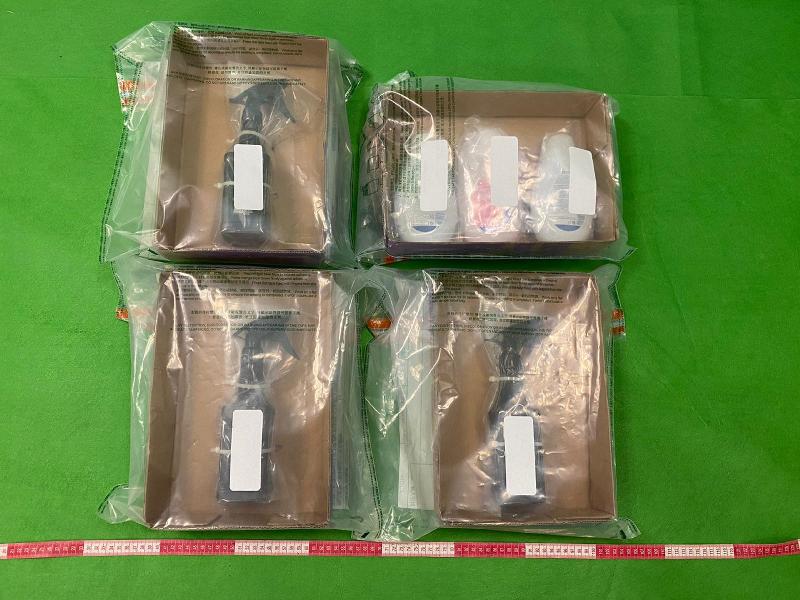
Hong Kong Customs seizes suspected liquid cocaine (with photo)

     â€‹Hong Kong Customs yesterday (December 24) seized about 1.8 kilograms of suspected liquid cocaine with an estimated market value of about $3.2 million at Hong Kong International Airport. 

     A male passenger arrived in Hong Kong from Sao Paulo, Brazil via Amsterdam, the Netherlands yesterday. During Customs clearance, six personal hygiene product bottles containing the batch of suspected liquid cocaine were found inside his check-in suitcase. He was then arrested.

     The arrested man, aged 30, has been charged with one count of trafficking in a dangerous drug. The case will be brought up at Kowloon City Magistrates’ Courts tomorrow (December 26). 

     Amid the Christmas and New Year holidays, there is a possibility that drug syndicates would need to traffic in dangerous drugs urgently in order to meet keen demand during the long holidays. Customs will further step up enforcement action before the long holidays. The department will also continue to apply a risk assessment approach and focus on selecting high-risk passengers for clearance and inspection to combat transnational drug trafficking activities effectively. 

     Under the Dangerous Drugs Ordinance, trafficking in a dangerous drug is a serious offence. The maximum penalty upon conviction is a fine of $5 million and life imprisonment.

     Members of the public may report any suspected drug trafficking activities to Customs’ 24-hour hotline 2545 6182 or its dedicated crime-reporting email account (crimereport@customs.gov.hk).

Photo  
read more

CHP investigates 57 additional confirmed cases of COVID-19

     The Centre for Health Protection (CHP) of the Department of Health (DH) announced that as of 0.00am, December 25, the CHP was investigating 57 additional confirmed cases of coronavirus disease 2019 (COVID-19), taking the number of cases to 8 482 in Hong Kong so far (comprising 8 481 confirmed cases and one probable case).

     Among the newly reported cases announced, two had a travel history during the incubation period.

     A total of 1 133 cases have been recorded in the past 14 days (December 11 to 24), including 1 047 local cases of which 400 are from unknown sources.
 
     The CHP’s epidemiological investigations and relevant contact tracing on the confirmed cases are ongoing. For case details and contact tracing information, please see Annex One or the list of buildings with confirmed cases of COVID-19 in the past 14 days and the latest local situation of COVID-19 available on the website “COVID-19 Thematic Website” (www.coronavirus.gov.hk).
 
     Meanwhile, the CHP reminded those who had visited the specified venues (Annex Two) under the Prevention and Control of Disease (Compulsory Testing for Certain Persons) Regulation (Cap. 599J) to receive COVID-19 nucleic acid test according to the compulsory testing notice. The public are also urged to seek medical attention early if symptoms develop.

     Regarding the severe epidemic situation, the CHP called on members of the public to avoid going out, having social contact and dining out. They should put on a surgical mask and maintain stringent hand hygiene when they need to go out. The CHP strongly urged the elderly to stay home as far as possible and avoid going out. They should consider asking their family and friends to help with everyday tasks such as shopping for basic necessities.
 
     The spokesman said, “Given that the situation of COVID-19 infection remains severe and that there is a continuous increase in the number of cases reported around the world, members of the public are strongly urged to avoid all non-essential travel outside Hong Kong.

     “The CHP also strongly urges the public to maintain at all times strict personal and environmental hygiene, which is key to personal protection against infection and prevention of the spread of the disease in the community. On a personal level, members of the public should wear a surgical mask when having respiratory symptoms, taking public transport or staying in crowded places. They should also perform hand hygiene frequently, especially before touching the mouth, nose or eyes.

     “As for household environmental hygiene, members of the public are advised to maintain drainage pipes properly, regularly pour water into drain outlets (U-traps) and cover all floor drain outlets when they are not in use. After using the toilet, they should put the toilet lid down before flushing to avoid spreading germs.”

     Moreover, the Government has launched the website “COVID-19 Thematic Website” (www.coronavirus.gov.hk) for announcing the latest updates on various news on COVID-19 infection and health advice to help the public understand the latest updates. Members of the public may also gain access to information via the COVID-19 WhatsApp Helpline launched by the Office of the Government Chief Information Officer. Simply by saving 9617 1823 in their phone contacts or clicking the link wa.me/85296171823?text=hi, they will be able to obtain information on COVID-19 as well as the “StayHomeSafe” mobile app and wristband via WhatsApp.

     To prevent pneumonia and respiratory tract infections, members of the public should always maintain good personal and environmental hygiene. They are advised to:

• Wear a surgical mask when taking public transport or staying in crowded places. It is important to wear a mask properly, including performing hand hygiene before wearing and after removing a mask;
• Perform hand hygiene frequently, especially before touching the mouth, nose or eyes, after touching public installations such as handrails or doorknobs, or when hands are contaminated by respiratory secretions after coughing or sneezing;
• Maintain drainage pipes properly and regularly (about once a week) pour about half a litre of water into each drain outlet (U-trap) to ensure environmental hygiene;
• Cover all floor drain outlets when they are not in use;
• After using the toilet, put the toilet lid down before flushing to avoid spreading germs;
• Wash hands with liquid soap and water, and rub for at least 20 seconds. Then rinse with water and dry with a disposable paper towel. If hand washing facilities are not available, or when hands are not visibly soiled, performing hand hygiene with 70 to 80 per cent alcohol-based handrub is an effective alternative;
• Cover your mouth and nose with tissue paper when sneezing or coughing. Dispose of soiled tissues into a lidded rubbish bin, then wash hands thoroughly; and
• When having respiratory symptoms, wear a surgical mask, refrain from work or attending class at school, avoid going to crowded places and seek medical advice promptly. read more

CHP closely monitors human case of avian influenza A(H5N6) in Mainland

     The Centre for Health Protection (CHP) of the Department of Health (DH) is today (December 25) closely monitoring a human case of avian influenza A(H5N6) in the Mainland, and again urged the public to maintain strict personal, food and environmental hygiene both locally and during travel.
 
     The case involved a 54-year-old female living in Yongzhou of Hunan Province, who had exposure to live chicken on December 8. She developed symptoms on December 13 and was admitted for treatment on the same day.

     From 2014 to date, 26 human cases of avian influenza A(H5N6) have been reported by the Mainland health authorities.
 
     “All novel influenza A infections, including H5N6, are notifiable infectious diseases in Hong Kong,” a spokesman for the CHP said.
 
     Travellers to the Mainland or other affected areas must avoid visiting wet markets, live poultry markets or farms. They should be alert to the presence of backyard poultry when visiting relatives and friends. They should also avoid purchasing live or freshly slaughtered poultry, and avoid touching poultry/birds or their droppings. They should strictly observe personal and hand hygiene when visiting any place with live poultry.
 
     Travellers returning from affected areas should consult a doctor promptly if symptoms develop, and inform the doctor of their travel history for prompt diagnosis and treatment of potential diseases. It is essential to tell the doctor if they have seen any live poultry during travel, which may imply possible exposure to contaminated environments. This will enable the doctor to assess the possibility of avian influenza and arrange necessary investigations and appropriate treatment in a timely manner.
 
     While local surveillance, prevention and control measures are in place, the CHP will remain vigilant and work closely with the World Health Organization and relevant health authorities to monitor the latest developments.
 
     The public should maintain strict personal, hand, food and environmental hygiene and take heed of the advice below when handling poultry:
 

  • Avoid touching poultry, birds, animals or their droppings;
  • When buying live chickens, do not touch them and their droppings. Do not blow at their bottoms. Wash eggs with detergent if soiled with faecal matter and cook and consume the eggs immediately. Always wash hands thoroughly with soap and water after handling chickens and eggs;
  • Eggs should be cooked well until the white and yolk become firm. Do not eat raw eggs or dip cooked food into any sauce with raw eggs. Poultry should be cooked thoroughly. If there is pinkish juice running from the cooked poultry or the middle part of its bone is still red, the poultry should be cooked again until fully done;
  • Wash hands frequently, especially before touching the mouth, nose or eyes, before handling food or eating, and after going to the toilet, touching public installations or equipment such as escalator handrails, elevator control panels or door knobs, or when hands are dirtied by respiratory secretions after coughing or sneezing; and
  • Wear a mask if fever or respiratory symptoms develop, when going to a hospital or clinic, or while taking care of patients with fever or respiratory symptoms.

     The public may visit the CHP’s pages for more information: the avian influenza page, the weekly Avian Influenza Reportglobal statistics and affected areas of avian influenza, the Facebook Page and the YouTube Channel. read more