Tag Archives: China

image_pdfimage_print

HAD opens temporary cold shelters

     In view of the cold weather, the Home Affairs Department has opened 18 temporary shelters today (January 8) for people in need of the service.
     
    The temporary shelters will remain open during the daytime tomorrow (January 9) when the cold weather warning is still in force.

    To ensure that cold shelter users can rest in a quiet and undisturbed environment, members of the public or agencies wishing to make donations to shelter users are requested to register with the staff of the shelter first. Donors will then be directed to place the donated items at a specified indoor location. The staff will help notify the shelter users to collect the items on their own.

    Anyone seeking temporary refuge or with any questions about the donation arrangements at the cold shelters may call the department’s hotline 2572 8427 for more information.

    The 18 temporary cold shelters are located at:

Hong Kong Districts:
——————–

Central and Western:
Sai Ying Pun Community Complex Community Hall
3/F, Sai Ying Pun Community Complex, 2 High Street, Sai Ying Pun

Eastern:
Causeway Bay Community Centre
3/F, 7 Fook Yum Road, Causeway Bay

Southern:
Lei Tung Community Hall
Lei Tung Estate, Ap Lei Chau

Wan Chai:
Wan Chai Activities Centre
LG/F, Wan Chai Market, 258 Queen’s Road East, Wan Chai

Kowloon Districts:
——————

Kowloon City:
Hung Hom Community Hall
1/F, Kowloon City Government Offices, 42 Bailey Street, Hung Hom

Kwun Tong:
Lam Tin (West) Estate Community Centre
71 Kai Tin Road, Lam Tin

Sham Shui Po:
Nam Cheong District Community Centre
1 Cheong San Lane, Sham Shui Po

Wong Tai Sin:
Tsz Wan Shan (South) Estate Community Centre
45 Wan Wah Street, Tsz Wan Shan

Yau Tsim Mong:
Henry G Leong Yaumatei Community Centre
60 Public Square Street, Yau Ma Tei

New Territories:
—————-

Islands:
Tung Chung Community Hall
G/F, Tung Chung Municipal Services Building,
39 Man Tung Road, Tung Chung

Kwai Tsing:
Tai Wo Hau Estate Community Centre
15 Tai Wo Hau Road, Kwai Chung

North:
Cheung Wah Community Hall
Cheung Wah Estate, Fanling

Sai Kung:
King Lam Neighbourhood Community Centre
King Lam Estate, Tseung Kwan O

Sha Tin:
Lung Hang Estate Community Centre
Lung Hang Estate, Sha Tin

Tai Po:
Tai Po Community Centre
2 Heung Sze Wui Street, Tai Po

Tsuen Wan:
Lei Muk Shue Community Hall
G/F, Hong Shue House, Lei Muk Shue Estate, Tsuen Wan

Tuen Mun:
Butterfly Bay Community Centre
Butterfly Estate (near Tip Sum House), Tuen Mun

Yuen Long:
Long Ping Community Hall
Long Ping Estate, Yuen Long read more

Speech by CE at Grand Opening Ceremony of Open University of Hong Kong Jockey Club Institute of Healthcare (English only) (with photo/video)

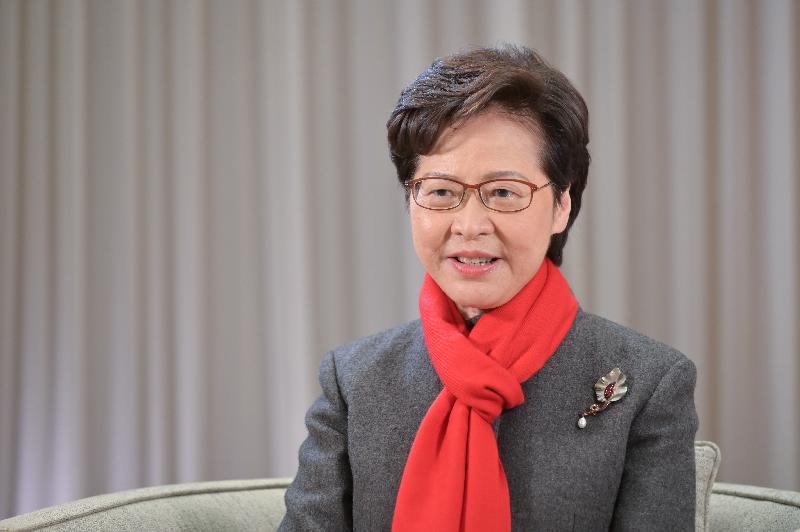
     Following is the video speech by the Chief Executive, Mrs Carrie Lam, at the Grand Opening Ceremony of the Open University of Hong Kong (OUHK) Jockey Club Institute of Healthcare today (January 8):

Mr Philip Chen (Chairman of the Hong Kong Jockey Club), Dr Charles Lee (Pro-Chancellor of OUHK), Mr Michael Wong (Chairman of the Council of OUHK), Dr Conrad Wong (Deputy Chairman of the Council of OUHK), Professor Wong Yuk-shan (President of OUHK), ladies and gentlemen,

     Good afternoon. It gives me great pleasure to join you at the Grand Opening of the Open University of Hong Kong Jockey Club Institute of Healthcare, although because of the COVID-19 epidemic, this joyful event has to take place online.

     COVID-19 is a powerful reminder of the importance of good health to our lives, at both personal, community and global levels. We rely, to an extraordinary degree, on our dedicated health-care professionals to safeguard the health and well-being of the people of Hong Kong and to ensure the daily operations of our society, which we have somehow taken for granted.

     So it is indeed gratifying to welcome the timely opening of the Institute of Healthcare of the Open University of Hong Kong. I applaud the vision of the Open University Council for spearheading this landmark initiative, and I am glad that the Government has provided support, with the granting of an interest-free loan of HK$400 million to the project.  

     The new building we are opening today – effectively the University’s third campus – expands overall space by more than one third. By putting all health-care-related programmes and teaching and learning facilities of the University under one roof, the Institute now presents itself as a central hub for the education and training of the healthcare personnel in Hong Kong.

     The University’s brand-new physiotherapy programme has moved to the Institute. So, too, has the School of Nursing and Health Studies, with its 13 programmes with more than 3 000 full-time and part-time students. Alongside state-of-the-art nursing laboratories, nursing and physiotherapy students at the Open University can count on the latest technology in the Institute, including the largest, most advanced, digital virtual dissection lab in Hong Kong, and the new Clinical Simulation Education Unit, which can create a real-life hospital-ward setting for the training of nursing skills.

     I’m also pleased to note that a new addition, the Child Development Centre, will open early next year in the Institute. The Centre will provide services to students with special educational needs and their families. It will also offer training to students enrolled in early childhood education programmes. 

     Open University has come a long and noteworthy way since its establishment in 1989 as the Open Learning Institute. I’m proud to say that it is growing endlessly to meet the ever-evolving needs of the Hong Kong community. Today, it is our largest self-financing university, offering more than 200 programmes, from sub-degree to postgraduate, for nearly 20 000 full-time and part-time students. It has also produced the largest number of nursing graduates in Hong Kong, accounting for about one-third of all graduates.

     Soon enough, Open University will make a difference in name and substance. Subject to the necessary legislative changes, this three-decade old university will adopt a new name – the Hong Kong Metropolitan University – which in my view, reflects the institution’s character and contribution to our city, and furthermore, to the Guangdong-Hong Kong-Macao Greater Bay Area. Pursuant to agreements signed last April between the Open University of Hong Kong and the Zhaoqing Municipal Government and Zhaoqing University, plans are under way to establish the Open University of Hong Kong (Zhaoqing). I have no reservation in supporting this project to the Ministry of Education and the Guangdong Provincial Government and certainly look forward to its early opening.

     It has always been the Government’s policy to promote the parallel development of publicly funded and self-financing post-secondary education. In particular, we believe that the self-financing sector is well placed to address pressing labour-force needs and flexibly respond to market demands. The Study Subsidy Scheme for Designated Professions/Sectors launched by the Education Bureau is a case in point. Under the scheme, the Government provides an annual subsidy of up to HK$75,000 per student enrolled in designated undergraduate and sub-degree programmes in disciplines with keen demand. At present, a total of 11 sub-degree and 12 undergraduate programmes at Open University are included in the scheme, accounting for about 1 700 places out of the total provision of about 5 500 places under the scheme. Amongst them are five healthcare-related programmes with an enrolment of nearly 800 students. The timely opening of the Institute of Healthcare will definitely benefit these students.

     Just in case the University has more ambitions, I am happy to mention the HK$1.3 billion Enhancement and Start-up Grant Scheme for Self-financing Education launched last year by the Education Bureau. It supports self-financing institutions, including Open University, in their continuing development of self-financing programmes that meet market needs. The scheme helps institutions build on their strengths and niche areas, while lessening the financial burden on students. The Education Bureau, let me add, has just launched a pilot study on the development of applied degree programmes. I encourage Open University and similar institutions to take part, to expand their offerings while serving the needs of Hong Kong.

     Finally, allow me to thank the Hong Kong Jockey Club Charities Trust, and others who have contributed to the development of the Institute of Healthcare. Your generous support will help ensure that healthcare education in Hong Kong remains innovative, welcoming and of the highest quality.

     I wish you all a healthy and prosperous New Year. Thank you.
Photo  
read more

HKSAR Government and SASAC jointly organise Belt and Road high-level roundtable (with photos)

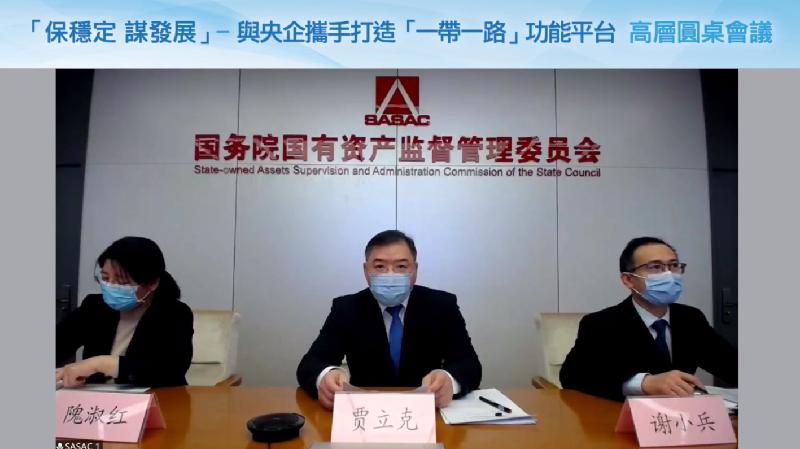
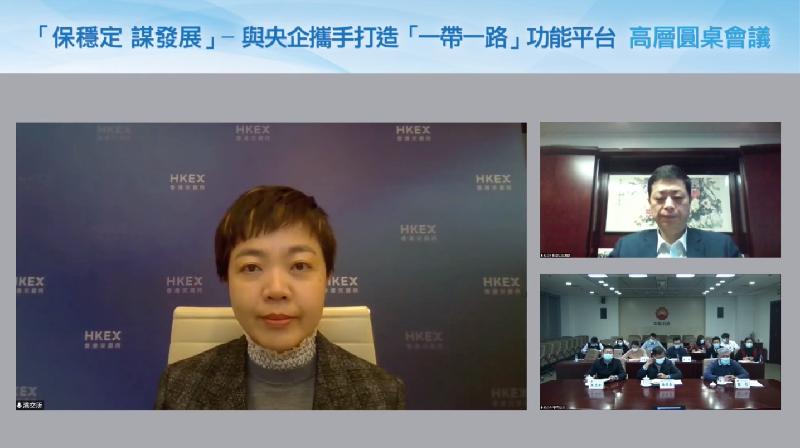
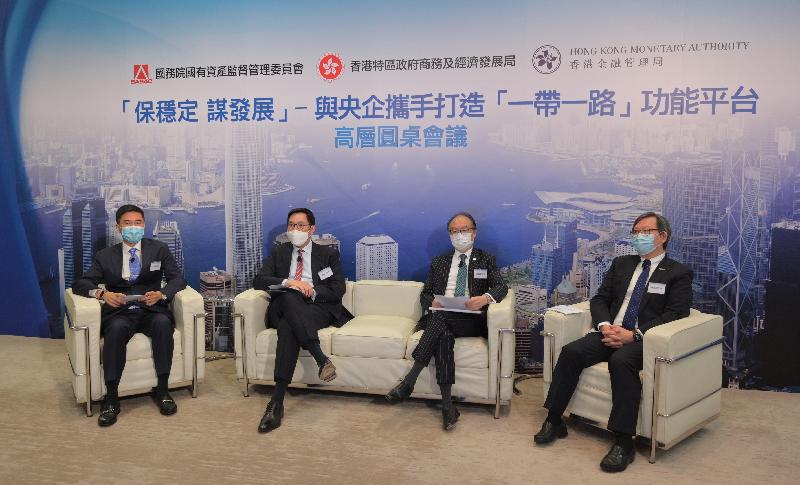
     The Commerce and Economic Development Bureau (CEDB), the State-owned Assets Supervision and Administration Commission of the State Council (SASAC) and the Hong Kong Monetary Authority (HKMA) jointly organised a high-level roundtable on “Fostering Hong Kong as Belt and Road Functional Platform together with State-owned Enterprises” today (January 8). The roundtable in an online format was joined by more than 100 representatives from 25 state-owned enterprises (SoEs), with close to 100 relevant enterprises or members from more than 10 professional services bodies and institutions in Hong Kong viewing it online.

     The roundtable sought to promote exchanges and co-operation between SoEs and Hong Kong’s business and professional services sector (including investment and financing) to leverage Hong Kong’s strengths and bring about complimentary advantages. With that, it was hoped that the competitiveness and the standard of participation under the Belt and Road Initiative could be raised for both sides, thereby bringing forth high-standard and sustainable development and enhancing integration into the overall development of the country.

     The Director-General of the Bureau of Property Right Management of the SASAC, Mr Jia Like, and the Secretary for Commerce and Economic Development, Mr Edward Yau, addressed the audience at the roundtable. The Chief Executive of the Hong Kong Monetary Authority, Mr Eddie Yue, and the Managing Director, Deputy Head of Market Development and Head of Global Issuer Services of the Hong Kong Exchanges and Clearing Limited, Ms Christina Bao, outlined the current status and prospects of Hong Kong as an international financial centre and shed light on how SoEs can utilise Hong Kong’s capital market to drive development, respectively.

     Mr Yau said at the roundtable that Hong Kong, as a comprehensive functional platform for the Belt and Road Initiative, is best placed to support SoEs in their Belt and Road projects by making the most of the city’s strengths. Hong Kong’s soft power on the financial, legal, management and other fronts could go hand-in-hand with the tangible strengths of SoEs. The country is fostering a development pattern with the domestic circulation serving as the mainstay, and with the domestic and international circulations mutually reinforcing each other. With this backdrop, enterprises were bound to attach more importance to internal system reforms, strategic restructuring and professional consolidation. They would also strengthen collaborative innovation to boost the quality and efficiency of their properties and projects, which would help enhance their core competitiveness in a comprehensive manner and expand the room for high-standard development. As the prime functional platform for the Belt and Road Initiative, Hong Kong could support SoEs in such areas as investment and financing, logistics as well as commerce and trade, etc, by capitalising on the city’s extensive international networks, and strengths in the professional services and application of innovation and technology. They would be supported to optimise their modern corporate system and management models to better respond to risks and grasp the opportunities ahead with enhanced competitiveness.

     Citing that the epidemic had led to a new landscape in the international economic and trade arena as well as a “new normalcy” in the community, Mr Yau emphasised that cohesion and co-operation of the international community, including the Belt and Road-related countries and region was important to controlling the epidemic and relaunching the economy. Collaboration among SoEs, Hong Kong’s businesses and its professional services sector would provide greater strengths in contributing to the Belt and Road Initiative and create opportunities for advancing development. He urged enterprises of both places and Hong Kong’s professional services sector to join hands to overcome the challenges and seize the new opportunities brought by the epidemic. They are also called upon to actively explore the growing Mainland market under the new landscape and the “new normalcy” with modern, professional and innovative vision, promote Belt and Road collaboration and orderly economic recovery as well as identify new growth areas of sustainable development.

     The Commissioner for Belt and Road, Mr Denis Yip, moderated a discussion session at the roundtable, which was joined by the Chairman of the Financial Services Development Council, Mr Laurence Li; the Immediate Past President of the Hong Kong Institute of Certified Public Accountants, Mr Johnson Kong; and the Chairman of the Hong Kong Productivity Council, Mr Willy Lin. They discussed how SoEs could promote the sustainable development of Belt and Road projects with Hong Kong’s professional services sector. They also shared Hong Kong’s experiences and relevant international principles in strengthening modern corporate governance by engaging professional services. The session also included a discussion on smart production and innovative technology as a means of raising resilience and competitiveness to pave the way for continuous development in post-epidemic times.

     The SASAC has all along rendered strong support to the Hong Kong Special Administrative Region on its Belt and Road related work, including co-organising various sharing sessions of different themes in conjunction with the Belt and Road Office of the CEDB since 2018, with a view to building interactive exchange platforms for Hong Kong’s businesses and professional services sector, as well as for SoEs and other Mainland enterprises.

Photo  Photo  Photo  Photo  Photo  
read more