Tag Archives: China

22 landlords of subdivided units under regulated tenancies convicted of contravening relevant statutory requirements

     Twenty-two landlords of subdivided units (SDUs), who contravened Part IVA of the Landlord and Tenant (Consolidation) Ordinance (Cap. 7) (the Ordinance), pleaded guilty and were fined a total of $42,000 today (February 7) at the Eastern Magistrates’ Courts. Since the Ordinance came into force, the Rating and Valuation Department (RVD) has successfully prosecuted 552 cases involving a total of 473 SDU landlords, with fines ranging from $400 to $34,800, amounting to a total of $1,307,010.
 
     The offences of these 22 landlords include (1) failing to submit a Notice of Tenancy (Form AR2) to the Commissioner of Rating and Valuation within 60 days after the term of the regulated tenancy commenced; (2) failing to produce copies of the bills and provide an account in writing when requiring the tenant to pay for the reimbursement of the apportioned water and/or electricity charges; (3) failing to provide the tenant with a rent receipt; and (4) requesting the tenant to pay money other than the types permitted under the Ordinance (including requiring the tenant to pay an amount of rent for the second-term tenancy exceeding the maximum amount of rent permitted under the Ordinance). Two joint landlords each committed five offences under (4) and were each fined $4,500.

     The RVD earlier discovered that the landlords failed to comply with the relevant requirements under the Ordinance. Upon an in-depth investigation and evidence collection, the RVD prosecuted against the landlords.
 
     A spokesman for the RVD reiterated that SDU landlords must comply with the relevant requirements under the Ordinance, including prohibiting landlords from doing any act calculated to interfere with the peace or comfort of members of the tenant’s household, with the intention of causing the tenant to give up occupation of the SDU; or requiring the tenant to pay an amount of rent for the second-term tenancy exceeding the maximum amount of rent permitted under the Ordinance, and also reminded SDU tenants of their rights under the Ordinance, including a four-year (i.e. two years plus two years) security of tenure. He also stressed that the RVD will continue to take resolute enforcement action against any contraventions of the Ordinance. Apart from following up on reported cases, the RVD has been adopting a multipronged approach to proactively identify, investigate and follow up on cases concerning landlords who are suspected of contravening the Ordinance. In particular, the RVD has been requiring landlords of regulated tenancies to provide information and reference documents of their tenancies for checking whether the landlords concerned have complied with the requirements of the Ordinance. If a landlord, without reasonable excuse, refuses to provide the relevant information or neglects the RVD’s request, the landlord commits an offence and is liable to a maximum fine at level 3 ($10,000) and to imprisonment for three months. Depending on the actual circumstances, and having regard to the information and evidence collected, the RVD will take appropriate actions on individual cases, including instigating prosecution against suspected contraventions of the Ordinance.
 
     To help curb illegal acts as soon as possible, members of the public should report to the RVD promptly any suspected cases of contravening the relevant requirements. Reporting can be made through the telephone hotline (2150 8303), by email (enquiries@rvd.gov.hk), by fax (2116 4920), by post (15/F, Cheung Sha Wan Government Offices, 303 Cheung Sha Wan Road, Kowloon), or in person (visiting the Tenancy Services Section office of the RVD at Room 3816-22, 38/F, Immigration Tower, 7 Gloucester Road, Wan Chai, Hong Kong, and please call 2150 8303 to make an appointment). Furthermore, the RVD has provided a form (Form AR4) (www.rvd.gov.hk/doc/en/forms/ar4.pdf) on its website to facilitate SDU tenants’ reporting to the RVD.
 
     The RVD reminds that pursuant to the Ordinance, a regulated cycle of regulated tenancies is to comprise two consecutive regulated tenancies (i.e. the first-term tenancy and second-term tenancy) for an SDU, and the term of each regulated tenancy is two years. A tenant of a first-term tenancy for an SDU is entitled to be granted a second-term tenancy of the regulated cycle, thus enjoying a total of four years of security of tenure. Since the first batch of regulated tenancies has already approached their second-term tenancies, the RVD has started a new round of publicity and education work in order to assist SDU landlords and tenants to understand the important matters pertaining to the second-term tenancy, and procedures that need to be followed about two months prior to the commencement of the purported second-term tenancy. In addition, the RVD has started issuing letters enclosing relevant information to the landlords and tenants concerned of regulated tenancies in batches, according to the expiry time of their first-term tenancies, to remind them about their respective obligations and rights under the Ordinance. These landlords and tenants may also visit the dedicated page for the second-term tenancy on the RVD’s website (www.rvd.gov.hk/en/tenancy_matters/second_term_tenancy.html) for the relevant information, including a concise guide, brochures, tutorial videos and frequently asked questions. SDU landlords and tenants are also advised to familiarise themselves with the relevant statutory requirements and maintain close communication regarding the second-term tenancy for handling the matters properly and in a timely manner according to the Ordinance.
 
     For enquiries related to regulated tenancies, please call the telephone hotline (2150 8303) or visit the RVD’s webpage (www.rvd.gov.hk/en/our_services/part_iva.html) for the relevant information. read more
CHP reminds public on precautions against cold weather

     The Centre for Health Protection (CHP) of the Department of Health (DH) today (February 7) reminded the public, particularly the elderly and people with chronic illnesses, to adopt appropriate measures to protect their health in view of the cold weather.

    A spokesman for the CHP said that cold weather can easily trigger or exacerbate diseases, especially among the elderly and persons suffering from heart disease, respiratory illnesses or other chronic illnesses.

     “Elderly people have less insulating fat beneath their skin to keep them warm, and their body temperature control mechanisms may be weaker. Their body may not be able to appropriately respond to thecold weather,” the spokesman said.

     Some senior persons may have decreased mobility, which can impair their ability to generate and conserve body heat. Chronic illnesses, such as hypertension, diabetes and endocrine disorders, may undermine the health of elderly people and lower their metabolic rate, subsequently causing their body to generate less heat. Persons with chronic illnesses, such as chronic respiratory illnesses or heart disease, are vulnerable to disease aggravation due to cold weather.

     The CHP reminded the public, in particular the elderly and persons with chronic illnesses, to adopt the following preventive measures:
 

  • Take note of the weather forecast. Wear warm clothing, including hats, scarves, gloves and socks, accordingly;
  • Consume sufficient food to ensure adequate calorie intake;
  • Perform regular exercise to facilitate blood circulation and heat production;
  • Stay in a warm environment and avoid prolonged outdoor exposure;
  • Use heaters with care and maintain adequate indoor ventilation; and
  • Seek medical advice if feeling unwell.
     
     â€‹In addition, the public should avoid alcoholic beverages.
     
     “Drinking alcohol cannot keep you warm. Alcohol accelerates the loss of body heat through dilated blood vessels, resulting in chilling instead,” the spokesman said.

     “Parents should ensure that babies are sufficiently warm, but it is also important to keep babies relatively lightly clothed to avoid overheating them,” the spokesman added.

     Parents should observe the following safety measures when putting their children to bed:  
  • Keep the room well ventilated and at a comfortable temperature;
  • Always place babies on their backs to sleep. Leave their heads, faces and arms uncovered during sleep;
  • Babies do not need pillows. Place babies on a firm and well-fitted mattress to sleep. Avoid soft objects, pillows and loose bedding;
  • Let babies sleep in a cot placed near their parents’ bed; and
  • Maintain a smoke-free environment.
 
     In addition, many respiratory pathogens, including influenza and SARS-CoV-2, may have increasing activity and community transmission during winter. Seasonal influenza vaccination is recommended for all persons aged 6 months or above, except those with known contraindications. Persons at higher risk of getting influenza and its complications, including the elderly and children, should receive seasonal influenza vaccinations early. Please see details of the vaccination schemes on the CHP’s website.
      
     A person who gets influenza and COVID-19 at the same time may be more seriously ill and would have a higher risk of death. It is important for elderly persons, especially those residing in residential care homes, to receive both a seasonal influenza vaccination and a COVID-19 vaccination. They should also receive an additional booster against COVID-19 according to recommendations as soon as possible. The public should also maintain good personal and environmental hygiene against respiratory illnesses and note the following:
 
  • Surgical masks can prevent transmission of respiratory viruses from ill persons. It is essential for persons who are symptomatic (even if having mild symptoms) to wear a surgical mask;
  • Wear a surgical mask when taking public transport or staying in crowded places. It is important to wear a mask properly, including performing hand hygiene before wearing and after removing a mask;
  • Avoid touching one’s eyes, mouth and nose;
  • Wash hands with liquid soap and water properly whenever possibly contaminated;
  • When hands are not visibly soiled, clean them with 70 to 80 per cent alcohol-based handrub;
  • Cover the mouth and nose with tissue paper when sneezing or coughing. Dispose of soiled tissue paper properly into a lidded rubbish bin and wash hands thoroughly afterwards;
  • Maintain good indoor ventilation;
  • When having respiratory symptoms, wear a surgical mask, refrain from work or attending classes at school, avoid going to crowded places and seek medical advice promptly; and
  • Maintain a balanced diet, exercise regularly, take adequate rest, do not smoke and avoid overstress.
    
     Food-borne diseases, particularly those linked to hotpot cuisine, are also common in cold weather. The following preventive measures should be taken:
 
  • Wash hands before handling and consuming food;
  • Do not patronise unlicensed vendors or those with poor hygienic standards while selecting food;
  • Wash and cook all food thoroughly;
  • Vegetables should be washed thoroughly in clean running water before cooking and consumption. When appropriate, scrub vegetables with hard surfaces with a clean brush to remove dirt and substances, including pesticide residues and contaminants, from surfaces and crevices;
  • Shrimps should be fully cooked until the shells turn red and the flesh turns white and opaque;
  • For shellfish such as scallops and geoduck, scrub the shells thoroughly and remove internal organs;
  • Do not eat any undercooked freshwater aquatic products. To ensure that the food is thoroughly cooked, the centre of the food should reach a temperature of at least 75 degrees Celsius so as to destroy pathogen;
  • Most hotpot ingredients should be stored in a refrigerator at 4 degrees C or below, while frozen food should be stored in a freezer at -18 degrees C or below;
  • Never use raw eggs as a dipping sauce for hotpot; and
  • Use different sets of chopsticks to handle raw and cooked food to avoid cross-contamination.
    
     â€‹In addition, when using fuel-burning appliances, especially in indoor areas, the public should ensure adequate ventilation to avoid harmful exposure to carbon monoxide (CO) and prevent CO poisoning.
     
     For more health information, the public may call the DH’s Health Education Infoline (2833 0111) or visit the CHP’s website and Facebook Fanpage.

     The public may also call Dial-a-Weather (1878 200) or visit the website of the Hong Kong Observatory for the latest weather information and forecasts, or its page on Weather Information for Senior Citizens. read more

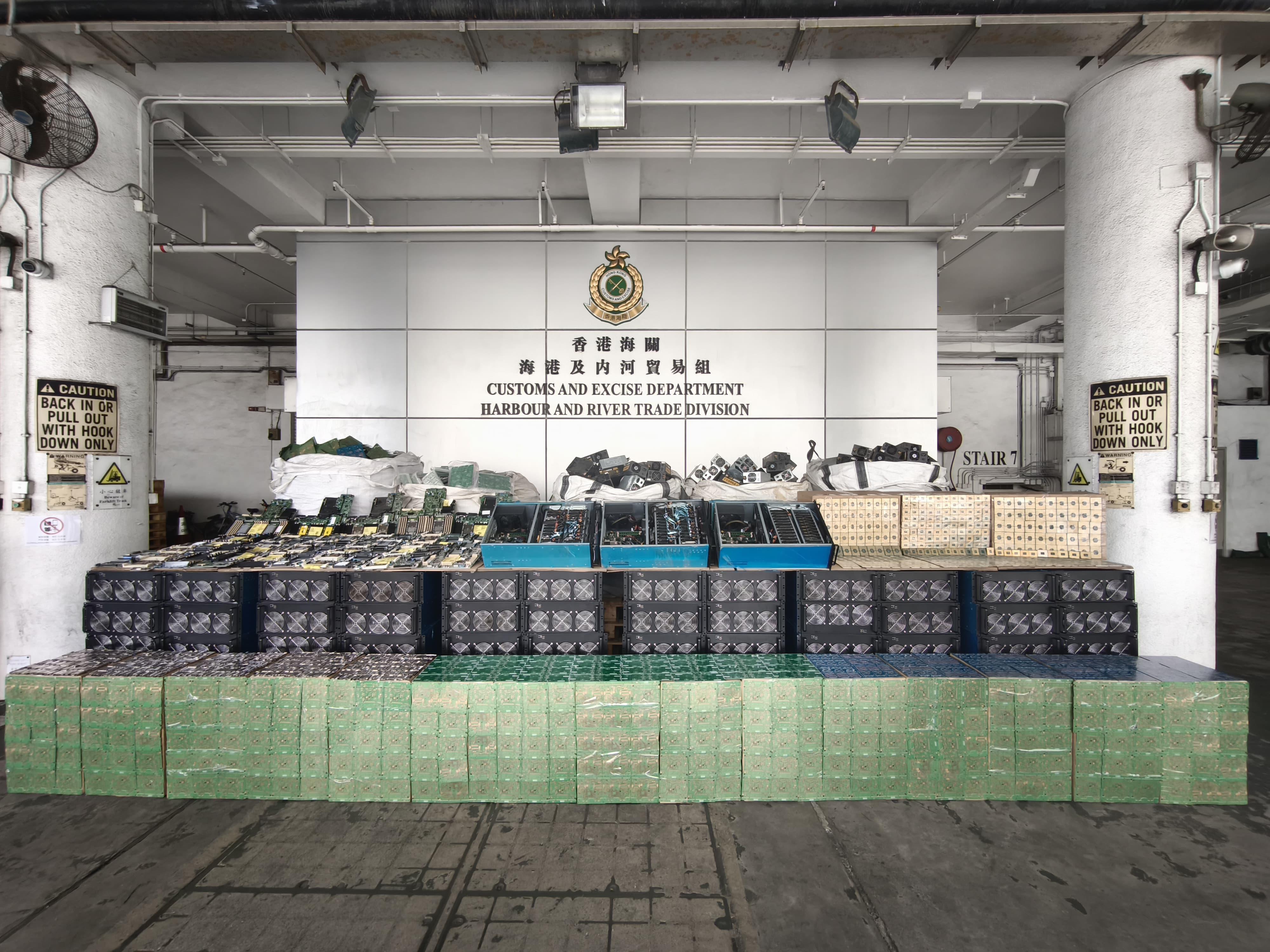
Hong Kong Customs detects smuggling case involving ocean-going vessel with goods worth about $30 million seized (with photo)

     Hong Kong Customs on January 23 detected a suspected case of using an ocean-going vessel to smuggle goods to Malaysia at the Kwai Chung Container Terminals. A batch of suspected smuggled electronic goods and parts with an estimated market value of about $30 million was seized.

     Through intelligence analysis and risk assessment, Customs discovered that criminals intended to use ocean-going vessels to smuggle goods and thus formulated strategies to combat related activities.

     On January 23, Customs officers identified an ocean-going vessel preparing to depart from Hong Kong for Malaysia for inspection and seized a batch of suspected smuggled electronic goods and parts, including computer main units, central processing units and printed circuit boards, inside a container that was declared as containing aluminium materials.

     An investigation is ongoing. The likelihood of arrests is not ruled out.

     Being a government department primarily responsible for tackling smuggling activities, Customs has long been combating various smuggling activities on all fronts. Customs will keep up its enforcement action and continue to resolutely combat sea smuggling activities through proactive risk management and intelligence-based enforcement strategies, and carry out targeted anti-smuggling operations at suitable times to disrupt relevant crimes.

     Smuggling is a serious offence. Under the Import and Export Ordinance, any person found guilty of importing or exporting unmanifested cargo is liable to a maximum fine of $2 million and imprisonment for seven years upon conviction.

     Members of the public may report any suspected smuggling activities to Customs’ 24-hour hotline 182 8080 or its dedicated crime-reporting email account (crimereport@customs.gov.hk) or online form (eform.cefs.gov.hk/form/ced002).

Photo  
read more