Tag Archives: China

image_pdfimage_print

Government announces Hong Kong Roadmap on Popularisation of Electric Vehicles (with photos)

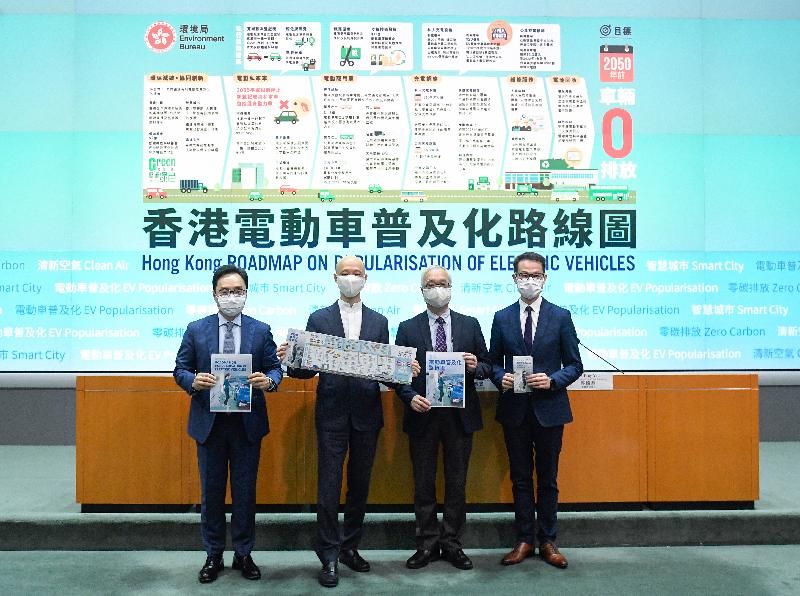
     The Government today (March 17) announced the Hong Kong Roadmap on Popularisation of Electric Vehicles, setting out the long-term policy objectives and plans to promote the adoption of electric vehicles (EVs) and their associated supporting facilities in Hong Kong.
 
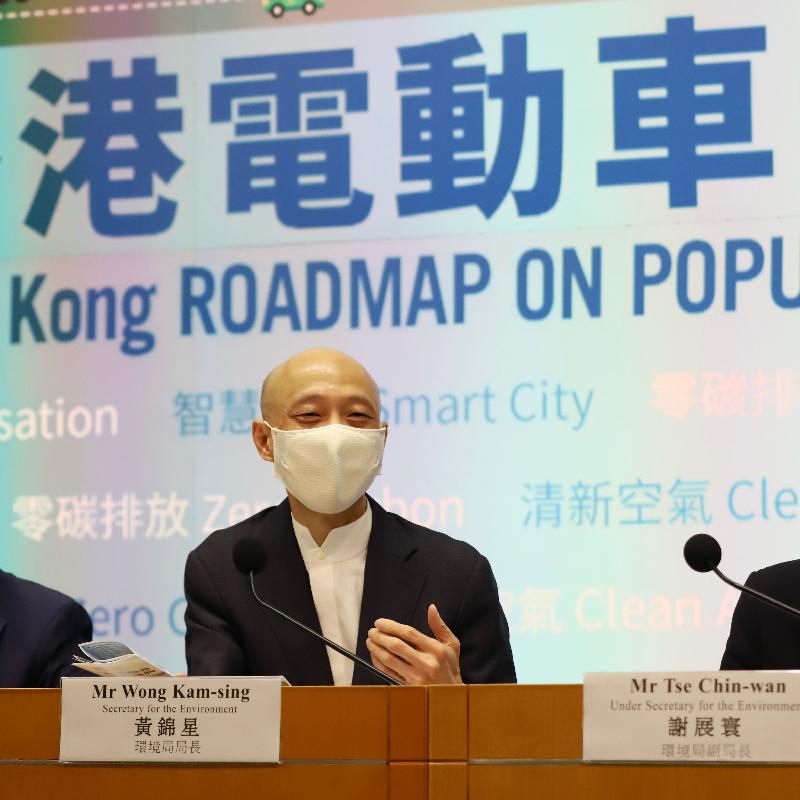
     Announcing the Roadmap today, the Secretary for the Environment, Mr Wong Kam-sing, said, “We have formulated our first Hong Kong Roadmap on Popularisation of EVs, which will guide Hong Kong’s future direction to attain zero vehicular emissions before 2050. This acts in concert with our other target to strive for carbon neutrality in the same time frame, and forges ahead with the vision of ‘Zero Carbon Emissions‧Clean Air‧Smart City’.”
 
     The key measures under the Roadmap cover various aspects:
 
Electric private cars

  • No new registration of fuel-propelled private cars including hybrid vehicles in 2035 or earlier
 
Electric commercial vehicles
  • Promote trials for electric public transport and commercial vehicles including buses, public light buses, taxis and goods vehicles, with a view to setting a concrete way forward and a timetable around 2025
 
Charging network
  • Expand the EV charging network on all fronts and marketise charging services progressively
 
Maintenance services
  • Promote education and training for technicians and mechanics on EV maintenance
 
Battery recycling
  • Strive to legislate a producer responsibility scheme for retired EV batteries in the next few years, and promote green technologies of second-life applications of EV batteries
 
Innovation and co-operation
  • Multi-pronged approach to create a conducive environment for the popularisation of EVs. This includes establishing a task force to examine the high-end development of new decarbonisation technology globally, the $200 million Green Tech Fund to fund the research and development of green technologies, making good use of development in technologies including the Internet of Things, big data and artificial intelligence, and seizing opportunities to be brought about by the EV technological development in the Guangdong-Hong Kong-Macao Greater Bay Area, etc
  
     “As EV technologies are rapidly evolving, we will review the various strategies and targets of the Roadmap around every five years. Taking into account new technological, environmental, social and economic development and situations, we will adjust in time Hong Kong’s policies and measures in promoting EVs, ensuring that we keep up with the times,” Mr Wong said.
      
      Mr Wong expressed sincere gratitude to different stakeholders for sharing their views on the directions and measures to be included in the Roadmap in the past year, especially the members of the Steering Committee on the Promotion of Electric Vehicles led by the Financial Secretary, who have provided much valuable advice on the strategies and measures regarding the popularisation of EVs. Looking ahead, the Government will continue to collaborate with different sectors in society to drive the popularisation of EVs, making Hong Kong a liveable, green and smart city.
      
     The Hong Kong Roadmap on Popularisation of Electric Vehicles and its leaflet are available on the Environmental Protection Department website (www.epd.gov.hk/epd/english/resources_pub/policy_documents/index.html).
Photo  Photo  
read more

CHP investigates 11 additional confirmed cases of COVID-19

     The Centre for Health Protection (CHP) of the Department of Health (DH) announced that as of 0.00am, March 17, the CHP was investigating 11 additional confirmed cases of coronavirus disease 2019 (COVID-19), taking the number of cases to 11 341 in Hong Kong so far (comprising 11 340 confirmed cases and one probable case).
 
     Among the newly reported cases announced, three are imported cases and two are local cases with unknown sources while the remaining six cases are epidemiologically linked with local cases.
 
     A total of 297 cases have been recorded in the past 14 days (March 3 to 16), including 234 local cases of which 54 are from unknown sources.
 
     The CHP’s epidemiological investigations and relevant contact tracing on the confirmed cases are ongoing. For case details and contact tracing information, please see the Annex or the list of buildings with confirmed cases of COVID-19 in the past 14 days and the latest local situation of COVID-19 available on the website “COVID-19 Thematic Website” (www.coronavirus.gov.hk).
 
     Meanwhile, the CHP reminded those who had visited specified venues under the Prevention and Control of Disease (Compulsory Testing for Certain Persons) Regulation (Cap. 599J) to receive COVID-19 nucleic acid testing according to the compulsory testing notice. The Regulation also requires all household members of close contacts of confirmed cases to undergo a COVID-19 nucleic acid test within a specified period according to compulsory testing notices published in the Gazette. The public are also urged to seek medical attention early if symptoms develop.
 
     The Government has launched the COVID-19 Vaccination Programme. Members of the public are encouraged to get vaccinated. Details of the programme can be found at the designated website (www.covidvaccine.gov.hk).
 
     The CHP called on members of the public to avoid going out, having social contact and dining out. They should put on a surgical mask and maintain stringent hand hygiene when they need to go out. The CHP strongly urged the elderly to stay home as far as possible and avoid going out. They should consider asking their family and friends to help with everyday tasks such as shopping for basic necessities.
 
     The spokesman said, “Given that the situation of COVID-19 infection remains severe and that there is a continuous increase in the number of cases reported around the world, members of the public are strongly urged to avoid all non-essential travel outside Hong Kong.
 
     “The CHP also strongly urges the public to maintain at all times strict personal and environmental hygiene, which is key to personal protection against infection and prevention of the spread of the disease in the community. On a personal level, members of the public should wear a surgical mask when having respiratory symptoms, taking public transport or staying in crowded places. They should also perform hand hygiene frequently, especially before touching the mouth, nose or eyes.
 
     “As for household environmental hygiene, members of the public are advised to maintain drainage pipes properly and regularly pour water into drain outlets (U-traps). After using the toilet, they should put the toilet lid down before flushing to avoid spreading germs.”
 
     Moreover, the Government has launched the website “COVID-19 Thematic Website” (www.coronavirus.gov.hk) for announcing the latest updates on various news on COVID-19 infection and health advice to help the public understand the latest updates. Members of the public may also gain access to information via the COVID-19 WhatsApp Helpline launched by the Office of the Government Chief Information Officer. Simply by saving 9617 1823 in their phone contacts or clicking the link wa.me/85296171823?text=hi, they will be able to obtain information on COVID-19 as well as the “StayHomeSafe” mobile app and wristband via WhatsApp.
 
     To prevent pneumonia and respiratory tract infections, members of the public should always maintain good personal and environmental hygiene. They are advised to:
 
• Wear a surgical mask when taking public transport or staying in crowded places. It is important to wear a mask properly, including performing hand hygiene before wearing and after removing a mask;
• Perform hand hygiene frequently, especially before touching the mouth, nose or eyes, after touching public installations such as handrails or doorknobs, or when hands are contaminated by respiratory secretions after coughing or sneezing;
• Maintain drainage pipes properly and regularly (about once a week) pour about half a litre of water into each drain outlet (U-trap) to ensure environmental hygiene;
• After using the toilet, put the toilet lid down before flushing to avoid spreading germs;
• Wash hands with liquid soap and water, and rub for at least 20 seconds. Then rinse with water and dry with a disposable paper towel. If hand washing facilities are not available, or when hands are not visibly soiled, performing hand hygiene with 70 to 80 per cent alcohol-based handrub is an effective alternative;
• Cover your mouth and nose with tissue paper when sneezing or coughing. Dispose of soiled tissues into a lidded rubbish bin, then wash hands thoroughly; and
• When having respiratory symptoms, wear a surgical mask, refrain from work or attending class at school, avoid going to crowded places and seek medical advice promptly. read more

LCQ6: Legislation on Article 23 of Basic Law

     Following is a question by Dr the Hon Junius Ho (Dr the Hon Priscilla Leung to ask on his behalf) and a reply by the Secretary for Security, Mr John Lee, in the Legislative Council today (March 17):
 
Question:
 
     Article 7 of the National Security Law for Hong Kong, which has been implemented since June 30 last year, stipulates that “the Hong Kong Special Administrative Region shall complete, as early as possible, legislation for safeguarding national security as stipulated in the Basic Law of the Hong Kong Special Administrative Region and shall refine relevant laws”. In other words, the Hong Kong Special Administrative Region (Hong Kong SAR) should, pursuant to Article 23 of the Basic Law, enact laws on its own to prohibit acts endangering national security. The Government has also repeatedly indicated that the Hong Kong SAR has a constitutional obligation to enact legislation on Article 23 of the Basic Law. In this connection, will the Government inform this Council:

(1) of the latest progress of the work to enact legislation pursuant to Article 23 of the Basic Law; and

(2) whether, according to the Government’s assessment, the relevant legislative work can be completed within the current term of the Legislative Council; if the assessment outcome is in the affirmative, of the legislative timetable; if it is in the negative, the reasons for that?

Reply:

President,

     My consolidated reply to the question by Dr the Hon Junius Ho (Dr the Hon Priscilla Leung to ask on his behalf) is as follows:

     Being an inalienable part of the People’s Republic of China, the Hong Kong Special Administrative Region (HKSAR) has the duty to safeguard national security. The HKSAR has the constitutional responsibility for enacting legislation on Article 23 of the Basic Law (BL23) to prohibit any act of treason, secession, sedition, subversion against the Central People’s Government (CPG), or theft of state secrets; to prohibit foreign political organisations or bodies from conducting political activities in the HKSAR; and to prohibit political organisations or bodies of the HKSAR from establishing ties with foreign political organisations or bodies. Article 7 of the Hong Kong National Security Law clearly stipulates that “the Hong Kong Special Administrative Region shall complete, as early as possible, legislation for safeguarding national security as stipulated in the Basic Law of the Hong Kong Special Administrative Region and shall refine relevant laws”.

     The HKSAR Government has been carrying out relevant work in respect of the enactment of legislation on BL23. Such work includes examining the bill submitted by the HKSAR Government to the Legislative Council in 2003 and conducting legal research related to national security. Regarding taking forward the relevant work, I would like to point out the following:

     Firstly, there have been drastic changes in Hong Kong’s national security risks since the unsuccessful attempt to enact legislation in 2003. This period saw acts and activities which seriously undermined the rule of law and public order and endangered national security, including illegal “Occupy Central” in 2014, the Mong Kok riot in 2016, the establishment of the Hong Kong National Party which was banned in 2018 for advocating “Hong Kong independence”; and in particular, there was a spate of violence and riots perpetrated by rioters since June 2019, which lasted for more than ten months: during the period, rioters wantonly blocked roads, seriously vandalised shops, MTR stations and other public facilities, hurled a large number of petrol bombs, set fires, violently stormed and trashed the Legislative Council building, damaged government premises, as well as wilfully assaulted people holding different views. Moreover, local terrorism started to breed, as marked by seizure of large quantities of explosives, firearms and bullets. Illegal acts advocating “Hong Kong independence” were rampant and interference from foreign forces was severe with shameless individuals colluding with foreign forces and willingly serving as puppets and foreign proxies, begging foreign countries for sanctions against China and the HKSAR. Scores of saboteurs attempted “mutual destruction”, with the intention of “jumping off the cliff” with Hong Kong and pushing Hong Kong residents into the abyss. Some even plotted subversion against State power, posing grave threat to national security. The implementation of the Hong Kong National Security Law has delivered immediate results: Hong Kong has emerged from chaos into stability, with a significant reduction in violent acts; activists endangering national security have either fled or announced their withdrawal; advocacy of “Hong Kong independence” has subsided substantially; the community has largely returned normal, and people’s lawful rights are protected. Our economy and people’s livelihood could revive. This fully testifies why legislation for safeguarding national security is important and necessary. However, law-abiding awareness among the public has been greatly weakened, and advocates of “Hong Kong independence” have not given up entirely; as such, national security risks remain and we must remain highly vigilant. Hence, the legislation on BL23 to be enacted must enable comprehensive and effective tackling of various serious and extreme circumstances which may arise and endanger national security.

     Secondly, the Hong Kong National Security Law has stipulated four categories of offences, namely secession, subversion, terrorist activities, and collusion with a foreign country or with external elements to endanger national security; thus, two of the seven categories of offences or activities stipulated by BL23 (i.e. secession and subversion against the CPG) are already covered by the Law. When examining the enactment of legislation on BL23, we have to determine whether it is no longer necessary for the HKSAR to legislate on secession and subversion against the CPG, or we have to review if there are other acts involving these two categories of offences which are not prohibited under the Hong Kong National Security Law, and would need to be dealt with in the legislation on BL23. At the same time, we have to ensure that the relevant details of the legislation must not conflict with the Decision of the National People’s Congress on Establishing and Improving the Legal System and Enforcement Mechanisms for the Hong Kong Special Administrative Region to Safeguard National Security and the Hong Kong National Security Law.

     Besides, the Police have arrested 100 persons suspected of having committed offences endangering national security since the Hong Kong National Security Law took effect. The Department of Justice has also instituted prosecution against five cases for offences under the Hong Kong National Security Law, including “secession”, “inciting secession”, “terrorist activities”, “collusion with a foreign country or with external elements to endanger national security” and “conspiracy to commit subversion”. Court hearings are also underway, and the implementation process, in particular court decisions, interpretation of legal provisions and their application, the procedures and experience of which could provide valuable references for the legislation on BL23.

     Thirdly, safeguarding national security is of the top priority in every country, and hence different countries have in place effective laws to safeguard national security. The relevant laws of these countries and their experience in implementing such laws are also worthy of our reference. Considerable efforts are involved in these tasks, which include examining the content of the relevant laws, measures adopted and approaches used. The expanse of the scope and complexity of such work should not be underestimated.

     Fourthly, looking back on the past experience of introducing the legislative proposal on BL23 in 2003, the Government at that time prepared a detailed consultation paper and conducted a three-month public consultation during which diverse views were received. Some considered certain provisions too stringent, whereas others considered that the provisions should have greater deterrent effect. I believe that the scenario of diverse public views will arise again. Hence, apart from the need to draw up effective and pragmatic proposals and provisions, the HKSAR Government also has to conduct public consultation properly, formulate appropriate publicity and explanation strategies, as well as communicate more with members of the public, with a view to explaining clearly the legislative principles and details and avoiding misunderstanding. We also have to guard against “demonisation” and malicious smear of BL23 by people with ulterior motives again.

     Although work on various fronts for the legislation on BL23 is already underway, we will not underestimate the complexity involved. As for the legislative timetable mentioned in the question, we have to make objective judgment on the legislative work in a pragmatic manner. In light of the work and scope involved which I have described just now, the relevant considerations and complexity, and the requirements under the Basic Law and the Hong Kong National Security Law, the HKSAR Government will complete the legislation on BL23 as early as possible, but it would be difficult to complete in the remaining term of the current Legislative Council.

     Thank you, President. read more

Government welcomes passage of abolition of Doubled Ad Valorem Stamp Duty on non-residential properties

     The Secretary for Financial Services and the Treasury, Mr Christopher Hui, welcomed the passage of the Stamp Duty (Amendment) Bill 2020 by the Legislative Council today (March 17). The Ordinance gives effect to the proposal in the 2020 Policy Address on the abolition of the Doubled Ad Valorem Stamp Duty (DSD) rates applicable to non-residential property transactions with effect from November 26, 2020, reverting the ad valorem stamp duty rates chargeable on non-residential properties to the Scale 2 rates. 
 
     DSD was introduced in 2013 against the backdrop of an overheating property market with hectic trading activities and soaring prices. The measure was necessary to dampen the demand for non-residential properties in order to maintain stability in the property market. As a result of the economic downturn and uncertainties surrounding the COVID-19 pandemic, prices and transactions for non-residential properties have eased noticeably for a period of time, signalling a slackening of market demand. The Government considers that it is the appropriate time to abolish DSD as a demand-side management measure.
 
     The abolition of DSD could facilitate the selling of non-residential property by businesses that are encountering financial predicaments or liquidity needs because of the economic downturn, mitigating the impact of the pandemic on Hong Kong’s economy and business activities.
 
      From November 26 last year until the end of February this year, the abolition of DSD on non-residential properties had allowed the stamp duty payers of about 5,000 property transactions to save a total of some $870 million. read more