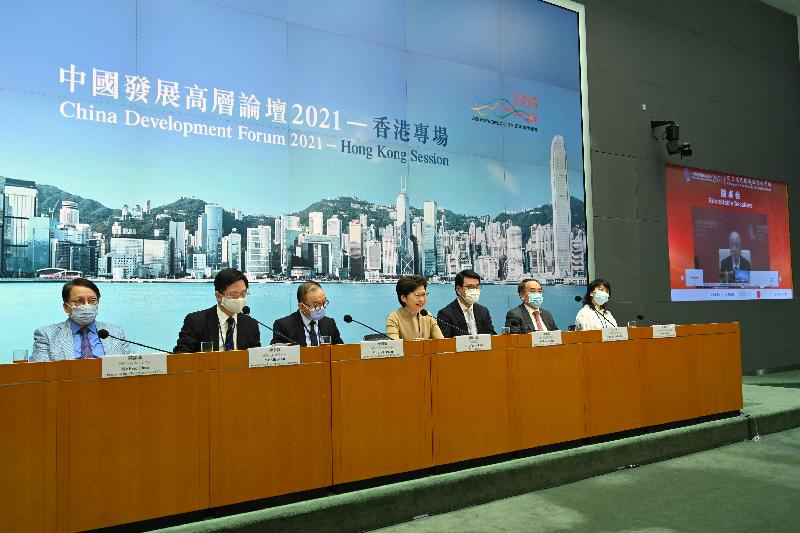
Following is the speech by the Chief Executive, Mrs Carrie Lam, at the Hong Kong Session of China Development Forum 2021 held online this evening (March 20):
Mr Lu Mai (Vice Chairman of China Development Research Foundation and Secretary General of China Development Forum), distinguished guests, ladies and gentlemen,
Good evening. Thank you for accepting my invitation to participate in this Hong Kong Session at the China Development Forum 2021. The idea of having a dedicated session to exchange views about Hong Kong’s development with business leaders of global companies came in March 2019 when I was invited, for the first time as Chief Executive of the HKSAR, to attend the China Development Forum 2019 to talk about the Guangdong-Hong Kong-Macao Greater Bay Area (GBA). If not because of the COVID-19 pandemic, this Hong Kong Session would have taken place last year at the Diaoyutai State Guesthouse. A Hong Kong Session will not be possible without the support of the Development Research Centre of the State Council and the China Development Research Foundation. I would in particular wish to express my personal gratitude to Mr Lu Mai, Secretary-General of the Foundation for his help and guidance.
When I raised the idea of a Hong Kong Session at the China Development Forum in the first half of 2019, Hong Kong, despite some moderation in economic growth because of the then China-US trade tension, was well and fine. The Greater Bay Area Outline Development Plan was just promulgated and cross-border infrastructure connectivity was boosted by the opening of the Hong Kong section of the Guangzhou-Shenzhen-Hong Kong high speed rail and the Hong Kong-Zhuhai-Macao Bridge in late 2018. Leveraging Hong Kong’s traditional strengths in the financial, legal, logistics, trade and business sectors, and enhanced connectivity in the capital markets of Hong Kong and Mainland, businesses and professionals here could look forward to huge opportunities and good prospects.
Unfortunately, dark clouds descended upon our city in June 2019 when a series of public protests turned into rioting across the city. For 12 months, the streets of Hong Kong had been sieged by rioting mobs who vandalised shops, train stations and traffic lights, set fires to buildings, attacked police officers with bricks, petrol bombs and even genuine firearms, desecrated the national flag and national emblem and called for “Hong Kong Independence”. Within the Legislative Council, anti-Government politicians resorted to extensive filibustering and even physical obstruction to derail government business. Some went abroad to seek interference into Hong Kong’s affairs by external forces and even begged for sanctions against the Country and Hong Kong by foreign governments. Our Country’s sovereignty and security were clearly at risk and the HKSAR was thrown into dark abyss. The foundations for Hong Kong’s stability were gravely shaken. There was simply no basis for the Chief Executive to promote Hong Kong to global businesses.
But this evening, under the theme of “The Development of Hong Kong in the Next Five Years”, I speak with confidence that Hong Kong will thrive, and soar higher, in the next five years. My confidence in Hong Kong and her future development is grounded in two major Decisions made by the National People’s Congress (NPC) – the enactment of The Law of the People’s Republic of China on Safeguarding National Security in the HKSAR (National Security Law) last June and the Decision to improve the HKSAR’s electoral system to implement “patriots administering Hong Kong” approved at the fourth session of the 13th NPC last week. These two important Decisions by the highest organ of State power, that is the NPC, have put Hong Kong back on its right track, that is, fully and faithfully upholding “One Country, Two Systems”, safeguarding national security and ensuring Hong Kong’s stability and prosperity. As a matter of fact, in the nine months since implementation of the National Security Law last June, mob violence has disappeared and peace and stability have been restored in our city.
My confidence is further boosted by the support given by the Central Government to Hong Kong as embedded in the 14th Five-Year Plan for National Economic and Social Development (the 14th Five Year Plan) approved by the NPC at its recent meeting. In this latest national blueprint, Hong Kong’s competitive strengths as international financial, transportation and trade centres as well as a centre for international legal and dispute resolution services in the Asia-Pacific region, or what I call the “four traditional sectors”, continue to be recognised for advancement, while new impetus has been awarded to what I call the “four emerging sectors”, namely, an international innovation and technology hub, an international aviation hub, an East meets West centre for international cultural exchange and an intellectual property trading hub. Hong Kong businesses and people are set to benefit from unlimited development opportunities in each of these eight areas and we wish to share them with our business partners in the Mainland and overseas. After all, by our last count, there are over 9 000 overseas and Mainland companies with a presence in Hong Kong, about half of them are using Hong Kong as their regional headquarters or regional office.
Before we look into the future, just allow me, for a moment, to look back at the year 2020. Mask wearing, social distancing, COVID-19 testing have become our daily routine and most of the business sectors have been hard hit. Hong Kong’s GDP in 2020 declined by 6.1 per cent. The good news is that vaccinations have begun in Hong Kong since last month. If the vaccines are as successful as we expect, there will be real momentum for recovery in the second half of this year. Let me illustrate with our prospects as an international financial centre and an innovation and technology hub.
The 14th Five-Year Plan reaffirms support for Hong Kong to enhance our status as an international financial centre and strengthen our role as a global offshore Renminbi business hub, an international asset management centre and a risk management centre. Accounting for some 21 per cent of our GDP, the financial sector has proven its resilience over two years of social, political and public health crises. Our city has been ranked as the world’s number one IPO venue in seven of the past 12 years. In 2020 alone, HKEX recorded a 27 per cent year-on-year increase in funds raised through IPO, with a total of HK$400 billion (US$51.6 billion) from 154 listings. This was the highest amount in a single year since 2010, and among the listings, we had the second-largest listing of 2020 globally. Hong Kong also provides unrivalled connectivity with the Mainland’s financial markets, offering direct two-way access through the Stock Connect and Bond Connect programmes, as well as the proposed GBA Wealth Management Connect. With the Central Government’s support, and in recognition of Hong Kong now being the second-largest listing platform for biotechnology companies in the world, we have included pre-revenue or pre-profit biotechnology companies listed in Hong Kong as eligible stocks under the Stock Connect scheme since December 2020.
We are, as well, the world’s largest offshore Renminbi business hub and the preferred place for international investors to park their funds. As of end 2019, the assets under management in Hong Kong increased by 20 per cent year-on-year to HK$29 trillion (US$3.7 trillion), which is about ten times of our GDP. We will further enhance Hong Kong’s position as a premier centre for asset and wealth management through a four-step approach, including enhancing our fund structures; providing tax concessions for carried interest issued by private equity funds operating in Hong Kong; establishing a mechanism for foreign funds to re-domicile in Hong Kong; and providing financial incentives for setting up open-ended fund companies or real estate investment trusts.
Backed by an open and sophisticated insurance market, we are catapulting Hong Kong as an international risk management centre. We have completed a series of legislative work to provide for half-rate profits tax concessions to eligible insurance businesses including marine insurance and specialty insurance; facilitate the issuance of insurance-linked securities in Hong Kong; expand the scope of insurable risks of captive insurance companies; and enhance the group-wide supervision framework. All these measures will be implemented by the end of this month.
Turning to innovation and technology, for the first time, Hong Kong’s strength in this area features in the National Plan. Over the past three years, we have been promoting innovation and technology development with the staunch support from the Central Government. We have invested over HK$100 billion (US$12.8 billion) so far and rolled out a series of measures to encourage research and development (R&D), nurture talents, improve infrastructure, etc. under a multi-pronged strategy steered personally by myself. These efforts are gradually bearing fruit. Our GDP on R&D significantly increased from HK$16.7 billion (US$2.1 billion) in 2014 to HK$26.3 billion (US$3.4 billion) in 2019. The number of local start-ups tripled from around 1 100 in 2014 to over 3 300 in 2020 with the manpower increased by over four times. Venture capital investment in Hong Kong increased from HK$1.2 billion (US$154 million) in 2014 to HK$10 billion (US$1.28 billion) in 2019, showing an increase of seven times. In a span of six years, eight unicorns emerged in Hong Kong.
The progress we made has been recognised globally. According to the World Digital Competitiveness Yearbook 2020 announced earlier by the International Institute for Management Development in Lausanne, Switzerland, Hong Kong climbed from 11th place in 2018 to fifth place globally. As for the ranking related to technological infrastructure, the global ranking of Hong Kong rose from 18th place to seventh place.
The most significant innovation and technology project being taken forward is the development of the Hong Kong-Shenzhen Innovation and Technology Park, with which we are pressing ahead full steam with a funding of over HK$30 billion (US$3.8 billion) recently approved. This will be the largest-ever innovation and technology platform in Hong Kong. Adjacent to Shenzhen, the Park leverages the complementary advantages brought by Hong Kong’s solid R&D strengths and Shenzhen’s strong capability in advanced manufacturing. Furthermore, Hong Kong’s two flagship innovation and technology organisations, Hong Kong Science Park and Cyberport, are taking forward their expansion plans. A purpose-built Data Technology Hub has just opened at the Tseung Kwan O Industrial Estate, and a world-class Advanced Manufacturing Centre and the Microelectronics Centre are also taking shape.
To support R&D, my Government has been financing projects that contribute to the upgrading in our manufacturing and services industries through the Innovation and Technology Fund. We are also setting up the first two InnoHK clusters in research consisting of collaborations between local universities and renowned Mainland and overseas institutions. Situated at the Hong Kong Science Park, they are focusing on healthcare technologies and artificial intelligence as well as robotics technologies. Recognising the importance of talents to science and technology, my Government will shortly launch the Global STEM Professorship Scheme to attract renowned scientists and their research teams to come and work in Hong Kong.
Innovation and technology is not only a sector by itself. It is driving development in other sectors as well. Just now I spoke about Hong Kong’s financial services, which is a sector benefitting hugely from innovation and technology development. Hong Kong is now home to more than 600 fintech companies and start-ups. Eight virtual banks and four virtual insurers have been granted licences, offering a wide variety of financial services for business and people. A virtual asset trading platform has been authorised, and a Faster Payment System (FPS) has been launched to connect banks and e-wallets, enabling 24-hour instant transfer in Hong Kong dollars and Renminbi; in a little more than two years since its launching in 2018, FPS now has recorded 7.5 million registrations. The average daily Hong Kong dollars real-time transactions reached some 600 000 last month, worth HK$6.2 billion (US$795 million). Furthermore, to promote innovative financial services products, our new Fintech Proof-of-Concept Subsidy Scheme is now open for application. It provides incentives for financial institutions to partner with fintech companies on proof-of-concept projects.
Hong Kong’s future lies in integration with the Mainland economy, while maintaining her uniqueness under “One Country, Two Systems”. With its total population of over 72 million and a combined GDP of US$1.7 trillion which is as big as that of Korea, the GBA will bring abundant development opportunities to different sectors of the community. We will strengthen our support for enterprises to tap into the Mainland domestic market and step up promotion of Hong Kong products and services. We will provide dedicated support for Hong Kong enterprises to expand their domestic sales and gain access to the large-scale e-commerce platforms in the Mainland.
Ladies and gentlemen, Hong Kong’s role as a gateway of investment into the Mainland will be reinforced in China’s “dual circulation” strategy, under which our nation is committed to wider, broader, and deeper economic opening, while at the same time more Chinese companies will go global. Hong Kong’s professional services are renowned for their high standard and we will collaborate with Mainland enterprises in going global. Our investment promotion agency Invest Hong Kong will work closely with its counterparts in the GBA to showcase our collective strengths and enhance our role in furthering international circulation. As a highly market-oriented city and an international economy, Hong Kong will proactively become a participant in domestic circulation and a facilitator in international circulation amidst the “dual circulation” development strategy of our country.
With these exciting developments, I can assure you that Hong Kong will once again rise to the challenge and move ahead confidently towards a bright future. I am delighted that we have some of the world’s top business leaders with us today to share their perspectives on how they see Hong Kong’s future economic development. I look forward to benefiting from your insights and wisdom.
Thank you very much.