Tag Archives: China

HKSAR Government holds seminar on 2024-2035 master plan on building China into a leading country in education (with photos)

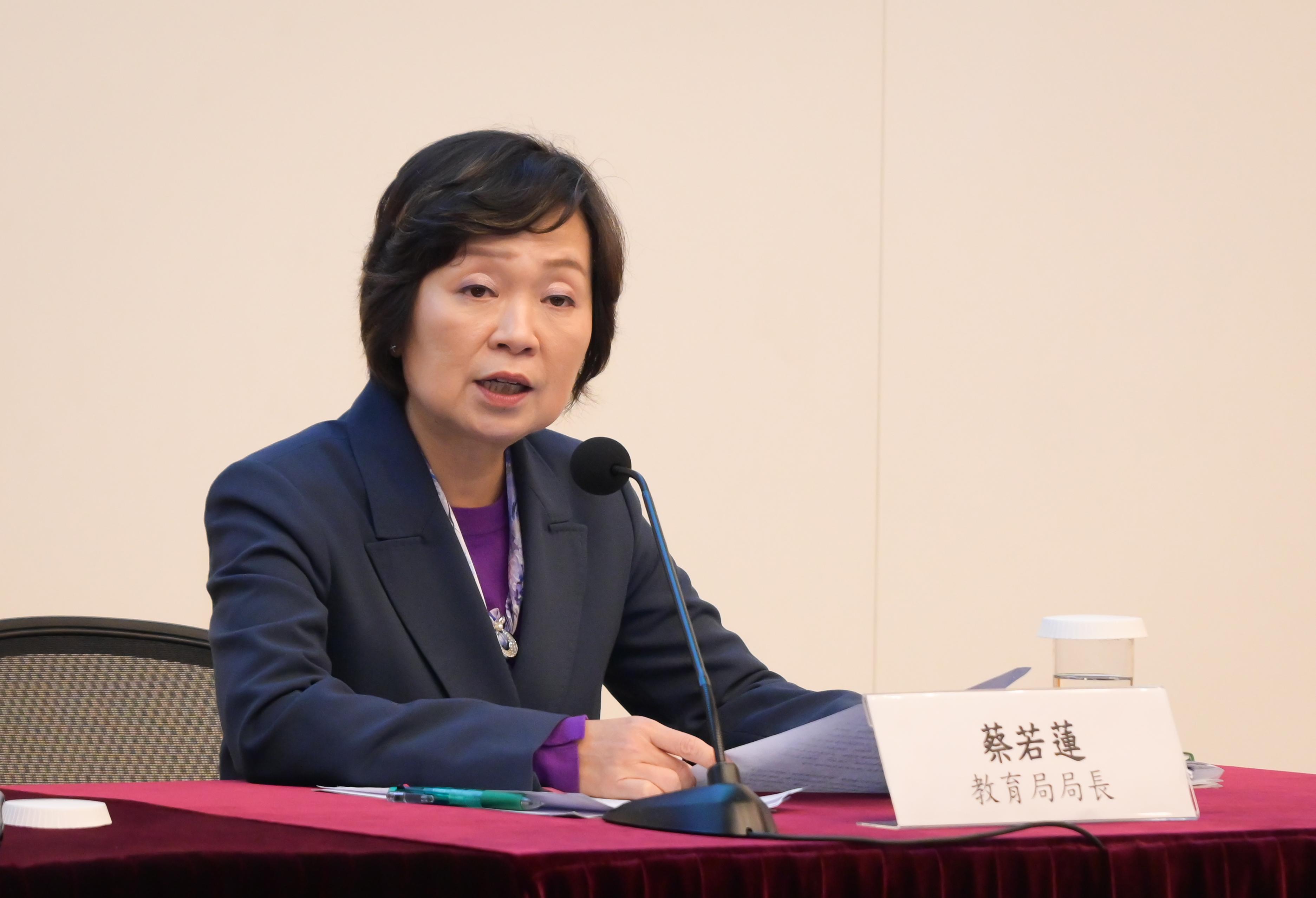
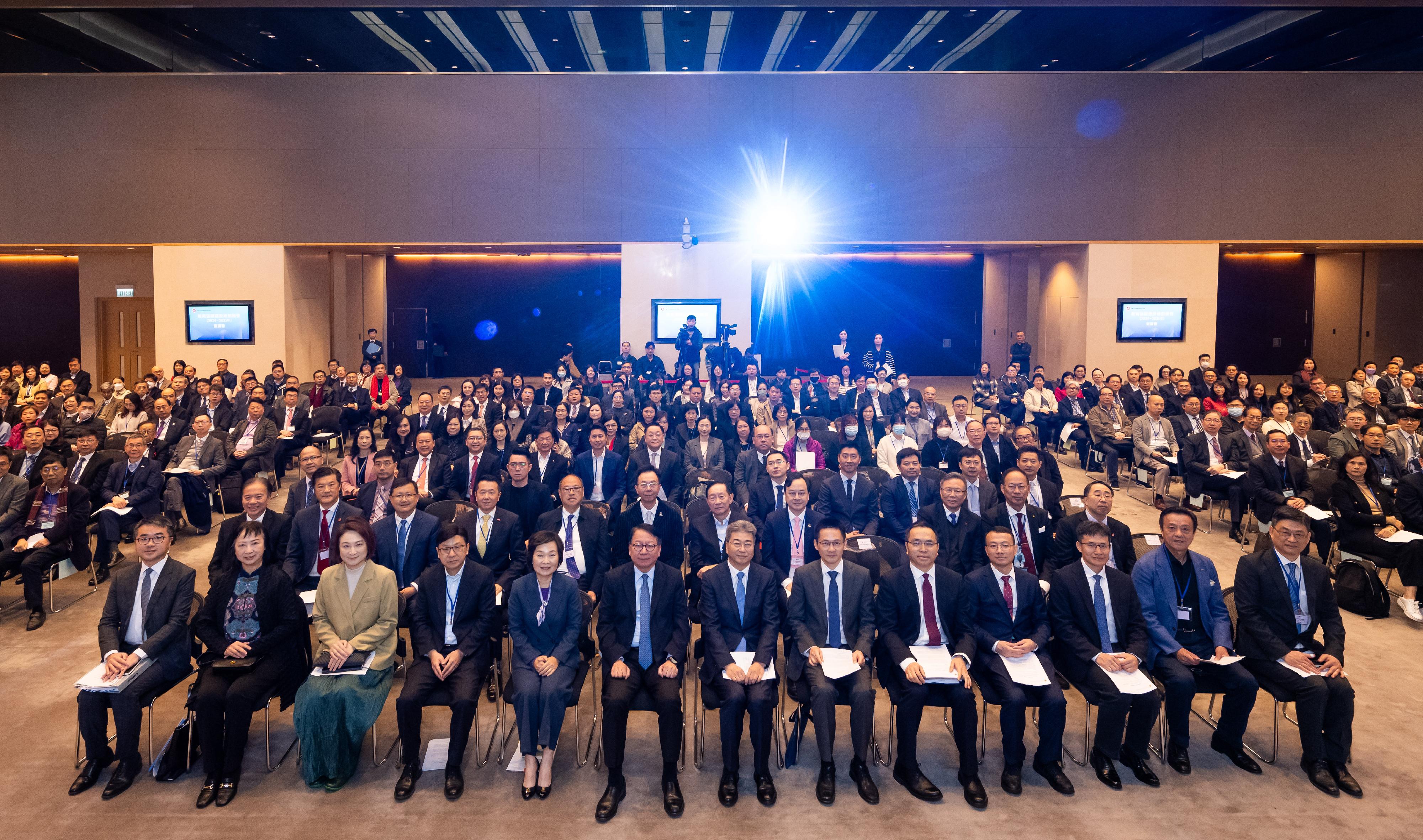
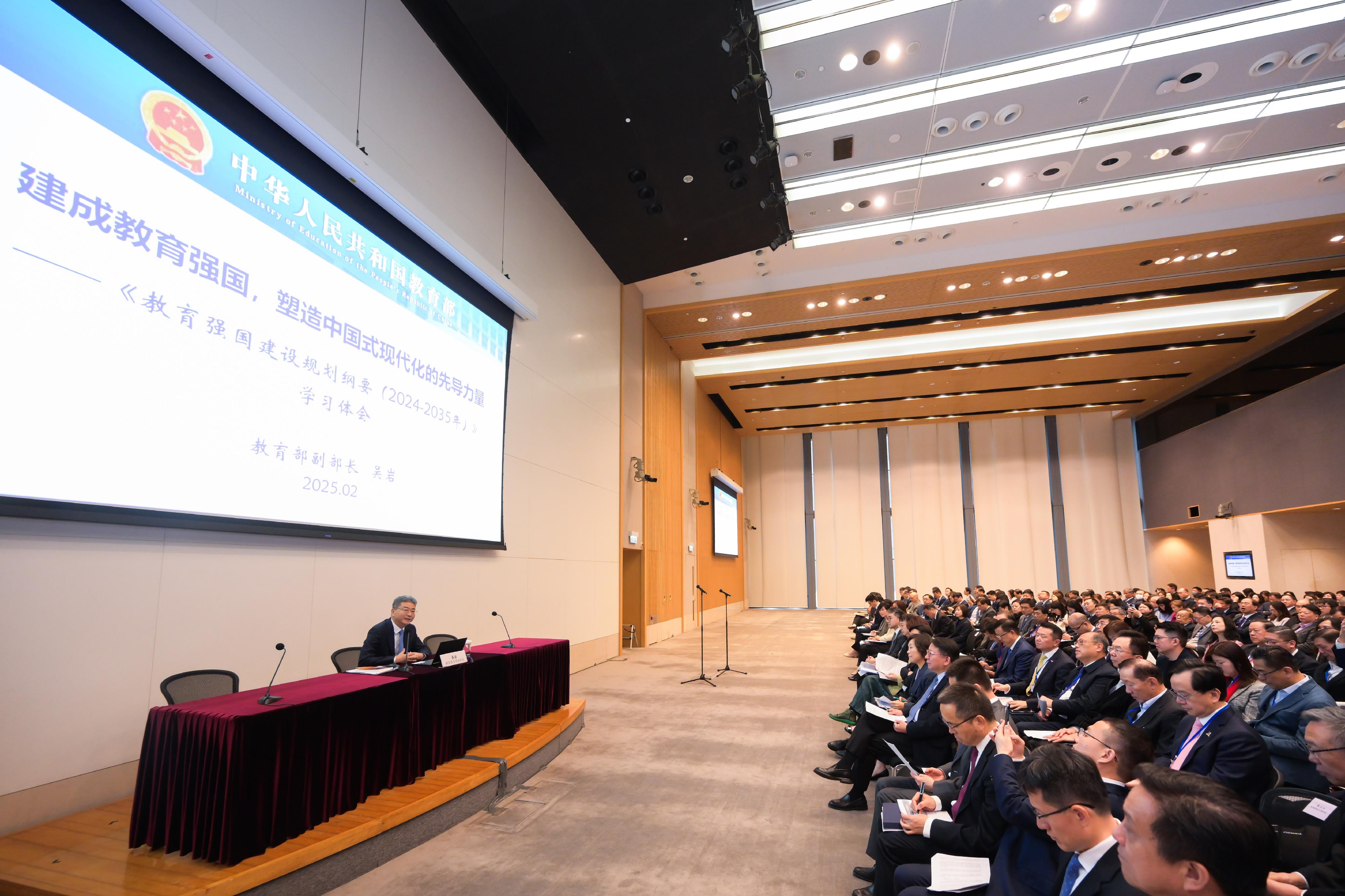
     President Xi Jinping delivered an important speech at the National Conference on Education last September, following which the 2024-2035 master plan on building China into a leading country in education (master plan) was issued, setting out a roadmap for the national education development in the next 10 years. The Hong Kong Special Administrative Region (HKSAR) Government today (February 12) held a seminar on the master plan at the Central Government Offices. Vice Minister of Education Mr Wu Yan was invited to deliver a keynote speech to enable different sectors to obtain a deeper understanding of the significance of the master plan. The Chief Secretary for Administration, Mr Chan Kwok-ki, and the Secretary for Education, Dr Choi Yuk-lin, delivered the opening and closing addresses respectively.
      
     The master plan is the first national action plan themed on building a leading country in education with the key mission to support the country’s modernisation in all aspects. It clearly proposed to establish a mechanism for co-ordinating and promoting the integration of education, technology and talent by leveraging the support of education to technology and talent. The master plan also set out the close collaboration with the development of the innovation and technology hub in the Guangdong-Hong Kong-Macao Greater Bay Area and the building of a high-calibre talent hub and platforms for talent attraction and retention, thereby enhancing the overall effectiveness of the innovation system.
      
     Speaking at the seminar, Mr Chan said that the Resolution of the Communist Party of China (CPC) Central Committee on Further Deepening Reform Comprehensively to Advance Chinese Modernization adopted in the Third Plenary Session of the 20th Central Committee of the CPC suggested that Hong Kong be built into an international hub for high-calibre talent. The HKSAR Government has been proactively creating favourable room for development for talent from different backgrounds, and fostering synergistic development of nurturing talent, gathering talent and science and technology, to enable talent to make Hong Kong their home and give full play to their strengths for contribution to the high-quality development of Hong Kong and the country.
      
     He pointed out that the HKSAR Government established the Committee on Education, Technology and Talents with him as the Chairman at the end of last year to enhance the systemic, holistic and synergistic nature of policies, which target the manpower demand of Hong Kong’s strategic positioning of “eight centres”. It aims to promote integrated development of education, technology and talent from the top and fully implement the work of invigorating the country through science and education.
      
     Speaking at the seminar, Dr Choi said that with the rapid development of education in the country in the coming 10 years, Hong Kong’s education will also thrive. The Education Bureau (EDB) will keep its principles and be innovative to tie in with the national strategy of invigorating the country through science and education, and grasp the development opportunities offered by the country’s initiatives such as the Belt and Road and the Greater Bay Area to push forward with Hong Kong’s education development.
      
     She stressed that the EDB will deepen Hong Kong’s role as an international post-secondary education hub, pooling together talent with a view to consolidating and developing Hong Kong’s education strengths. Apart from boosting the comprehensive strengths of tertiary education and forging new development competitive edges with digital education, the EDB will also create multiple pathways for young generations, further enhance students’ whole-person development, and raise teachers’ professional qualities and capabilities to achieve the goal of cultivating values and nurturing people.
      
     A number of participants also shared their views at the seminar.
      
     The seminar today was attended by around 400 participants, including representatives from the Ministry of Education, the Hong Kong and Macao Work Office of the CPC Central Committee, and the Hong Kong and Macao Affairs Office of the State Council; Hong Kong deputies to the National People’s Congress; Hong Kong Standing Committee members of the Chinese People’s Political Consultative Conference; members of the Legislative Council Panel on Education; the EDB directorate; representatives from the councils of universities and post-secondary institutions; representatives from school councils and principals’ associations in relation to kindergartens, primary schools and secondary schools, and representatives from relevant education organisations and advisory and statutory bodies.
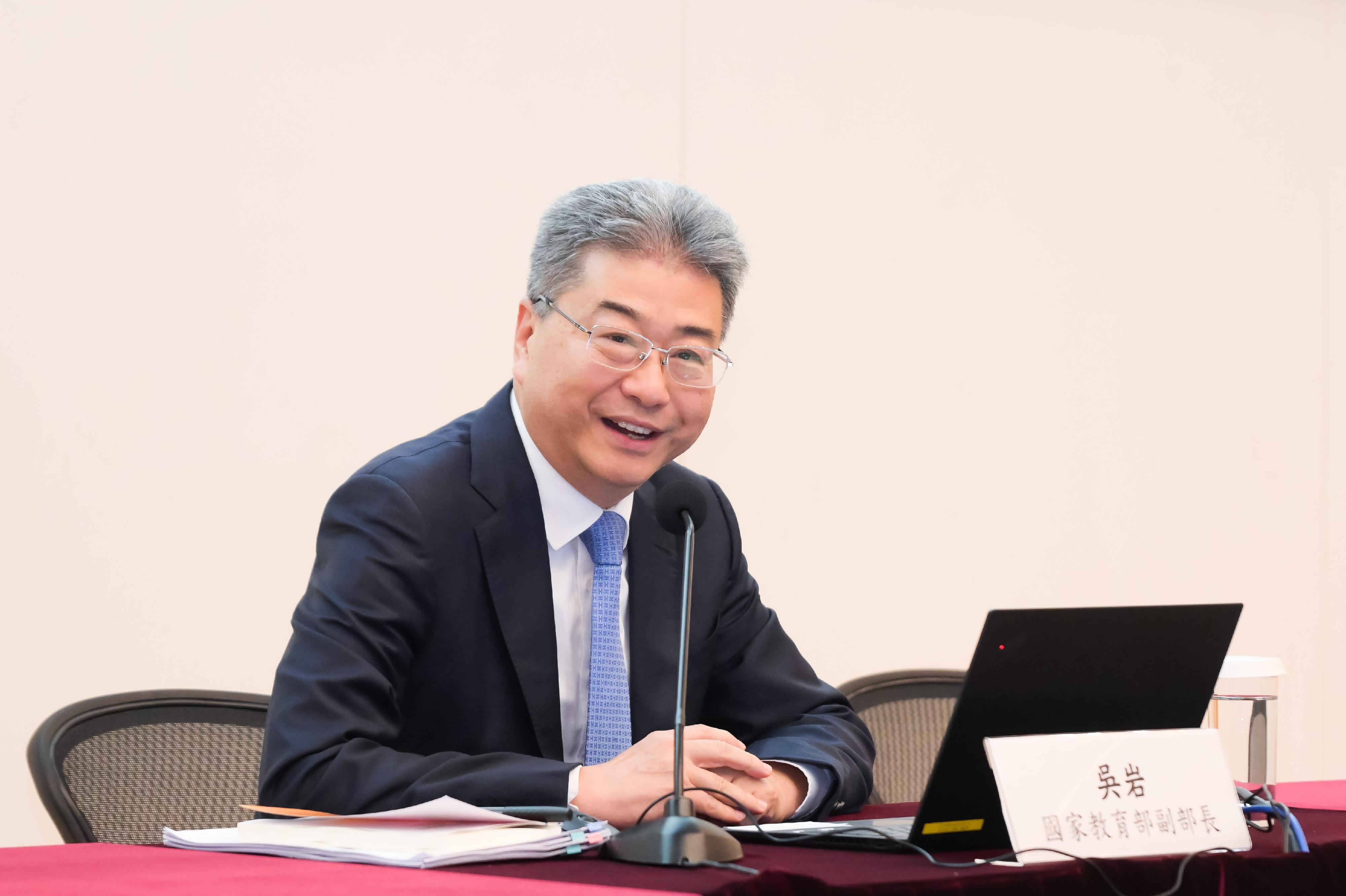
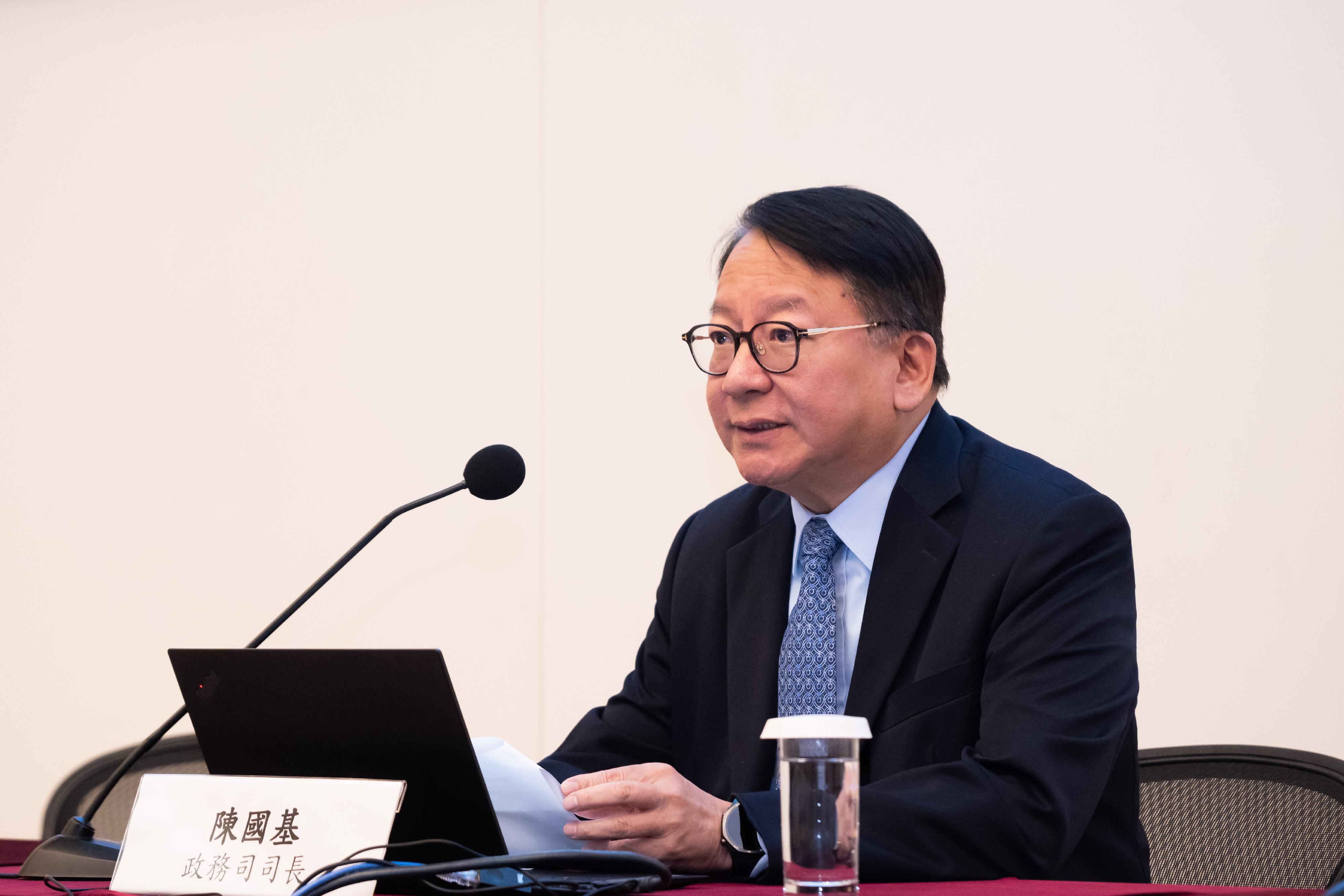
Photo  Photo  Photo  Photo  Photo  
read more

LCQ18: Evaluation mechanism of Mainland “Professional Title” qualifications for Hong Kong professionals

     â€‹Following is a question by Dr the Hon Lo Wai-kwok and a written reply by the Secretary for Development, Ms Bernadette Linn, in the Legislative Council today (February 12):
 
Question:

     It has been reported that the SAR Government and the Guangdong Provincial Government established in 2023 an evaluation mechanism of Mainland “Professional Title” qualifications for Hong Kong engineering professionals, and implemented it as a pilot scheme in five engineering disciplines, namely civil engineering, geotechnical, highway, electrical and measurement, control and instrumentation. Recently, the first batch of more than 200 Hong Kong engineers have successfully passed the Guangdong-Hong Kong-Macao Greater Bay Area engineering Professional Title evaluation and obtained corresponding engineering professional qualifications on the Mainland, representing a major breakthrough in the convergence of professional qualifications between Hong Kong and the Mainland. In this connection, will the Government inform this Council:

(1) whether the authorities have discussed with the Mainland the gradual extension of evaluation of Professional Title qualifications to all engineering professions; if so, of the details; if not, the reasons for that;

(2) whether the authorities will formulate a strategy and timetable for discussing with the Mainland the gradual extension of evaluation of Professional Title qualifications to more professional sectors other than the engineering sector, so as to enable more professional sectors to facilitate the integrated development of Hong Kong and the Mainland; if so, of the details; if not, the reasons for that; and

(3) whether the authorities will take the breakthrough in the convergence of professional qualifications between Hong Kong and the Mainland as an opportunity to join hands with Mainland government departments and relevant professional sectors to encourage Hong Kong and Mainland enterprises to jointly bid for large-scale national and multinational projects, so as to broaden the horizons of and seek more opportunities for the various types of professionals and small and medium-sized enterprises in Hong Kong; if so, of the details; if not, the reasons for that?

Reply:

President,

     The Government has always attached importance to the interconnected flow of talents between Hong Kong and the Mainland, among which the recognition of professional qualifications is crucial to the flow of talents and the technological exchange. The first batch of more than 200 Hong Kong engineers passed the Guangdong-Hong Kong-Macao Greater Bay Area (GBA) engineering “Professional Title” evaluation and obtained corresponding engineering professional qualifications in the Mainland (i.e. the professional qualifications were officially recognised under the Mainland qualifications framework for engineering sector), which represents a major breakthrough in the convergence of the rules between the two places in the area of professional qualifications. The “Professional Title” evaluation was implemented as a pilot scheme in five engineering disciplines, namely civil engineering, geotechnical, highway, electrical and measurement, control and instrumentation. It successfully opened up a channel for the Hong Kong engineering profession to connect with the “Professional Title” evaluation mechanism in the Mainland, and also set a benchmark for other professional sectors in Hong Kong.

     In consultation with the Commerce and Economic Development Bureau, our responses to the question raised by Dr the Hon Lo Wai-kwok are as follows:

(1) and (2) After the implementation of the pilot evaluation of “Professional Title” qualifications in 2024, the Development Bureau (DEVB) promptly engaged in discussion with relevant Mainland authority and reached a consensus on regularising the relevant evaluation mechanism in mid-2025 with additional engineering disciplines; and even extending the mechanism to other construction-related professions with the right conditions. We expect that the next batch will cover professionals in manufacturing, industrial and systems engineering; mechanical engineering; electronic engineering and quantity surveying. Looking ahead, the DEVB will maintain close co-ordination with Hong Kong construction-related professional institutes and relevant Mainland authorities, and strive to facilitate more professionals in the local construction sector to obtain corresponding “Professional Title” qualifications through the “Professional Title” evaluation mechanism in the Mainland.

     As for extending the “Professional Title” evaluation mechanism to other professional sectors outside the construction industry, the implementation of this initiative will depend on a number of factors, such as whether there are corresponding “Professional Title” in the Mainland; the inclination of relevant institutes and groups, etc.

(3) To dovetail with the National 14th Five-Year Plan in respect of supporting the strategy of high-quality development of the GBA, we have collaborated with the relevant Mainland authorities to promulgate a number of measures to drive Hong Kong’s construction and engineering sectors to seize opportunities to pursue development in the Mainland cities of the GBA, thereby better integrating into the national development. Apart from facilitating various professions of Hong Kong’s construction industry to enter the Mainland’s “Professional Title” evaluation mechanism, we promulgated the registration system in the nine Mainland cities of the GBA in 2021, which allows Hong Kong construction and engineering enterprises and professionals to acquire qualifications through a simple registration process and bid for construction projects of the government in the Mainland. The above measures not only play a positive role in promoting exchanges and collaboration between professional talents of the two places, but also help enterprises and talents of the two places to work together to promote high-quality development of the construction sector of the country and Hong Kong.

     In addition, the DEVB has been committed to promoting collaboration by construction enterprises in both places for bidding large-scale national and overseas projects, so as to seek more business for relevant Hong Kong enterprises, especially small and medium-sized enterprises, and job opportunities for professionals. Over the years, relevant government departments and the construction industry of the two places have co-organised a number of large-scale events. For example, the Mainland and Hong Kong Construction Forum 2024 was held in Guangzhou in March 2024, providing an exchange and interface platform for practitioners from Hong Kong and 26 provinces and cities in the Mainland. During the forum, more than 60 business matchings were arranged for a number of construction and engineering-related enterprises in the Mainland and Hong Kong, allowing enterprises from the two places to form alliances and “go global” to jointly explore the infrastructure markets along the “Belt and Road” regions and overseas. Moreover, we hosted the International Infrastructure and Projects Leaders Summit in Hong Kong in November 2024, bringing together more than 500 major infrastructure project leaders and experts from over 20 countries, 180 government departments, and private organisations from the Mainland and overseas countries, and representatives of renowned international organisations such as the World Economic Forum and the International Institute for Management Development, to have an in-depth experience exchange in infrastructure project management, share opportunities in large infrastructure projects and strengthen the collaboration network with construction enterprises in various places. The summit further consolidates Hong Kong’s position as an international infrastructure centre. It will not only facilitate Hong Kong and Mainland enterprises to jointly bid for large infrastructure projects in the Mainland and overseas, but also help attract overseas enterprises to invest in infrastructure development in the Mainland and Hong Kong, enabling Hong Kong to better serve its important roles as “super connector” and “super value-adder”. read more

Inspection of aquatic products imported from Japan

     In response to the Japanese Government’s plan to discharge nuclear-contaminated water at the Fukushima Nuclear Power Station, the Director of Food and Environmental Hygiene issued a Food Safety Order which prohibits all aquatic products, sea salt and seaweeds originating from the 10 metropolis/prefectures, namely Tokyo, Fukushima, Ibaraki, Miyagi, Chiba, Gunma, Tochigi, Niigata, Nagano and Saitama, from being imported into and supplied in Hong Kong.
 
     For other Japanese aquatic products, sea salt and seaweeds that are not prohibited from being imported into Hong Kong, the Centre for Food Safety (CFS) of the Food and Environmental Hygiene Department will conduct comprehensive radiological tests to verify that the radiation levels of these products do not exceed the guideline levels before they are allowed to be supplied in the market.
 
     As the discharge of nuclear-contaminated water is unprecedented and will continue for 30 years or more, the Government will closely monitor and step up the testing arrangements. Should anomalies be detected, the Government does not preclude further tightening the scope of the import ban.
 
     From noon on February 11 to noon today (February 12), the CFS conducted tests on the radiological levels of 149 food samples imported from Japan, which were of the “aquatic and related products, seaweeds and sea salt” category. No sample was found to have exceeded the safety limit. Details can be found on the CFS’s thematic website titled “Control Measures on Foods Imported from Japan” (www.cfs.gov.hk/english/programme/programme_rafs/programme_rafs_fc_01_30_Nuclear_Event_and_Food_Safety.html).

     In parallel, the Agriculture, Fisheries and Conservation Department (AFCD) has also tested 50 samples of local catch for radiological levels. All the samples passed the tests. Details can be found on the AFCD’s website (www.afcd.gov.hk/english/fisheries/Radiological_testing/Radiological_Test.html).
 
     The Hong Kong Observatory (HKO) has also enhanced the environmental monitoring of the local waters. No anomaly has been detected so far. For details, please refer to the HKO’s website
(www.hko.gov.hk/en/radiation/monitoring/seawater.html).
 
     From August 24, 2023, to noon today, the CFS and the AFCD have conducted tests on the radiological levels of 115 241 samples of food imported from Japan (including 75 415 samples of aquatic and related products, seaweeds and sea salt) and 26 724 samples of local catch respectively. All the samples passed the tests. read more