Tag Archives: China

image_pdfimage_print

LCQ21: Safeguarding mental health of academic staff members and students

     Following is a question by the Hon Lillian Kwok and a written reply by the Secretary for Education, Dr Choi Yuk-lin, in the Legislative Council today (June 11):
 
Question:
 
     The mental health of academic staff members and students in Hong Kong draws societal concern. There are views that the Government should strengthen the protection of their physical and mental health as well as to provide appropriate support services to the families of suicide victims concerned. In this connection, will the Government inform this Council:
 
(1) of the respective numbers of academic staff members and students committing suicide and attempting to commit suicide in each of the past five years and, among them, the numbers of cases in which death inquests were held, together with a breakdown by types of school (i.e. (i) primary school, (ii) secondary school and (iii) university);
 
(2) of the Government’s follow-up and support procedures in respect of cases of suicide attempts among academic staff members and students, including the policy bureaux involved, the category of professionals providing support services in those cases and the areas and extent of intervention, as well as details of the support services provided by them; and
 
(3) in respect of the suicide cases mentioned in (1), whether the Government has provided support services (e.g. professional emotional counselling services) to the families, relatives and friends of the suicide victims; if so, of the details; if not, the reasons for that; primarily which government departments’ staff members to provide assistance to the families of suicide victims and inform them of their rights under the law (including the rights of the families to request for holding a death inquest)?
 
Reply:
 
President,
 
     The Education Bureau (EDB) attaches great importance to the mental health of teachers and students, and has all along been encouraging schools to adopt the Whole School Approach. Through cross-departmental, cross-disciplinary and cross-sector collaboration, the EDB enhances the mental health of teachers and students and provides enhanced support for students with mental health needs (including those with suicidal risk) via various measures and activities directed at three levels, namely Universal, Selective and Indicated. In recent years, the EDB has implemented a number of measures to support students’ mental health. This includes implementing the “4Rs Mental Health Charter” in the 2024/25 school year, with a view to helping students develop healthy living habits and positive interpersonal relationships, and enhancing their resilience. In addition, starting from the 2023/24 school year, the EDB has launched the Mental Health Literacy Resource Packages suitable for students at different learning stages. In consultation with the Social Welfare Department (SWD), our reply to the question raised by the Hon Lillian Kwok is as follows:
 
(1) and (2) The EDB has all along required primary and secondary schools to report fatal suspected student suicide cases. The numbers of relevant cases in primary and secondary schools in the past five years (2020 to 2024) are tabulated as follows. Of the cases reported, secondary students accounted for about 91 per cent of the total cases, while primary students accounted for about 9 per cent. 
 

Year Number of cases
2020 21
2021 25
2022 25
2023 32
2024 28
 
     The EDB does not collect data on fatal suspected suicide cases of school personnel, attempted suicides of students, relevant cases of university students and number of death inquests held.
 
     We continue to strengthen the identification of and support for students with mental health risks. For example, the EDB organises about 40 additional thematic teacher training workshops in the 2024/25 school year to introduce the practical skills, counselling techniques and intervention strategies in supporting students with mental health needs, as well as organises parent education talk series for parents of primary and secondary school students that cover topics related to the mental health of children.
 
     Regarding support measures, if schools suspect the students having suicidal risk, schools will arrange school guidance personnel (for example, student guidance teacher/student guidance personnel or school social worker) for early support. If necessary, schools will solicit professional support from the school-based educational psychologists, clinical psychologists, psychiatrists, medical, or police officers to ensure that appropriate intervention measures will be taken. To enhance cross-sector collaboration, starting from December 2023, the Government has implemented the Three-tier School-based Emergency Mechanism in all secondary schools in Hong Kong by pooling together the schools’ multi-disciplinary teams, the off-campus support network and medical services. The implementation of the Mechanism has been extended till the end of 2025 and related arrangements were enhanced.
 
     Furthermore, the Government established a cross-departmental referral and collaboration mechanism in April 2024. For instance, when police officers handle attempted suicide cases concerning primary and secondary students that happen outside schools, the Police will, upon obtaining the consent from the student concerned and the parent/guardian, refer the case to the school the student is attending, via the EDB, for support services. If the student and parent/guardian wish to receive support services from other organisation(s), the SWD will refer the case for services provided by other social services units, such as Integrated Family Service Centres (IFSCs), Integrated Community Centres for Mental Wellness, and Integrated Children and Youth Services Centres. Schools or relevant social welfare organisations will provide students with emergency intervention services, such as assessments, support and counselling through individual, group or online mode.
 
     Regarding support for teachers’ physical and psychological well-being, the EDB has set up the Teachers’ Helpline since 2006 to support teachers in coping with stress at work and mental health problems. Apart from this, professional counselling services and face-to-face counselling will be provided as and when necessary, and professionals will be arranged to follow up relevant cases. Meanwhile, the service providers will organise talks on how to relieve stress for teachers. In addition, starting from the 2023/24 school year, the EDB has commissioned non-governmental organisations (NGOs) or tertiary institutions to organise courses on physical and mental health for teachers every year, covering topics on mental health, expressive arts, mindfulness and physical health, to enhance teachers’ capacity at work.
 
(3) The SWD subvents The Samaritan Befrienders Hong Kong to operate the Suicide Crisis Intervention Centre (SCIC), which offers immediate crisis intervention and in-depth counselling services for persons in need. The SCIC also renders support services to persons affected by suicidal behaviours (including familes and friends), including consultation hotline, groups, talks and workshops. Moreover, 67 territory-wide IFSCs (including two Integrated Service Centres), operated by the SWD or subvented NGOs also provide appropriate service and assistance for the families and relatives of suicide victims, including financial assistance, counselling service, and connection with community resources. read more
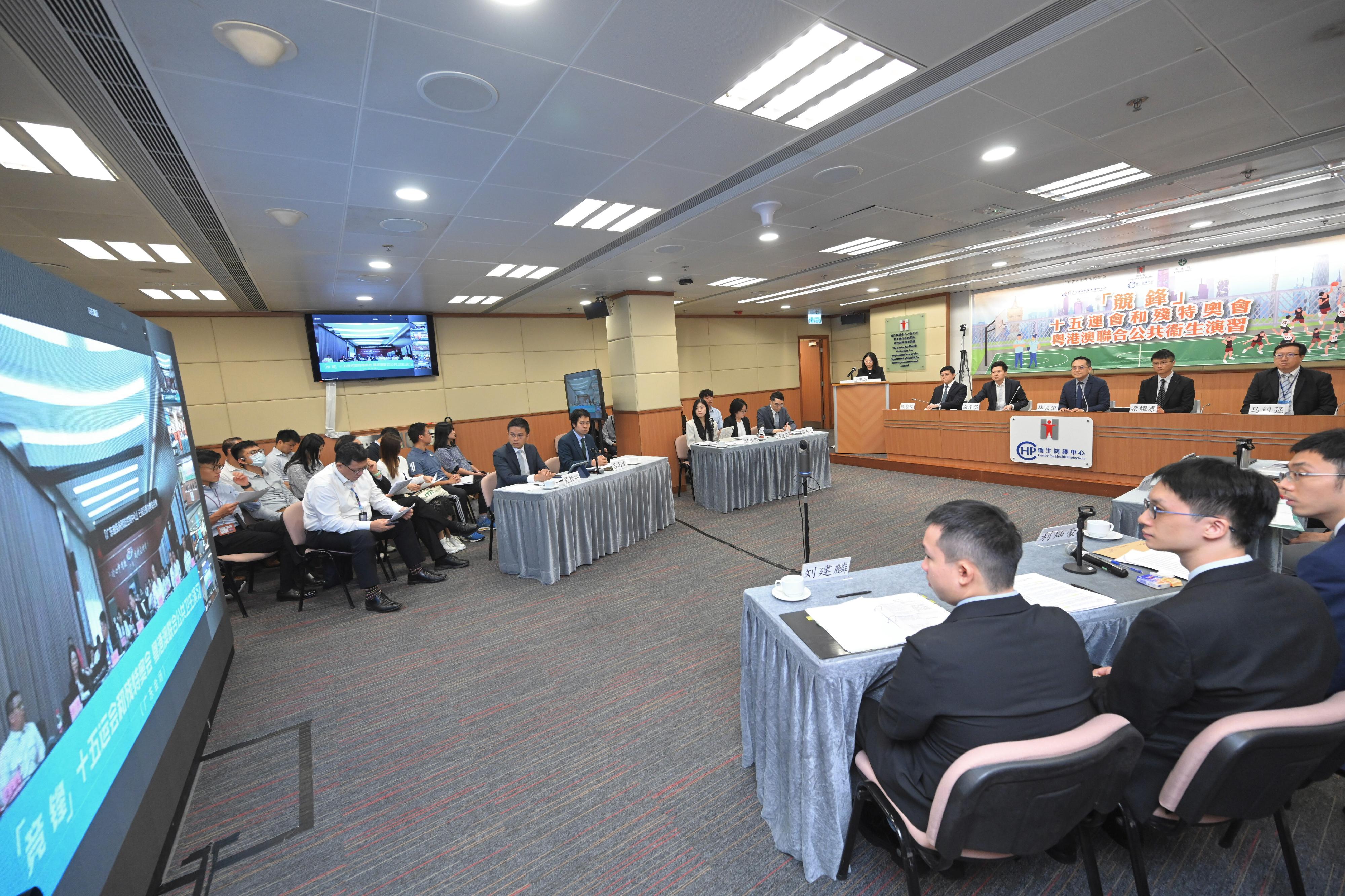
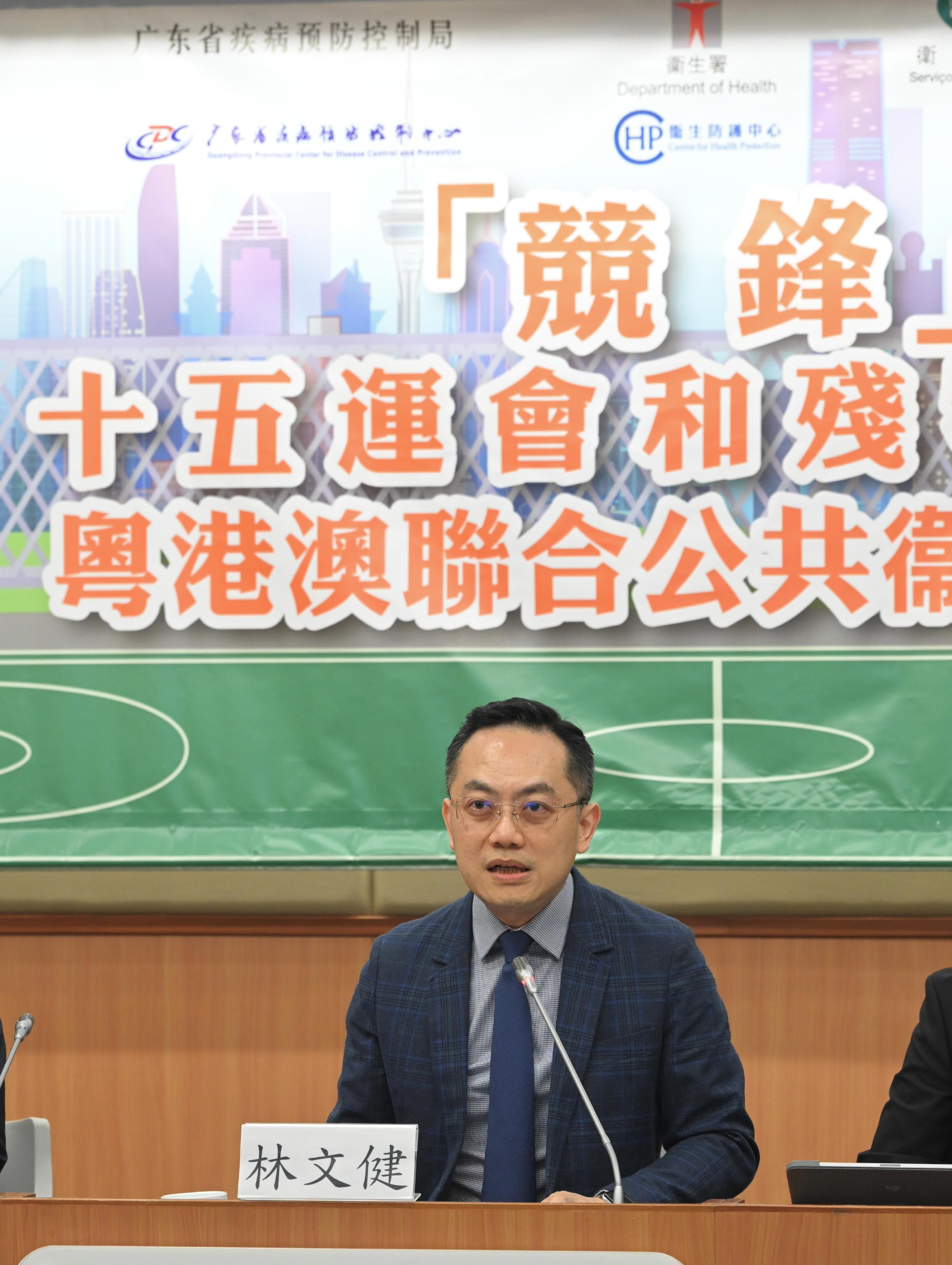
Guangdong, Hong Kong and Macao hold public health exercise in preparation for hosting 15th NG, NGD and NSOG (with photos)

     â€‹The Centre for Health Protection (CHP) of the Department of Health, in collaboration with the health authorities of Guangdong Province and Macao, today (June 11) conducted a public health exercise, code-named “Jingfeng”, to enhance the capacity of the three places to co-operate in preventing and controlling communicable diseases during major sports events. The exercise was held in preparation for the 15th National Games (15th NG), the 12th National Games for Persons with Disabilities (NGD), and the 9th National Special Olympic Games (NSOG), which will be co-hosted by Guangdong, Hong Kong and Macao this November and December.

     The exercise simulated a scenario in which two players participating in the 15th NG basketball competition in Hong Kong were diagnosed with meningococcal infection while they were in the city. An epidemiological investigation revealed that some of their close contacts had already departed Hong Kong for Shenzhen and Macao respectively. In accordance with the established mechanism, Hong Kong immediately notified the health authorities of Guangdong and Macao. The health authorities of the three places promptly traced the cases and implemented appropriate infection control measures to prevent the spread of the communicable disease.

     During the exercise, the CHP, together with the Guangdong Provincial Disease Control and Prevention Administration, the Guangdong Provincial Center for Disease Control and Prevention and the Health Bureau of Macao conducted a drill and exchanged views on communicable disease surveillance, prevention, control and notification mechanisms during the 15th NG, and 12th NGD and 9th NSOG via a video conference. More than 30 officers from the health authorities of the three places participated in the exercise.

     Before the commencement of the exercise, the Director of Health, Dr Ronald Lam, gave a speech. “The 15th NG, and NGD and NSOG are the largest and highest-level national multisport events in the country. It is of great strategic significance for the health authorities of Guangdong, Hong Kong and Macao to jointly organise this exercise on communicable disease prevention and control at the countdown stage of the opening of the Games. Through the simulation, we hope to achieve three major objectives: to strengthen the joint prevention mechanism of the three places; to build a solid risk identification defense; and to consolidate the foundation of event protection. This will allow the top athletes in the country to demonstrate the country’s sports prowess under a ‘zero significant outbreak, zero cross-infections’ condition, and showcase the country’s excellence in public health governance to the world,” he said.

     Dr Lam added that since its establishment, the CHP has organised a total of 32 emergency response exercises and drills, simulating human cases of avian influenza, measles, plagues and Middle East Respiratory Syndrome. As Guangdong, Hong Kong and Macao are geographically and culturally connected, only through close collaboration can the three centres cope with major public health challenges. In the future, the three places will continue to strengthen joint efforts in the prevention and control of communicable diseases. They will maintain communication and collaboration on aspects such as the prevention and control of communicable diseases, and the development of the public health system, with a view to enhancing global health safety standards. They will also fulfil the tripartite co-operation agreement on public health emergencies and the Guangdong-Hong Kong-Macao Health Cooperation Consensus.

     Apart from the health authorities of the three places, representatives from the Medical and Health Office of the Comprehensive Security Department of the Guangdong Provincial Executive Committees for the 15th NG, NGD and NSOG, National Games Coordination Office (Hong Kong) of the Culture, Sports and Tourism Bureau of the Hong Kong Special Administrative Region, the Auxiliary Medical Service, the Fire Services Department and the Hospital Authority have also sent their staff to observe the exercise.

Photo  Photo  
read more

Appointments to Tourism Strategy Committee announced

     â€‹The Government announced today (June 11) the appointment of three new members to the Tourism Strategy Committee (the Committee) for the period from June 11 to December 31, 2025.
      
     The three newly appointed members are Mr Raymond Chow Wai-kam, Dr Peter Lam Kin-ngok, and Mr Tommy Tam Kwong-shun. 

     The composition of the Committee with effect from June 11 is as follows:

Professor Kaye Chon
Mr Raymond Chow Wai-kam*
Mrs Gianna Hsu Wong Mei-lun
Dr Peter Lam Kin-ngok*
Mr Ronald Lam Siu-por
Mr Simon Lee Siu-po
Mr Dominic Lee Tsz-king
Mr Jonathan Leung Chun
Mr Ma Ho-fai
Mr Michael Moriarty
Mr Wilfred Ng Sau-kei
Dr Pang Yiu-kai
Mr Tommy Tam Kwong-shun*
Mr Paul Tse Wai-chun
Mrs Annie Tse Yau On-yee
Mr Peter Wong Chak-fung
Mr James Wong Cheuk-on
Mr Ivan Wong Chi-fai
Ms Belinda Yeung Bik-yiu
Dr Frankie Yeung Wai-shing
Mr Yiu Pak-leung
Dr Allan Zeman 

*Newly appointed members

     The Committee is chaired by the Secretary for Culture, Sports and Tourism and is responsible for providing the Government with strategic advice and fostering collaboration among different stakeholders in tourism and other related sectors for promoting the long-term and sustainable development of Hong Kong’s tourism industry. Members include prominent figures and key leaders from the tourism and other related sectors such as culture, sports, retail and catering. read more

LCQ2: Developing Hong Kong into international education hub

     Following is a question by the Hon Chu Kwok-keung and a reply by the Secretary for Education, Dr Choi Yuk-lin, in the Legislative Council today (June 11):
 
Question:
 
     The Government is now establishing the “Study in Hong Kong” brand to develop Hong Kong into an international hub for education. There are views pointing out that with the robust development of local basic education and the extensive recognition of the Hong Kong Diploma of Secondary Education Examination qualification, primary and secondary schools are well-positioned to admit non-local students amid the continuing decline in the number of students. At present, however, entry for non-local students to study in Hong Kong’s public or aided primary and secondary schools (other than English Schools Foundation (ESF) schools and Direct Subsidy Scheme (DSS) schools) is not permitted. In this connection, will the Government inform this Council:
 
(1) of the respective numbers of minor students coming to Hong Kong on student visas to study in private primary and secondary schools, ESF schools, and DSS primary and secondary schools over the past three school years, as well as the distribution of their years of study;
 
(2) whether it will consider drawing on the practices of other countries to relax the eligibility criteria for student visas, so as to allow non-‍local minor students entry into Hong Kong to study in public or aided primary and secondary schools, as well as introducing student guardian visas for their parents to stay in Hong Kong and engage in time-limited employment; and
 
(3) whether it will consider encouraging private enterprises or educational institutions to establish additional student hostels or overseas students’ apartments to provide accommodation and ancillary services suitable for students of different ages, as well as establishing corresponding licensing and registration regimes?
 
Reply:
 
President,
 
     The Chief Executive announced in the 2024 Policy Address that the Government would promote the development of an international hub for post-secondary education by establishing the “Study in Hong Kong” brand as well as pooling together and nurturing excellent global talents. The policy is built on the foundation that Hong Kong’s universities enjoy an international reputation. Among our eight public universities, five are ranked among the world’s top 100 and six within Asia’s top 50, and four are among the top ten on the list of the most international universities in the world. The internationalisation and diversity of our post-secondary education attract outstanding talents from all over the world to Hong Kong for further studies and research. Meanwhile, the National 14th Five-Year Plan supports Hong Kong as a development centre in eight key areas (“eight centres”), the Education Bureau (EDB) has been proactively encouraging post-secondary education institutions to develop more related applied degree programmes to complement with the talent backing for the “eight centres”. At the same time, we are also committed to promoting the “Study in Hong Kong” brand, developing Hong Kong into an international education hub, attracting outstanding talent from all over the world in all aspects to enrich the local talent pool.
 
     Regarding our basic education, under the “one country, two systems”, Hong Kong has the distinctive advantages of enjoying strong support of the motherland and being closely connected to the world. We have been providing 12-year free and quality primary and secondary education to all local children through public sector schools, and parents of local children are offered with diversified choices. Meanwhile, non-local children can study in non-public sector schools, including international schools, private schools and Direct Subsidy Scheme schools, on a self-financing basis. These arrangements aim to ensure a reasonable balance between the supply and demand of school places in basic education in the relevant arrangements, while achieving prudent use of public funds. In fact, Hong Kong’s diversified and quality school education system has long been ranked among the top in international education comparative studies.
 
     Having consulted the Security Bureau and the Immigration Department (ImmD), our reply to the question raised by the Hon Chu Kwok-keung is as follows:
 
(1) In the past three years (2022 to 2024), a total of 1 686 applications for student visa/entry permit were approved by the ImmD for non-local children aged 17 or below coming to Hong Kong for education (see Annex). The ImmD and the EDB do not keep statistics on the types of schools admitting these students.
 
(2) The Government is committed to developing a vibrant international school sector to meet the demand for education from non-local families living in Hong Kong as well as children of families coming to Hong Kong for work or investment. International schools operate on a self-financing and market-driven basis and belong to the private school sector. They have been enjoying the flexibility, including the medium of instruction, curriculum arrangements, public examinations, etc, and they are not subsidised by public funds for daily operation, providing diversified choices for local parents, while offering school places to non-local children who pay school fees at their own expense under the “user pays” principle. As seen from the figures provided by the ImmD over the past three years, there have been hundreds non-local children aged from five years eight months to 17 years being approved with study visa/entry permit to come to Hong Kong for education annually. We will closely keep in view the demand for school places from non-local children, conduct dynamic assessments of the demand and supply of school places, create conditions in a timely manner, and launch policy measures to adjust the supply of school places including supporting the development of non-profit-making private schools offering non-local curriculum through the school allocation exercise. Meanwhile, we will proactively explore the feasibility of facilitating non-local students to come to Hong Kong to study in non-public sector schools on a self-financing basis.
 
     As the goal of public sector schools is to provide 12-year quality and free primary and secondary education to eligible children to meet the educational needs of local children, we adopt mother-tongue teaching. The medium of instruction, curriculum arrangements, public examination (i.e. Hong Kong Diploma of Secondary Education Examination), etc in public sector schools are based on the learning needs of local children. 
 
     Therefore, for public sector schools, the Government has always been devoting substantial resources to public sector schools in providing quality education to students over the years, meeting the different learning needs of students in an all-round way, including catering for the learning diversity for students with special educational needs and non-Chinese speaking students with the provision of additional learning support and complementary measures. Public sector schools are publicly funded at full costs, offer local curriculum and serve local children. It ensures the prudent use of public funds and fair allocation of educational resources, and benefit local children.
 
     At present, the parallel development of the public sector schools and non-public sector schools not only caters for the learning needs of the children of different stakeholders, but also achieves the purpose of prudent use of public funds and an appropriate allocation of resources. Therefore, the policy meets Hong Kong’s actual circumstances.

(3) In general, the boarding services provided by different types of schools are mainly aimed at enriching local students’ learning experiences, and cater for the residential needs of a small number of non-local students. At present, there are a total of 16 publicly-funded and private ordinary primary and secondary schools across the territory, which provide boarding services offering about 3 500 boarding places altogether. If individual schools have needs, and the premises and space allow, they can submit applications to the EDB to provide boarding facilities on a self-financing basis. We will consider the applications based on the actual needs. The facilities and management of boarding schools should comply with the relevant stipulations such as the Education Regulations (Cap. 279A). The accommodation arrangements outside schools should also comply with all relevant laws and requirements. The EDB will closely monitor the residential needs of non-local students, including the boarding facilities provided by different types of schools, and maintain communication with the education sector and relevant government departments to review the related arrangements in a timely manner.
 
     President, education is the key to a hundred-year plan. While being open to different views, the EDB will carefully consider each and every policy initiative to maintain the strengths of Hong Kong education, orderly promote the development of an international hub for post-secondary education, and strengthen the high quality development of education in Hong Kong.

     Thank you, President. read more

Government urges public to be wary of fraudulent advertisements on Voluntary Health Insurance Scheme

     The Voluntary Health Insurance Scheme (VHIS) Office of the Health Bureau today (June 11) reminds the public to stay vigilant against fraudulent VHIS advertisements to safeguard their personal interests.

     The VHIS Office has recently noticed that some advertisements were placed on social media under the pretext of promoting VHIS products, inducing the public to click on embedded hyperlinks to fraudulent websites. The Office has already contacted the Police and relevant social media platforms for follow-up.

     The VHIS Office emphasises that it does not request members of the public to click on hyperlinks through advertisements, emails, text messages, or any other means, nor does it collect any personally identifiable information on its website.

     The VHIS Office urges members of the public to stay vigilant, avoid clicking on suspicious advertisements, and refrain from providing personal particulars to any unverified websites. For enquiries, please contact the VHIS Office’s enquiry hotline at 2529 8900 or email vhis_enquiry@healthbureau.gov.hk. read more