Tag Archives: China

Speech by SJ at 2025 SCIA and SCIAHK Spring Reception (English only)

     Following is the speech by the Secretary for Justice, Mr Paul Lam, SC, at the 2025 SCIA and SCIAHK Spring Reception today (February 13):
 
President Liu (President of the Shenzhen Court of International Arbitration (SCIA) and Executive Chairman of the South China International Arbitration Center (Hong Kong) (SCIAHK), Dr Liu Xiaochun), SCIA Council Members and SCIAHK Board Directors, distinguished guests, ladies and gentlemen,
 
     A very good morning. I would like to begin by wishing you all good health and a prosperous Year of the Snake! It gives me great pleasure to join you today at the Spring Reception of the SCIA and SCIAHK. I am also very pleased to meet many old and new friends here, including Mr Li Ning.
 
     The Year of the Dragon was a fruitful year for Hong Kong’s arbitration community. Most notably, the ICCA Congress – hailed as the Olympics of the international arbitration community – attracted a record high of over 1 300 leading arbitration experts from more than 70 jurisdictions to Hong Kong last May. The Congress was warmly applauded for its diversity and quality in terms of participation and discussion. And for the present purpose, I have to mention the Shenzhen Side Event, co-hosted by the SCIA and SCIAHK, together with the Department of Justice (DoJ) and other institutions, which took place at the SCIA Tower in Qianhai. The event, featuring impactful and inspiring speeches, together with diversified thematic discussions, was attended by nearly 300 professionals from 36 countries and regions. Its success demonstrated the efforts of the Department of Justice in collaborating with the legal and arbitration sectors, including, of course, the SCIA and SCIAHK and other leading arbitral institutions in Hong Kong.
 
     Indeed, we treasure our strong partnership with the SCIAHK. I am very pleased that the SCIAHK’s representatives joined our promotion trips last year to the Middle East, Southeast Asia and also the Greater Bay Area (GBA) wherein we, as a team, promoted to the legal and businesses sectors of those cities the distinctive advantages of Hong Kong as a strongly competitive venue for dispute resolution and also, on a wider perspective, the latest developments in the legal and dispute resolution landscape in the GBA and beyond.
 
     Looking ahead and anchoring on wisdom and agility, the symbolic elements of the zodiac sign of the snake, the DoJ will spare no efforts in fostering the competiveness of Hong Kong’s arbitration regime.
 
     Firstly on wisdom, we will continue to draw on the collective wisdom of stakeholders, particularly our counterparts in the GBA. Under the GBA Legal Departments Joint Conference, we are working closely with Guangdong and Macao to work towards the promulgation of the first list of GBA arbitrators within this year. This initiative would promote the complementary strengths of arbitration resources in the GBA and provide increased confidence and convenience to users.
 
     Second, also on wisdom, starting from next month, Hong Kong-invested enterprises registered in all nine Mainland cities in the GBA may choose Hong Kong as the arbitration seat even in the absence of “foreign-related” elements. The Hong Kong business communities have been seeking such a wider choice of arbitration seat for a long time, and I am sure the latest extension would be very welcomed, and I do encourage businesses to make best use of such added flexibility under the CEPA framework.   
 
     In terms of agility, we strive to support the arbitration community to adapt to the changing needs in the dispute resolution landscape and cultivate new and specialised practice areas. In this connection, we are exploring possible options for the establishment of a neutral, fair and efficient mechanism in Hong Kong for settling sports disputes, leveraging our institutional advantages in dispute resolution and energising the sustainable growth of the arbitration industry. An advisory committee was established by the DoJ last month to work on the design and implementation of a pilot scheme in this area.
 
     What is more, in order to make our arbitration talent to be more inclusive and adaptive, and as just announced by the DoJ yesterday, we have regularised and refined the Pilot Scheme on Facilitation for Persons Participating in Arbitral Proceedings in Hong Kong. Under the Scheme, relevant individuals may participate in arbitral proceedings in Hong Kong as visitors without having to obtain any employment visa. The Scheme has now become part of our standing immigration facilitative measures. Its scope will be expanded to cover tribunal secretaries and tribunal-appointed experts, and it will also cover all arbitrations physically taking place in Hong Kong, including those in which parties opt to have the seat of arbitration elsewhere. Such refinements would further facilitate the conduct of arbitral proceedings in Hong Kong, enhancing our attractiveness as a seat and venue for arbitrations.
 
     On the part of the DoJ, in the days to come, we look forward to strengthening our collaboration with arbitral institutions, including the SCIA and SCIAHK, as well as other stakeholders, in showcasing Hong Kong’s unique strengths under our common law system and enhancing our role as a “super connector” and “super value-adder” between the Mainland and the rest of the world.
 
     As the saying goes, “A year’s plan starts with spring” 一年之計在於春, I would like to share with you one of our important promotion initiatives this year. We will be holding the biennial Legal Services Forum in Xi’an in May. We chose Xi’an because we would like to work with our counterparts in Xi’an to leverage Hong Kong’s strengths in supporting Xi’an’s development in its role as the major central city of the western region in the country and also as an international gateway on the Belt and Road. We hope the SCIAHK could join and support the Forum in Xi’an if circumstances permit. Together with the stakeholders from the legal and dispute resolution sectors, I am sure that we would make the Forum yet another success.  
 
     Just a few days ago, the Director of the Hong Kong and Macao Affairs Office of the State Council, Mr Xia Baolong, visited, among other places, the SCIA headquarters in Qianhai, Shenzhen. This signifies the important role the SCIA and SCIA(HK) play in the development of a multifaceted dispute resolution system in the GBA and beyond. To this end, Hong Kong will, as always, continue to collaborate closely with all stakeholders, including, once again, the SCIA and SCIAHK.
 
     On this note, I wish you all every success in the Year of the Snake, with wisdom, agility and loads of blessings! Thank you very much. read more
Inspection of aquatic products imported from Japan

     In response to the Japanese Government’s plan to discharge nuclear-contaminated water at the Fukushima Nuclear Power Station, the Director of Food and Environmental Hygiene issued a Food Safety Order which prohibits all aquatic products, sea salt and seaweeds originating from the 10 metropolis/prefectures, namely Tokyo, Fukushima, Ibaraki, Miyagi, Chiba, Gunma, Tochigi, Niigata, Nagano and Saitama, from being imported into and supplied in Hong Kong.
 
     For other Japanese aquatic products, sea salt and seaweeds that are not prohibited from being imported into Hong Kong, the Centre for Food Safety (CFS) of the Food and Environmental Hygiene Department will conduct comprehensive radiological tests to verify that the radiation levels of these products do not exceed the guideline levels before they are allowed to be supplied in the market.
 
     As the discharge of nuclear-contaminated water is unprecedented and will continue for 30 years or more, the Government will closely monitor and step up the testing arrangements. Should anomalies be detected, the Government does not preclude further tightening the scope of the import ban.
 
     From noon on February 12 to noon today (February 13), the CFS conducted tests on the radiological levels of 169 food samples imported from Japan, which were of the “aquatic and related products, seaweeds and sea salt” category. No sample was found to have exceeded the safety limit. Details can be found on the CFS’s thematic website titled “Control Measures on Foods Imported from Japan” (www.cfs.gov.hk/english/programme/programme_rafs/programme_rafs_fc_01_30_Nuclear_Event_and_Food_Safety.html).

     In parallel, the Agriculture, Fisheries and Conservation Department (AFCD) has also tested 50 samples of local catch for radiological levels. All the samples passed the tests. Details can be found on the AFCD’s website (www.afcd.gov.hk/english/fisheries/Radiological_testing/Radiological_Test.html).
 
     The Hong Kong Observatory (HKO) has also enhanced the environmental monitoring of the local waters. No anomaly has been detected so far. For details, please refer to the HKO’s website
(www.hko.gov.hk/en/radiation/monitoring/seawater.html).
 
     From August 24, 2023, to noon today, the CFS and the AFCD have conducted tests on the radiological levels of 115 518 samples of food imported from Japan (including 75 584 samples of aquatic and related products, seaweeds and sea salt) and 26 774 samples of local catch respectively. All the samples passed the tests. read more

Incoming passenger convicted and jailed for possession of duty-not-paid cigarettes (with photo)

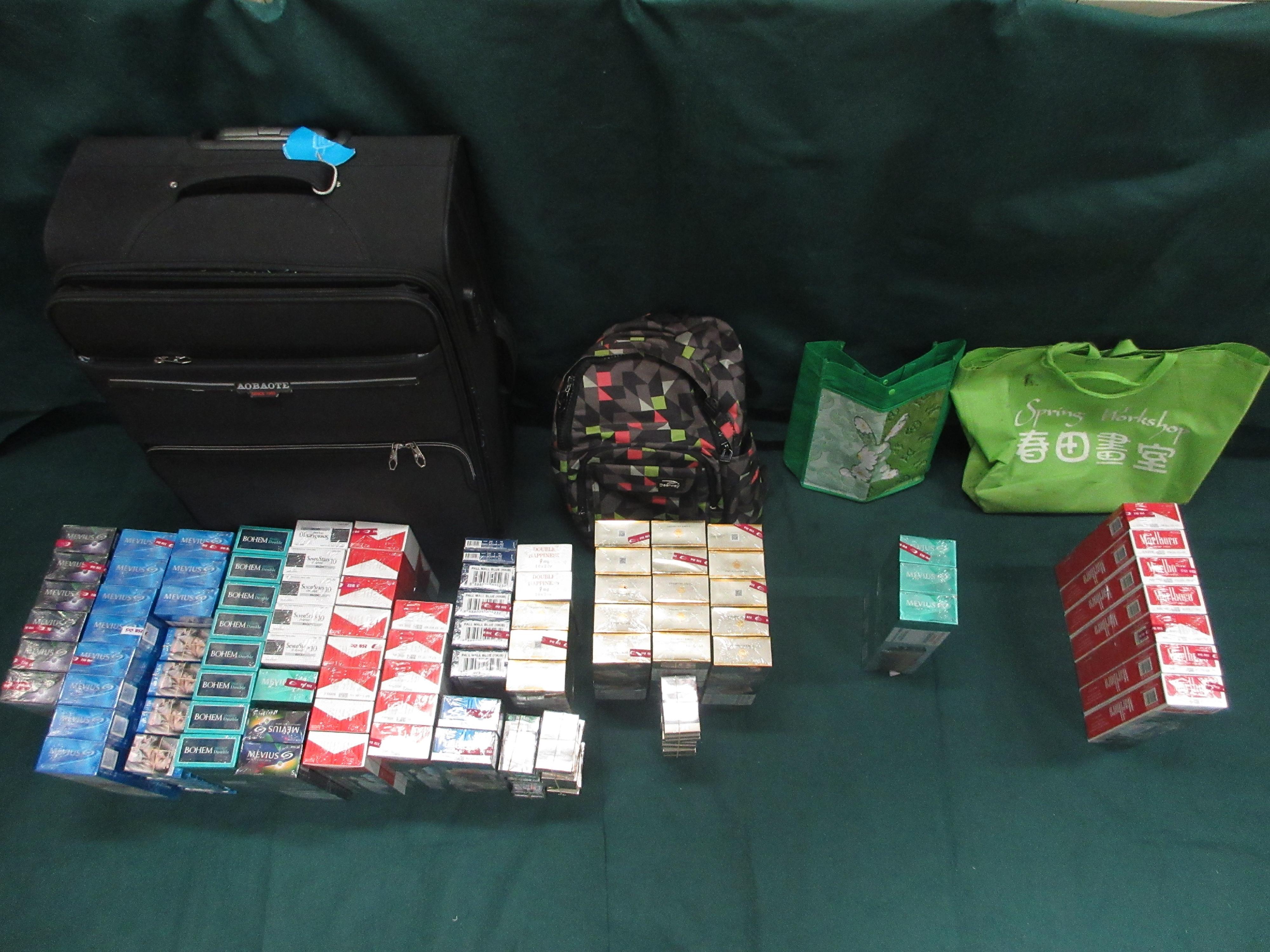
     An incoming female passenger was sentenced to three months’ imprisonment with a fine at the Fanling Magistrates’ Courts today (February 13) for possessing duty-not-paid cigarettes and for failing to declare to Customs Officers, in contravention of the Dutiable Commodities Ordinance (DCO).

     Customs officers intercepted the incoming 42-year-old female passenger at the Lo Wu Control Point on January 23 and seized about 18 000 duty-not-paid cigarettes with an estimated market value of about $74,000 and a duty potential of about $60,000 from her personal baggage. The passenger was subsequently arrested.

     Customs welcomes the sentence. The custodial sentence has imposed a considerable deterrent effect and reflects the seriousness of the offences. Customs reminds members of the public that under the DCO, tobacco products are dutiable goods to which the DCO applies. Any person who deals with, possesses, sells or buys illicit cigarettes commits an offence. The maximum penalty upon conviction is a fine of $1 million and imprisonment for two years.

     Members of the public may report any suspected illicit cigarette activities to Customs’ 24-hour hotline 182 8080 or its dedicated crime-reporting email account (crimereport@customs.gov.hk) or online form (eform.cefs.gov.hk/form/ced002/en).

Photo  
read more

Lunar New Year auction of vehicle registration marks this Sunday

     The Transport Department today (February 13) reminded the public that the Lunar New Year auction of vehicle registration marks will be held this Sunday (February 16) at Meeting Room N201, L2, New Wing, Hong Kong Convention and Exhibition Centre, Wan Chai.

     A total of 49 vehicle registration marks will be put up for public auction. Forty-eight of them are traditional vehicle registration marks (TVRMs), and one of them is a personalised vehicle registration mark (PVRM). The list of marks has been posted on the department’s website, www.td.gov.hk/en/public_services/vehicle_registration_mark/index.html.

     People who wish to participate in the bidding at the auction should take note of the following points:

(1) Bidders are required to produce the following documents for completion of registration and payment procedures immediately after the successful bidding:

(i) the identity document of the successful bidder;
(ii) the identity document of the purchaser if it is different from the successful bidder;
(iii) a copy of the Certificate of Incorporation if the purchaser is a body corporate; and
(iv) a crossed cheque payable to “The Government of the Hong Kong Special Administrative Region” or “The Government of the HKSAR”. Any bidder who wishes to bid for both TVRMs and the PVRM, should bring along at least two crossed cheques for payment of auction prices (for an auctioned mark paid for by cheque, the first three working days after the date of auction will be required for cheque clearance confirmation before processing of the application for mark assignment can be completed). Successful bidders may also pay through the Easy Pay System (EPS), but are reminded to note the maximum transfer amount on the same day of the payment card. Payment by post-dated cheque, cash, credit card or other methods will not be accepted.

(2) Purchasers must make payment of the purchase price through the EPS or by crossed cheque and complete the Memorandum of Sale of Registration Mark or the Memorandum of Sale of Personalised Vehicle Registration Mark immediately after the bidding. Subsequent alteration of the particulars in the Memorandum will not be permitted.

(3) A registration mark can only be assigned to a motor vehicle which is registered in the name of the purchaser. The Certificate of Incorporation must be produced immediately by the purchaser if a vehicle registration mark purchased is to be registered under the name of a body corporate.

(4) The display of a vehicle registration mark on a motor vehicle should be in compliance with the requirements stipulated in Schedule 4 to the Road Traffic (Registration and Licensing of Vehicles) Regulations.

(5) Special vehicle registration marks are non-transferable. Where the ownership of a motor vehicle with a special vehicle registration mark is transferred, the allocation of the special vehicle registration mark shall be cancelled.

(6) The purchaser shall, within 12 months after the date of auction, apply to the Commissioner for Transport for the vehicle registration mark to be assigned to a motor vehicle registered in the name of the purchaser. If the purchaser fails to assign the registration mark within 12 months, allocation of the registration mark will be cancelled and arranged for re-allocation by the Commissioner for Transport in accordance with the statutory provision without prior notice to the purchaser.

     For other auction details, please refer to the Guidance Notes – Auction of Traditional Vehicle Registration Marks (www.td.gov.hk/en/public_services/vehicle_registration_mark/tvrm_auction/index.html) and Guidance Notes – Auction of PVRMs (www.td.gov.hk/en/public_services/vehicle_registration_mark/pvrm_auction/index.html). read more